The Good Samaritan parable Myth Meaning & Symbolism
A traveler is left for dead. Two respected figures pass by. A despised outsider stops, binds his wounds, and pays for his care, redefining neighbor and humanity.
The Tale of The Good Samaritan parable
The road from [Jerusalem](/myths/jerusalem “Myth from Biblical culture.”/) down to [Jericho](/myths/jericho “Myth from Biblical culture.”/) is a throat of stone, a gash in [the earth](/myths/the-earth “Myth from Hindu culture.”/) where the sun bakes the rocks and the shadows hold their breath. It is a place of passage and peril, where the civilized world thins to a desperate track. A man—just a man, with a name lost to the dust—walked this road. He carried with him the ordinary hopes of commerce or kinship. Then, from the blind corners of the wadi, violence descended. Robbers, all hunger and hard hands, fell upon him. They stripped him of cloak and coin, beat him with the indifference of a storm, and left him broken by the roadside, half in [the world](/myths/the-world “Myth from Tarot culture.”/), half out.
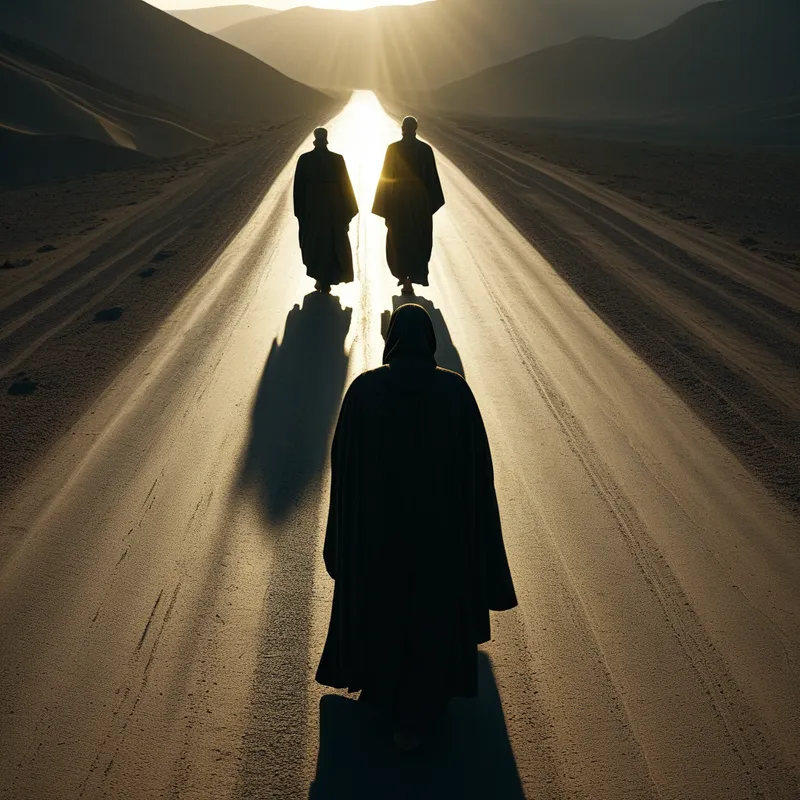
The sun climbed, a merciless eye. The heat shimmered on the stones. First came a priest of [the Temple](/myths/the-temple “Myth from Jewish culture.”/), a man whose life was a map of sacred boundaries. He saw the crumpled form, the stain upon the path. His step did not falter. He moved to the far side of the road, his gaze fixed on a holy horizon, his purity preserved by the width of the path between him and the polluting spectacle of suffering.
Later, a Levite, another servant of the ritual order, approached. He too saw. He may have even paused, a flicker of recognition crossing his face before it was extinguished by calculation. To touch blood, to touch death, would mean days of impurity, a complex ritual quarantine. The cost was too high. He adjusted his robes and continued on his way, leaving the silence to deepen.
Then, a sound. Not of sandaled feet in haste, but of a steady plodding beast. A Samaritan traveler came into view—a man from a people despised, whose worship was deemed heresy, whose blood was considered unclean by those who had just passed by. He saw the same wounded flesh. But where the others saw a threat to law, he saw a call to life. His journey ceased.
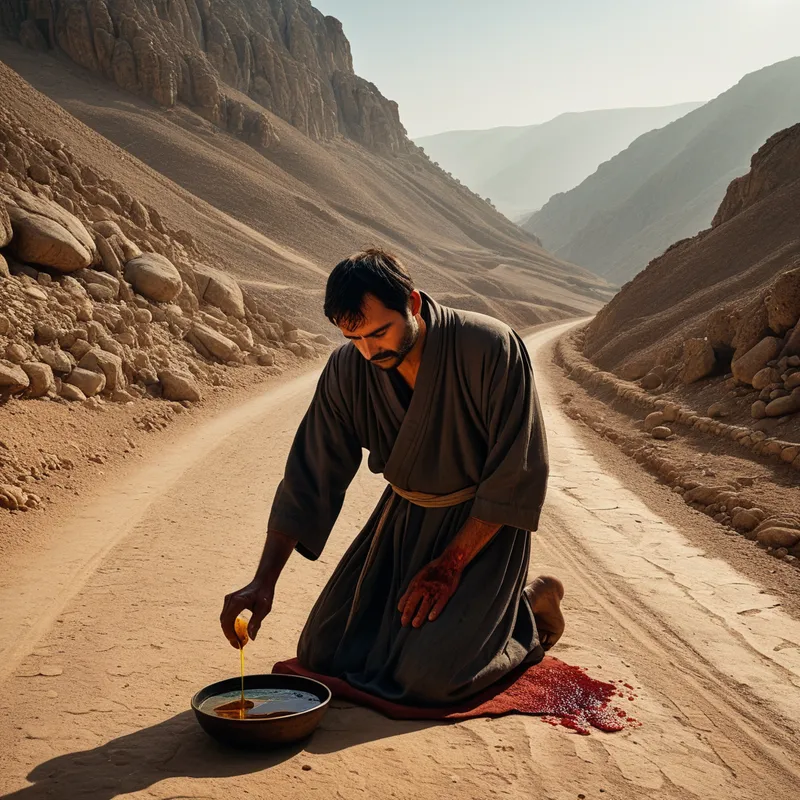
He knelt in the dust. He did not see a Jew, an enemy, a theological problem. He saw a man. With his own hands, he cleaned the wounds with wine, anointing them with oil from his own provisions. He tore his own linen to make bandages. He lifted the dead weight onto his own beast, walking while the injured rode. He brought him to an inn, a place of common commerce, and tended to him through the night.
At dawn, before departing, he took out two silver coins—a substantial sum. He gave them to the innkeeper. “Look after him,” he said. “And if you spend more than this, I will repay you when I return.” No contract was signed. No kinship claimed. Only a promise rooted in an unrecognized covenant of care, paid for by a stranger, for a stranger.
Cultural Origins & Context
This story is not a myth of gods and monsters, but a parable—a teaching story—attributed to [Jesus of Nazareth](/myths/jesus-of-nazareth “Myth from Christian culture.”/), recorded in the Gospel of Luke in the Christian New Testament. Its setting is the first-century Levant, a world stratified by intricate layers of ethnic identity, religious purity, and tribal allegiance. The tension between Jews and Samaritans was profound and historical, rooted in centuries of religious schism and cultural alienation. They were not just different; they were mutually contemptuous.
The parable was told in response to a legalistic question: “Who is my neighbor?” The question sought a limit, a definition to circumscribe the demanding law to “love your neighbor as yourself.” By placing a hated Samaritan as the hero, the story dynamites the very framework of the question. It was passed down orally within early Christian communities as a radical ethical core, a story designed not just to instruct but to disorient and reorient the listener’s moral compass. Its societal function was subversive: to redefine community not by blood, creed, or custom, but by the active principle of mercy.
Symbolic Architecture
The parable is a perfect, brutal map of the [psyche](/myths/psyche “Myth from Greek culture.”/)’s [crossroads](/symbols/crossroads “Symbol: A powerful spiritual symbol representing a critical decision point where paths diverge, often associated with fate, transformation, and life-altering choices.”/). The road itself is the [path](/symbols/path “Symbol: The ‘path’ symbolizes a journey, choices, and the direction one’s life is taking, often representing individual growth and exploration.”/) of [life](/symbols/life “Symbol: The symbol of ‘Life’ represents a journey of growth, interconnectedness, and existential meaning, encompassing both the joys and challenges that define human experience.”/), where [trauma](/symbols/trauma “Symbol: A deeply distressing or disturbing experience that overwhelms the psyche, often manifesting in dreams as unresolved emotional wounds or psychological injury.”/) (the robbers) can leave [the ego](/myths/the-ego “Myth from Jungian culture.”/) shattered and exposed. The [priest](/symbols/priest “Symbol: A priest symbolizes spirituality, guidance, and the quest for understanding the deeper meanings of life.”/) and the Levite symbolize the conscious [personality](/symbols/personality “Symbol: Personality in dreams often symbolizes the traits and characteristics of the dreamer, reflecting how they perceive themselves and how they believe they are perceived by others.”/)’s ruling principles—in this [case](/symbols/case “Symbol: A case often signifies containment, protection of personal matters, and the need for organization in one’s life.”/), the [persona](/symbols/persona “Symbol: The social mask or outward identity one presents to the world, often concealing the true self.”/) of religious respectability and the rigid adherence to law and order. They represent the part of us that prioritizes [system](/symbols/system “Symbol: A system represents structure, organization, and interrelated components functioning together, often reflecting personal or social order.”/), cleanliness, and self-preservation over the messy, bleeding [reality](/symbols/reality “Symbol: Reality signifies the state of existence and perception, often reflecting one’s understanding of truth and life experiences.”/) of pain, especially pain that is inconvenient or deemed “other.”
The wounded man is the [shadow](/symbols/shadow “Symbol: The ‘shadow’ embodies the unconscious, repressed aspects of the self and often represents fears or hidden emotions.”/) and the [victim](/symbols/victim “Symbol: A person harmed by external forces, representing vulnerability, injustice, or sacrifice in dreams. Often symbolizes powerlessness or moral conflict.”/), cast out and left to die. He is every part of ourselves and others we would rather not see.
The Samaritan is the ultimate symbol of the transcendent function—the psychic force that arises to bridge irreconcilable opposites. He is the despised outsider who becomes the savior, the “unclean” who performs the only holy act.
He embodies the [archetype](/symbols/archetype “Symbol: A universal, primordial pattern or prototype in the collective unconscious that shapes human experience, behavior, and creative expression.”/) of the [Caregiver](/symbols/caregiver “Symbol: A spiritual or mythical figure representing nurturing, protection, and unconditional support, often embodying divine or archetypal parental energy.”/) in its most profound form: [compassion](/symbols/compassion “Symbol: A deep feeling of empathy and concern for others’ suffering, often involving a desire to help or alleviate their pain.”/) that bypasses all cognitive categorization. The oil and [wine](/symbols/wine “Symbol: Wine often symbolizes celebration, indulgence, and the deepening of personal connections, but it can also represent excess and escape.”/) are not just [medicine](/symbols/medicine “Symbol: Medicine symbolizes healing, transformation, and the pursuit of knowledge, addressing both physical and spiritual health.”/); they are symbols of healing and sacrifice, of pouring out one’s own resources into the wounds of the world. The inn is the holding [space](/symbols/space “Symbol: Dreaming of ‘Space’ often symbolizes the vastness of potential, personal freedom, or feelings of isolation and exploration in one’s life.”/) of the psyche—the therapeutic container—and the two coins represent the ongoing cost and promise of [integration](/symbols/integration “Symbol: The process of unifying disparate parts of the self or experience into a cohesive whole, often representing psychological wholeness or resolution of internal conflict.”/): “I will repay you when I return.” The work is never fully done.
The Dreamer’s Resonance
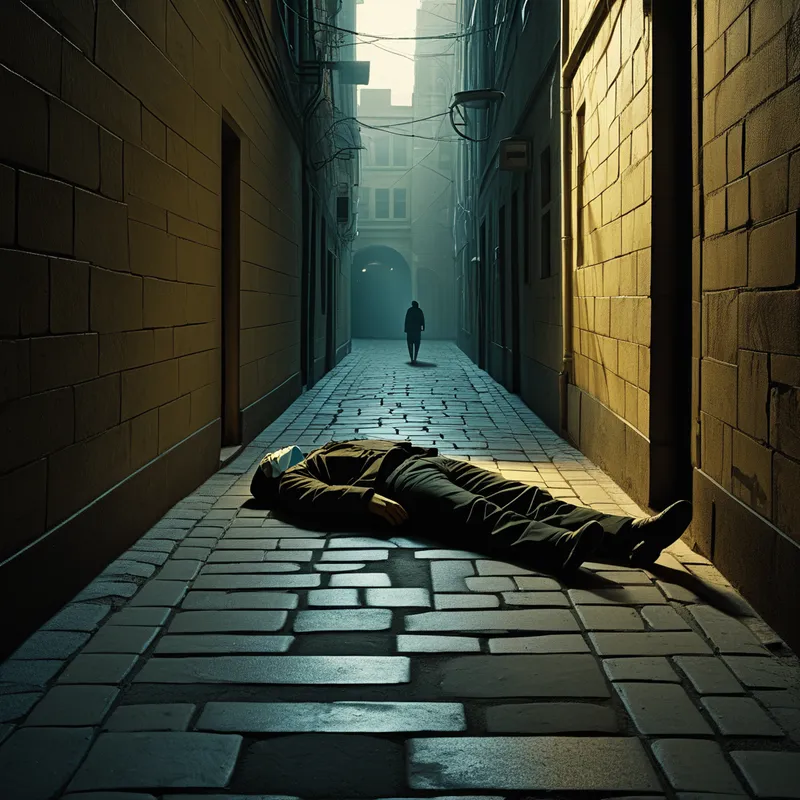
To dream of this parable is to dream at the frontier of empathy. You may dream of being the wounded one, lying helpless as figures of authority (bosses, parents, your own idealized self) walk past, ignoring your plight. This somatic experience—the paralysis, the choked voice—speaks to a profound feeling of abandonment by the very structures you thought would protect you.
Conversely, you may dream of being the passerby, filled with a cold, urgent need to get somewhere important, actively avoiding a crying child, a wounded animal, or a destitute figure. This dream evokes the guilt and dissociation of the modern psyche, over-scheduled and under-connected, sacrificing humanity for productivity.
Most powerfully, you may dream of being the Samaritan, but in a surreal key. The figure you help may have the face of an old enemy, or a rejected part of yourself. The “oil” you use may be tears, or light from your own hands. Such a dream marks a critical shift: the ego’s identification is moving from the one who upholds [the law](/myths/the-law “Myth from Biblical culture.”/) to the one who enacts the grace. It is the psyche practicing the alchemy of turning aversion into attention, otherness into kinship.
Alchemical Translation
The parable’s core is a manual for psychic transmutation. The process begins with the [nigredo](/myths/nigredo “Myth from Alchemical culture.”/), the blackening: the brutal attack, the stripping bare, the abandonment on the road. This is the necessary dissolution of the old identity—the “respectable traveler”—into a state of utter vulnerability.
The passing by of the priest and Levite represents the failure of the old, conscious attitudes (the [persona](/myths/persona “Myth from Greek culture.”/)) to handle the crisis. Their refusal is a necessary failure; it clears [the way](/myths/the-way “Myth from Taoist culture.”/) for a new, unexpected agency to emerge from the depths of the psyche—the Samaritan, a content from the personal or collective shadow.
The alchemical work is in the stopping, the kneeling, and the pouring. This is the albedo, the whitening: the application of conscious mercy to unconscious wounding. You must take your own wine (spirit) and oil (soul) and pour them into your own wounds, and by extension, into the wounds you perceive in the “other.”
Lifting the wounded onto the beast is the citrinitas, the yellowing: the ego must now carry the burden of the integrated shadow, no longer walking alone but bearing a new, precious weight. The inn is the [vessel of transformation](/myths/vessel-of-transformation “Myth from Alchemical culture.”/), and the payment of silver is the [rubedo](/myths/rubedo “Myth from Alchemical culture.”/), the reddening—the commitment of one’s tangible resources (time, energy, money, attention) to the long work of convalescence.
The final promise, “I will repay you when I return,” is the recognition of individuation as an open-ended covenant. The integrated Self is not a static state but a returning, reparative presence. The myth teaches that our true neighbor is not the one who is like us, but the one to whom we, in our fullest humanity, choose to become neighborly. In that choice, the road itself is transformed from a throat of peril into a path of sacred meeting.
Associated Symbols
Explore related symbols from the CaleaDream lexicon: