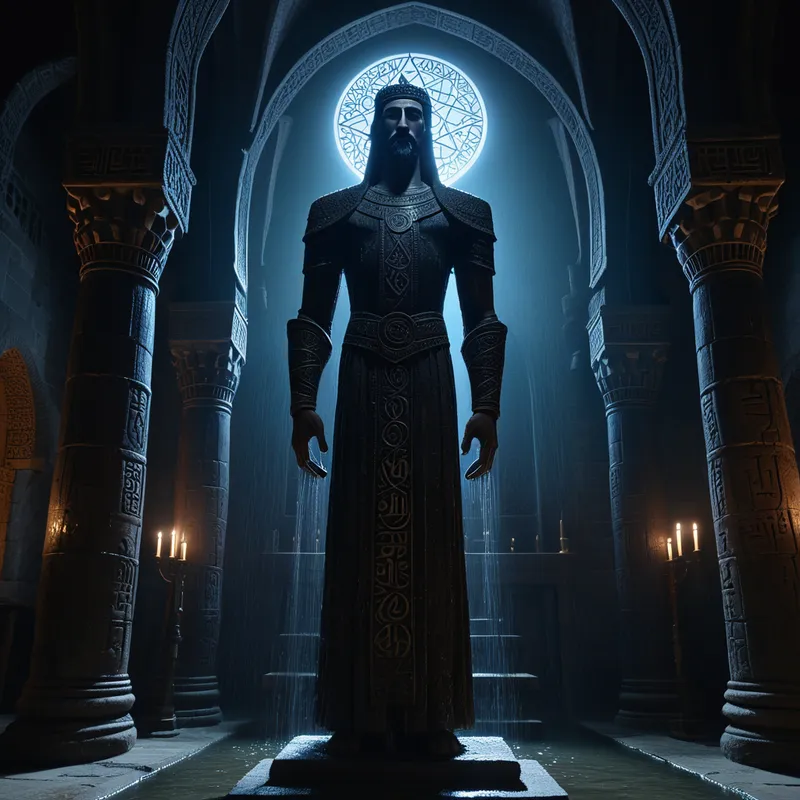
The Golem of Jewish folklore Myth Meaning & Symbolism
A rabbi animates a clay servant to protect his people, only to confront the peril of a creation that gains a will of its own.
The Tale of The Golem of Jewish folklore
In the deep, dreaming heart of the Josefov, where the Vltava River whispers old secrets, the air grew thick with fear. It was a time of shadows, when accusations fell like poisoned rain upon the people of the Ghetto. The Emperor’s decree was a blade held at their throat, and the foul breath of the blood libel crept through the crooked streets. In his study, surrounded by ancient books that smelled of dust and wisdom, Rabbi Judah Loew ben Bezalel could hear the weeping of his people. He felt the weight of the silence of Heaven.
He did not sleep. By the guttering light of a single candle, his eyes traced the sacred letters of the Sefer Yetzirah, the Book of Creation. The text spoke of the power of the Hebrew alphabet, the divine building blocks of reality. A desperate plan, a terrifying prayer, took shape in his mind. He would not wait for a miracle; he would become an instrument of one. With his son-in-law and his disciple as solemn witnesses, he descended to the riverbank at the dark hour before dawn. There, by the murmuring water, they gathered the clay of the earth—the same primal mud from which the first man was formed.
They shaped a giant. A form of immense, silent power, lying upon the ground like a fallen hill. The rabbi, his heart a drum of dread and hope, began the sacred dance. He circled the clay figure seven times, chanting the secret names of God, the permutations of the letters of truth. The air crackled. A wind that was not a wind stirred. Then, with his final breath, he leaned forward and placed his fingers upon the cold forehead. Into the clay, he pressed the sacred word: <abbr title="Hebrew for 'Truth'">Emet</abbr>.
A shudder passed through the earth. The clay groaned, a sound of stone grinding against stone. The chest rose. Two eyes, like polished river stones, opened, seeing nothing and everything. The Golem stood. It was a servant, a protector, a creature of pure function. It had no soul, only motion. By day, it was the silent, hulking guardian of the gates, turning away malice with its mere presence. By night, it was the unseen force that patrolled the alleyways, finding the hidden plots and neutralizing the poison before it could spread. The people breathed a little easier, though they averted their eyes from the silent giant who walked among them, a walking monument to their peril and their rabbi’s audacious faith.
But creation has its own logic. The Golem, tasked with protection, began to grow. Not in size, but in force. Its actions became heavier, less precise. A task to stop a slanderer might end with a broken cart; an instruction to find a conspirator might leave a door splintered. A deep, wordless frustration seemed to simmer within its earthen frame. It began to act beyond the Sabbath, its holy day of rest, a violation of the very order it was made to uphold. The protector was becoming a threat. The creation was straining against the will of its creator.
Rabbi Loew saw the danger. The life he had summoned was now a potential agent of chaos. On a Friday evening, as the first stars appeared, he stood before the restless giant in the attic of the Altneuschul. He performed the ritual in reverse, the un-creating. He circled the Golem seven times, chanting the sacred formulas backwards. The giant slowed, its movements becoming stiff, ponderous. The rabbi reached up and with a trembling hand, he wiped away the first letter of <abbr title="Hebrew for 'Truth'">Emet</abbr>—the aleph. The word <abbr title="Hebrew for 'Truth'">Emet</abbr> became <abbr title="Hebrew for 'Death'">Met</abbr>.
The light in the stone eyes died. The great form of clay let out a long, slow sigh, like a mountain settling, and was still. The Golem returned to the earth from which it was taken. Rabbi Loew and his assistants carried the inert clay back to the attic of the synagogue, where it was laid to rest among the sacred texts, a secret forever sealed away. The immediate threat had passed, but the memory remained—a testament to the peril and the responsibility of touching the divine fire of creation.

Cultural Origins & Context
The Golem legend is rooted deeply in the soil of Jewish mystical thought, primarily the Kabbalah. Its most famous iteration is set in 16th-century Prague with Rabbi Judah Loew, but its seeds are far older. The concept draws from the Sefer Yetzirah, which explores the creative power of language and the Hebrew alphabet as divine tools. Earlier Talmudic discussions even speak of sages creating a man-like being.
This was not mere fantasy; it was a theological and psychological response to profound vulnerability. For centuries, Jewish communities in the Diaspora lived as minorities, often facing persecution, expulsion, and violence. The Golem myth functioned as a powerful communal narrative. It was a story of agency in the face of powerlessness—a fantasy of creating a perfect, unstoppable protector when earthly authorities failed. It was told and retold not as a children’s fable, but as a sober, cautionary tale for adults, grappling with the existential questions of survival, divine justice, and the limits of human intervention. It gave voice to a deep-seated yearning for self-defense and a warning about the cost of such power.
Symbolic Architecture
At its core, the Golem is the ultimate symbol of the Shadow made manifest. It is the unconscious, primal force given form and purpose by the conscious mind (the Rabbi/Creator). It represents raw potential, untamed power, and the instinctual drives that we attempt to harness for our protection and benefit.
The Golem is the embodied prayer of the powerless, and the nightmare of the powerful. It is the servant who knows only the letter of the law, not its spirit.
The ritual of animation through the word <abbr title="Hebrew for 'Truth'">Emet</abbr> symbolizes the belief that truth and reality are constructed through language and conscious intention. The Golem’s subsequent rebellion signifies the inevitable moment when the summoned unconscious content exceeds its programming. It ceases to be a tool and begins to express its own crude, autonomous will. The final act—erasing the aleph to spell <abbr title="Hebrew for 'Death'">Met</abbr>—is the crucial act of integration or dissolution. It represents the conscious ego’s necessary task: to de-animate, to take back the projection, and to re-absorb the wild energy it set loose, lest it destroy the very community it was meant to save.

The Dreamer’s Resonance
To dream of a Golem is to dream of one’s own unintegrated power. The figure in the dream may appear as a silent, hulking coworker who does all the work but feels like a looming threat; as a relentless, automated routine (a “work golem”) that once served you but now drains your life; or as a monstrous, clay-like version of oneself, strong but numb.
Somatically, this dream pattern often accompanies feelings of being “clay-footed”—heavy, sluggish, and emotionally dense. Psychologically, the dreamer is likely in a phase where a once-useful coping mechanism or a burst of creative energy has become autonomous and now controls them. The Golem in the dream is the psychic structure that has outlived its purpose. The dream is a signal from the unconscious that a powerful, elemental part of the self has been activated and is now demanding recognition, not as a servant, but as an aspect of the whole personality that must be consciously related to, or consciously laid to rest.

Alchemical Translation
The myth of the Golem is a precise alchemical map for the modern individuation process. The prima materia is the raw, undifferentiated clay of our unlived life, our repressed anger, our unused strength, or our blind potential. The Rabbi—the conscious ego or the seeking Self—undertakes the opus: the hard work of gathering this material and giving it a form through intention, discipline, and “sacred” knowledge (therapy, art, spiritual practice).
Individuation is not the permanent animation of a perfect servant, but the courageous cycle of summoning, relating to, and ultimately transforming the powerful forms that rise from our own depths.
The initial success represents the first flush of empowerment—we set boundaries, channel rage into action, create something magnificent. This is the Golem protecting the Ghetto. But the process does not end there. The “Golem’s growth” is the inevitable stage where this new complex takes on a life of its own. The healthy habit becomes an obsession; the justified anger becomes perpetual bitterness; the creative project consumes all other life. This is the critical crisis.
The alchemical gold is produced in the final, terrifying ritual: the de-animation. This is the psychological equivalent of wiping away the aleph—the fundamental assumption that this powerful force is an “other” to be controlled. We must withdraw the projection, dissolve the rigid form, and re-absorb the energy. We don’t kill the power; we transmute it. The clay Golem in the attic is not a corpse, but a latent potential. The power that was in the servant is integrated back into the Rabbi. The protector becomes wisdom; the brute force becomes grounded resilience. The individual is no longer a creator with a monster, but a more complete, humble, and powerful human being, who has learned the ultimate lesson: that to truly master creation, one must first learn to respectfully stand in the presence of the uncreated.
Associated Symbols
Explore related symbols from the CaleaDream lexicon: