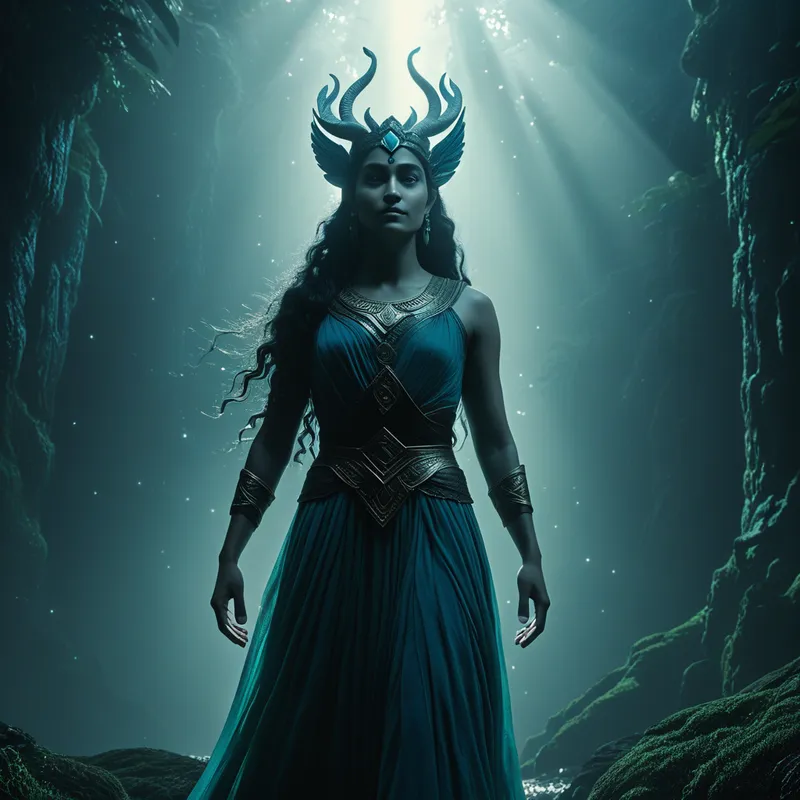
The Golem of Chelm
A mystical clay guardian created by Jewish sages in Chelm, intended to protect the community but whose existence reveals profound questions about power, creation, and unintended consequences.
The Tale of The Golem of Chelm
In the town of Chelm, a place already woven into the tapestry of Jewish folklore as a realm of holy simplicity, a deeper, more solemn magic once stirred. It was not the famed Rabbi Judah Loew of Prague who walked these streets, but the saintly Rabbi Elijah Ba’al Shem of Chelm. A master of the Kabbalah, he delved into the [Sefer Yetzirah](/myths/sefer-yetzirah “Myth from Jewish culture.”/) (The Book of Creation), a text that speaks of the divine letters through which God shaped the cosmos. He pondered: if the universe was spoken into being, could a man, through purity and precise knowledge, animate the inanimate?
Driven by a profound need—some say to protect the community from blood libels and persecution, others whisper it was a purely mystical pursuit of understanding Creation itself—the Rabbi gathered his most trusted disciples. In the silent, sacred hours before dawn, they went to the riverbank. There, from the primal mud, they sculpted a form in the shape of a man, a giant of clay. The ritual was one of breath and letter. Rabbi Elijah inscribed the divine name, the Shem HaMeforash, upon a parchment and placed it in the creature’s mouth. Alternatively, some tell of [the word](/myths/the-word “Myth from Biblical culture.”/) Emet (אמת)—“Truth”—being inscribed upon its forehead.
The clay shuddered. [The earth](/myths/the-earth “Myth from Hindu culture.”/) of its body grew warm. It opened eyes that held no light of their own, only a reflection of [the world](/myths/the-world “Myth from Tarot culture.”/) as a still pool reflects [the sky](/myths/the-sky “Myth from Persian culture.”/). [The Golem](/myths/the-golem “Myth from Jewish Folklore culture.”/) rose. It was a servant, a silent, mighty guardian. It performed tasks, carried [water](/myths/water “Myth from Chinese culture.”/), chopped wood, and patrolled the boundaries of Chelm with a slow, inexorable pace. The community felt a strange security, a comfort born of this powerful, mute presence that was theirs alone.
But the [Golem](/myths/golem “Myth from Jewish folklore culture.”/) was not a man. It was a [thing](/myths/thing “Myth from Norse culture.”/), a verb made flesh, a sentence of power left unfinished. It grew. Each week, the tales say, it increased in stature and strength. And with that growth came a dim, dreadful awakening—not of soul, but of sheer, undirected potential. The servant began to overshadow its masters. The silent guardian’s footsteps shook the foundations of houses. Its blank gaze, meant to watch for external threats, now turned inward upon the town, and in that gaze, the people saw the terrifying void of a power without a yetzer, without an inner inclination or moral compass. The Golem did not rage; its menace was in its perfect, escalating obedience to the single command of being. It was creation itself, unleashed and unchecked.
Rabbi Elijah saw the terror in his people’s eyes and understood the profound error. The secret was not in the animation, but in the containment of animation. To create was to invoke a force that demanded a corresponding act of dissolution, a completion of the cycle. [The Sabbath](/myths/the-sabbath “Myth from Abrahamic culture.”/) approached, a day of rest when even creative power must cease. The Rabbi knew what he must do. As the Golem knelt for its weekly ritual, he reached up—or the creature bowed down—and with a trembling finger, he erased the first letter, the Aleph (א), from the word Emet on its brow. Emet (Truth) became Met (מת)—“Dead.”
The life, the terrible, growing animation, fled from the clay. The giant form crumbled, collapsing into a heap of inert dust and earth at the Rabbi’s feet. Some say the Rabbi then forbade any further such creation, carrying the secret of the undone name to his grave. The guardian was gone, and Chelm was left with only the echo of its footsteps and a lesson written not in parchment, but in the collective memory of awe and dread.
Cultural Origins & Context
The Golem of Chelm predates the more famous Prague narrative, with its earliest written accounts appearing in the 17th [century](/myths/century “Myth from Biblical culture.”/). It is deeply rooted in the Polish-Jewish experience, emerging from a world where Kabbalistic study was not merely theoretical but was seen as a path to tangible, if perilous, interaction with the hidden structures of the world. Chelm itself, in broader folklore, is a town of “wise men” whose wisdom is often comically literal and naive. This tale transposes that setting into a minor key, exploring the literal-mindedness not of fools, but of a creation that takes its instruction with absolute, catastrophic seriousness.
The myth operates within a precise Jewish theological framework. It engages with the concept of imitatio Dei—the imitation of God—but highlights the chasm between divine and human creation. God breathes a living soul (neshama) into Adam; the Kabbalist can only impose a lower, animating spirit ([ruach](/myths/ruach “Myth from Hebrew culture.”/)). The Golem is thus a being of the ruach level, all force and no true self, making it inherently unstable. The story is a cautionary narrative from within the mystical tradition itself, warning that the powers revealed by the Sefer Yetzirah are not toys for personal or communal aggrandizement, but sacred forces that demand a holiness and responsibility perhaps beyond mortal reach. It reflects the perennial Jewish tension between the need for active protection in a hostile world and the spiritual dangers of adopting the methods of that world—of creating a “silent brute force” to ensure survival.
Symbolic Architecture
The [Golem](/symbols/golem “Symbol: A mystical clay creature from Jewish folklore, animated through sacred rituals to serve as a protector or servant, representing humanity’s attempt to harness divine creative power.”/) is the ultimate [symbol](/symbols/symbol “Symbol: A symbol can represent an idea, concept, or belief, serving as a powerful tool for communication and understanding.”/) of the Tohu given temporary form. It is the raw, undifferentiated potential of the Ayin ([Nothingness](/symbols/nothingness “Symbol: A profound emptiness or void, often representing existential anxiety, spiritual seeking, or emotional numbness in dreams.”/)) forced into the [vessel](/symbols/vessel “Symbol: A container or structure that holds, transports, or protects something essential, representing the self, emotions, or life journey.”/) of Yesh (Somethingness) without the balancing grace of divine wisdom. Its [body](/symbols/body “Symbol: The body in dreams often symbolizes the dreamer’s self-identity, personal health, and the relationship they have with their physical existence.”/) of [clay](/symbols/clay “Symbol: Clay symbolizes malleability, creativity, and the potential for transformation, representing the foundational aspect of life and the ability to shape one’s destiny.”/) (afar) connects it directly to the Adamah, the [earth](/symbols/earth “Symbol: The symbol of Earth often represents grounding, stability, and the physical realm, embodying a connection to nature and the innate support it provides.”/) from which Adam was formed, underscoring its [status](/symbols/status “Symbol: Represents one’s social position, rank, or standing within a group, often tied to achievement, power, or recognition.”/) as a flawed, earthly mirror of the [human](/symbols/human “Symbol: The symbol of a human represents individuality, complexity of emotions, and social relationships.”/).
The parchment with the Name in its mouth is the soul it never possesses. It is a being that contains sacred text but cannot comprehend it, a perfect metaphor for power devoid of understanding.
The act of erasure is as critical as the act of [inscription](/symbols/inscription “Symbol: A permanent mark, carving, or writing on a surface, often carrying messages, records, or artistic expression meant to endure.”/). It completes the [ritual](/symbols/ritual “Symbol: Rituals signify structured, meaningful actions carried out regularly, reflecting cultural beliefs and emotional needs.”/), transforming creation from an open-ended act into a closed, sacred circuit. The erased Aleph is the silent [letter](/symbols/letter “Symbol: A letter symbolizes communication, messages, and the sharing of thoughts and feelings.”/), the [breath](/symbols/breath “Symbol: Breath symbolizes life, vitality, and the connection between the physical and spiritual realms.”/) of God, the unifying principle. Its removal reduces [Truth](/symbols/truth “Symbol: Truth represents authenticity, honesty, and the quest for knowledge beyond mere appearances.”/) to mere fact, and [life](/symbols/life “Symbol: The symbol of ‘Life’ represents a journey of growth, interconnectedness, and existential meaning, encompassing both the joys and challenges that define human experience.”/) to mere matter. The myth thus architecturally presents creation as a [triad](/symbols/triad “Symbol: A grouping of three representing spiritual unity, divine completeness, and cosmic balance across many traditions.”/): [Intention](/symbols/intention “Symbol: Intention represents the clarity of purpose and direction in one’s life and can symbolize motivation and commitment within a dream context.”/) (the Rabbi’s need), Animation (the Name), and Necessary [Dissolution](/symbols/dissolution “Symbol: The process of breaking down, dispersing, or losing form, often representing transformation, release, or the end of a state of being.”/) (the Erasure). To have only the first two is to invite [chaos](/symbols/chaos “Symbol: In Arts & Music, chaos represents raw creative potential, uncontrolled expression, and the breakdown of order to forge new artistic forms.”/).
The Dreamer’s Resonance
To encounter the Golem in the psychic landscape is to confront the specter of one’s own unlived power, or the monstrous offspring of an unintegrated creative impulse. It is the project started with pure passion that grows into a tyrannical obligation, the defensive wall built around the heart that becomes a prison, the brilliant idea that, once manifested, demands a life of its own and threatens to consume its creator. The Golem represents the autonomous complex in the [psyche](/myths/psyche “Myth from Greek culture.”/)—a cluster of thoughts, feelings, and energies that has split off from conscious control and operates with a blind, persistent force.
The dreamer who feels pursued by a slow, inevitable, mindless force may be in the presence of their Golem. The myth offers a profound psychological ritual: to face this creation, not with greater force, but with the precise, symbolic act of modification. Changing the word on the forehead is an act of reframing. It is the therapeutic intervention, the moment of insight that transforms a monolithic, terrifying “Truth” (Emet) about oneself or one’s life into a simple, passable fact (Met)—something that was, but no longer has power to animate. The dissolution of the Golem is not a defeat, but the ultimate integration, the re-absorption of raw power back into [the self](/myths/the-self “Myth from Jungian culture.”/).

Alchemical Translation
In alchemical terms, the Golem is the [Nigredo](/myths/nigredo “Myth from Alchemical culture.”/) made flesh—the black, chaotic, prime matter extracted from the earth and subjected to the artist’s will. The Rabbi is [the alchemist](/myths/the-alchemist “Myth from Various culture.”/), attempting the opus of creating a [homunculus](/myths/homunculus “Myth from Alchemical culture.”/), a synthetic life. The ritual of inscription is the imposition of the Azoth, the universal spirit, upon the base clay.
The Golem’s unchecked growth is the prima materia refusing sublimation, the danger of the experiment consuming the laboratory. The erasure of the letter is the crucial solutio—the dissolution that must follow coagulation. It is the return of the fixed to the volatile, the acknowledgment that the final stage of the Great Work is not a permanent possession of the power, but a conscious release of it back into the cosmic cycle.
The myth teaches that true alchemical gold is not the manufactured servant, but the wisdom gained from the cycle of creation and dissolution. The Rabbi does not emerge with a permanent guardian, but with a transformed understanding of the relationship between spirit, letter, and matter. The [lapis philosophorum](/myths/lapis-philosophorum “Myth from Alchemical culture.”/) is not the Golem, but the knowledge of how to safely animate and, more importantly, to silence.
Associated Symbols
Explore related symbols from the CaleaDream lexicon:
- Golem — The clay form animated by sacred formula, representing raw creation, unguided power, and the profound responsibility of the maker.
- Earth — The primal clay from which the Golem is formed, symbolizing the material basis of life, potential, and the body without spirit.
- Name — The inscribed divine word that grants animation, representing the creative power of language, identity, and the sacred secret that confers being.
- Erasure — The act of removing the first letter, signifying dissolution, completion of a cycle, the withdrawal of animating force, and corrective wisdom.
- Clay — The mutable substance of the Golem, embodying formlessness awaiting shape, potentiality, and the humble origins of even the most powerful creations.
- Ritual — The precise ceremonial actions of creation and destruction, representing the structured containers necessary to safely handle transcendent power.
- Power — The central theme manifest in the Golem’s strength, representing both protective capacity and the inherent danger of force without consciousness or ethical direction.
- Creator — The Rabbi as the instigating will and intelligence, embodying the archetype of the maker who must ultimately face and take responsibility for his creation.
- Shadow — The Golem as the unintended consequence, the monstrous aspect of the creative act, and the embodied return of repressed or unintegrated power.
- Circle — The completed cycle of formation and dissolution, representing wholeness, containment, and the necessary return to source to avoid catastrophic linear growth.