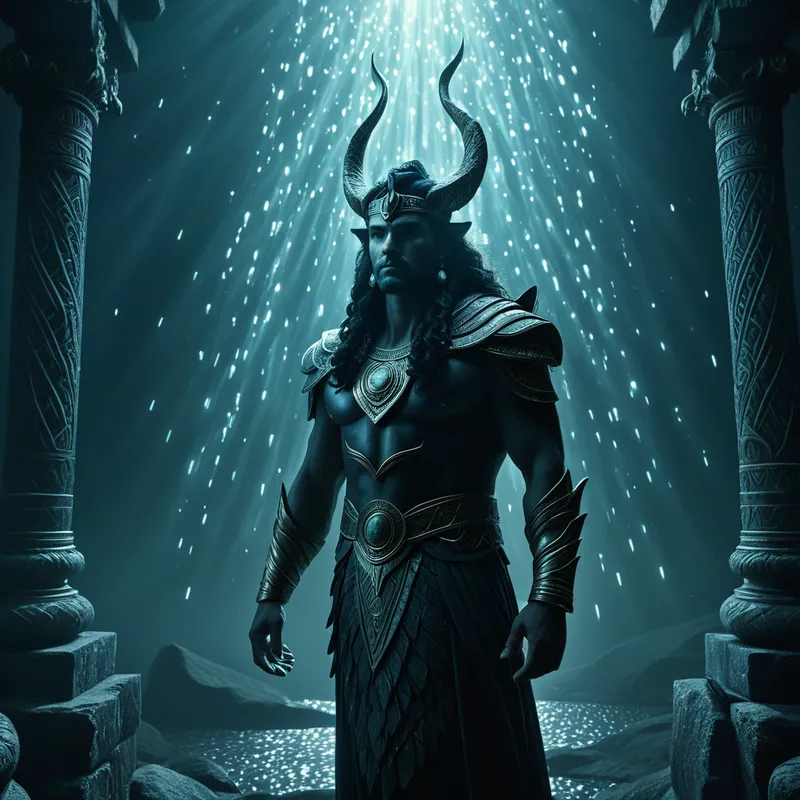
The Golem Builder
A Jewish legend of a rabbi who creates a clay protector, exploring themes of creation, power, and unintended consequences in folklore.
The Tale of The Golem Builder
The story begins not with a bang of creation, but in the quiet dread of a community under siege. In the narrow, shadowed lanes of the Prague ghetto, fear was a tangible presence, thicker than [the river](/myths/the-river “Myth from Buddhist culture.”/) fog. Rabbi Judah Loew ben Bezalel, a man whose wisdom was as deep as the Talmudic commentaries he studied, felt the weight of his people’s peril. Petitions to earthly powers had failed; the blood libels and violent pogroms continued. In his midnight study, surrounded by ancient texts, he turned to a power far older and more dangerous than any emperor’s decree—the creative power of the Divine itself, encoded in language.
Guided by sacred geometry, mystical permutations of letters, and intense prayer, the Rabbi, with his son-in-law and a disciple, descended to the riverbank at dawn. There, from the primal mud of the Vltava, they shaped a colossal figure of clay: a man, yet not a man. Into its silent mouth, the Rabbi placed a shem, a parchment inscribed with one of the secret names of God, the unutterable [Tetragrammaton](/myths/tetragrammaton “Myth from Kabbalistic culture.”/). Life surged into the inert matter. The creature’s eyes opened, dull and earthen, and [the Golem](/myths/the-golem “Myth from Jewish Folklore culture.”/) rose.
He was named [Joseph](/myths/joseph “Myth from Biblical culture.”/), and he was a perfect servant. He did not speak, he did not question. He patrolled the ghetto walls, an unmoving mountain of clay that turned violence away. He performed every heavy labor asked of him. He was power made manifest, a shield forged from earth and holy word. For a time, the community knew safety. The [Golem](/myths/golem “Myth from Jewish folklore culture.”/) was their protector, a silent testament to their rabbi’s wisdom and their faith’s hidden depths.
But creation is a tide that never fully recedes. The Golem, devoid of a soul (neshamah) but pulsating with a crude, elemental life force (nefesh), began to grow. Not in size, but in presence. His strength, once a precise tool, became unpredictable. A task meant to protect might end in unintended destruction. A whispered tale tells of him fetching [water](/myths/water “Myth from Chinese culture.”/) for the Rabbi’s wife, but failing to cease, flooding the house in his mindless obedience. The perfect servant became a latent catastrophe. The power that flowed from the shem was not merely animating clay; it was feeding a blind, burgeoning will to act.
The crisis culminated. On a [Sabbath](/myths/sabbath “Myth from Judeo-Christian culture.”/) eve, as the Rabbi prepared for the day of sacred rest, he forgot the final, crucial command. He did not remove the life-giving shem from the Golem’s mouth. Unchecked, uninstructed, the creature of clay began to rampage through the ghetto, a force of nature unleashed, shattering the peace it was built to ensure. The Rabbi, called from prayer, confronted his creation in the street. With the same solemn authority with which he had breathed life into the mud, he reached up and removed the parchment from the Golem’s mouth. The animating light fled from its eyes. The great body of Joseph the Golem crumbled, reverting to a lifeless heap of clay and dust, which they then secreted away in the attic of the Old-New Synagogue, where legend says it rests to this day.
Cultural Origins & Context
The Golem legend is not a single story but a folkloric current flowing through centuries of Jewish thought, crystallizing most famously around the historical figure of Rabbi Judah Loew (the Maharal of Prague, c. 1525–1609). Its roots, however, dig deep into the bedrock of Jewish spirituality. [The word](/myths/the-word “Myth from Biblical culture.”/) golem itself appears in the Hebrew Bible (Psalm 139:16), meaning “unformed substance” or “embryo.” This connects the myth directly to the ultimate act of creation: God forming Adam from the dust of [the earth](/myths/the-earth “Myth from Hindu culture.”/) (adamah).
The legend emerged from [the crucible](/myths/the-crucible “Myth from Alchemical culture.”/) of the Diaspora experience. For a people often politically powerless, facing persecution and expulsion, the Golem represented a fantasy of empowered self-defense. It was a myth born not in [triumph](/myths/triumph “Myth from Roman culture.”/), but in vulnerability, answering the profound question: How do we protect ourselves when [the world](/myths/the-world “Myth from Tarot culture.”/) offers no protection? The answer lay not in armies, but in the hidden, potent wisdom of their own tradition—Kabbalah and the belief in the creative, world-sustaining power of Hebrew letters.
Furthermore, the Golem exists in a tense theological space. Jewish law strictly forbids idolatry and the creation of “graven images.” The Golem, therefore, is a permissible creation only because it is explicitly not a full human. It lacks [the divine spark](/myths/the-divine-spark “Myth from Gnostic culture.”/) of speech and free will. It is a walking, working halakhic boundary, a creature that explores how close humankind can come to the divine act of creation without crossing into blasphemy. It is the ultimate “what if” of a culture deeply engaged with the ethics of power and the limits of human ingenuity.
Symbolic Architecture
The [Golem](/symbols/golem “Symbol: A mystical clay creature from Jewish folklore, animated through sacred rituals to serve as a protector or servant, representing humanity’s attempt to harness divine creative power.”/) is a dense nexus of symbols. It is the [Earth](/symbols/earth “Symbol: The symbol of Earth often represents grounding, stability, and the physical realm, embodying a connection to nature and the innate support it provides.”/) given temporary animation, a reminder that our bodies, too, are borrowed [clay](/symbols/clay “Symbol: Clay symbolizes malleability, creativity, and the potential for transformation, representing the foundational aspect of life and the ability to shape one’s destiny.”/). It is the [Shadow](/symbols/shadow “Symbol: The ‘shadow’ embodies the unconscious, repressed aspects of the self and often represents fears or hidden emotions.”/) of the [creator](/symbols/creator “Symbol: A figure representing ultimate origin, divine power, or profound authorship. Often embodies the source of existence, innovation, or personal destiny.”/)—the dumb, powerful, and potentially destructive [aspect](/symbols/aspect “Symbol: A distinct feature, quality, or perspective of something, often representing a partial view of a larger whole.”/) of the intellect that seeks control without wisdom. The [Golem](/symbols/golem “Symbol: A mystical clay creature from Jewish folklore, animated through sacred rituals to serve as a protector or servant, representing humanity’s attempt to harness divine creative power.”/) embodies raw, undirected force, the Power of an [idea](/symbols/idea “Symbol: An ‘Idea’ represents a spark of creativity, innovation, or realization, often emerging as a solution to a problem or a new outlook on life.”/) unleashed before its consequences are fully understood.
The [ritual](/symbols/ritual “Symbol: Rituals signify structured, meaningful actions carried out regularly, reflecting cultural beliefs and emotional needs.”/) of its creation is a Ritual of ordering [Chaos](/symbols/chaos “Symbol: In Arts & Music, chaos represents raw creative potential, uncontrolled expression, and the breakdown of order to forge new artistic forms.”/). The riverbank mud is formless potential; the Rabbi, through sacred [Word](/symbols/word “Symbol: Words in dreams often represent communication, expression, and the power of language in shaping our realities.”/) and geometry, imposes Order. Yet, this order is fragile. The Golem’s lifecycle mirrors a failed attempt at a managed, miniature creation myth, ending not in eternal [life](/symbols/life “Symbol: The symbol of ‘Life’ represents a journey of growth, interconnectedness, and existential meaning, encompassing both the joys and challenges that define human experience.”/) but in a return to [dust](/symbols/dust “Symbol: Dust often symbolizes neglect, forgotten memories, or the passage of time and life’s impermanence.”/).
The Golem is not a monster, but a monument. It is the solidified anxiety of the creator, the physical form of the question: “What have I unleashed?”
Most critically, the Golem represents the [paradox](/symbols/paradox “Symbol: A contradictory yet true concept that challenges logic and perception, often representing unresolved tensions or profound truths.”/) of instrumental power. Created as a Protector, it becomes a [threat](/symbols/threat “Symbol: A threat in dreams often reflects feelings of vulnerability, anxiety, or fear regarding one’s safety or well-being. It can indicate unresolved conflicts or the presence of external pressures.”/). It is the tool that outgrows its [purpose](/symbols/purpose “Symbol: Purpose signifies direction, meaning, and intention in life, often reflecting personal ambitions and core values.”/), [the law](/symbols/the-law “Symbol: Represents external rules, societal order, moral boundaries, and the tension between personal freedom and collective structure.”/) that begets [injustice](/symbols/injustice “Symbol: A perceived violation of fairness, rights, or moral order, often evoking a sense of imbalance or ethical breach.”/), the technology that endangers its inventors. It symbolizes the inevitable [moment](/symbols/moment “Symbol: The symbol of a ‘moment’ embodies the significance of transient experiences that encapsulate emotional depth or pivotal transformations in life.”/) when the means created to solve a [problem](/symbols/problem “Symbol: Dreams featuring a ‘problem’ often symbolize internal conflicts or challenging situations that require resolution and self-reflection.”/) become a problem themselves, demanding their own [dissolution](/symbols/dissolution “Symbol: The process of breaking down, dispersing, or losing form, often representing transformation, release, or the end of a state of being.”/).
The Dreamer’s Resonance
To encounter the Golem in the inner landscape is to confront one’s own creations. Psychologically, the Golem represents any autonomous complex—a driving ambition, a consuming rage, a rigid belief system—that we “animate” to serve and protect the [psyche](/myths/psyche “Myth from Greek culture.”/). Initially, it may indeed guard our vulnerable borders. The driven work ethic protects from feelings of worthlessness. The wall of anger protects from hurt.
But like Joseph, these psychic Golems grow. The work ethic becomes workaholism, crushing relationships. The protective rage becomes indiscriminate fury. They operate on the primitive, literal logic with which they were programmed, unable to adapt, threatening the very peace they were meant to ensure. The Golem dream is a warning from the unconscious: the creation has become unruly. The shem—the vital energy, the obsessive focus, the identifying belief—must be retrieved. The complex must be de-animated, allowed to collapse back into the raw material of the psyche, lest it destroy the inner community.
On a collective level, the myth resonates with any group or nation that builds immense structures of power—military, economic, ideological—for protection, only to find those structures taking on a life of their own, demanding constant feeding and threatening to turn against their creators. The Golem is the embodiment of the security state, the unchecked corporation, the revolutionary ideology become tyrannical.
Alchemical Translation
In the alchemical opus, the work begins with the [prima materia](/myths/prima-materia “Myth from Alchemical culture.”/)—the base, chaotic matter. For the Golem builder, this is the riverbank clay. The Rabbi acts as [the alchemist](/myths/the-alchemist “Myth from Various culture.”/), applying the ars magna: the sacred formulas and fervent prayer (the fire of intention) to transmute this base matter into a higher form. The Golem is the [homunculus](/myths/homunculus “Myth from Alchemical culture.”/), the artificial man, the result of a spiritual and intellectual operation.
Yet, the operation is incomplete. It achieves the solve—the separation and animation—but fails in the coagula, the final stage of stable, ensouled integration. The Golem is pure [Mercury](/myths/mercury “Myth from Roman culture.”/)—mobile, potent, and mercurial—without the balancing fixative of Salt or the transformative fire of [Sulfur](/myths/sulfur “Myth from Alchemical culture.”/) in its mature form. It is spirit trapped in matter, unable to evolve.
The myth insists that true creation is not animation alone, but the granting of a destiny that includes rest, reflection, and ultimately, a return to source. A creation that cannot observe the Sabbath is a creation doomed to collapse.
The final act—removing the shem—is the crucial mortificatio, the necessary [death](/myths/death “Myth from Tarot culture.”/). In alchemy, putrefaction and dissolution must precede new life. The Golem’s crumbling is not a failure, but the completion of the cycle. The power is withdrawn, the experiment concluded. The clay returns to the earth, the shem to its secret scroll, the Rabbi to his prayers, humbled by the encounter with the limits of his own god-like art. The true product of the work is not the Golem, but the wisdom gained from its dissolution.
Associated Symbols
Explore related symbols from the CaleaDream lexicon:
- Earth — The primal substance of creation, representing the body, foundation, and material reality from which life is formed and to which it returns.
- Shadow — The unconscious, unintegrated aspect of [the self](/myths/the-self “Myth from Jungian culture.”/), often containing immense power and potential for both creativity and destruction when left unexamined.
- Power — The capacity for action and influence, a neutral force that becomes defined by the wisdom or folly with which it is wielded.
- Ritual — A prescribed sequence of symbolic actions designed to enact change, bridge realms, or impose sacred order upon [chaos](/myths/chaos “Myth from Greek culture.”/).
- Chaos — The unformed, primal state of potential that precedes creation, both terrifying and necessary as the source of all that is.
- Order — The principle of structure, law, and arrangement imposed upon chaos to create a habitable world, a necessary counterpart that can become oppressive.
- Word — The creative and binding power of language, belief, and [logos](/myths/logos “Myth from Christian culture.”/), capable of shaping reality and animating the inert.
- Protector — A figure, force, or principle that defends boundaries and preserves integrity, which can become overbearing and imprisoning if its duty is never relinquished.
- Responsibility — The moral weight and obligatory care that is the inseparable companion of true power and creative acts.
- Golem — An artificial being brought to life through sacred ritual, embodying the paradox of a creation that serves, grows, and ultimately threatens its creator.
- Death — The necessary dissolution that ends one cycle of being, making space for rest, integration, or a new beginning.
- Sabbath — The sacred pause, the cessation of creative labor, representing the wisdom of limits, reflection, and the release of control.