The Golden Cord Myth Meaning & Symbolism
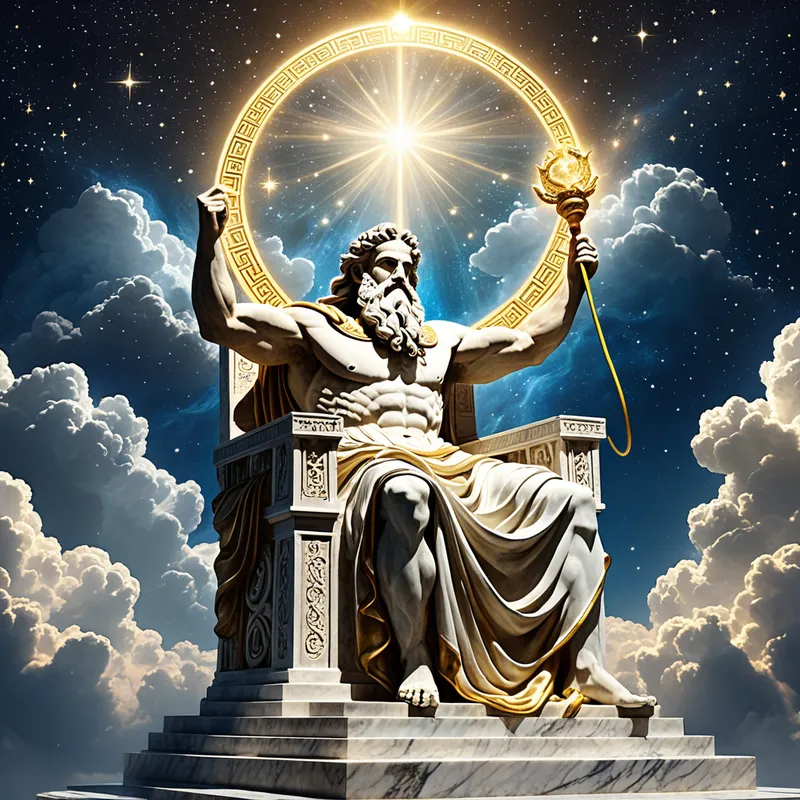
Zeus boasts he could draw all creation to Olympus with a golden cord, revealing the absolute nature of divine will and cosmic order.
The Tale of The Golden Cord
The air in the hall of Olympus was thick, not with nectar-mist, but with a silence that crackled like distant lightning. The war below—that great, grinding conflict of men at Troy—had become a mirror held up to the gods, and in it, they saw their own rivalries reflected, magnified, twisted into mortal agony.
Hera, her eyes like polished obsidian, had woven a plot of exquisite subtlety. With the help of Aphrodite’s girdle and the god of sleep himself, she had ensnared her husband, Zeus, in a cloud of enchanted slumber. A precious moment stolen, a chance to sway the battle in favor of her beloved Achaeans. But the sleep of a god is a shallow sea, and the king of storms awoke.
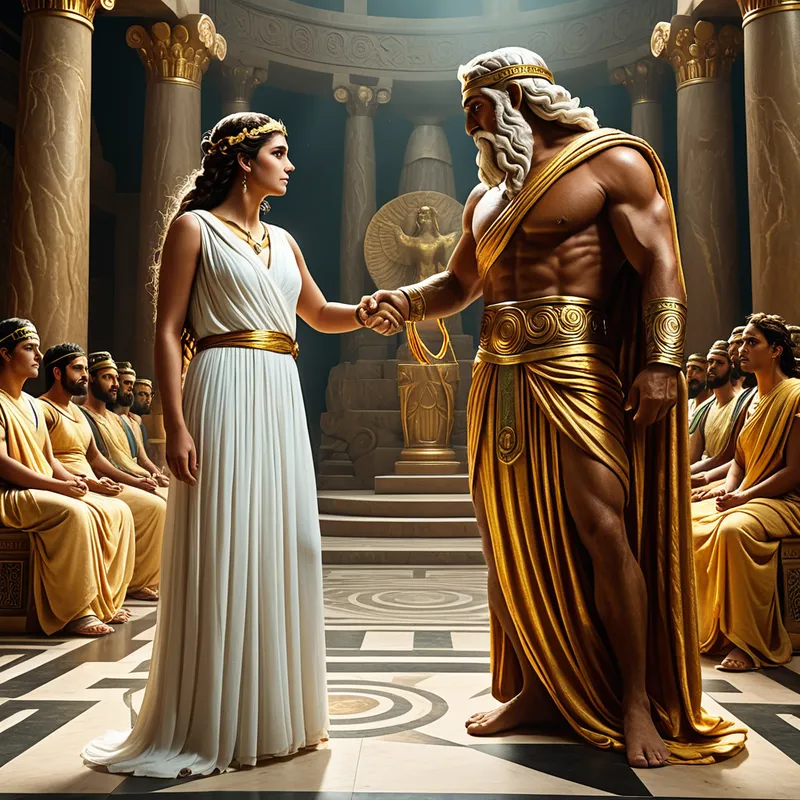
He rose. The very marble of the floor seemed to flinch. His gaze swept the hall, and where it fell, the lesser deities shrank back, becoming like statues of themselves. He saw the scheming, the fractured loyalties, the rebellion in his own house. His voice, when it came, was not a shout, but a low rumble that vibrated in the bones of the cosmos.
“You dare?” The words were simple, colder than the peaks of Olympus. He turned his ire on Hera, and for all her power, she was a sapling before a hurricane. He spoke of punishments, of hanging her from the heavens with golden chains, of hurling any who aided her into the bottomless pit of [Tartarus](/myths/tartarus “Myth from Greek culture.”/). Fear, palpable and sour, filled the air.
Then, his expression shifted from wrath to something more terrifying: absolute, unassailable certainty. He wished to make them understand, once and for all, the nature of reality. The nature of him.
“Hear this, all you who dwell in bliss,” he declared, his hand extending. From the aether itself, he manifested it—a cord of purest gold. It was not heavy, but its presence pulled at the soul. It shone with a light that was not warm, but fundamental, the light of raw order.
“Fasten this golden cord to the floor of heaven,” Zeus commanded, his voice now filling all spaces. “All you gods and goddesses, take hold of it. Pull. Strain with all the divine strength that is in you. You will not drag me, Zeus the counselor, from heaven to earth.”
He paused, letting the image sink in—[the pantheon](/myths/the-pantheon “Myth from Greek culture.”/), united, heaving in vain against his will.
“But I,” he continued, and here a smile, devoid of mirth, touched his lips. “If I should wish to pull you? I would draw you up, with the very earth and [the sea](/myths/the-sea “Myth from Greek culture.”/) besides. I would fasten the cord about the peak of Olympus, and all would hang in space together.”
He held the cord aloft. In that moment, it was not merely an object. It was a line of demarcation, a theorem made manifest. It was the axis of [the world](/myths/the-world “Myth from Tarot culture.”/). “For my might is greater far than that of gods and men.”
The silence returned, deeper now. It was the silence of comprehension, of a truth so vast it annihilates argument. The golden cord gleamed, a silent, perfect proof in the god’s hand. There was no battle, no struggle. Only the presentation of an irrevocable fact. The scheming was over. The war below would follow its course, his course. The cord vanished, but its lesson was etched into the fabric of divine consciousness, a permanent scar of sovereignty. The council was adjourned, not by vote, but by the sheer, gravitational weight of reality itself.
Cultural Origins & Context
This potent vignette is not from a standalone epic of creation, but from the heart of human conflict: Book 8 of [Homer](/myths/homer “Myth from Greek culture.”/)’s Iliad. Its placement is critical. Amidst the chaos of [the Trojan War](/myths/the-trojan-war “Myth from Greek culture.”/), a narrative saturated with human courage, folly, and suffering, [Homer](/myths/homer “Myth from Greek culture.”/) reminds his audience of the ultimate framework. The myth was performed orally by bards (rhapsodes) for aristocratic audiences, serving as both entertainment and profound cultural programming.
Its function was multifaceted. For a society deeply engaged with concepts of honor (time) and fate (Moira), the scene established the cosmic hierarchy. It answered the implicit question in every prayer and sacrifice: how much agency do even the gods possess? The myth declares that above the squabbles of Olympians, above the interventions in human affairs, resides an impersonal, absolute principle of order and power embodied by Zeus. It is a theological anchor, preventing the divine narrative from collapsing into mere soap opera and grounding it in a recognizable, if terrifying, structure of authority. It taught acceptance of a world where ultimate control rests with forces beyond appeal, a lesson as relevant for a Greek warrior as for a modern soul.
Symbolic Architecture
The Golden [Cord](/symbols/cord “Symbol: Represents connections, bindings, lifelines, and structural support in architectural and spatial contexts.”/) is one of the most concentrated symbols in all of mythology. It is not a [weapon](/symbols/weapon “Symbol: A weapon in dreams often symbolizes power, aggression, and the need for protection or defense.”/), a tool, or a gift. It is a demonstration.
The cord is the visible suture between will and manifestation, the tensile line of causation itself.
First, it symbolizes Absolute Sovereignty. Zeus’s power is not merely greater in [degree](/symbols/degree “Symbol: A ‘degree’ symbolizes achievement and recognition, especially in the context of education but can also reflect status and authority in various domains.”/); it is different in kind. The cord illustrates a metaphysical [truth](/symbols/truth “Symbol: Truth represents authenticity, honesty, and the quest for knowledge beyond mere appearances.”/): his will is the linchpin of cosmic coherence. Without it, all is [chaos](/symbols/chaos “Symbol: In Arts & Music, chaos represents raw creative potential, uncontrolled expression, and the breakdown of order to forge new artistic forms.”/); with it, all hangs in ordered, if suspended, balance.
Second, it represents The Unbreakable Law of [Fate](/symbols/fate “Symbol: Fate represents the belief in predetermined outcomes, suggesting that some aspects of life are beyond human control.”/) (Moira). The gods themselves are subject to a [framework](/symbols/framework “Symbol: Represents the underlying structure of one’s identity, emotions, or life. It signifies the mental or emotional scaffolding that supports or confines the self.”/), an Ananke (Necessity), of which Zeus is the chief executor. The cord is the physical [expression](/symbols/expression “Symbol: Expression represents the act of conveying thoughts, emotions, and individuality, emphasizing personal communication and creativity.”/) of this [framework](/symbols/framework “Symbol: Represents the underlying structure of one’s identity, emotions, or life. It signifies the mental or emotional scaffolding that supports or confines the self.”/). The gods cannot pull him down because they operate within the [system](/symbols/system “Symbol: A system represents structure, organization, and interrelated components functioning together, often reflecting personal or social order.”/) he ultimately governs.
Psychologically, the myth maps the [relationship](/symbols/relationship “Symbol: A representation of connections we have with others in our lives, often reflecting our emotional state.”/) between the conscious ego and the totality of the [psyche](/myths/psyche “Myth from Greek culture.”/), the Self. The squabbling gods represent the complex, often conflicting, sub-personalities and drives within us (the complexes). Zeus represents the central, ordering principle of the [psyche](/myths/psyche “Myth from Greek culture.”/)—[the Self](/myths/the-self “Myth from Jungian culture.”/). His boast is [the ego](/myths/the-ego “Myth from Jungian culture.”/)’s shocking realization that it is not, and cannot be, the master of this inner [pantheon](/myths/pantheon “Myth from Roman culture.”/). True power lies in aligning with, not commanding, the deeper, unifying current of the [psyche](/myths/psyche “Myth from Greek culture.”/).
The Dreamer’s Resonance
To dream of a golden cord is to encounter the somatic signature of a profound psychological reckoning. It rarely appears in scenes of action. More often, the dreamer simply finds it, or sees it held by a vast, impersonal figure, or feels it connected to their core, stretching into an unseen beyond.
The experience is one of inescapable connection and ultimate limitation. You may tug on it in frustration and feel the whole world tug back. You may follow it, seeking its source, and find only a hand, a throne, a void. The cord in a dream speaks to a confrontation with a reality principle. It appears when the dreamer is struggling against a fundamental truth of their life: a diagnosis, a relational inevitability, the consequences of a core choice, or the limits of their own willpower.
The somatic sensation is key: a taut pull in the chest or solar plexus, a vibration along the spine. It is the body dreaming the feeling of being bound by reality, of hitting the walls of one’s own fate. This is not a nightmare of persecution, but a sober, awe-filled dream of orientation. It asks the dreamer: “Against what immovable object are you currently straining? What deep, ordering principle of your own life are you refusing to acknowledge?”
Alchemical Translation
The alchemical process mirrored here is not [solve et coagula](/myths/solve-et-coagula “Myth from Alchemical culture.”/) (dissolve and coagulate) in its active sense, but the supreme stage of [Rubedo](/myths/rubedo “Myth from Alchemical culture.”/)—the reddening, often associated with the revelation of the [Lapis Philosophorum](/myths/lapis-philosophorum “Myth from Alchemical culture.”/) (Philosopher’s Stone). It is the moment when the seeker understands the nature of [the prima materia](/myths/the-prima-materia “Myth from Alchemical culture.”/) they have been laboring with: it is not base lead to be conquered, but the very law of the universe to be recognized.
The transmutation is not of substance, but of perception. The ego’s ambition to be the puller of the cord is sacrificed to the awe of being part of the cord’s design.
For the modern individual navigating individuation, the myth models the final surrender of the ego’s fantasy of total control. The “gold” is not achieved through heroic effort, but through the humble, shocking acknowledgment of a pre-existing, golden order. Our psychic “gods”—our ambitions, our passions, our intellect—wrangle and scheme. The alchemical work is to hear the voice of the inner Zeus, the Self, which does not argue, but demonstrates.
The [triumph](/myths/triumph “Myth from Roman culture.”/) is the end of futile struggle. It is the integration of the knowledge that our freedom exists not in defying gravity, but in learning its laws and building our house upon the solid earth it defines. To see the Golden Cord is to have one’s personal myth re-contextualized within a cosmic one. The psychic transmutation is from a hero who would storm heaven to a sage who understands his place in its architecture, finding not limitation, but a profound and sobering liberation within the bounds of his own true nature.
Associated Symbols
Explore related symbols from the CaleaDream lexicon: