
The Golden Chain of Homer Myth Meaning & Symbolism
A cosmic chain linking all existence, from Zeus to the earth, embodying the sacred tension between divine order and mortal reality.
The Tale of The Golden Chain of Homer
Hear now, a tale not of a single hero, but of the cosmos itself—a story sung by the blind bard [Homer](/myths/homer “Myth from Greek culture.”/) in the flickering firelight of a bygone age. It begins not on the blood-soaked plains of Troy, but in the silent, star-dusted halls of high Olympus.
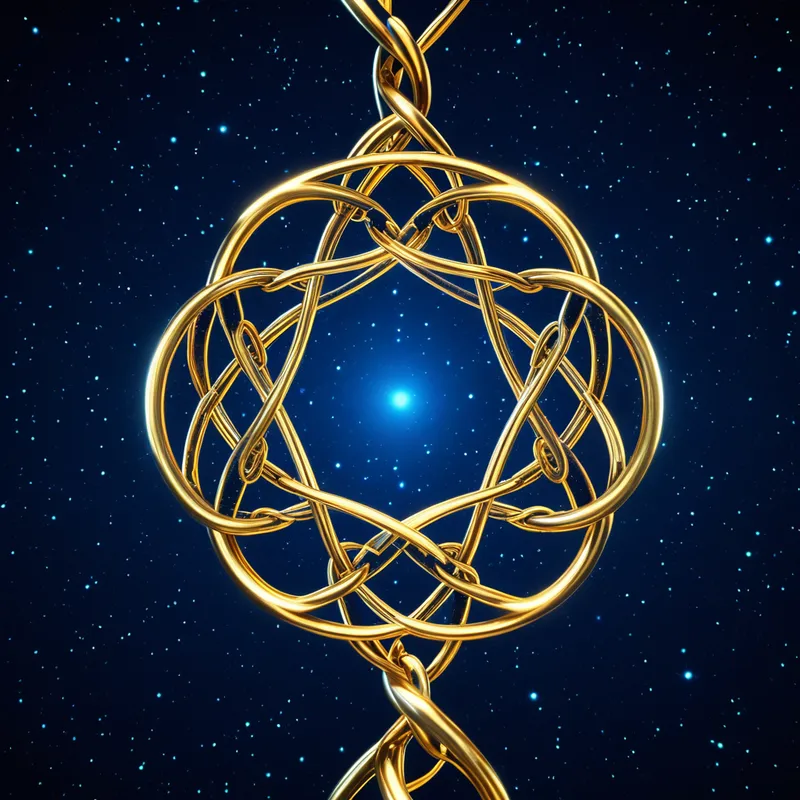
In the beginning, there was a golden chain. Not forged in mortal fire, but spun from the very will of Zeus, the Cloud-Gatherer. From his shimmering throne, he let it fall. It unspooled, link by perfect link, a river of molten light piercing the vault of heaven. It passed through the realm of the wandering planets and the fixed, watchful stars, through the breath of the four winds and [the veil](/myths/the-veil “Myth from Various culture.”/) of the clouds. Down, down it descended, until its final, weighty link brushed the fertile soil of [the earth](/myths/the-earth “Myth from Hindu culture.”/), the Gaia.
This was no mere tether. It was a living cord, a vibration of divine order. Through it flowed the [logos](/myths/logos “Myth from Christian culture.”/) of Zeus—his law, his reason, his sovereign command. When the god willed it, he would take the chain in his mighty hand and pull. And all of creation would shudder in response. The heavens would tremble, the seas would rear up, and the earth would quake to its deepest roots. Every being, from the loftiest god to the lowliest crawling [thing](/myths/thing “Myth from Norse culture.”/), was strung upon this chain. It was the ultimate hierarchy, the great scale of being, connecting all things in a sacred, unbreakable sequence.
But the chain was also a test, a question posed by the father of gods to all who dared to dream of rebellion or ascent. Could any power, divine or mortal, pull Zeus himself down from his throne by this very chain? The answer echoed through the myth: No. If all the gods and all of humanity were to grasp the chain and pull with all their collective might, they would fail. Zeus alone would remain unmoved, and he, with effortless grace, would draw them all up—gods, men, the very earth and sea—into the dazzling, terrible light of Olympus.
This is the vision Homer gifted [the world](/myths/the-world “Myth from Tarot culture.”/): a universe not of chaos, but of profound, resonant connection. A cosmos where every sigh, every struggle, every [triumph](/myths/triumph “Myth from Roman culture.”/) is a vibration sent humming up and down the links of a golden, celestial ladder.

Cultural Origins & Context
The so-called “Golden Chain of Homer” is not a narrative myth in the traditional sense, but a powerful philosophical image embedded within the epic poetry of the Homeric works, specifically in Book VIII of the Iliad. Here, Zeus boasts of his supreme power, declaring his ability to hoist the entire cosmos. This vivid metaphor was later expanded and codified by philosophers and commentators, most notably the Stoics and Neoplatonists.
For the Greeks, this was not mere poetry. It was a cosmological model. It explained the observable order (kosmos) of the world—why the stars moved in their fixed paths, why kings ruled men, and why fathers ruled households. It provided a metaphysical justification for the Great Chain of Being, a concept that would influence Western thought for millennia. The myth was passed down not only by rhapsodes singing Homer’s verses but by philosophers in the agora and the academy, who saw in it a key to understanding fate (moira), divine providence, and the place of the human soul within the grand design.
Symbolic Architecture
The Golden Chain is perhaps the ultimate [symbol](/symbols/symbol “Symbol: A symbol can represent an idea, concept, or belief, serving as a powerful tool for communication and understanding.”/) of The Great Chain of Being. Each link represents a distinct level of existence, [consciousness](/symbols/consciousness “Symbol: Consciousness represents the state of awareness and perception, encompassing thoughts, feelings, and experiences.”/), or [reality](/symbols/reality “Symbol: Reality signifies the state of existence and perception, often reflecting one’s understanding of truth and life experiences.”/), from the inanimate to the divine. Yet, its true psychological power lies in its dual [nature](/symbols/nature “Symbol: Nature symbolizes growth, connectivity, and the primal forces of existence.”/).
It is a symbol of both [connection](/symbols/connection “Symbol: Connection symbolizes relationships, communication, and bonds among individuals.”/) and [separation](/symbols/separation “Symbol: A spiritual or mythic division between realms, states of being, or consciousness, often marking a transition or loss of connection.”/), of unity and [hierarchy](/symbols/hierarchy “Symbol: A structured system of ranking or authority, often representing social order, power dynamics, and one’s position within groups or institutions.”/). It assures us we are part of a vast, ordered whole, yet it also defines our specific, limited place within it. The chain represents the psychic [tension](/symbols/tension “Symbol: A state of mental or emotional strain, often manifesting physically as tightness, pressure, or unease, signaling unresolved conflict or anticipation.”/) between the yearning for spiritual [ascent](/symbols/ascent “Symbol: Symbolizes upward movement, progress, spiritual elevation, or striving toward higher goals, often representing personal growth or transcendence.”/) and the gravitational pull of embodied, earthly reality.
The chain is the soul’s tether: it grounds us in the world, yet it is our only line back to the source.
The “test” of the chain—the impossible [effort](/symbols/effort “Symbol: Effort signifies the physical, mental, and emotional energy invested toward achieving goals and personal growth.”/) to pull Zeus down—symbolizes the futility of pure rebellion against the fundamental laws of existence (be they cosmic, psychological, or natural). True power, the myth suggests, lies not in dragging the divine down to our level, but in allowing its pull to elevate us. The chain is not a cage, but a lifeline.
The Dreamer’s Resonance
When this myth stirs in the modern unconscious, it often manifests in dreams of verticality and connection. One might dream of a ladder, a rope, a DNA strand, or a filament of light linking the dreamer to a point high above or deep below. The somatic feeling is crucial: is the chain a supportive guide, or a heavy, constricting weight?
Dreaming of climbing the golden chain suggests an active process of psychological or spiritual integration, striving to connect higher consciousness ([the Self](/myths/the-self “Myth from Jungian culture.”/)) with [the ego](/myths/the-ego “Myth from Jungian culture.”/). Dreaming of being pulled up by the chain often coincides with moments of grace, insight, or synchronicity—a sense of being aided by a force beyond one’s own will. Conversely, dreaming of a chain that is tarnished, broken, or unbearably heavy may reflect a profound feeling of disconnection, a crisis of meaning, or the burden of one’s place in a rigid system (familial, social, or professional). The dream asks: What are you connected to? What is pulling you? And what are you, in turn, pulling behind you?

Alchemical Translation
In the alchemy of the [psyche](/myths/psyche “Myth from Greek culture.”/), the process of individuation is mirrored perfectly in the myth of the Golden Chain. The initial state is one of unconscious connection—we are simply a link, unaware of the greater structure. The awakening of the ego is the realization of our specific, isolated link-ness, which can feel like confinement.
The alchemical work is the conscious reconnection. It is the arduous task of cleaning the tarnished links of our personal history, our complexes, and our shadow material, so that the golden current of the Self (the inner Zeus, the central ordering principle) can flow freely. We cannot break the chain without severing our own soul. Nor can we, through sheer force of will (the ego), pull the Self down to our command.
The transmutation occurs when we stop pulling against the chain and instead attend to its vibration, learning its music.
The triumph is not in reaching Olympus, but in realizing that Olympus is already present in the connection itself. By consciously accepting our link—our unique, irreplaceable position in the order of our own being—we become a conscious conductor of the divine will. We are both the pulled and the puller, the individual link and the entire chain. In that realization, the hierarchy dissolves into a network of sacred relationship, and the soul finds its authentic place in [the great work](/myths/the-great-work “Myth from Alchemical culture.”/) of existence.
Associated Symbols
Explore related symbols from the CaleaDream lexicon: