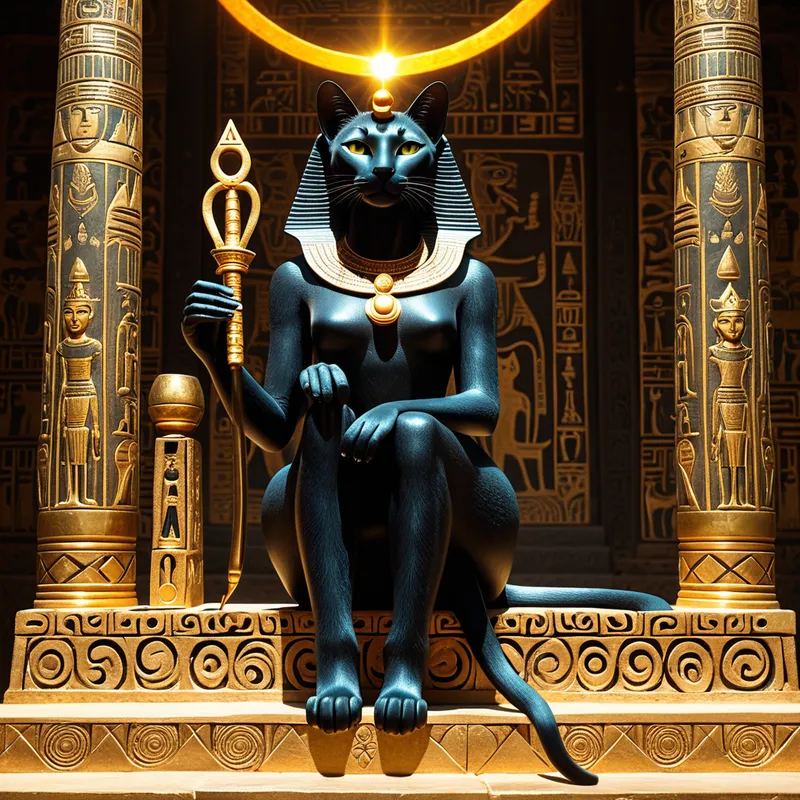
The Goddess Bastet Myth Meaning & Symbolism
A goddess of sun and vengeance transforms into a protector of hearth and home, embodying the alchemy of fierce power into nurturing grace.
The Tale of The Goddess Bastet
Hear now a tale woven from the reeds of the Nile and the sands of time. In the beginning, there was a fire in the sky, and a fire on the earth. The fire in the sky was Ra, whose eye blazed with the fury of noon. And the fire on the earth was his daughter, the Eye of Ra herself. She was a storm of teeth and claws, a desert lioness whose roar shook the mountains. Her name was Sekhmet, and she was the scorching wind, the bringer of plague, the unleashed wrath of her father against those who dared defy the order of Ma’at.
The gods whispered of a time when Ra, grown old and weary of humanity’s rebellion, sent his Eye among them. Sekhmet descended, not as a goddess, but as a slaughter. Her joy was in the hunt, her thirst slaked only by blood. The Nile, it is said, ran red for three days and nights. The other gods watched in horror as the very people they were meant to shepherd were being erased. Ra’s vengeance had become a cancer, consuming all. A great remorse filled him. The fire had to be quenched, but how does one stop a force of nature that is also a part of one’s own soul?
A cunning plan was woven in the halls of the gods. They sent swift messengers to the far southern lands, to the island of Elephantine, where the red earth yielded ochre. There, they commanded the people to grind seven thousand jars of barley and mix it with the red ochre, until it resembled the very blood that soaked the fields. Under the cover of the night’s last hour, they poured this crimson paste across the plains of Dendera, where Sekhmet hunted at dawn.
The lioness goddess, her muzzle stained, her senses drunk on carnage, saw the field glistening in the first light. She believed it to be a great lake of blood, the final work of her rampage. With a roar of triumph, she bent her head and drank. She drank and drank, the fermented barley muddling her senses, weighing down her limbs. The fury that burned in her belly cooled, replaced by a warm, drowsy contentment. The killing light in her eyes softened. The taut muscles of the hunter relaxed. Where once stood a creature of unbridled destruction, now sat a being of serene pleasure. The sharp claws retracted; the fierce snout softened into a delicate muzzle. The lioness had become a cat.
And she was given a new name, a new aspect: Bastet. No longer the Eye of Ra that burns, but the Eye that watches over. She became the lady of Bubastis, where her temple echoed not with screams, but with music and laughter. She was the protector of the hearth, the guardian of women in childbirth, the goddess who danced to the shake of the sistrum. Her festivals were the most joyous in the land, a river of singing, dancing, and celebration flowing to her city. The fire remained, but it was now the warm glow of the hearth, the playful spark in a cat’s eye, the gentle warmth of the sun that nurtures, not destroys.
Cultural Origins & Context
The veneration of Bastet is deeply rooted in the practical and spiritual life of ancient Egypt. Her primary cult center was at Bubastis in the Nile Delta, and her worship spanned millennia, evolving significantly over time. Initially depicted as a lioness, akin to Sekhmet, her iconography softened during the Late Period, when she was almost exclusively shown as a cat or a woman with a cat’s head. This shift mirrors her theological transformation from a national protector-goddess of war to a more personal, domestic deity.
Her myths were not codified in a single, canonical text like a Greek epic, but were woven from ritual texts, hymns, and temple inscriptions. The tale of her pacification was part of the larger “Myth of the Eye of the Sun,” a cycle explaining the dangerous and benevolent aspects of solar power. Her story was told by priests in her temples and enacted during her enormous annual festival, described by the Greek historian Herodotus as a riotous, music-filled pilgrimage where inhibitions were released—a societal pressure valve of immense importance. Functionally, Bastet served as a crucial psychological counterbalance. In a cosmology that also contained the terrifying Sekhmet and the unforgiving desert, Bastet represented the safe interior, the joy of community, the successful taming of chaotic forces into protective, life-affirming ones.
Symbolic Architecture
At its core, the myth of Bastet is a profound allegory for the integration of opposites. She embodies the sacred duality of nature and the psyche: the untamed wild and the cultivated home, destructive rage and nurturing love, the searing sun and the gentle moonlight.
The most dangerous power is not that which is destroyed, but that which is successfully transformed. The lioness does not die; she curls by the fire.
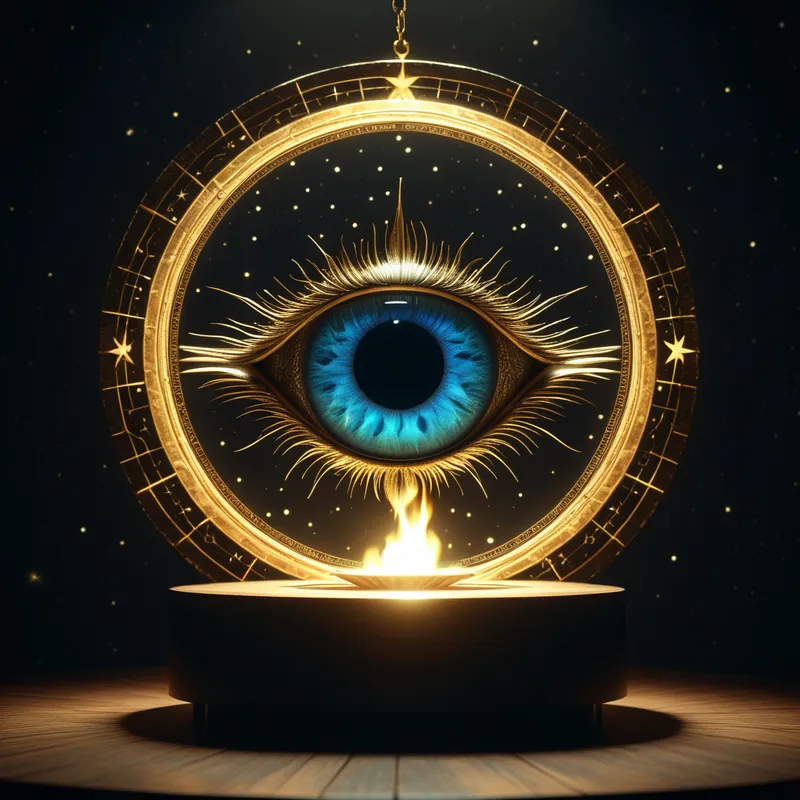
Bastet/Sekhmet represents a single archetypal force—the fierce, protective, feminine power—seen through two different lenses. The cat, an animal both domestic and stealthy, independent yet affectionate, is the perfect symbol for this integrated energy. It can hunt vermin (protect) without burning down the granary (destroy indiscriminately). The ankh she often holds signifies the life her nurturing aspect fosters, while the wedjat eye she sometimes wears is a reminder of her original, all-seeing, retaliatory power. The sistrum, whose sound was said to repel chaotic forces, symbolizes the use of rhythm, art, and celebration to keep darkness at bay—a far cry from meeting violence with greater violence.
The Dreamer’s Resonance
When the archetype of Bastet stirs in the modern unconscious, it often manifests in dreams of cats—especially cats that shift in form or context. To dream of a wild, large cat (a panther, lioness) that becomes approachable, or even transforms into a house cat, signals a profound inner process. Somatically, one might feel a loosening in the jaw or shoulders, a release of long-held tension. Psychologically, this is the pacification of a raw, potentially destructive instinct—perhaps a simmering rage, a capacity for harsh criticism (directed inward or outward), or a hyper-vigilant “fight” response that has outlived its usefulness.
The dream is not about eliminating this power, but about intoxicating it with a new substance: not blood, but the “red beer” of self-awareness, compassion, or creative expression. The dreamer is integrating their inner Sekhmet, learning to channel a fierce, protective energy into a form that guards their psychic hearth—their boundaries, their creativity, their loved ones—without causing unnecessary devastation. It is the move from reactive aggression to empowered, graceful protection.

Alchemical Translation
The journey from Sekhmet to Bastet is a masterclass in psychic alchemy, a roadmap for the modern individuation process. The first stage is recognizing the unintegrated fire. This is the Sekhmet phase: the outbursts of anger, the perfectionism that burns out the self, the defensive aggression that isolates. It is a necessary, if painful, acknowledgment of one’s own potent shadow.
The second, crucial stage is the divine trick, the cunning of the gods. The ego cannot confront this raw power directly; it must be approached with indirect, symbolic means. In our lives, this is the role of therapy, art, ritual, or meditation—the “red ochre and barley.” These practices “intoxicate” the raging inner force, not to destroy it, but to alter its state of consciousness, to show it another way of being.
Individuation is the art of intoxicating your inner destroyer with the wine of awareness, until it chooses to become your guardian.
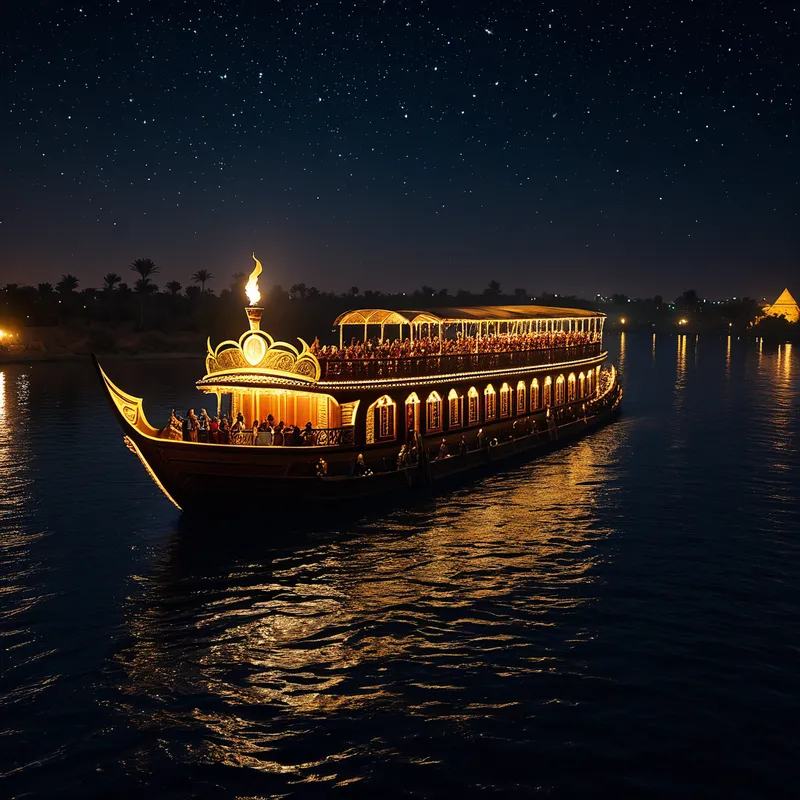
The final stage is integration and celebration—the Bastet phase. The energy that once threatened to consume is now seated calmly within the personal temple. It manifests as the ability to set fierce boundaries with love, to protect one’s time and energy (the hearth), to find joy and pleasure without guilt, and to nurture new life—be it projects, relationships, or aspects of the self—with a confident, watchful grace. The festival barge to Bubastis is the ongoing celebration of this hard-won inner harmony, where the once-separated parts of the self dance together to the sacred, shaking rhythm of a life lived in integrated wholeness.
Associated Symbols
Explore related symbols from the CaleaDream lexicon: