The God Bragi's Hall Myth Meaning & Symbolism
The myth of the hall where the god of poetry serves mead of inspiration, weaving the deeds of gods and heroes into eternal song.
The Tale of The God Bragi’s Hall
Hear now, and listen well, you who dwell in the world of wood and iron. Let your mind travel the shimmering path to Asgard, not to the thunderous halls of the All-Father, nor to the feasting grounds of the slain. Turn your ear instead to a quieter, deeper place, where the air itself hums with a low, resonant string.
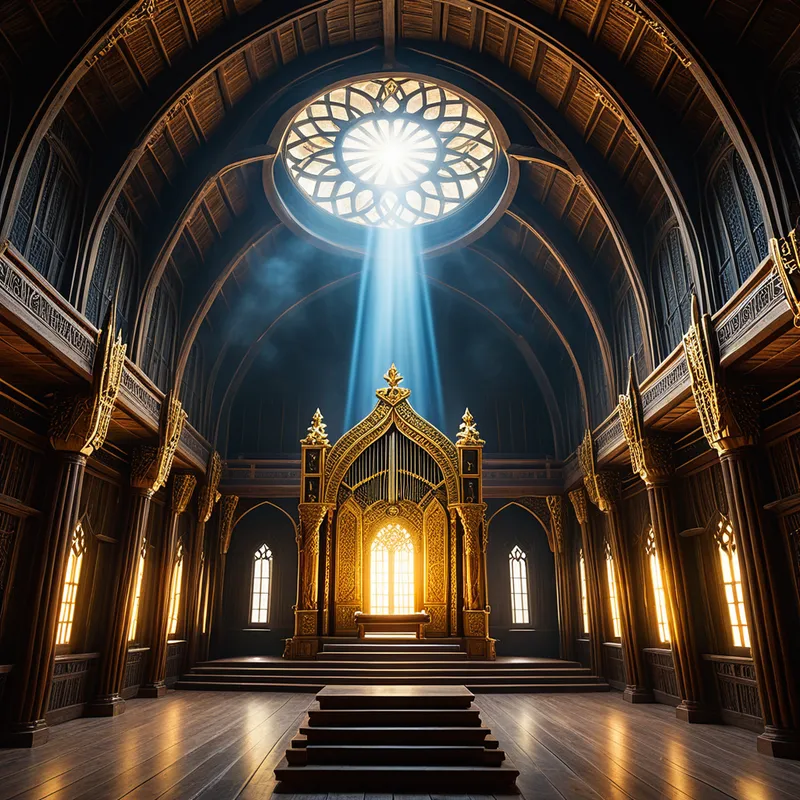
Follow the sound. It leads you to a hall unlike any other. Its walls are not of stone, but of finely polished shields, overlapping like the scales of the Midgard Serpent, catching the eternal twilight in a soft, burnished glow. Its roof is thatched not with straw, but with golden spears, their points turned inward, a forest of silent sentinels. This is Bragi’s Hall.
Within, there is no clamor of battle-play, no boasting of blows struck. A profound silence reigns, a listening silence, thick as mead and just as potent. Upon a high-seat carved from the root of an ancient, unknown tree sits Bragi himself. His beard is long and white as winter frost, but his eyes hold the keen, ageless light of the summer stars. In his hands rests a harp, its wood dark with age, its strings spun from the hair of fate itself.
He does not play for you. Not yet.
Arrayed before him on benches that seem to stretch into infinity are figures cloaked in shadow and light. Here, the shimmering form of a god, there, the solid, grim presence of a hero from ages past. They sit utterly still, their eyes fixed on the empty space before the high-seat. They are waiting. They are remembering.
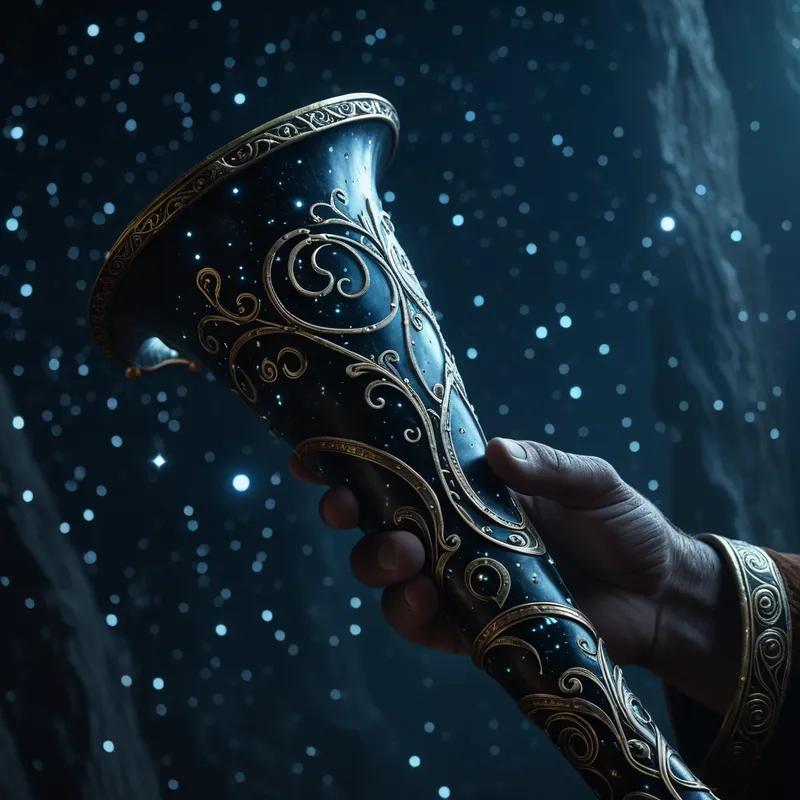
Then, Bragi moves. His fingers, gnarled like old roots, touch the strings. No melody emerges, but a single, pure note—a sound that is the color of deep gold and the taste of honey on the tongue. As the note hangs in the fragrant air (the scent is of aged oak, damp earth, and the ozone before a storm), a servant—silent, graceful—steps forward. In his hands is a drinking horn, not of rough cattle horn, but of something translucent, like polished amber or captured moonlight. It is filled to the brim with a liquid that moves with a life of its own, swirling with faint, glowing symbols.
This is the Mead of Poetry. The servant offers it not to the assembled host, but to the empty space. And as the horn is raised, Bragi begins to speak. But his speech is song, and his song is story. He names a name—perhaps of a god’s deed on a forgotten battlefield, perhaps of a mortal’s act of impossible courage. As the name is sung, the liquid in the horn flares, and a figure from the benches shines, their form becoming clear, their story vivid and whole for a breathtaking moment. The mead is the memory; the song is the soul. The hall thrums with the truth of the tale, and the silent assembly drinks it in, not with their mouths, but with their very beings. This is the endless ritual: the god of poetry serving the mead of memory, weaving the raw deeds of existence into the eternal tapestry of song. To enter this hall is to be seen, to be named, to be remembered. It is the quiet, essential forge where chaos is given form, and action becomes meaning.
Cultural Origins & Context
The figure of Bragi and the conception of his hall are threads woven deeply into the later tapestry of Norse literary culture, primarily preserved in the Poetic Edda and the Prose Edda of Snorri Sturluson. Unlike the myths of Thor or Odin, which have roots in broader Germanic cultic practice, Bragi often feels like a myth about mythology itself. He is the deification of the skaldic art—the complex, kenning-rich poetry performed in the halls of Viking-age chieftains and kings.
His hall was not a destination for the dead, like Valhalla, but a metaphorical and spiritual space for the preservation of the dead—and the living. The societal function was profound: in a pre-literate culture, memory and identity were not recorded in books but in verse. A warrior’s immortality depended not solely on dying with a sword in hand, but on having his deeds skillfully composed into a poem that would be recited for generations. Bragi’s Hall represents the institutionalization of this process on a divine scale. The skald, by channeling the symbolic mead, was performing a sacred act of cultural memory, ensuring the community’s past remained a living, guiding force. The myth legitimized the poet’s role as a crucial social pillar, equal in importance to the warrior and the law-speaker.
Symbolic Architecture
At its core, the myth of Bragi’s Hall is an elaborate symbol for the psyche’s faculty of meaning-making. The hall itself is the ordered, sacred space of consciousness where raw experience is processed.
The unspoken deed is a ghost; the un-sung life is a shadow. Only in the hall of poetry does action become soul, and event become essence.
The silent assembly of gods and heroes represents the totality of a person’s—or a culture’s—experiences and potentials, waiting in the anteroom of the unconscious. They are latent, unintegrated. Bragi, the god of poetry, is the archetypal principle of the narrator, the conscious ego-function that observes, selects, and structures. His harp is the capacity for pattern recognition and emotional resonance. The Mead of Poetry is the intoxicating, transformative fluid of inspiration and insight—the aha moment that lifts a mere sequence of events into a coherent story with emotional truth. The ritual of serving the mead while singing the name is the precise act of psychical integration: to name a experience with the right words, with the right feeling, is to redeem it from the chaos of forgotten time and allow it to take its rightful place in the ongoing story of the self.

The Dreamer’s Resonance
When this myth pattern stirs in the modern dreamscape, it often manifests not as a literal Viking hall, but as an atmosphere. The dreamer may find themselves in a vast, silent library, a grand museum after hours, or a data archive of impossible scale. The feeling is one of hushed awe and profound responsibility. The figures present may be dream versions of people from the dreamer’s past, family members, or even abstract representations of their own talents and neglected actions, all sitting in expectant silence.
The somatic sensation is crucial: a pressure in the chest or throat, a feeling of being full of something that must be expressed. This is the unmetabolized mead of lived experience. The psychological process underway is one of life review and narrative integration. The dream ego is being cast in the role of Bragi—it is being asked to speak for these silent parts, to find the words that will “serve them the mead,” that will acknowledge their existence and value. Failure to do so in the dream leads to a lingering sense of anxiety, of stories left untold and potentials forever waiting in the wings. The hall demands its poet.

Alchemical Translation
The alchemical process mirrored here is solution and coagulation—the dissolving of raw matter into its essential spirit, and its re-forming into a new, perfected substance. The raw matter is the prima materia of a life: the countless actions, failures, triumphs, and mundane moments.
Individuation is the slow, lifelong work of becoming the skald of your own soul, distilling the chaotic brew of experience into the golden mead of personal myth.
First, these experiences are “dissolved” in the silent, reflective waters of the unconscious (the waiting assembly in the hall). Then, through the conscious, creative fire of the ego (Bragi), they are distilled into their essential meaning—the “mead.” Finally, this insight is “coagulated” back into the fabric of the personality as wisdom, as a chapter in one’s own understood narrative. The struggle is the discipline of the process: to sit in the silence, to resist the urge to leave the hall for noisier, more distracting realms, and to take up the harrowing responsibility of the harp. The triumph is the moment of song, when a previously painful or confusing period of life is suddenly seen as a necessary stanza in a greater epic, its meaning clear, its place assured. In this act, the modern individual performs their own seidr (magic), transforming the lead of fleeting time into the gold of eternal story. They do not just live; they author.
Associated Symbols
Explore related symbols from the CaleaDream lexicon: