The Gjallarhorn Myth Meaning & Symbolism
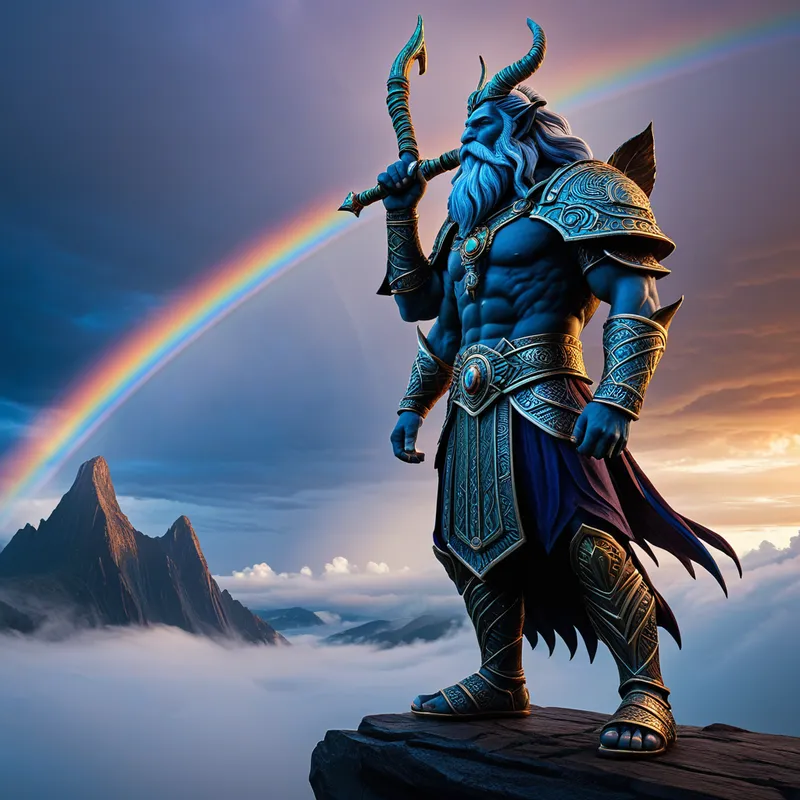
Heimdallr, the watchman of the gods, guards the rainbow bridge and possesses the Gjallarhorn, whose blast will shatter silence and announce the end of all things.
The Tale of The Gjallarhorn
Hear now, and listen well, for the air grows thin and the roots of the Yggdrasil tremble. At the edge of all that is known, where the shimmering road of the gods, Bifröst, meets the swirling mists of possibility, there stands a figure. He is Heimdallr, the whitest of the Aesir, born of nine mothers at the world’s dawn. His eyes see for a hundred leagues, by day or by blackest night. His ears are so keen he can hear the grass growing on the earth and the wool growing on the sheep. He needs less sleep than a bird.
His home is Himinbjörg, the cliff of heaven, a fortress that is not a fortress, a watchtower that is a threshold. Here, he guards. He guards the bridge from the frost-giants’ tread, from any who would cross uninvited into Asgard. But his greatest duty is one of listening—a listening so profound it holds the silence of the worlds in balance.
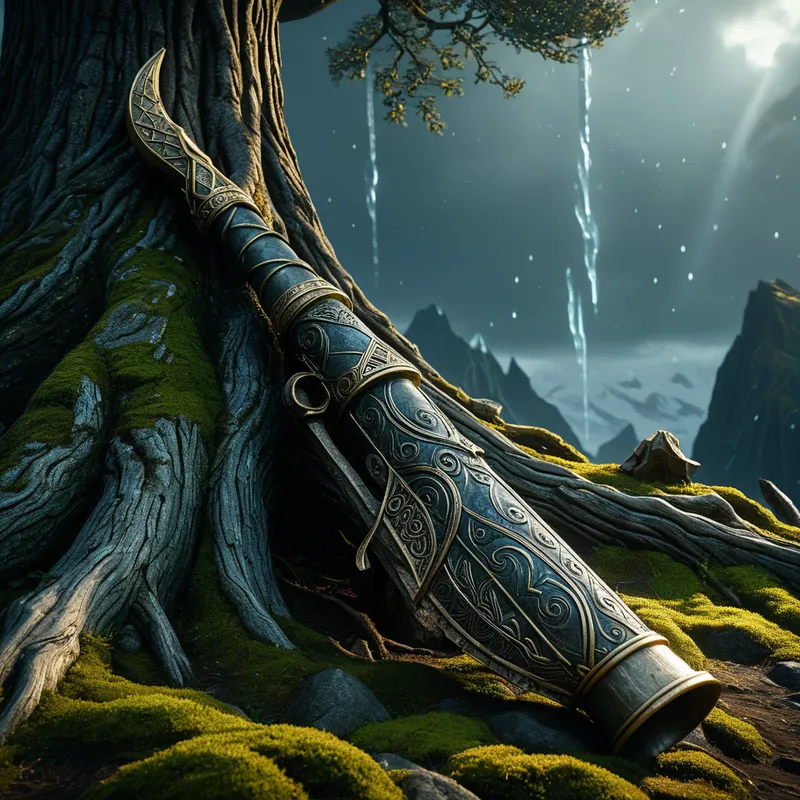
And beside him, sometimes at his hip, sometimes hidden deep beneath the Yggdrasil where the roots drink from the Well of Urd, rests his charge. The Gjallarhorn. It is not a weapon of blade or flame. It is an instrument of pure announcement, forged in a time before time, its bell wide enough to swallow a man’s head, its surface etched with runes that speak of endings and hearings.
The silence is its sheath. For ages, Heimdallr listens to the slow turning of fate at the well, to the whispers of the Norns, to the distant, gathering rumble in Jötunheimr. He hears the serpent Jörmungandr stir in the deep seas. He hears the wolf Fenrir strain at his bonds, his growl a promise of snapped chains. He hears the slow, inevitable decay of all things, the entropy woven into the tapestry.
Then, the moment arrives. Not with a shout, but with a cessation—a final, fateful snap in the web. The bonds break. The armies of chaos begin their march. And Heimdallr, the watcher who has waited for this since his first breath, will raise the Gjallarhorn to his lips. He will draw in a breath drawn from the very winds of the Nine Worlds. And he will blow.
The sound will not be a melody. It will be a fracture. A crack in the sky of reality. It will ring out over all mountains, through all rivers, into every hall and hovel, into the ears of gods and men alike. It is the sound for which all other sounds were merely a rehearsal. It is the call to the final gathering, the alarm that cannot be ignored, the note that begins the symphony of Ragnarök. It is the end of silence, and the beginning of the end.
Cultural Origins & Context
The myth of the Gjallarhorn reaches us primarily through the Poetic Edda, specifically in the Völuspá (The Prophecy of the Seeress) and the Grímnismál. These poems, compiled in the 13th century but containing far older oral traditions, were the preserve of skalds and learned individuals. The horn was not a relic of everyday ritual but a cosmic fixture in the Norse worldview, a narrative device of immense gravity.
In a culture intimately acquainted with harsh winters, sudden raids, and the ever-present threat of chaos (embodied by giants and monsters), the concept of a final, definitive alarm held profound resonance. Norse society was built on vigilance—the watchman on the hill, the sentry by the longship. Heimdallr is this principle elevated to a divine level. The Gjallarhorn myth served a critical societal function: it framed existence within a cycle of order, vigilance, inevitable collapse, and renewal. It taught that even the gods are subject to fate, and that the ultimate duty is to stand one’s post, to be awake and aware until the very last moment. The horn’s blast was the ultimate warning, a concept as practical in defending a homestead as it was in understanding the cosmos.
Symbolic Architecture
The Gjallarhorn is far more than a apocalyptic trumpet. It is a profound symbol of consciousness itself. Heimdallr, with his hyper-acute senses, represents the faculty of awareness—the part of the psyche that watches, listens, and perceives without immediate judgment or action. The horn is the instrument of that awareness, the means by which pure perception is translated into a signal that the entire system must heed.
The Gjallarhorn is the psychic apparatus that transforms silent knowing into a call that demands a response. It is the moment intuition breaks through into conscious realization.
Its location—both with Heimdallr and hidden at the Well of Urd—is key. It connects the vigilant ego (Heimdallr at his post) with the deep, unconscious source of fate and wisdom (the well of the Norns). The horn is the bridge between what the psyche senses in the depths and what it announces to the conscious self. Its sound is disruptive, shattering complacency and the illusion of perpetual peace. Symbolically, it represents any truth so fundamental and urgent that its acknowledgment forces a catastrophic and necessary restructuring of one’s inner world.

The Dreamer’s Resonance
When the motif of the Gjallarhorn sounds in the modern dreamscape, it rarely appears as a literal horn. Its essence manifests as a somatic and psychological event of awakening. The dreamer may experience a sudden, piercing sound that jolts them awake within the dream—a telephone ringing with unnatural urgency, a deafening alarm, a tree cracking in a silent forest. They may dream of being a watchman on a high wall, gripped by the certainty that a crucial moment is approaching.
Psychologically, this signals that a deep, unconscious process has reached a tipping point. The “watchman” function of the psyche—perhaps neglected or overwhelmed—has perceived a fundamental truth: a lifestyle is unsustainable, a relationship is terminally ill, a long-ignored talent demands expression. The “blast” is the internal crisis that can no longer be avoided. The somatic feeling is often one of adrenaline, dread, but also a strange, crystalline clarity. The dream is the sounding of the personal Gjallarhorn, announcing that a personal Ragnarök—a necessary ending—is now inevitable.

Alchemical Translation
The alchemical process mirrored in this myth is the Nigredo—the blackening, the putrefaction, the necessary death of an old state of being. In the journey of individuation, we build structures of identity, relationships, and belief. Over time, these structures can become rigid, imprisoning the self just as the gods’ actions ultimately bind the wolf Fenrir. We ignore the rumblings from our personal Jötunheimr (the shadow).
Heimdallr’s vigil represents the slow, patient cultivation of self-observation. The sounding of the horn is the critical moment when this observing consciousness finally forces a confrontation. It is the psychic “line in the sand.”
The blast of the Gjallarhorn is the ego’s consent to its own dissolution for the sake of a greater truth. It is the courageous act of calling an end to what is, so that what must be can begin.
For the modern individual, this translates not to literal doom, but to the terrifying, liberating decision to end a career, leave a marriage, confront an addiction, or abandon a lifelong persona. It is the internal call to arms that precedes any authentic rebirth. The myth assures us that this function—the watchman and his horn—is sacred. The ending it announces is not a meaningless catastrophe, but a destined phase within a larger cycle of death and renewal. To hear the call of your own Gjallarhorn is to be summoned to your most necessary, and perhaps most formidable, transformation.
Associated Symbols
Explore related symbols from the CaleaDream lexicon: