
The Girdle of Aphrodite: Myth Meaning & Symbolism
The story of a goddess's enchanted belt, embodying the primal, terrifying, and beautiful power of attraction that can sway gods and mortals alike.
The Tale of The Girdle of Aphrodite
Listen, and hear of the weave that could bind the cosmos. In the high halls of Olympus, where ambrosia flows and thunder is but a tool, there existed a power more subtle than Zeus’s bolt, more penetrating than Hades’s gloom. It was the power of Aphrodite, born of sea-foam and star-stuff, and its physical form was her girdle.
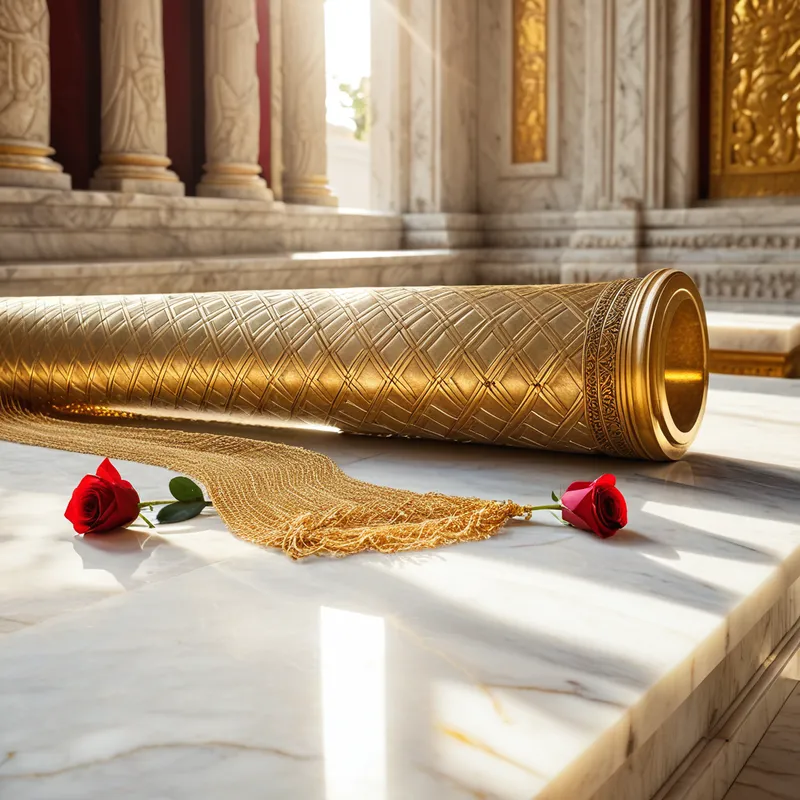
This was no mere adornment. Fashioned by the cunning Hephaestus himself, perhaps, or woven from the very essence of her birth, the girdle was a tapestry of enchantment. Within its golden threads were spun the whisper of the first attraction, the heat of longing, the dizzying promise of union. To wear it was to command the very force that drives the world—not through fear, but through irresistible, beautiful want.
The tale unfolds not in war, but in a moment of divine domestic strife. The great conflict between the Achaeans and Trojans raged below, a puppet show for the gods who took sides like gamblers at a dice game. Zeus, in his capricious wisdom, forbade the Olympians from direct intervention. But his wife, Hera, burned with a desire to see her favored Greeks triumph. She looked upon the battlefield and saw her champion, the mighty Achilles</abrodite, withdrawn in his tent, and the tide turning toward Troy.
A plan, cold and cunning, formed in her mind. Not with force could she sway the war, but with the oldest trick in the cosmos. She descended to Aphrodite’s bower, a place of perpetual spring where the air itself was sweet. “Daughter,” Hera began, her voice honeyed with false purpose. “I journey to the ends of the earth to reconcile a quarrel between the ancient ones, Oceanus and Tethys. For such a sacred mission, I must appear in my most potent form. Lend me, I pray, that girdle of yours, in which are housed all your beguilements.”
Aphrodite, the laughter-loving, did not see the web being woven. Perhaps she was flattered; perhaps the politics of the war bored her. With a smile that could launch a thousand ships, she unfastened the gleaming band from her own waist. “Take it,” she said, the air thickening with the scent of roses as the power transferred. “There is nothing I would deny you.”
Hera clasped the girdle, and a new aura, terrifying in its potency, enveloped her. She was no longer just the stern queen of heaven, but the very embodiment of allure. Next, she visited Hypnos and, with promises and threats, secured his aid. Thus armed, she approached Zeus where he sat upon his golden throne, gazing upon the world.
The effect was instantaneous, catastrophic. The girdle’s magic, wielded by Hera’s fierce will, was a tsunami of charm. Zeus, the cloud-gatherer, the unshakeable, felt the foundations of his being tremble. The world faded; only Hera, radiant and irresistible, filled his vision. He was enveloped in a cloud of desire so profound it blinded him to all else—to his own decrees, to the war below, to the machinations of his wife. In that enchanted union, woven by the girdle’s spell, Hera achieved her goal. Hypnos poured sweet oblivion upon the father of gods, and while he slept, the divine balance of the war was tipped.
And the girdle? It returned to its mistress, to the warm curve of Aphrodite’s hip, a tool once borrowed but whose true home was the source of desire itself. The gods learned anew that day: the mightiest fortress can be undone not by the siege tower, but by the scent of a flower held by the right hand.
Cultural Origins & Context
This myth is preserved primarily in Homer’s Iliad (Book XIV), the foundational epic of ancient Greek culture. It was not a standalone folktale but a pivotal episode within a vast oral tradition, recited by bards (aoidoi) for aristocratic audiences. Its function was multifaceted. On one level, it provided a divine, often humorous, explanation for the twists of the Trojan War, a story every Greek knew. On a deeper level, it explored the hierarchy and personality of the gods, presenting a cosmos where raw power (Zeus) could be momentarily subverted by cunning (Hera) channeling a more primal, chaotic force (Aphrodite’s power).
The girdle, or kestos himas, reflects a society deeply engaged with the concepts of charis (grace, favor) and eros. It objectifies the terrifying, awesome, and socially necessary power of sexual attraction and marital persuasion. In a patriarchal structure, Aphrodite’s domain was a recognized and potent—if often destabilizing—force that even the king of gods could not rationally withstand. The myth acknowledges this power, contains it within the symbol of the girdle, and demonstrates its potent, world-altering use in the hands of a strategic mind.
Symbolic Architecture
The Girdle of Aphrodite is not merely a love charm; it is the symbolic encapsulation of the autonomous, animating force of Desire.
It represents the moment when attraction ceases to be a feeling and becomes a field of reality-altering physics, bending wills and forging destinies not through argument, but through magnetic reconfiguration of the soul.
Psychologically, the girdle symbolizes the persona of allure—the cultivated, worn identity that projects and manages the power of Eros. It is the “spell” one can consciously or unconsciously cast. Yet, as the myth shows, this power can be divorced from its source and wielded by another (Hera) for ulterior ends. This speaks to the danger of the charm becoming a manipulative tool, separating the appearance of love from its authentic source.
The key figures form a dynamic triad: Aphrodite (Source) is the raw, amoral, life-giving force of desire itself. The Girdle (Vessel/Tool) is the conscious articulation and focusing of that force into a wieldable influence. Hera (Wielder) represents the strategic, often patriarchal-adjacent, consciousness that seeks to harness this primal power for goals of order, victory, or control. The myth dramatizes the tension between the wild, generative core of Eros and the civilized, political world’s attempt to harness it.
The Dreamer’s Resonance
To dream of such a girdle—a belt, a sash, a glowing cord—is to encounter a moment of profound personal magnetism or its shadow. The dreamer may be undergoing a process where their own attractiveness, influence, or “personal magic” is in question.
If one finds the girdle, it may signal an awakening to one’s own potent allure or persuasive power, a calling to step into a more charismatic role. If one is asked to lend it, as Aphrodite was, it may reflect a fear of having one’s authentic charm or creative energy co-opted by another—a partner, a employer, a family role—leaving the dreamer feeling depleted and used. To dream of wearing it to deceive, like Hera, points to the use of sexuality, charm, or flattery as a calculated strategy, often masking a deeper feeling of powerlessness or a fear of direct confrontation. The somatic sensation may be one of heat around the waist (the seat of will and generative power) or a feeling of being visually “highlighted” and exposed.

Alchemical Translation
The alchemical journey modeled here is the integration of the anima/animus principle—not as a passive inner figure, but as a wieldable, creative force. The modern individual’s “Trojan War” is their internal and external conflict, their rigidly held positions and conscious decrees (the Zeus principle).
The work is to move from being an unconscious source of sporadic attraction (Aphrodite without strategy) or a cynical wielder of manipulation (Hera without connection to the source), to becoming the conscious artisan of one’s own girdle.
First, one must acknowledge the raw power (Aphrodite’s birth from chaos). This is accepting one’s own capacity for deep desire, beauty, and connection, without shame. Second, one must craft the vessel (Hephaestus’s forge). This is the disciplined work of integrating that raw power into one’s personality—not letting it run wild, but weaving it into one’s character with skill and artistry, creating a “charm” that is authentic and integral. Finally, one must assume sovereign ownership (Aphrodite wearing her own girdle). This is refusing to “lend” one’s core magnetic power to others’ agendas. It is using one’s integrated allure not to deceive or control (Hera’s borrowed magic), but to genuinely connect, create, and attract what is in true alignment with the Self. The triumph is not the seduction of another, but the marriage of one’s deepest desiring nature with one’s conscious will, creating an indissoluble bond where power and authenticity are one.
Associated Symbols
Explore related symbols from the CaleaDream lexicon: