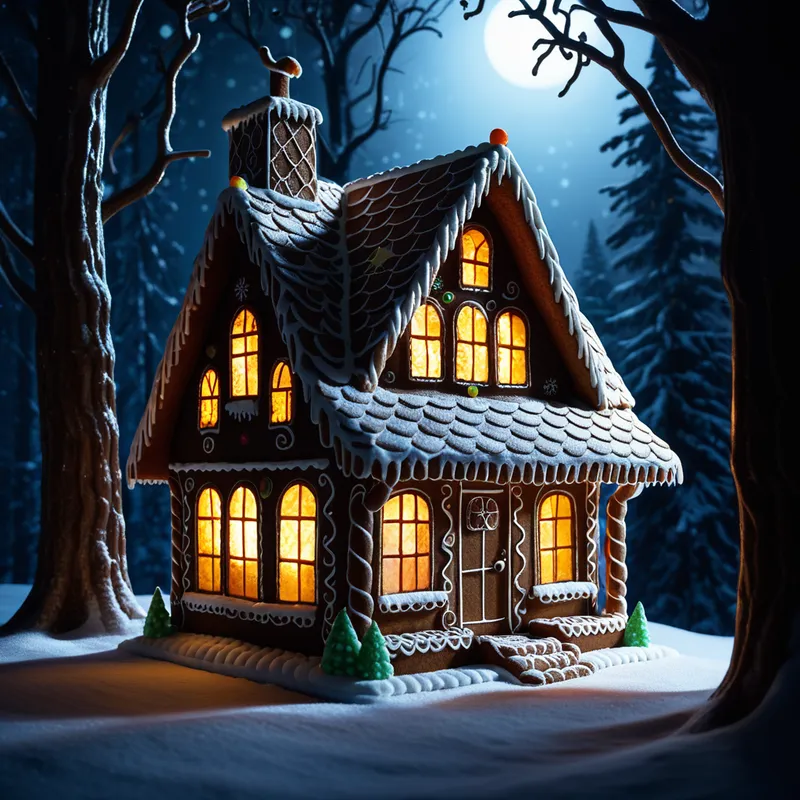
The Gingerbread House Myth Meaning & Symbolism
A tale of two children lured by a confectionary prison, confronting a devouring witch, and finding their way home through cunning and courage.
The Tale of The Gingerbread House
Listen, and let the old trees bear witness. In a time when the woods were deep and [the hearth](/myths/the-hearth “Myth from Norse culture.”/)-fires small, there lived a brother and sister, [Hansel and Gretel](/myths/hansel-and-gretel “Myth from German Folklore culture.”/). Their world was one of want, of a stepmother’s cold whisper and a woodcutter father’s helpless sigh. One evening, the whisper won. The children were led, not to gather kindling, but to be lost. A trail of breadcrumbs, a desperate hope, was scattered and devoured by the patient, feathered mouths of the forest.
Now they were truly alone. The dark closed in, a living [thing](/myths/thing “Myth from Norse culture.”/) of rustling leaves and distant, unknown cries. Hunger, a sharper beast than any wolf, gnawed at their bellies. For three days they wandered, until the scent found them. It was not the scent of mushrooms or berries. It was the smell of a feast-day dream: warm ginger, sweet molasses, vanilla, and sugar spun into air. It pulled them forward, through thorns that now seemed mere inconveniences.
And then they saw it. A cottage, but like no cottage born of timber and stone. Its walls were slabs of dark, spiced gingerbread, studded with plump raisins. Its roof was a thatch of crisp, glazed biscuits. Its windows were clear panels of golden barley-sugar, and its garden path was lined with luminous white peppermints. It was a vision of impossible satiety, a promise made solid. With a cry that was half joy, half desperation, they fell upon it. Hansel broke a piece of the roof; Gretel pried loose a sugar pane. They ate until their fingers were sticky and their mouths burned with sweetness.
The door, made of a giant, iced [gingerbread man](/myths/gingerbread-man “Myth from Folklore culture.”/), creaked open. Out stepped an old woman, leaning on a candy-cane crutch. Her eyes were dim, her smile was wide and gentle. “Poor little lambs,” she cooed, her voice like warm milk. “Come in, come in from the cold. Eat your fill. You are safe now.”
And for a time, it seemed true. They were fed cakes and syrup, tucked into soft beds. But with the dawn, the dream curdled. The kind old woman was a witch, and her house was a larder. Hansel was thrust into a cage of iron, to be fattened. Gretel was made a slave, to serve and to watch. The witch’s blindness was a lie; she saw with a nose that could smell the fear-sweat of childhood. Each day she would hobble to the cage, her bony finger poking Hansel’s arm. “Let me feel if you are plump enough,” she would cackle, her hunger a palpable chill in the sugary air.
The house of delight had become a prison of impending doom. The sugar in the air now smelled of decay. But in the depths of that candy-coated belly, a spark remained. When the witch, impatient, ordered the oven lit for the final baking, it was Gretel, playing [the fool](/myths/the-fool “Myth from Tarot culture.”/), who asked, “But how do I know if it is hot enough?” “Simple, child,” snapped the witch, bending to peer into the fiery maw. And with a strength born of pure survival, Gretel shoved. The door clanged shut on a single, choked shriek.
The silence that followed was immense. The children, trembling, found the witch’s hoard—pearls, gold, jewels that glittered with a cold, real light. They filled their pockets and fled, not eating a single crumb of the house that now stood silent and terrible behind them. This time, they found their way. A white duck carried them across a wide lake, from the shore of enchantment back to the shore of the real. They burst into their father’s cottage. The stepmother was gone, claimed by the same woods. Only love and the hard-won treasure remained, proof of the nightmare they had survived and the cunning they had forged within it.
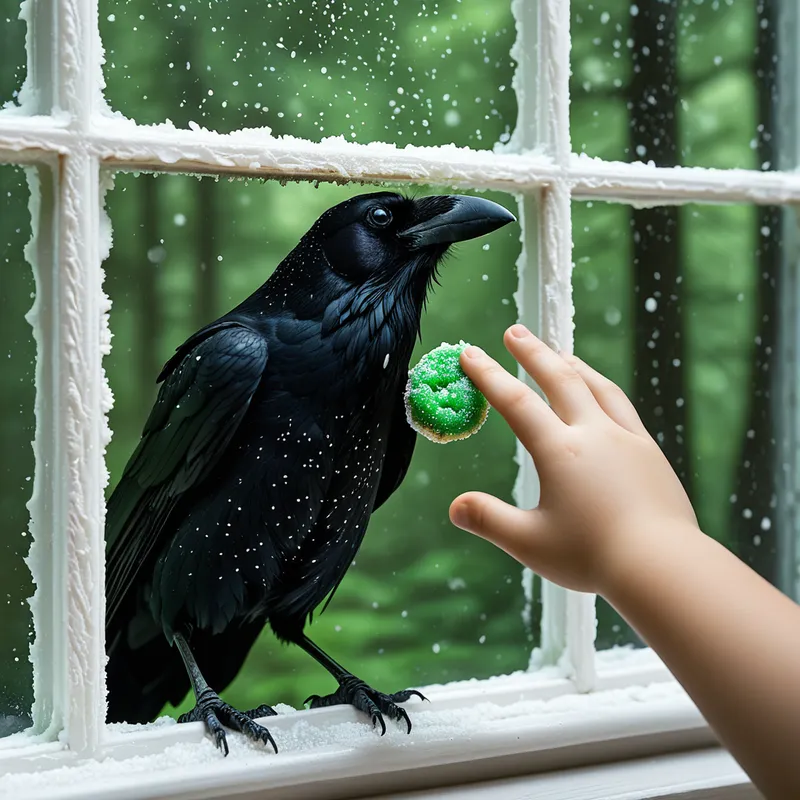
Cultural Origins & Context
This tale, collected by the Brothers Grimm, is a folktale of the deepest European woods. It belongs not to the court or the salon, but to the peasant hearth, told on nights when hunger was a familiar guest and the forest a real, encroaching wilderness. Its function was not merely to entertain, but to initiate. It was a story told by adults to children, a darkly pedagogical map of [the world](/myths/the-world “Myth from Tarot culture.”/)’s dangers.
It encodes very real historical anxieties: the terror of famine (“the great want”), the peril of abandonment in an era of high mortality, and the predatory figures who might lurk at society’s edges. The witch is the ultimate stranger-danger, but also a perversion of the nurturing figure. The story served as a warning about the seduction of the unknown and the necessity of developing street-smarts—or rather, forest-smarts. It taught that not all who offer sweetness are kind, and that the path to maturity requires leaving the literal and symbolic “home” and confronting a world that can be both wondrous and devouring.
Symbolic Architecture
The [Gingerbread House](/symbols/gingerbread-house “Symbol: The gingerbread house symbolizes warmth, imagination, and the sweetness of childhood, often evoking memories of familial bonds during the holiday season.”/) is the myth’s central, paradoxical [symbol](/symbols/symbol “Symbol: A symbol can represent an idea, concept, or belief, serving as a powerful tool for communication and understanding.”/). It is the [Temenos](/myths/temenos “Myth from Greek culture.”/) turned trap.
The greatest temptations are not those that appeal to our vices, but to our deepest, most legitimate needs.
The house represents the regressive pull of the Great [Mother](/symbols/mother “Symbol: The symbol of ‘Mother’ represents nurturing, protection, and the foundational aspect of one’s emotional being, often associated with comfort and unconditional love.”/) [archetype](/symbols/archetype “Symbol: A universal, primordial pattern or prototype in the collective unconscious that shapes human experience, behavior, and creative expression.”/) in its negative, devouring [aspect](/symbols/aspect “Symbol: A distinct feature, quality, or perspective of something, often representing a partial view of a larger whole.”/). It promises unconditional satiation, an end to striving, a return to the [womb](/symbols/womb “Symbol: A symbol of origin, potential, and profound transformation, representing the beginning of life’s journey and the unconscious source of creation.”/) of pure oral gratification. It is the [siren](/symbols/siren “Symbol: The siren symbolizes temptation, danger, and the duality of beauty and peril, often representing alluring yet treacherous situations.”/) song of the unconscious itself when we are lost in a psychological “[forest](/symbols/forest “Symbol: The forest symbolizes a complex domain of the unconscious mind, representing both mystery and potential for personal growth.”/)” of [confusion](/symbols/confusion “Symbol: A state of mental uncertainty or disorientation, often reflecting internal conflict, lack of clarity, or overwhelming choices in waking life.”/) or deprivation—offering easy, addictive answers, be they in substance, ideology, or a [relationship](/symbols/relationship “Symbol: A representation of connections we have with others in our lives, often reflecting our emotional state.”/) that infantilizes.
Hansel and Gretel represent the nascent ego-[consciousness](/symbols/consciousness “Symbol: Consciousness represents the state of awareness and perception, encompassing thoughts, feelings, and experiences.”/), split into complementary parts. Hansel, who initially devises the plan of the breadcrumbs ([logic](/symbols/logic “Symbol: The principle of reasoning and rational thought, often representing order, structure, and intellectual clarity in dreams.”/), foresight), becomes the passive, imprisoned [animus](/symbols/animus “Symbol: In Jungian psychology, the masculine inner personality in a woman’s unconscious, representing logic, action, and spiritual guidance.”/). Gretel, initially following, becomes the active, cunning [anima](/symbols/anima “Symbol: The feminine archetype within the male unconscious, representing soul, creativity, and connection to the inner world.”/) who executes the final, ruthless act of liberation. The [witch](/symbols/witch “Symbol: The image of a witch embodies the archetype of the outlawed or misunderstood, often associated with feminine power, magic, and the unknown.”/) is the [shadow](/symbols/shadow “Symbol: The ‘shadow’ embodies the unconscious, repressed aspects of the self and often represents fears or hidden emotions.”/) of the Mother, the part of the [psyche](/myths/psyche “Myth from Greek culture.”/) that would rather consume our potential than see it grow independent. Her defeat is not a murder, but a necessary act of psychological self-[defense](/symbols/defense “Symbol: A protective mechanism or barrier against perceived threats, representing boundaries, security, and resistance to external or internal challenges.”/)—burning up the devouring complex in the [oven](/symbols/oven “Symbol: The oven symbolizes creation, nurturing, and transformation, often linked to the metaphorical ‘heating up’ of emotions or situations.”/) of confrontation.

The Dreamer’s Resonance
To dream of a [Gingerbread House](/myths/gingerbread-house “Myth from Fairy Tale culture.”/) is to dream at [the crossroads](/myths/the-crossroads “Myth from Celtic culture.”/) of hunger and danger. The dreamer is likely in a state of acute need—emotional, creative, or spiritual—and is being presented with a seductive, too-easy solution.
Somatically, one might awaken with a dry, sweet taste in the mouth or a feeling of sticky claustrophobia. Psychologically, this is the dream of the tempting job that will stifle the soul, the relationship that offers security at the cost of self, or the addictive behavior that numbs a deeper pain. The dream is a warning from the psyche’s own guidance system: This nourishment is poison. This sanctuary is a cage. The figure of the witch may appear not as a hag, but as a charming benefactor, a guru, or a comforting, yet smothering, partner. The dream asks the critical question: What am I being fattened for? What part of me is being lulled into a cage?

Alchemical Translation
The journey of Hansel and Gretel is a perfect allegory for the alchemical process of individuation. They begin in the [nigredo](/myths/nigredo “Myth from Alchemical culture.”/), the blackening: the poverty of their home, the abandonment in the dark forest (the unconscious). The Gingerbread House is the false albedo, a deceptive whitening that promises purity and salvation but is actually a regressive dissolution into instinctual consumption.
The treasure is never found in the candy; it is always discovered in the ashes, after the fire.
Their imprisonment is the necessary mortificatio, the death of their childish innocence and passive hope. Gretel’s act of pushing the witch into the oven is the fierce, transformative [rubedo](/myths/rubedo “Myth from Alchemical culture.”/), the reddening. It is the application of conscious will (fire) to destroy the complex that holds them captive. This is not a act of cruelty, but of sacred violence against the inner tyrant.
The jewels they retrieve are the [lapis philosophorum](/myths/lapis-philosophorum “Myth from Alchemical culture.”/), the philosopher’s stone—the hard, enduring value of their own experience, the psychic gold of earned wisdom and resilience. The final crossing of the [water](/myths/water “Myth from Chinese culture.”/) with the duck’s aid symbolizes reintegration, a return to the conscious world transformed, bearing the treasure of a more complex, capable self. The story teaches that the path to wholeness requires being devoured by an illusion so that we may learn to devour it, in turn, and extract its hidden, lasting nutrient: the unshakeable knowledge of our own capacity to survive, outwit, and return home, changed.
Associated Symbols
Explore related symbols from the CaleaDream lexicon: