The Ger Myth Meaning & Symbolism
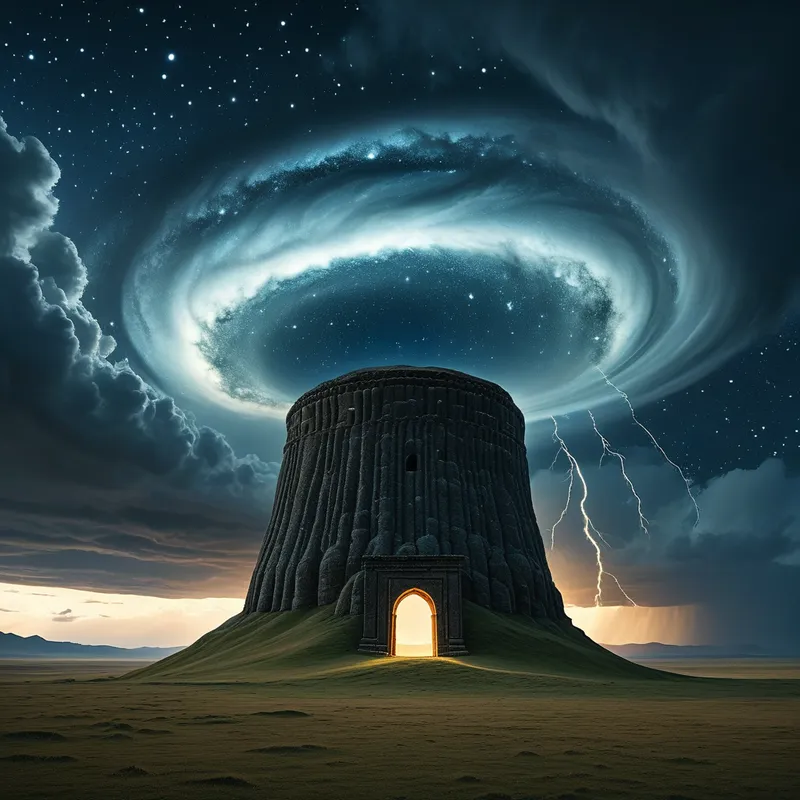
The myth of the first Ger, a celestial dwelling born from cosmic chaos, establishing the sacred center of the world and the blueprint for human belonging.
The Tale of The Ger
In the time before time, when [the sky](/myths/the-sky “Myth from Persian culture.”/) was a restless, roiling membrane of grey and [the earth](/myths/the-earth “Myth from Hindu culture.”/) was a formless plain of whispering grass, there was no inside and no outside. [The wind](/myths/the-wind “Myth from Various culture.”/), Tengri’s breath, roamed unchecked, a cold, relentless force that knew no kindness. The people, children of the blue wolf and the fallow doe, wandered. They carried their world on their backs—skins for warmth, memories for fire—but they had no center. Their souls were as scattered as the dust.
Then, in the deep dream of [the world](/myths/the-world “Myth from Tarot culture.”/), the first shaman, a being whose bones were carved from mountain stone and whose eyes held the stillness of a mountain lake, received a vision. It came not as a voice, but as a shape pressing against the inside of his skull: a circle within a circle, a crown upon a lattice, a convergence. He saw the dome of the sky, Köke Möngke Tengri, not as a distant ceiling, but as a shelter. He saw the curve of the earth, Etügen Eke, not as a mere floor, but as a foundation.
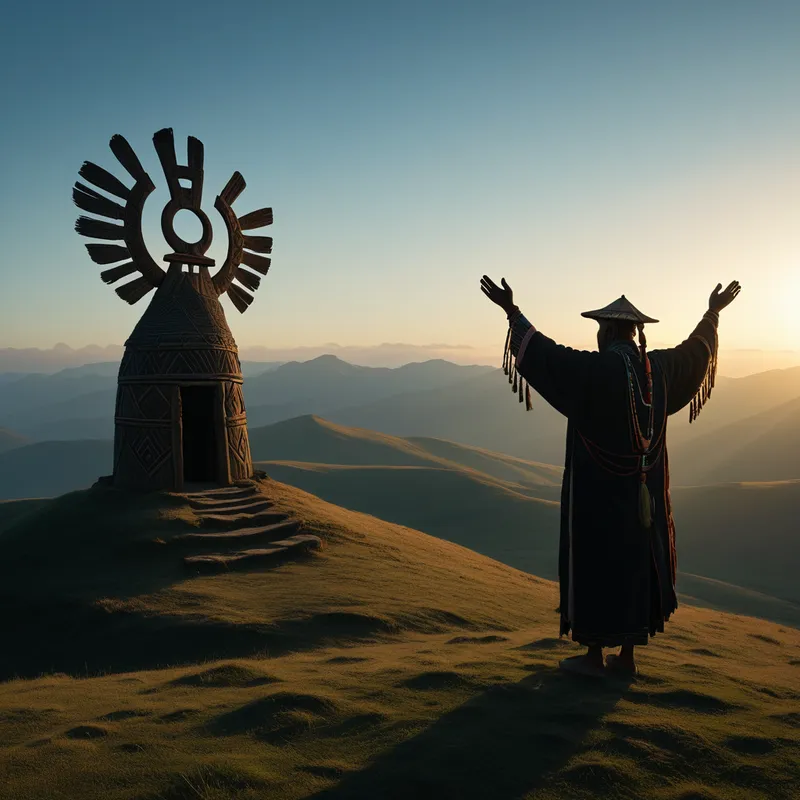
With this knowing burning in his palms, he gathered the people. “We will build a piece of the sky,” he said, his voice the sound of river stones. “We will build a cup for the earth.” From the forest they brought slender poles, the ribs of the sleeping earth. They bent them, not breaking their spirit, and bound them at [the crown](/myths/the-crown “Myth from Various culture.”/) with a wooden wheel, the toono, an eye open to the heavens. Around this skeleton they wove a lattice wall, the khana, a net to catch and hold their shared breath.
Then came the felts, sheared from the sheep that ate the sacred grass, beaten and steamed by the women until they were thick as cloud. Layer upon layer, they dressed the skeleton, tying it with ropes of horsehair, each knot a whispered prayer. Finally, they placed the door, always facing the south, the direction of warmth and growth, a threshold between the known and the unknown.
They lifted the covering over the crown, and as the last rope was secured, a profound silence fell. The ceaseless wind now spoke only as a murmur against the walls. Inside, the air was still, warm, and smelled of earth and wool. In the very center, they built a fire. The first flame leapt up, its light dancing on the curved poles, tracing a miniature cosmos on the felt ceiling. The smoke curled upward, escaping through the toono, carrying their prayers directly to Köke Möngke Tengri.
In that moment, the wandering ceased. They were no longer on the earth; they were of it. They had drawn a sacred circle in the chaos and called it home. The first Ger stood, not as a mere shelter, but as a living universe in miniature, a covenant between the human heart and the wild, wide world.
Cultural Origins & Context
This foundational myth is not a single story preserved in a sacred text, but a living narrative encoded in the very act of building, dwelling, and orienting oneself on the steppe. It is the implicit mythology of Ger life, passed down through generations not by bards, but by mothers arranging the interior, fathers raising the toono, and children learning the unbreakable rules of [the hearth](/myths/the-hearth “Myth from Norse culture.”/).
Its origins are inseparable from Tengrism, the ancient animistic-shamanic worldview of the steppe peoples. In Tengrism, the cosmos is a sacred, interconnected whole. The myth of The Ger provided a tangible, portable model of this cosmos. Its societal function was profound: it was a manual for creating sacred order (Tör) in a landscape that offered none. It taught harmony with the elements, respect for spatial hierarchy (the north for elders and sacred objects, the south for daily life), and the central, unifying principle of the hearth—the family’s spiritual and physical core. To erect a Ger was to perform the creation of the world anew, establishing a microcosm of balance in the macrocosm of the boundless plain.
Symbolic Architecture
The Ger is far more than a [tent](/symbols/tent “Symbol: A tent often symbolizes temporary shelter, transition, and the need for safety.”/); it is a profound symbolic diagram of the integrated [psyche](/myths/psyche “Myth from Greek culture.”/) and the structured [universe](/symbols/universe “Symbol: The universe symbolizes vastness, interconnectedness, and the mysteries of existence beyond the individual self.”/).
The circular [floor](/symbols/floor “Symbol: The floor in dreams often symbolizes the foundation of one’s life or psyche, representing stability, grounding, and the underlying structures of our experiences.”/) represents the eternal, cyclical [nature](/symbols/nature “Symbol: Nature symbolizes growth, connectivity, and the primal forces of existence.”/) of [life](/symbols/life “Symbol: The symbol of ‘Life’ represents a journey of growth, interconnectedness, and existential meaning, encompassing both the joys and challenges that define human experience.”/) and the encompassing [womb](/symbols/womb “Symbol: A symbol of origin, potential, and profound transformation, representing the beginning of life’s journey and the unconscious source of creation.”/) of Etügen Eke. The walls are the [boundary](/symbols/boundary “Symbol: A conceptual or physical limit defining separation, protection, or identity between entities, spaces, or states of being.”/) of [the self](/myths/the-self “Myth from Jungian culture.”/)—flexible, resilient, defining an [interior](/symbols/interior “Symbol: The interior symbolizes one’s inner self, thoughts, and emotions, often reflecting personal growth, vulnerabilities, and secrets.”/) world from the exterior [chaos](/symbols/chaos “Symbol: In Arts & Music, chaos represents raw creative potential, uncontrolled expression, and the breakdown of order to forge new artistic forms.”/). The sloping poles, converging at the toono, are the pathways of aspiration, the [connection](/symbols/connection “Symbol: Connection symbolizes relationships, communication, and bonds among individuals.”/) between the earthly and the divine. The hearth at the exact center is the irreducible core of being, the [source](/symbols/source “Symbol: The origin point of something, often representing beginnings, nourishment, or the fundamental cause behind phenomena.”/) of warmth, light, and sustenance—[the Self](/myths/the-self “Myth from Jungian culture.”/) in Jungian terms.
The Ger does not keep the world out; it draws the cosmos in, organizing infinity into a habitable, heart-centered order.
Every element is dual: the [structure](/symbols/structure “Symbol: Structure in dreams often symbolizes stability, organization, and the framework of one’s life, reflecting how one perceives their environment and personal life.”/) is both supremely portable and eternally stable; it is a profound shelter that remains intimately connected to the sky through its open [crown](/symbols/crown “Symbol: A crown symbolizes authority, power, and achievement, often representing an individual’s aspirations, leadership, or societal role.”/). Psychologically, it represents the achieved state where one carries one’s center, one’s sacred order, within. The [hero’s journey](/symbols/heros-journey “Symbol: A universal narrative pattern representing personal transformation through trials, discovery, and return with wisdom.”/) here is not to slay a [monster](/symbols/monster “Symbol: Monsters in dreams often symbolize fears, anxieties, or challenges that feel overwhelming.”/), but to construct a universe—to build the container strong enough to hold one’s own [spirit](/symbols/spirit “Symbol: Spirit symbolizes the essence of life, vitality, and the spiritual journey of the individual.”/).
The Dreamer’s Resonance
When this myth stirs in the modern unconscious, it often manifests in dreams of searching for or building a sacred space. One might dream of finding a perfect, round room in a chaotic house, of constructing a shelter from a storm with unexpected, elegant materials, or of seeing a familiar, domed structure in a vast, empty landscape.
Such dreams signal a profound somatic and psychological process: the instinct to create inner order amidst outer or inner chaos. The feeling is often one of deep, somatic urgency—a need for containment, for a center that holds. It is the psyche’s blueprint for individuation-in-place, the process of establishing a stable, sacred interiority from which to engage the world. The dream may arise during life transitions, periods of fragmentation, or when one’s sense of “home” or belonging has been shattered. The act of building in the dream is the therapeutic process itself: the slow, deliberate work of weaving together disparate parts of the self (the lattice wall) around a central, vital truth (the hearth).
Alchemical Translation
The alchemical process modeled by The Ger myth is that of coagulatio—the transformation of the volatile and wandering (solve) into the fixed and centered. The raw materials of a life—experiences, relationships, traumas, joys—are the scattered poles and felts on the plain. The alchemical fire is the focused attention and conscious intention of the modern individual, the “shaman-self.”
The first operation is raising the toono, the crown. This is the act of establishing a higher principle or orientation—a connection to something transcendent (be it a creative purpose, a ethical framework, or a spiritual practice). It is the “eye to heaven” that guides the entire structure. Then comes the weaving of the khana, the lattice of the personality. This is the integration of complexes, the binding of contradictions into a flexible, resilient whole. Finally, the laying of the felt covers: the embodiment of this structure in daily habits, relationships, and a chosen environment that protects the delicate inner work.
The ultimate triumph is not in becoming impervious, but in becoming porous in the right way—allowing the smoke of introspection to rise and the light of spirit to descend, while the hearth of the Self burns steadily at the center of it all.
To complete this psychic transmutation is to no longer feel like a wanderer on your own steppe. You carry your Ger within. Chaos may rage at the door, but you have built, from your own essence, a universe that is round, whole, and oriented to the sacred. You have become, at last, both the dweller and the dwelling.
Associated Symbols
Explore related symbols from the CaleaDream lexicon: