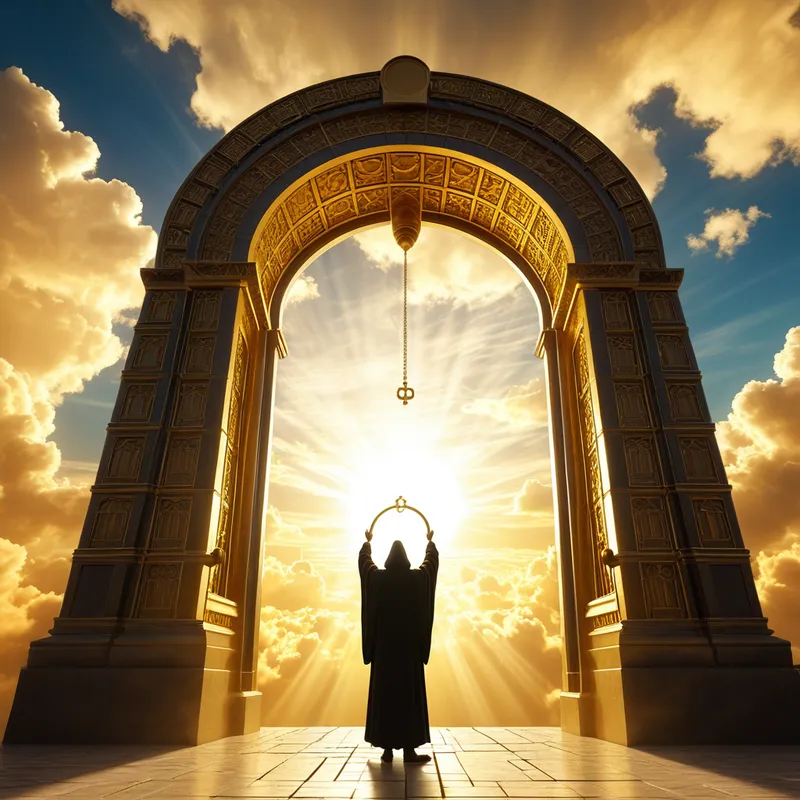
The Gateway to Heaven Myth Meaning & Symbolism
The celestial portal guarded by Saint Peter, a mythic threshold between earthly life and divine eternity, symbolizing judgment, mercy, and final passage.
The Tale of The Gateway to Heaven
Listen, and hear of the final threshold, the last and first of all doors. It stands not in the east or the west, but at the end of the long road of a life. [The sky](/myths/the-sky “Myth from Persian culture.”/) there is not our sky, but a fabric of living light, and the air hums with a silence that is also a song.
After the last breath is drawn and the clay vessel is left behind, the soul travels a path only the dead may walk. It arrives not at a place, but at a Presence. And before that Presence, there stands a Gate. It is described as a single, magnificent [pearl](/myths/pearl “Myth from Chinese culture.”/), wrought not by mortal hands but from the substance of divine tears and celestial promise. Its arch is vast, and through it pours a light that does not blind but reveals, a warmth that does not burn but absolves.
Before this Gate stands its keeper, [Saint Peter](/myths/saint-peter “Myth from Christian culture.”/). In his hand, he holds not a sword, but a heavy ring of keys—keys of iron and keys of gold. His face is etched with the memory of waves and denial, of faith and failure, and in his eyes is the terrible, gentle weight of knowing.
One by one, the travelers approach. The light from the Gateway falls upon them, and in its glow, their lives are not recounted, but unfolded. Every kindness is a note in a chorus; every cruelty, a crack in a vessel. [Peter](/myths/peter “Myth from Biblical culture.”/) consults a ledger, but it is written in a script only the heart can fully decipher. Some he welcomes with a smile that is like a homecoming, and the great Pearl Gate swings open without a sound. For them, the light beyond is a welcoming embrace. Others, he turns away, and the sorrow in his gaze is deeper than any darkness. For them, the Gate remains shut, a beautiful, terrible monument to what was lost.
This is the moment of ultimate consequence. No riches, no titles, no cunning words matter here. Only the truth of a life, weighed in the balance of mercy and [justice](/myths/justice “Myth from Tarot culture.”/). The Gateway does not move, yet it is the axis upon which eternity turns.

Cultural Origins & Context
The image of the [Pearly Gates](/myths/pearly-gates “Myth from Biblical culture.”/) is a powerful folk elaboration within Christian eschatology, rooted in scripture but blossoming in popular imagination. Its primary biblical anchor is the Gospel of Matthew, where [Jesus](/myths/jesus “Myth from Christian culture.”/) tells Peter, “I will give you the keys of the kingdom of heaven.” The description of the [New Jerusalem](/myths/new-jerusalem “Myth from Biblical culture.”/) in Revelation states, “The twelve gates were twelve pearls, each gate made of a single pearl.”
These sparse, potent images were woven into a coherent narrative by early Church Fathers, medieval theologians, and, most enduringly, by preachers, poets, and the laity. It functioned as a vivid, accessible myth for communities where literacy was rare but existential questions were urgent. The tale was told from pulpits to instill moral order, in folk songs to express hope, and in Ars Moriendi (The Art of Dying) manuals to prepare the soul for its final journey. It served a crucial societal function: making the abstract concepts of divine judgment, salvation, and the afterlife tangible and immediate. Peter became the compassionate, yet just, intermediary—a figure familiar enough to inspire hope, and authoritative enough to inspire awe.
Symbolic Architecture
The myth is a masterful symbolic construct addressing the [psyche](/myths/psyche “Myth from Greek culture.”/)’s deepest anxieties and aspirations about finality, worth, and home.
The [Gateway](/symbols/gateway “Symbol: A threshold between states, representing transition, opportunity, or initiation into new phases of life or consciousness.”/) itself is the ultimate [symbol](/symbols/symbol “Symbol: A symbol can represent an idea, concept, or belief, serving as a powerful tool for communication and understanding.”/) of the liminal threshold. It is the final [boundary](/symbols/boundary “Symbol: A conceptual or physical limit defining separation, protection, or identity between entities, spaces, or states of being.”/) between the profane and the sacred, the temporal and the eternal, the fragmented self and the integrated Self. Made of a single [pearl](/symbols/pearl “Symbol: The pearl symbolizes purity, wisdom, and the beauty derived from overcoming adversity.”/), it symbolizes something precious formed through [irritation](/symbols/irritation “Symbol: A state of annoyance or agitation, often signaling unmet needs, unresolved conflicts, or internal disharmony in dreams.”/) and endurance—a perfect whole born from struggle.
The gate is not a barrier to keep us out, but a definition to let us in. It marks the point where the journey of becoming meets the state of being.
Saint Peter with his keys embodies the archetypal Gatekeeper, the function of conscience and discernment amplified to a cosmic scale. The keys represent the power to bind and loose, to acknowledge or reject the narrative a [soul](/symbols/soul “Symbol: The soul represents the essence of a person, encompassing their spirit, identity, and connection to the universe.”/) has lived. Peter’s own [story](/symbols/story “Symbol: The symbol of ‘Story’ represents the narrative woven through our lives, embodying experiences, lessons, and emotions that shape our identities.”/)—of fervent [faith](/symbols/faith “Symbol: A profound trust or belief in something beyond empirical proof, often tied to spiritual conviction or deep-seated confidence in people, ideas, or outcomes.”/), profound denial, and ultimate [redemption](/symbols/redemption “Symbol: A theme in arts and music representing transformation from failure or sin to salvation, often through creative expression or cathartic performance.”/)—makes him the perfect [psychopomp](/myths/psychopomp “Myth from Greek culture.”/) for this [role](/symbols/role “Symbol: The concept of ‘role’ in dreams often reflects one’s identity or how individuals perceive their place within various social structures.”/); he judges not from a place of remote perfection, but from hard-won understanding of [human](/symbols/human “Symbol: The symbol of a human represents individuality, complexity of emotions, and social relationships.”/) frailty and grace.
The [Ledger](/symbols/ledger “Symbol: A symbolic record of accounts, debts, and balances, representing life’s moral, emotional, and transactional reckonings.”/) or Book of [Life](/symbols/life “Symbol: The symbol of ‘Life’ represents a journey of growth, interconnectedness, and existential meaning, encompassing both the joys and challenges that define human experience.”/) is the externalized symbol of the life review, the psyche’s own terrifying and liberating [capacity](/symbols/capacity “Symbol: A measure of one’s potential, limits, or ability to contain, process, or achieve something, often reflecting self-assessment or external demands.”/) for total self-assessment. It represents the undeniable record of one’s actions and intentions, the [shadow](/symbols/shadow “Symbol: The ‘shadow’ embodies the unconscious, repressed aspects of the self and often represents fears or hidden emotions.”/) and the light made manifest.
The Dreamer’s Resonance
When this myth surfaces in modern dreams, it rarely appears as a literal pearl gate. Instead, the dreamer encounters its symbolic architecture: an impassable bridge, a heavily guarded door in a familiar house, a final exam for a class they never attended, or a judgment before a council of vague but authoritative figures.
These dreams often occur during life transitions—career changes, the end of relationships, or existential crises—where one’s identity and life path feel “under judgment.” The somatic experience is one of profound anxiety, a tightening in the chest, a feeling of being scrutinized. Psychologically, this is [the ego](/myths/the-ego “Myth from Jungian culture.”/) standing before the tribunal of the Self. The dream asks: Does the life you are living align with your deepest, truest nature? What have you neglected or denied? The “judgment” is not a punishment from an external god, but the psyche’s own urgent call for accountability and integration before one can pass into a new stage of wholeness.

Alchemical Translation
The alchemical process mirrored here is the [separatio](/myths/separatio “Myth from Alchemical culture.”/) and coniunctio on a grand scale—the final purification and union. The journey to the Gateway is the culmination of the individuation process.
First, the [Nigredo](/myths/nigredo “Myth from Alchemical culture.”/): The dissolution of the earthly identity (death). All personas, attachments, and worldly achievements are stripped away, leaving the raw essence of the soul.
Second, the Albedo: The confrontation at the gate. The light of consciousness (the Gate’s radiance) illuminates the entirety of the psyche—the gold and the dross, the saint and the sinner. Peter’s judgment represents the necessary, often painful, discernment where one must own all aspects of [the self](/myths/the-self “Myth from Jungian culture.”/).
The key that opens the gate is not a record of flawless victory, but the courage to have the record read in full, in the blinding light of truth.
Finally, the [Rubedo](/myths/rubedo “Myth from Alchemical culture.”/): Passage through the Gate. This is the ultimate coniunctio, the marriage of the purified individual soul with the divine ground of being, the Self. The single pearl gate signifies the achievement of psychic wholeness—a state where contradictions are held in a unified, luminous form. For the modern individual, the myth does not point to a literal afterlife, but to the psychological goal of living in such integrated authenticity that when the end comes, there is no shadow left to fear, only a threshold to cross into the completion one has spent a lifetime forging. The struggle is to live a life that, in its essence, becomes its own key.
Associated Symbols
Explore related symbols from the CaleaDream lexicon: