The Gardener Myth Meaning & Symbolism
A myth of mistaken identity at an empty tomb, where profound grief is transformed by a single, intimate recognition.
The Tale of The Gardener
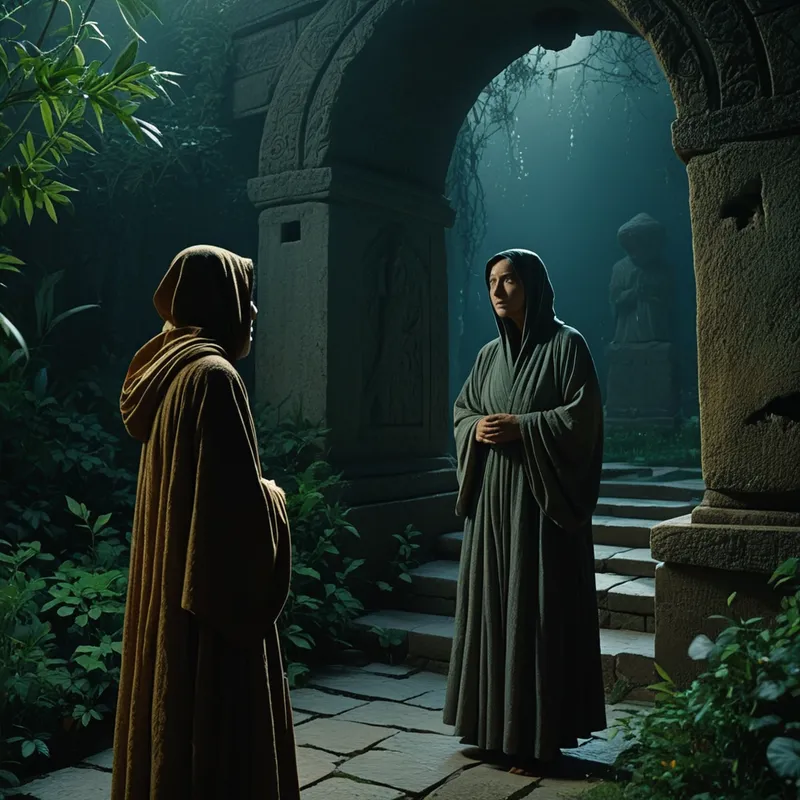
Before the sun had claimed [the sky](/myths/the-sky “Myth from Persian culture.”/), in the hour when [the world](/myths/the-world “Myth from Tarot culture.”/) is held in a breath of grey and silver, she went to the tomb. The air was cold, tasting of dew and crushed myrrh. Her heart was a stone heavier than the one she feared she would find sealing [the cave](/myths/the-cave “Myth from Platonic culture.”/)’s mouth. The world had ended three days prior, and she moved through its corpse, a ghost among ghosts.
But the stone was rolled aside. A gaping, dark mouth in the limestone hill. The careful rituals of grief shattered before they could even begin. She ran, a cry torn from her throat, bringing the men who came, saw the empty linen, and left in bewildered silence. She remained. Alone. The tears came then, a flood she had thought spent. She bent to look again into the shadows, and through the [water](/myths/water “Myth from Chinese culture.”/) in her eyes, she saw two figures seated where the body had been, luminous and still.
“Woman, why are you weeping?”
“They have taken my Lord,” she sobbed, “and I do not know where they have laid him.”
Turning, blinded by grief, she saw another figure standing among the olive trees. The low dawn light cast his face in shadow. The curve of a shoulder, the stance of a man waiting. The gardener, she thought. Of course. The keeper of this place of death. He must have seen.
“Woman, why are you weeping? Whom are you seeking?”
Her voice broke. “Sir, if you have carried him away, tell me where you have laid him, and I will take him away.” Please, just let me complete my duty. Let me anoint the beloved dead.
Then he spoke a single word. Not a title, not a doctrine. A name. Her name. Spoken as only one voice in all creation had ever spoken it—a sound that carved through the fog of despair, that resonated in the marrow of her being.
“Mary.”
The world tilted. The grey dawn ignited. The gardener’s form, the ordinary posture, the assumed role—it all fell away like a discarded veil. The recognition was not visual; it was a seismic shift in the soul. The one she sought as a corpse was speaking her name as a living breath.
“Rabboni!” My Teacher.
He was there. Not as a phantom, not as a memory, but there. Alive. The command that followed was gentle, yet it carried the weight of a new cosmos: “Do not cling to me.” Do not hold the living as you would the dead. Do not confine this new reality to the old gestures of loss. Go. Tell.
And she went. The woman who came bearing spices for a corpse became the first [herald](/myths/herald “Myth from Greek culture.”/) of a mystery that would echo through ages. “I have seen the Lord,” she said, and in her saying, the world began again.

Cultural Origins & Context
This story is found in the twentieth chapter of the Gospel according to John, a text composed in the latter half of the first century. It emerges from a community grappling with the cataclysmic event of [Jesus](/myths/jesus “Myth from Christian culture.”/)‘s execution and the perplexing, transformative reports of his continued presence.
Unlike the synoptic gospels, John’s narrative is deeply theological and symbolic, often structuring events as “signs” pointing to deeper truths. The account of [Mary Magdalene](/myths/mary-magdalene “Myth from Christian culture.”/) at the tomb is its poignant, human core. It was not a story for grand public pronouncement initially, but one that circulated within early communities, affirming the reality of [the resurrection](/myths/the-resurrection “Myth from Christian culture.”/) not as a abstract dogma, but as an intimate, personal encounter. It served a critical function: validating the testimony of women in a patriarchal culture, and modeling the transition from a physical, localized understanding of the teacher to a new, spiritual relationship with the living Christ. The “Gardener” is a moment of profound narrative irony, where the truth is hidden in plain sight, accessible only through the lens of personal love and recognition.
Symbolic Architecture
The Gardener is one of the most potent symbols of the unrecognized sacred. He represents the divine [presence](/symbols/presence “Symbol: Presence in dreams often signifies awareness or acknowledgment of something significant in one’s life.”/) that meets us not in expected glory, but in the humble, everyday vestments of our immediate [reality](/symbols/reality “Symbol: Reality signifies the state of existence and perception, often reflecting one’s understanding of truth and life experiences.”/). He is the answer that is already present, waiting to be perceived within the very [landscape](/symbols/landscape “Symbol: Landscapes in dreams are powerful symbols representing the dreamer’s emotional state, personal journey, and the broader context of life situations.”/) of our [grief](/symbols/grief “Symbol: A profound emotional response to loss, often manifesting as deep sorrow, yearning, and a sense of emptiness.”/).
The ultimate revelation often comes disguised as the most ordinary thing, waiting for the heart to speak its true name.
[The empty tomb](/myths/the-empty-tomb “Myth from Christian culture.”/) is not a proof, but a void. It represents the collapse of known meaning, the point where all previous understandings and rituals fail. Mary’s insistence on finding a [corpse](/symbols/corpse “Symbol: A corpse symbolizes death, the end of a cycle, and often implies the need for transformation and renewal.”/) shows her clinging to the past form of her [relationship](/symbols/relationship “Symbol: A representation of connections we have with others in our lives, often reflecting our emotional state.”/). The Gardener appears at this precise threshold of [despair](/symbols/despair “Symbol: A profound emotional state of hopelessness and loss, often signaling a need for transformation or surrender to deeper truths.”/) and [emptiness](/symbols/emptiness “Symbol: Emptiness signifies a profound sense of void or lack in one’s life, often related to existential fears, loss, or spiritual quest.”/). His question, “Whom are you seeking?” is the central question of the spiritual and psychological [quest](/symbols/quest “Symbol: A quest symbolizes a journey or search for purpose, fulfillment, or knowledge, often representing life’s challenges and adventures.”/). We often seek a [memory](/symbols/memory “Symbol: Memory symbolizes the past, lessons learned, and the narratives we construct about our identities.”/), a lost ideal, a dead god, or a finished [story](/symbols/story “Symbol: The symbol of ‘Story’ represents the narrative woven through our lives, embodying experiences, lessons, and emotions that shape our identities.”/). The Gardener redirects the search from a what to a who, and ultimately, back to the [seeker](/symbols/seeker “Symbol: A person actively searching for meaning, truth, or a higher purpose, often representing the dreamer’s own quest for identity or fulfillment.”/) herself through the calling of her name.
The recognition scene is the myth’s alchemical fire. It is not an intellectual deduction but a transformative [event](/symbols/event “Symbol: An event within dreams often signifies significant life changes, transitions, or emotional milestones.”/) of the [heart](/symbols/heart “Symbol: The heart symbolizes love, emotion, and the core of one’s existence, representing deep connections with others and self.”/). “Rabboni!” is the cry of the [soul](/symbols/soul “Symbol: The soul represents the essence of a person, encompassing their spirit, identity, and connection to the universe.”/) when the fragmented world suddenly coheres around a living center. The command “Do not cling to me” is the essential next step: the new [life](/symbols/life “Symbol: The symbol of ‘Life’ represents a journey of growth, interconnectedness, and existential meaning, encompassing both the joys and challenges that define human experience.”/) must not be fossilized by the old patterns of possession and attachment. It must be released into [motion](/symbols/motion “Symbol: Represents change, progress, or the flow of life energy. Often signifies transition, personal growth, or the passage of time.”/), into witness, into the [community](/symbols/community “Symbol: Community in dreams symbolizes connection, support, and the need for belonging.”/) of the living.
The Dreamer’s Resonance
When this myth stirs in the modern dreamer, it often manifests as a profound experience of misrecognition. You may dream of a beloved person—a parent, a partner, a lost friend—who appears but does not acknowledge you, or who you fail to recognize until they speak or turn in a certain light. They may be performing an ordinary task in a significant place. The somatic feeling is one of aching frustration melting into overwhelming, tearful relief.
This dream pattern signals a [psyche](/myths/psyche “Myth from Greek culture.”/) working through a process of reorientation. The “tomb” is a state of psychological death: the end of a relationship, a career, an identity, a deeply held belief. You are in mourning for a version of your life or your self that has ended. The dream presents the “Gardener”—a part of your own deeper Self, the Self archetype, or an aspect of the animus/anima—disguised in the humble clothes of daily life. The moment of recognition is [the ego](/myths/the-ego “Myth from Jungian culture.”/)’s surrender to a truth it had refused because it did not fit the old narrative. It is the healing insight that arises not from frantic searching “out there,” but from a call that comes from within the situation of loss itself. The dream is an invitation to stop clinging to the corpse of the past and to turn toward the living, though unfamiliar, future.

Alchemical Translation
The myth of the Gardener is a perfect map for the individuation process, specifically the stage of enantiodromia—where something transforms into its opposite. Here, death becomes the ground for a new kind of life; despair becomes the precondition for a more profound joy.
The first alchemical operation is mortificatio, represented by the crucifixion and [the sealed tomb](/myths/the-sealed-tomb “Myth from Christian culture.”/). All is blackness, dissolution, and putrefaction. The known “gold” of one’s life (the relationship with the teacher, the old identity) is slain. Mary at dawn embodies the [nigredo](/myths/nigredo “Myth from Alchemical culture.”/), the black sun of the soul, consumed by grief and performing a futile ritual.
The appearance of the Gardener initiates the albedo, the whitening. He is the lapis, the philosopher’s stone, hidden in the common earth. But the transformation is not automatic. It requires the [separatio](/myths/separatio “Myth from Alchemical culture.”/)—the separation of the living spirit from the dead form. Mary’s tears, her willingness to engage even with the supposed gardener, are the [solutio](/myths/solutio “Myth from Alchemical culture.”/), the dissolving of rigid ego defenses. The calling of her name is the coniunctio, [the sacred marriage](/myths/the-sacred-marriage “Myth from Various culture.”/) of the seeking soul and the found spirit.
The psyche’s resurrection begins not with an answer from the heavens, but with your name spoken in the garden of your deepest grief.
The final instruction, “Do not cling… go and tell,” is the [rubedo](/myths/rubedo “Myth from Alchemical culture.”/), the reddening, the return of the transformed substance to the world. The insight, the healing, the new consciousness is not for private hoarding. It must be integrated and expressed. The individual, having touched the core of their own reality, becomes a vessel for a message that transcends them. The myth thus charts the full arc: from the death of the literal and historical, through the intimate, personal encounter with the numinous in the ordinary, to the birth of a witnessing consciousness that carries the living mystery forward. The Gardener tends not just to plants, but to the soul’s capacity to see life where it once saw only loss.
Associated Symbols
Explore related symbols from the CaleaDream lexicon: