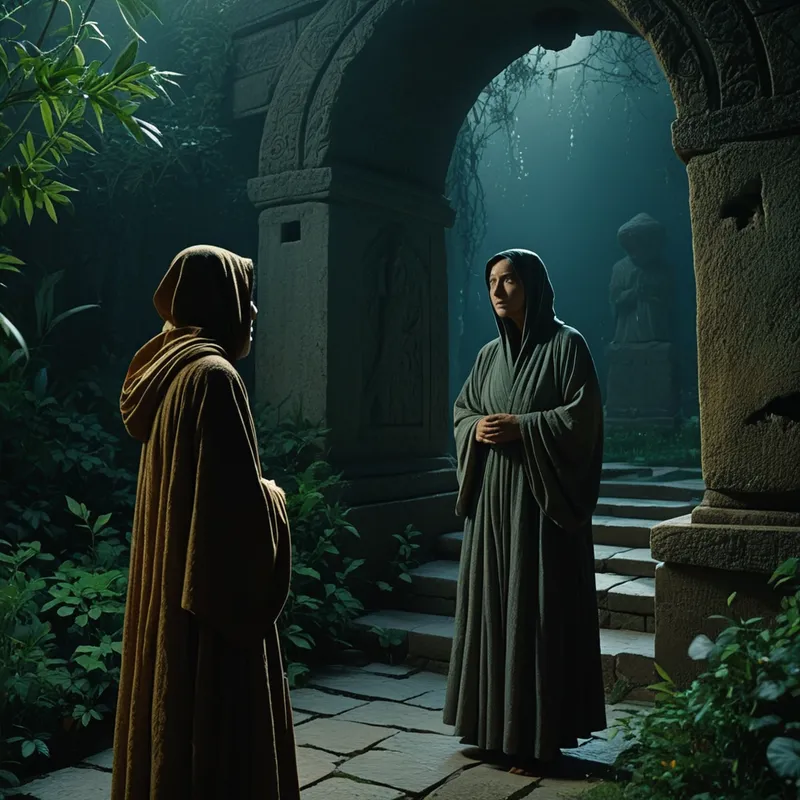
The Dream of Recognition: A Summons from the Unseen Self
The Somatic Echo
Before the mind can parse the image, the body knows. It is a peculiar, hollow pull in the solar plexus—not fear, but a resonant absence. A vibration of something missing, like a phantom limb of the spirit. It’s the feeling of standing in a crowded room where every gaze slides past you, yet your own skin feels electric, broadcasting a signal on a frequency no one else receives. This is the somatic prelude to the dream of Recognition: a deep, cellular longing for a specific kind of witness. It is the ache of a truth that has not yet found its mirror, a part of you that has been living in exile, waiting for the internal embassy to send its credentials.
The Dreamer's Log
In the dream, I am walking through a vast, abandoned archive of forgotten things. The air is thick with dust and the hum of dormant machines. I am not searching for anything in particular, but my feet carry me to a terminal, its screen flickering with static. I type a command I don’t consciously know. A single file appears, labeled with my childhood nickname—a name no one has spoken in decades. As I open it, a wave of warmth, profound and devastating, floods my chest, and I wake with tears on my cheeks, whispering, “Oh. There you are.”
This is not a dream of public acclaim, but the alchemical moment when the conscious ego finally authenticates the login credentials of a long-dormant, essential part of the soul.

The False Lead
Do not mistake this for a simple wish-fulfillment fantasy of fame or validation from others. That is its cheap imitation, its shadow. The dream of Recognition is not about the crowd chanting your name; it is about you hearing your own true name spoken from within the silence. It is not about being seen for your achievements, but about being met in your essence. The terror here is not of obscurity, but of a fundamental disconnection from the core self—a life lived in a psychic witness protection program where even you do not know your own identity.
Psychological Architecture
The architecture of this dream is built on the fault line between the persona—the mask you wear to navigate the world—and the shadow, the vast internal populace you have disowned. Recognition is the process of Shadow Work made visceral. It is the moment a feeling, a memory, a capacity, or a wound that has been operating autonomously in the dark is suddenly illuminated by the light of conscious awareness. This is not a passive observation; it is an active, often destabilizing, act of re-membering. You are literally putting the fragmented self back together.
Think of your psyche as an internal family system. The dream of Recognition is when the internal “Manager” parts, who run the daily operations of your life, finally pause their busywork and turn toward a crying child part locked in a basement room. Or when the “Firefighter” part, who numbs pain with distraction, is seen not as a problem to be solved, but as a loyal, desperate protector. The grief that often accompanies these dreams is the grief of neglect—the profound sorrow of realizing how long this essential aspect of you has been waiting, unheard, in the wings of your own life.
Mythic Resonance
This is the universal human firmware of the Return. In the Odyssey, after twenty years of war and wandering, Odysseus arrives home to Ithaca. But his journey is not complete upon setting foot on shore. He is in rags, unrecognized in his own kingdom. The final, most profound test is not a battle with monsters, but a scene of Recognition. His old nurse, Eurycleia, washes his feet and sees the scar from the boar’s tusk—a mark known only to her. In that silent, private moment, the hero is not recognized as a king by his crown, but as a man by his wound. The myth tells us that true homecoming requires being seen in our entirety, scars and all, by one who knows our hidden history.
Symbolic Nodes
- Mirrors that reflect a different face: The shock of the familiar made strange, or the strange made familiar.
- Being called by an old, forgotten name: A direct signal from a prior version of the self.
- Finding a lost object (key, locket, book) that holds profound personal meaning: The psyche presenting the token needed for re-entry.
- A familiar person in the dream who does not recognize you (or vice versa): The alienation of the self from a part of its own experience.
- Receiving a message (letter, email, transmission) meant specifically for you: The unconscious sending its communiqué to consciousness.
Archetypal Resonance
The energy here is most purely that of The Orphan Archetype. Not in its shadow state of Victim or Self-Pity, but in its essential, grounded form: the Realist and the Survivor. The Orphan’s core journey is toward authentic connection and belonging. The somatic echo of hollowness is the Orphan’s feeling of being adrift. The dream itself is the Orphan’s moment of truth—the realization that the belonging you seek must first be forged within, by recognizing and welcoming the exiled parts of yourself. The alchemical potential lies in the Orphan’s profound strength: having touched the reality of alienation, it can build a true, integrated home in the psyche that is based on genuine self-knowledge, not borrowed identity. This Recognition is the foundation of that home.
The Alchemical Process
The alchemical transmutation for Recognition is Authentication. The base material is the leaden, confused identity—the feeling of being a collection of masks without a core. The intense heat and pressure required is the courageous, sustained attention you must apply to the very parts of yourself you have been trained to ignore or despise. This is the nigredo, the blackening: the despair of feeling fundamentally unknown, even to yourself.
The process begins when you stop projecting the need for recognition outward onto the world and turn the searchlight inward. You must sit in the silent, dusty archive of your own soul and run the query. You must open the file labeled with the old shame, the abandoned joy, the unexpressed rage. The fire is the emotional charge—the tears, the warmth, the shock—that accompanies this opening. It melts the rigid structures of the persona. The silver that emerges is not a new identity, but a verified one. It is the conscious, compassionate acknowledgment: “This too is me.” The gold is the profound sovereignty that comes from no longer being a stranger in your own life. You become the sole, legitimate authority of your own experience.

The Integration Protocol
Question 1: In the dream, what or who was being recognized? Was it a part of you, a memory, a feeling, or a potential? Describe it not as an idea, but as a living entity with its own presence.
Question 2: How have you, in your waking life, been refusing to recognize this same element? What fear or old rule has mandated its exile?
Question 3: If this newly recognized aspect were to take a permanent, welcomed seat at the table of your psyche, what one quality would it contribute to your daily life?
Action 1 (The Silent Naming): For one day, practice internal recognition. Each time a feeling arises—anxiety, joy, irritation, longing—silently acknowledge it by name as a part of you. "I see the part that feels anxious." Do not analyze or change it. Simply authenticate its presence.
Action 2 (The Exile's Portrait): Engage in unstructured, creative expression. Using any medium (drawing, clay, digital collage, free writing), create a portrait or artifact for the part of you that was recognized in the dream. Do not aim for art; aim for representation. Let the shape, color, or words emerge from the feeling of the dream itself.
Action 3 (The Credential Ritual): Craft a simple, physical token of recognition. Find a small stone, a ring, a specific pen. Hold it and state clearly, either aloud or in writing, that this object now symbolizes your commitment to recognizing your whole self. Carry it or place it where you will see it, not as a magic charm, but as a tangible anchor to the internal agreement you have made.
Final Validation
The ache for true Recognition is one of the most profound and disorienting lonelinesses a human can experience, for it is a loneliness within one's own being. To feel this is not a sign of brokenness, but a testament to your depth. It means there are vast, rich continents within you that are still uncharted by the light of your own awareness. This dream is not a sentence to isolation; it is a summons. It is your psyche’s most urgent invitation to turn toward yourself with the curiosity, courage, and reverence you might offer a mysterious and long-lost friend. The integration is the end of the civil war within. You are not becoming someone new. You are, at last, coming home to the someone who has always been there, waiting in the quiet dark, to be seen.