The Garden of Truth Sanai Myth Meaning & Symbolism
A mystical allegory of the soul's perilous journey through the gardens of illusion to the barren, luminous ground of ultimate reality and divine truth.
The Tale of The Garden of Truth Sanai
Listen, and let the veil be drawn aside. There was a seeker, a soul parched with longing, who heard a whisper on the wind of a place called The Garden of Truth. It was said to lie beyond the seven valleys, past the mountains of longing, in a realm where the Beloved walked unveiled.
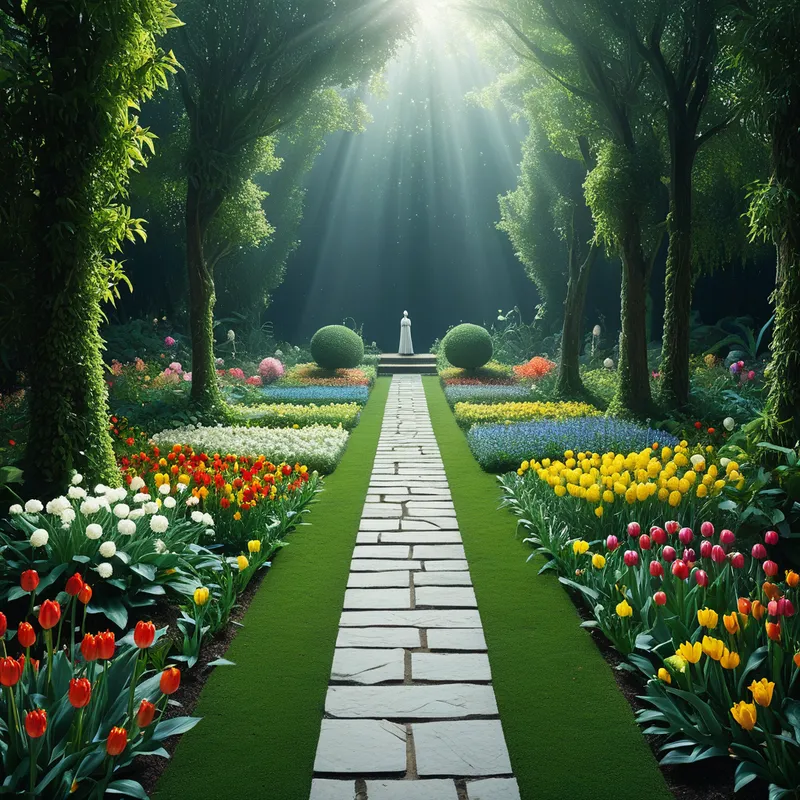
The seeker journeyed for lifetimes. First, they entered the Garden of Forms, where every tree bore fruit of gemstone, every flower sang a siren’s song of color and scent. “Stay,” the garden murmured, “for is this not beauty? Is this not truth?” The seeker’s heart swelled, but a deeper thirst pulled them on.
Next came the Garden of Knowledge, where fountains flowed with the wine of philosophy and the trees were laden with the ripe fruit of all scriptures. Scholars debated in shaded groves. “Stay,” the garden intoned, “for is this not wisdom? Is this not truth?” The seeker drank deeply, yet the thirst remained, a burning coal in the chest.
Through garden after garden they passed—the Garden of Power, with its towering cypresses of command; the Garden of Love, with roses that promised eternal union; the Garden of Renunciation, austere and proud in its barrenness. Each was more exquisite, more convincing than the last. Each offered a final answer, a perfect end to the journey. And in each, the seeker left a piece of their soul, entranced, believing they had arrived.
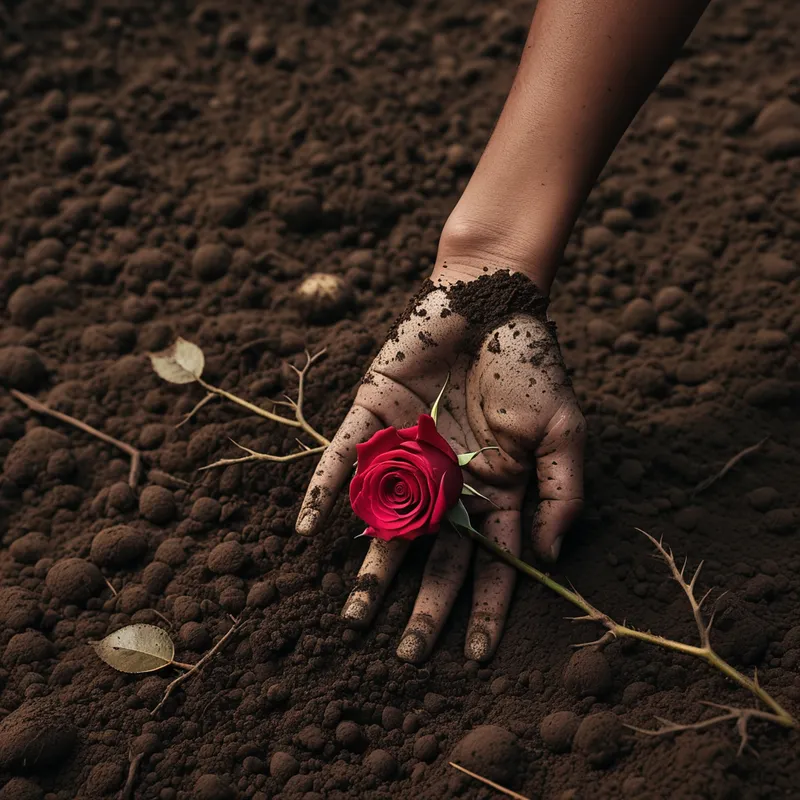
Until one day, stumbling and empty-handed, having surrendered every trophy of every garden, the seeker broke through a final, silver-threaded hedge. The perfume vanished. The music ceased. Before them lay no garden at all, but a vast, open plain of hard, sun-baked earth. A single, ancient stone platform stood at its center, upon which burned a flame with no fuel—a pure, silent radiance.
There was nothing to acquire, nothing to admire, nothing to become. In that devastating emptiness, the seeker fell to their knees, not in despair, but in a final, total surrender. The “I” that had sought the garden dissolved like mist. And in that dissolution, they heard not a voice, but a knowing that was their own deepest essence: “You have passed through the gardens of my attributes. Now you stand in the courtyard of my essence. This is the Garden. This is the Truth.” The barren ground itself blossomed from within, not with flowers, but with the uncreated light of reality itself.
Cultural Origins & Context
This allegory flows from the wellspring of Sufism, most famously articulated in the Hadiqat al-Haqiqa (The Garden of Truth) by the 12th-century Persian poet Hakim Sanai of Ghazna. Sanai’s work is a cornerstone of Sufi literature, a masnavi (poetic couplet) that maps the soul’s journey from worldly attachment to divine realization.
The myth was not “told” in a single sitting but woven into didactic poetry, recited in khanqahs, and contemplated by students under the guidance of a sheikh. Its function was societal and psychological: to deconstruct the ego’s projects. In a culture where piety, scholarship, power, and even asceticism could become new prisons of the self, Sanai’s allegory served as a radical critique. It reminded the community that all pursuits—even the most noble—are but waystations, beautiful gardens that must ultimately be left behind to reach the desert of pure presence.
Symbolic Architecture
The myth’s power lies in its systematic dismantling of spiritual materialism. Each “garden” represents a stage of development, a level of understanding, or an [aspect](/symbols/aspect “Symbol: A distinct feature, quality, or perspective of something, often representing a partial view of a larger whole.”/) of the divine that can be grasped and thus idolized.
The greatest illusion is to mistake a facet of the truth for the whole gem. The gardens are the facets; the barren ground is the gem itself.
The [seeker](/symbols/seeker “Symbol: A person actively searching for meaning, truth, or a higher purpose, often representing the dreamer’s own quest for identity or fulfillment.”/) is the ego-complex in its [journey](/symbols/journey “Symbol: A journey in dreams typically signifies adventure, growth, or a significant life transition.”/) toward the Self. The initial gardens (Forms, [Knowledge](/symbols/knowledge “Symbol: Knowledge symbolizes learning, understanding, and wisdom, embodying the acquisition of information and enlightenment.”/)) represent the allure of the phenomenal world and the intellect. The later gardens (Power, Love, Renunciation) are subtler, representing spiritual achievements that can become new identities. The final, barren plain is the Haqiqah, [reality](/symbols/reality “Symbol: Reality signifies the state of existence and perception, often reflecting one’s understanding of truth and life experiences.”/) stripped of all projections, concepts, and self-images. The flame is the unmediated [presence](/symbols/presence “Symbol: Presence in dreams often signifies awareness or acknowledgment of something significant in one’s life.”/) of the divine, which only appears when the [seeker](/symbols/seeker “Symbol: A person actively searching for meaning, truth, or a higher purpose, often representing the dreamer’s own quest for identity or fulfillment.”/)—as a separate entity seeking something—ceases to exist.

The Dreamer’s Resonance
When this myth stirs in modern dreams, it often manifests as a series of frustrating or sublime arrivals. You dream of finally achieving the perfect home (Garden of Forms), only to find a locked door leading further on. You receive the ultimate degree or award (Garden of Knowledge) and feel a hollow emptiness. You attain a hard-won state of peace or love (Garden of Renunciation/Love) and discover it, too, is a room, not the sky.
Somatically, this may feel like a profound fatigue after a success, a grief for a lost goal, or a restless agitation amidst comfort. Psychologically, it is the process of the psyche outgrowing its own containers. The dream is not a failure but a divine discontent, signaling that an identification has become a cage. The soul is being compelled to shed another layer of the false self, moving closer to the core where no image remains.
Alchemical Translation
The myth models the alchemical solve et coagula—dissolve and coagulate—applied to the psyche. Each garden represents a coagula, a coagulation of identity: “I am a scholar,” “I am a lover,” “I am an ascetic.” The journey out of each garden is the solve, the dissolution of that identity in the acid of direct experience, which proves it partial.
Individuation is not the cultivation of a better garden, but the courageous return to the uncultivated ground of one’s own being.
The ultimate transmutation occurs in the barren plain. Here, the lead of the ego—the seeker who wants, achieves, and possesses—is exposed to the radiant flame of awareness until it transmutes into the gold of pure witness. The “journey” ends where it began, but the traveler is gone; only the landscape remains, now recognized as one’s own true nature. For the modern individual, this translates as the movement from seeking self-improvement to self-surrender, from building a perfect personality to inquiring, “Who is it that seeks?” The triumph is not a victory, but a homecoming to the naked, unadorned reality of the present moment, prior to all story.
Associated Symbols
Explore related symbols from the CaleaDream lexicon:
- Garden — The entire field of cultivation, both the beautiful illusions of partial truths and, paradoxically, the ultimate truth itself when understood as the ground of being.
- Truth — The ultimate, unmediated reality that cannot be possessed or described, only realized through the dissolution of the seeking self.
- Journey — The soul’s necessary pilgrimage through the stations of understanding and identity, each of which must be fully experienced and then transcended.
- Mirror — Each garden acts as a mirror, reflecting back to the seeker their own desires and attachments, which must be recognized and seen through.
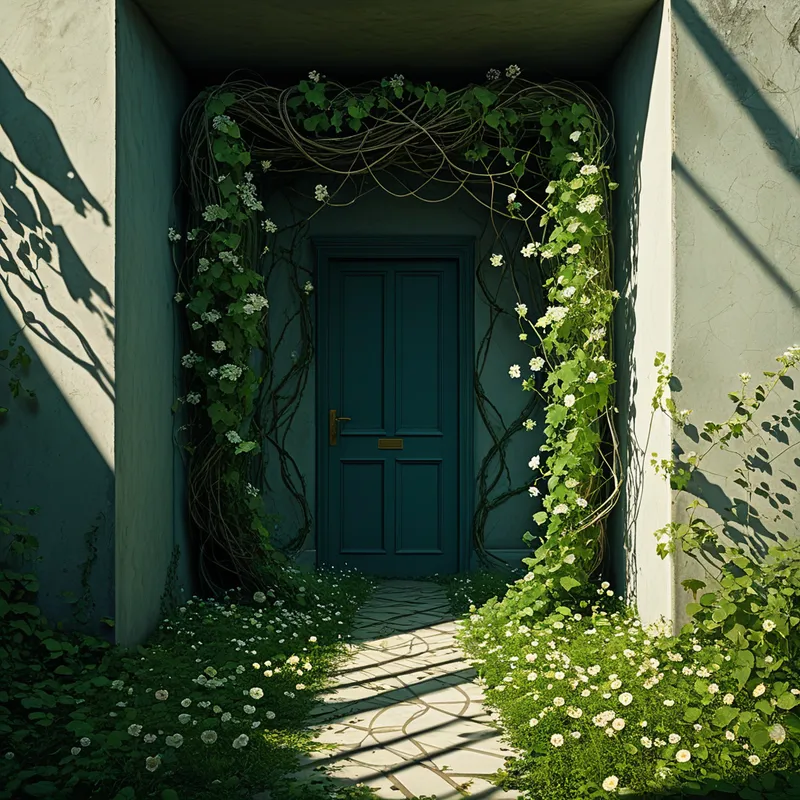
- Door — The threshold between each garden and the next, representing the crisis of leaving a comfortable level of understanding for the unknown.
- Light — The final, fuel-less flame on the stone platform, symbolizing the divine essence that is self-subsisting and only visible when all other lights (of ego) are extinguished.
- Shadow — The unrecognized attachments and identifications that make each garden feel like a final destination; integrating the shadow is what propels the seeker forward.
- Key — Not an object to be found, but the act of surrender itself, which unlocks the final gate to the barren plain.
- Veiled Truth — The nature of reality as it appears within each garden, partially revealed but ultimately concealed by the seeker’s own concepts and desires.
- Mask — The provisional identities (scholar, lover, ascetic) the seeker wears and must remove in each successive stage of the journey.
- Tended Garden Plot — The ego’s lifelong project of cultivating a perfect self, which the myth reveals must ultimately be abandoned for wild, uncultivated reality.
- Patient Gardener — The aspect of the Self or the divine guide that allows the seeker to experience each garden fully, knowing the harvest is the exhaustion of seeking itself.