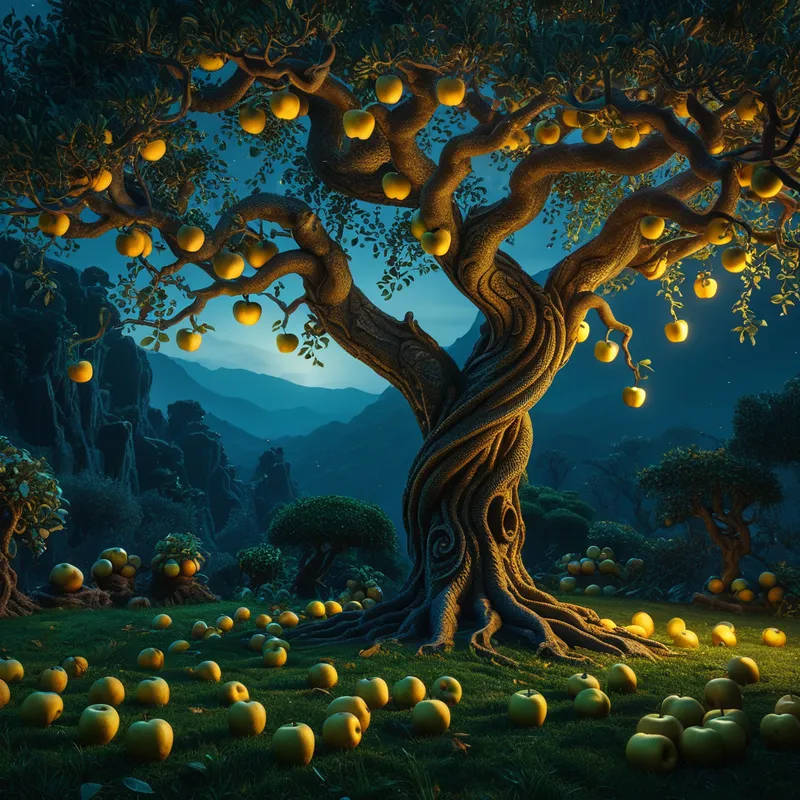
The Garden of the Hesperides Myth Meaning & Symbolism
A hero's quest for immortality's golden apples, guarded by a dragon and nymphs in a western garden at the edge of the known world.
The Tale of The Garden of the Hesperides
Listen, and let your mind travel to the very edge of the world, where the sun sinks into the ocean and paints the sky with the blood of day. Here, in the farthest West, lies a garden that is not a garden, a place whispered of by sailors and feared by gods. This is the Garden of the Hesperides.
It was a wedding gift, they say, from the Earth herself, Gaia, to the Queen of Olympus, Hera. And what a gift it was! Not of flowers or simple fruit, but of trees that bore apples of pure, shimmering gold. To eat of them was to taste a sliver of immortality itself, a power so potent it could not be left unguarded. So Hera set her most faithful wardens: her own radiant daughters, the Hesperides—Aegle, Erytheia, and Hesperarethusa—whose songs were sweeter than any bird’s and whose forms were as shifting and beautiful as the twilight. And with them, she placed a sentinel whose vigilance never slept: the great, hundred-headed dragon Ladon, whose every head hissed a different tongue, whose coils were stronger than iron chains, and whose eyes saw every approach.
For ages, the garden slept in its golden haze, a secret at the world’s rim. Until a labor was decreed. The mighty Heracles, son of Zeus, bound to atone for a madness sent by Hera herself, was given his eleventh impossible task: to fetch the golden apples. Not by force of arm alone, for what muscle can strangle a mist or wrestle a secret? His journey was one of cunning and aid. He wrestled the shape-shifting sea god, Nereus, until he revealed the garden’s hidden path. He freed the Titan Atlas, who bore the weight of the sky, and in return, the giant agreed to enter his own daughters’ garden, where the dragon would not strike at its master’s kin.
So Atlas walked into the twilight grove, past his singing daughters, and plucked three apples of blazing gold. But a trick was in the air. Having tasted freedom from his eternal burden, Atlas offered to deliver the apples himself, suggesting Heracles hold up the sky a little longer… forever. The hero, his bones groaning under the cosmic weight, agreed—but with a request for a moment’s respite, a pad to cushion his shoulders. As Atlas took the sky back, Heracles seized the apples and fled, the weight of heaven traded for the weight of destiny. The apples were presented, but such divine property could not remain in mortal hands. They were returned to the garden, to the dragon, to the nymphs, and to the endless western twilight, completing the circle. The quest was over, but the garden remained, eternal and just out of reach.
Cultural Origins & Context
The myth of the Garden is a late-blooming flower on the ancient Greek vine, with roots stretching into deeper, older soils. It appears most definitively in the fragments of the epic Catalogue of Women attributed to Hesiod and later in the accounts of Apollodorus. Its function was not merely to entertain but to map the limits of the known world. The “Far West” was a mythical geography, a placeholder for the ultimate beyond—be it the Atlantic, the Elysian Fields, or the land of the dead. The story served as an etiological myth for the golden apples, explaining their existence and their connection to divine royalty and immortality.
Societally, it reinforced a core heroic ideal: that even the greatest strength (bia) must be tempered with cleverness (metis) and the seeking of aid. Heracles’ success is not a solo conquest but a negotiation with primordial forces (Nereus) and a perilous deal with a Titan (Atlas). The myth was told and retold, a reminder that the greatest prizes lie at the boundaries of human endeavor, guarded by both beauty and terror.
Symbolic Architecture
The Garden is not a location but a state of consciousness, a psychic pleroma where the ultimate value—immortality, wholeness, the Self—is nurtured and protected.
The Golden Apples symbolize the telos, the ultimate goal of the individuation process: psychic integration and the incorruptible value of the realized Self. They are not merely eternal life, but the quality of a life lived in full alignment with one’s deepest nature.
The treasure you seek is always guarded. The dragon is not the obstacle to your goal; it is the quality of consciousness required to attain it.
Ladon, the hundred-headed dragon, represents the complex, multifaceted nature of the guardian at the threshold. This is not a mindless beast but the embodiment of instinctual, primal awareness—the protective and often terrifying power of the unconscious that safeguards the nascent Self from premature exposure or ego-inflation. Its many heads signify the myriad forms of resistance, doubt, and fear that arise when one approaches a core transformation.
The Hesperides, the “Daughters of the Evening,” embody the alluring, aesthetic, and nurturing aspect of the unconscious. They are the anima figures who beautify and tend the treasure, representing the soul’s capacity for relatedness, receptivity, and the gentle, persuasive power of the inner world. Together with Ladon, they form the complete guardian system: the fierce, masculine principle of defense and the enticing, feminine principle of invitation.
The Dreamer’s Resonance
When this myth stirs in the modern dreamer, it signals a profound approach to a central, life-giving value within the psyche. To dream of a radiant, forbidden orchard at the edge of a landscape is to sense the proximity of one’s own potential wholeness.
The somatic experience is often one of simultaneous awe and dread—a tightening in the chest, a quickening pulse at the beauty, coupled with a visceral chill at the presence of the guardian. The dreamer may find themselves in the role of Heracles: feeling the weight of a labor or atonement, seeking a way around direct confrontation through cleverness or seeking aid (perhaps dreaming of a guide or a negotiated deal). Alternatively, they may be the garden, feeling something precious within them is under vigilant, perhaps oppressive, guard. The dragon in a modern dream may appear as a complex security system, an impassable bureaucratic rule, or a multifaceted personal anxiety whose “heads” all argue why the treasure cannot be reached. The psychological process is the ego’s tentative approach to the Self, testing the boundaries of what it is ready to confront and integrate.
Alchemical Translation
The myth models the alchemical opus, the great work of psychic transmutation. Heracles’ journey is the ego’s arduous path toward the lapis philosophorum, the golden apple of the Self.
The initial labors represent the necessary nigredo, the blackening—the confrontation with shadow and the burdens of one’s history (his madness, his servitude). Seeking out Nereus is the stage of solutio, a dissolving of rigid ego positions by wrestling with the fluid, prophetic wisdom of the deep unconscious. The encounter with Atlas is the critical coniunctio, the conjunction of opposites. Heracles (the striving ego) and Atlas (the burdened, foundational structure of the psyche, the personal “world”) must exchange roles. The ego must consciously take on the unbearable weight of cosmic responsibility—the full awareness of its condition—so that the latent, titanic power within (Atlas) can be freed to retrieve the treasure.
The hero does not slay the guardian of the treasure; he learns its nature, honors its function, and finds a way to have the treasure delivered. Integration, not conquest, is the alchemical key.
The final trick—retrieving the apples and returning the sky—is the rubedo, the reddening, where the integrated ego, now wiser, uses its cunning to secure the prize without being trapped in an eternal, static burden. Crucially, the apples are returned to their source. The achieved Self is not a trophy for the ego to possess, but a living reality that must reside in its proper, sacred place within the greater psyche. The labor is complete, the hero is transformed, and the Garden remains, an eternal potential within the soul’s westernmost reach.
Associated Symbols
Explore related symbols from the CaleaDream lexicon:
- Yard
- Ranch
- Resort
- Tropical
- Bountiful Orchard
- Secret Garden
- Abandoned Theme Park
- Fruit-Laden Citrus Tree
- Fruit-bearing Tree
- Orchard in Bloom
- Petrified Forest
- Underwater Garden
- Ice Cream Forest
- Ball Pit
- Garden Party
- Fruit Picking
- Mediterranean Villa
- Safari Lodge
- Rooftop Garden
- Nostalgic Playground
- City Park
- Sculpture Park
- Hanging Gardens
- Thorn Barricade
- Cherry Tree
- Data Privacy