The Ganges Myth Meaning & Symbolism
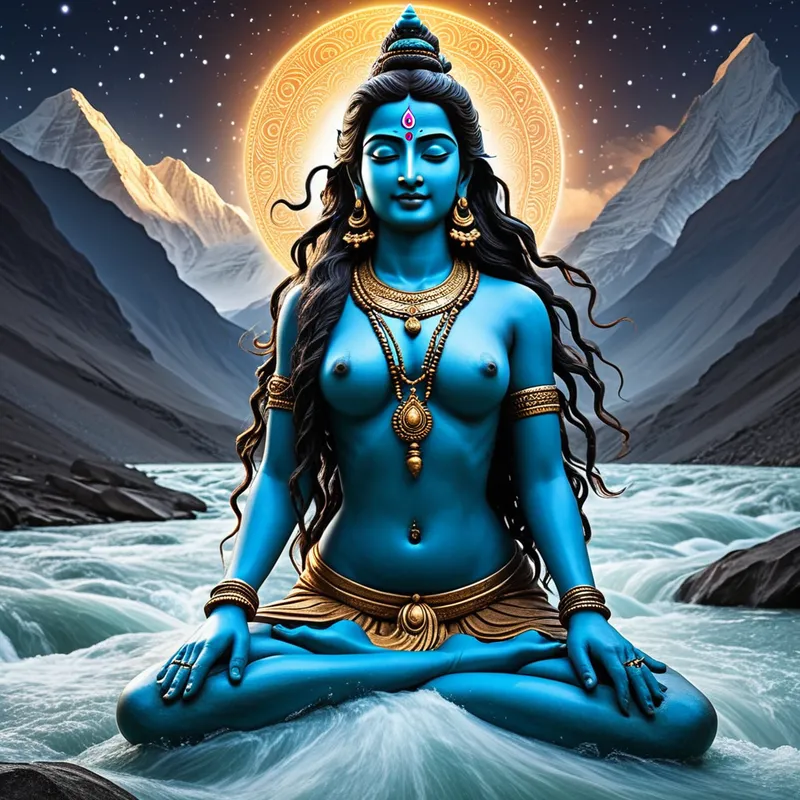
The celestial river Ganga descends to Earth to purify the ashes of ancestors, caught in the matted locks of Shiva to tame her world-shattering power.
The Tale of The Ganges
Hear now the tale of [the river](/myths/the-river “Myth from Buddhist culture.”/) that flows from heaven to earth, a story not of [water](/myths/water “Myth from Chinese culture.”/), but of grace, of fire, and of a weight borne for eternity.
In a time when [the world](/myths/the-world “Myth from Tarot culture.”/) was younger and the line between the realms was thin, a great sorrow lay upon the land. The sixty thousand sons of King Sagara had been reduced to ashes by the wrath of a sage, their souls cursed to wander as restless ghosts, unable to find peace. For generations, their descendants performed rites, but the ashes would not settle, the spirits would not ascend. The air itself tasted of dust and despair.
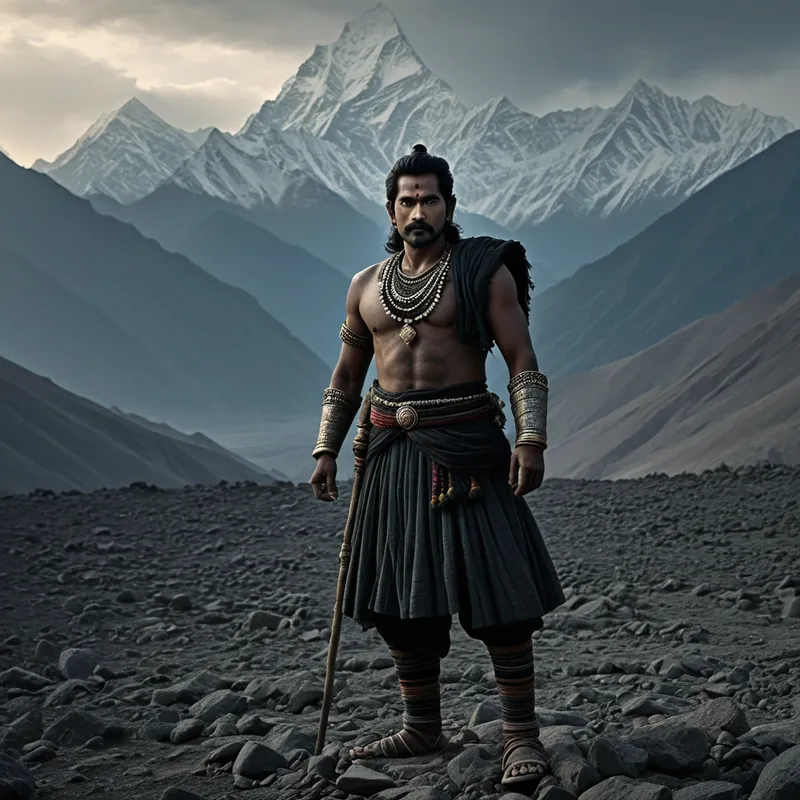
Then came a king named Bhagiratha. He renounced his throne, his comforts, his very self. He walked into the fierce silence of the mountains, stood on one leg, arms raised to a pitiless sky. For a thousand years he prayed, his body becoming a skeleton wrapped in skin, his will a single, unbreakable thread of intention aimed at the court of the gods. He sought not power, not wealth, but a single boon: let the celestial [Ganga](/myths/ganga “Myth from Hindu culture.”/) descend. Only her sacred waters could wash the ashes of his ancestors and grant them liberation.
The gods, moved by such unbearable devotion, relented. Brahma appeared in a shimmer of [lotus](/myths/lotus “Myth from Hindu culture.”/)-light. “Your penance has moved us, O King. Ganga will descend. But consider this: her fall from the foot of [Vishnu](/myths/vishnu “Myth from Hindu culture.”/)’s toe is [the fall](/myths/the-fall “Myth from Biblical culture.”/) of the universe itself. [The earth](/myths/the-earth “Myth from Hindu culture.”/) cannot bear her impact. She will shatter the world you seek to save.”
Bhagiratha’s hope, so long nurtured, turned to ice in his chest. But Brahma offered a glimpse of a possibility. “Only one can break her fall. Only he whose hair holds the poison that can destroy worlds, and [the moon](/myths/the-moon “Myth from Tarot culture.”/) that cools the cosmos. Only [Shiva](/myths/shiva “Myth from Hindu culture.”/).”
And so Bhagiratha began a second penance, more severe than the first, directed now to the icy, inaccessible peak of [Mount Kailash](/myths/mount-kailash “Myth from Hindu culture.”/). For another age, he prayed, until the mountain itself seemed to soften. The great ascetic, Shiva, opened his eyes. A faint, compassionate smile touched his lips. He nodded. “Let her come.”
The moment arrived. From the highest heaven, Ganga, proud and mighty, a roaring river of stars and liquid light, plunged toward the earth with the arrogance of divinity. She intended to sweep away this mortal plane for daring to summon her. But as she fell, Shiva merely raised his tangled, matted locks of hair—Jata—a [labyrinth](/myths/labyrinth “Myth from Various culture.”/) of cosmic space. Into that infinite maze Ganga crashed, swirled, tumbled, and raged. For years she struggled, a furious serpent of light trapped in a silent, meditative snare. Slowly, Shiva gentled her. He divided her into seven streams, then a single, holy thread.
Released at last from his hair at the base of the Himalayas, Ganga flowed, now tamed, now sacred. Bhagiratha, in a chariot of fire, raced ahead, guiding her course across the plains, all [the way](/myths/the-way “Myth from Taoist culture.”/) to the ashen remains of the Sagara princes. The waters touched the ashes. A sigh older than mountains was heard. Sixty thousand lights rose like a constellation being born in reverse, ascending into a sky suddenly clear. The ghosts were free. The river, her purpose fulfilled, flowed on—no longer just water, but a flowing path to liberation, forever.
Cultural Origins & Context
This myth, primarily recounted in the Ramayana and the Bhagavata Purana, is not merely an etiological story for a river. It is a foundational narrative embedded in the ritual and spiritual life of India. Passed down through millennia by sages (rishis) and storytellers, it served to explain the supreme sanctity of the Ganga. Her waters are considered physically and spiritually purifying (pavitra) precisely because of this divine origin story.
The myth functioned as a societal anchor, connecting geography to theology. It provided the cosmological justification for pilgrimage (tirtha-yatra), for the practice of depositing ashes in the river, and for the belief in [moksha](/myths/moksha “Myth from Hindu culture.”/). By linking the river to the determined penance of Bhagiratha and the compassionate intervention of Shiva, it established a model of devotion, perseverance, and the belief that divine grace can be earned and channeled for the benefit of all, even the dead. The river became a visible, tangible link between the three worlds: heaven (its origin), earth (its course), and [the underworld](/myths/the-underworld “Myth from Greek culture.”/) (its power to reach the ancestors).
Symbolic Architecture
At its core, the myth is a profound [allegory](/symbols/allegory “Symbol: A narrative device where characters, events, or settings represent abstract ideas or moral qualities, conveying deeper meanings through symbolic storytelling.”/) for the descent of transcendent [consciousness](/symbols/consciousness “Symbol: Consciousness represents the state of awareness and perception, encompassing thoughts, feelings, and experiences.”/) into the [realm](/symbols/realm “Symbol: The symbol of ‘Realm’ often signifies the boundaries of one’s consciousness, experiences, or emotional states, suggesting aspects of reality that are either explored or ignored.”/) of matter and suffering.
The river is grace itself—unconscious, overwhelming, and pure. Its untamed descent represents raw spiritual power, which, unmediated, would destroy the fragile psyche (the earth).
Bhagiratha represents the [human](/symbols/human “Symbol: The symbol of a human represents individuality, complexity of emotions, and social relationships.”/) ego with a singular, sacred [purpose](/symbols/purpose “Symbol: Purpose signifies direction, meaning, and intention in life, often reflecting personal ambitions and core values.”/). His penance is the focused discipline of consciousness, the will directed toward a goal beyond personal gain. He is the part of us that seeks to heal ancestral [trauma](/symbols/trauma “Symbol: A deeply distressing or disturbing experience that overwhelms the psyche, often manifesting in dreams as unresolved emotional wounds or psychological injury.”/), to resolve what has been left unresolved for generations.
Shiva is the transformative principle, the great container. His matted [hair](/symbols/hair “Symbol: Hair often symbolizes identity, power, and self-expression, reflecting how we perceive ourselves and how we wish to be perceived by others.”/) (jata) symbolizes the complex, often chaotic, network of the unconscious mind and [the ascetic](/myths/the-ascetic “Myth from Christian culture.”/)’s control over primal energies.
The hair that held the poison Halahala now holds the Ganga. This is the alchemical secret: the same vessel that contains destruction can also temper and channel salvation.
The ancestors’ ashes are the accumulated [karma](/myths/karma “Myth from Hindu culture.”/), the unresolved psychic [material](/symbols/material “Symbol: Material signifies the tangible aspects of life, often representing physical resources, desires, and the physical world’s influence on our existence.”/), the “sins” or burdens of the past that haunt the present. The [river](/symbols/river “Symbol: A river often symbolizes the flow of emotions, the passage of time, and life’s journey, reflecting transitions and movement in one’s life.”/)’s flow is the process of [catharsis](/symbols/catharsis “Symbol: A profound emotional release or purification through artistic expression, often involving intense feelings of relief and transformation.”/) and purification, not by avoiding the dark [residue](/symbols/residue “Symbol: What remains after a process or event; traces left behind that persist beyond the original occurrence.”/) of [life](/symbols/life “Symbol: The symbol of ‘Life’ represents a journey of growth, interconnectedness, and existential meaning, encompassing both the joys and challenges that define human experience.”/), but by immersing it in the conscious, mediated flow of [spirit](/symbols/spirit “Symbol: Spirit symbolizes the essence of life, vitality, and the spiritual journey of the individual.”/).
The Dreamer’s Resonance
When this myth stirs in the modern dreamer, it often signals a profound process of emotional or psychic purification. To dream of a mighty, uncontrollable flood may reflect a fear of being overwhelmed by unconscious contents—a surge of grief, rage, or spiritual longing that feels world-shattering.
Dreaming of guiding a river, or searching for a source of pure water in a wasteland, mirrors Bhagiratha’s quest. It suggests the dreamer is engaged in a deep, perhaps arduous, personal penance. They are seeking the “divine source” that can cleanse a persistent wound, often one that feels inherited or familial. The somatic sensation may be one of intense thirst, of bones aching from standing too long, or conversely, a feeling of cool, liberating release upon finding the water.
The image of something being caught, tangled, and slowed—like the river in the hair—can appear in dreams as being stuck in a maze, caught in a net, or feeling one’s energy being diffused. This is not a negative symbol, but an indication that a powerful transformative process is being contained and mediated by the [psyche](/myths/psyche “Myth from Greek culture.”/)’s own structures to prevent a destructive breakthrough.
Alchemical Translation
The individuation process modeled here is the transmutation of ancestral and personal shadow material through the disciplined invocation and conscious channeling of transpersonal energy.
First, the Bhagiratha Stage: Acknowledging the “curse”—the recurring patterns, the depressions, the anxieties that feel larger than oneself. This is the “ancestral ash.” [The ego](/myths/the-ego “Myth from Jungian culture.”/) must commit to a focused, often lonely, quest (“penance”) to call forth a higher solution. This is active engagement with [the Self](/myths/the-self “Myth from Jungian culture.”/), a prayer not for comfort, but for transformative power.
Second, the Shiva Stage: This is the critical act of psychic containment. When new energy, insight, or emotion floods in (a spiritual experience, a breakthrough in therapy, a surge of creativity), the untamed ego may wish to let it run wild. The myth instructs otherwise. One must develop the “matted locks”—the complex, patient, meditative capacity of the unconscious to receive, slow, and temper this energy. This is the practice of mindfulness, of holding powerful feelings without acting them out, of allowing insight to be integrated, not just experienced.
The alchemy occurs in the tangle. The raw gold of divine grace is made wearable, flow-able, useful only after being worked through the labyrinth of the embodied psyche.
Finally, the Liberation Stage: The now-conscious, guided energy (Bhagirathi) is directed specifically to the site of the wound. It washes over the “ashes”—the old identities, the traumas, the fixed narratives. This is not an erasure, but a transmutation. The weight of the past is lifted, not by forgetting, but by being seen in a new, sacred light. What was a ghost of memory becomes a liberated essence. The river then flows onward, no longer just a solution to a single problem, but the newly established, permanent channel of the dreamer’s own sacred connection between the heights of their spirit and the depths of their world.
Associated Symbols
Explore related symbols from the CaleaDream lexicon: