The GangaDescent Myth Meaning & Symbolism
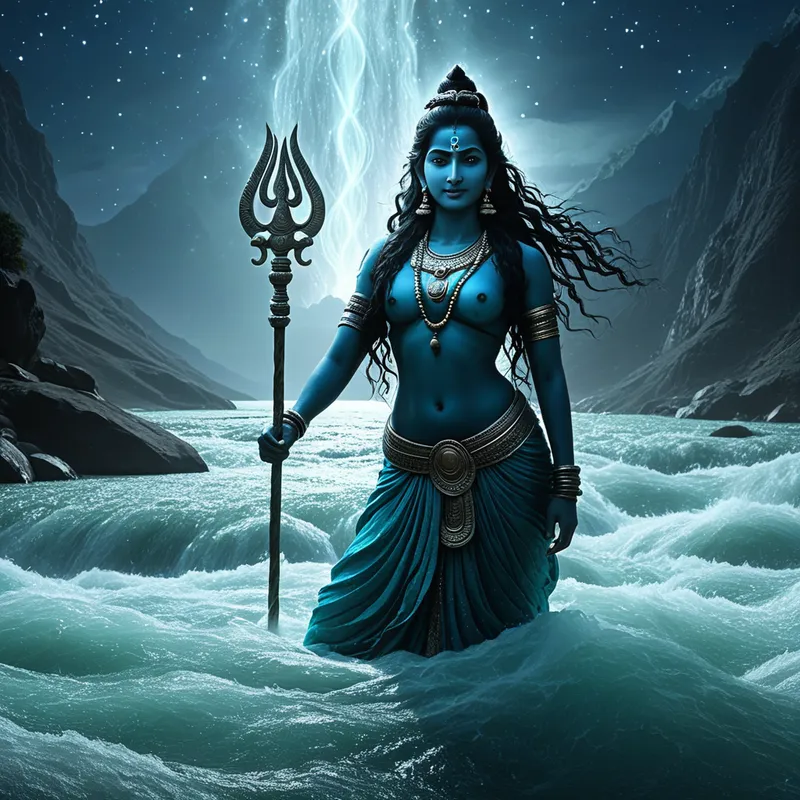
The celestial river Ganga descends to Earth, her torrential power tamed by Shiva's hair, to purify the ashes of dead princes and grant them liberation.
The Tale of The GangaDescent
Hear now the tale of [the river](/myths/the-river “Myth from Buddhist culture.”/) that fell from heaven, a story of ash and fire, of penance that shook the pillars of the worlds.
Once, in a time before time was measured, the great and noble lineage of the Ikshvaku kings lay under a terrible curse. Sixty thousand sons, princes of [the earth](/myths/the-earth “Myth from Hindu culture.”/), were reduced to fine, gray ash by the wrath of a sage. Their souls could find no passage to the realms beyond, trapped in the liminal dust of the mortal plane, crying out for a liberation that only the most potent grace could provide.
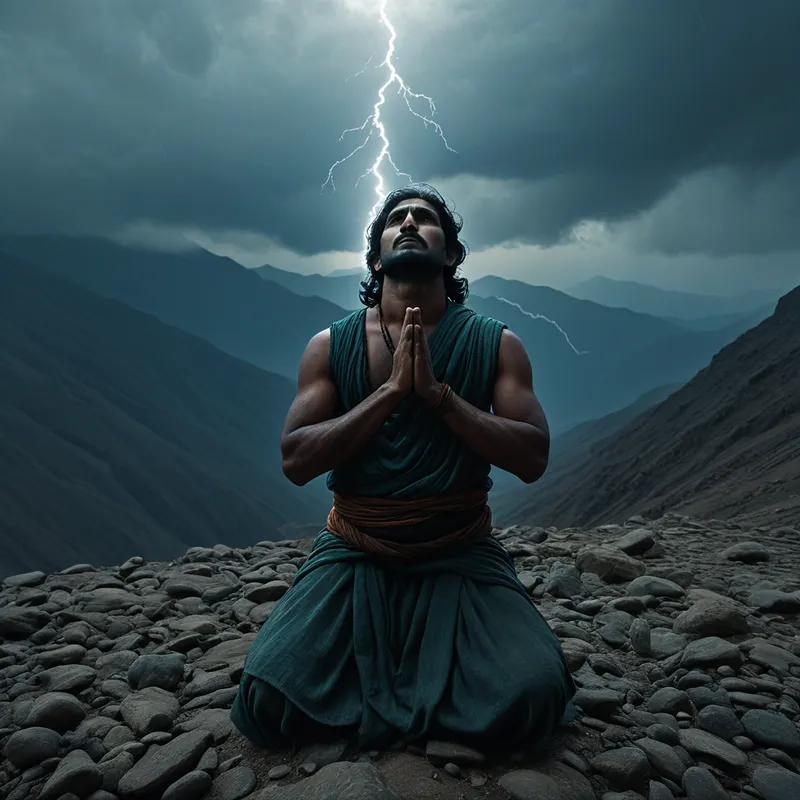
From this line arose a king named Bhagiratha. His heart was a vessel of duty, filled not with the desire for conquest or riches, but with a sorrow so vast it became a kind of fuel. He renounced his throne, left his palace of marble and [pearl](/myths/pearl “Myth from Chinese culture.”/), and walked into the fierce silence of the mountains. For one thousand years, he stood on one leg, arms raised, his body consuming itself in the fire of his will. For another thousand, he stood amidst four blazing fires with the fifth, the sun, scorching him from above. His prayer was a single, relentless note vibrating through the three worlds: Let the celestial waters flow. Let my ancestors be free.
The heavens trembled. The devas, the gods themselves, were moved by this austerity that bent the axis of fate. Brahma</ab title>, the creator, appeared in a chariot of light. “Your penance is unparalleled, Bhagiratha. I grant your boon. The [Ganga](/myths/ganga “Myth from Hindu culture.”/) shall descend. But hear this: her fall from the foot of [Vishnu](/myths/vishnu “Myth from Hindu culture.”/)’s heaven is [the force](/myths/the-force “Myth from Science Fiction culture.”/) of creation and destruction combined. If she strikes the earth directly, she will shatter it. Who will bear her cataclysmic descent?”
Only one being in all the cosmos possessed the strength, the stability, and the boundless capacity to contain such a force. Bhagiratha turned his prayer now to the wild-haired ascetic, the lord of paradox, who dwells on the icy peaks of Kailasha. He prayed to [Shiva](/myths/shiva “Myth from Hindu culture.”/).
And Shiva, the great yogi, whose matted locks are forests of eternity, smiled. A smile that held the patience of mountains. “Let her come,” he said.
Then, from the highest vault of heaven, she came. Ganga, the goddess, arrogant in her celestial might, believing she would wash this trifling ascetic-king and his plea off the face of creation. She threw herself down in a torrent of unimaginable power, a deluge meant to humble worlds. The sound was the end of all sounds.
And Shiva, unperturbed, merely lifted his head. He caught the entire furious cascade in the tangled infinity of his hair. For years, the divine river raged, swirling through labyrinthine coils, her pride broken, her fury dissipated into countless gentle streams. Tamed, humbled, and purified by his presence, she emerged from the god’s locks not as a destroying flood, but as a controlled, sacred flow. Guided by the steadfast Bhagiratha in his chariot, she followed him across the bones of the land, to the barren place where the ashes of the sixty thousand lay.
The moment her waters touched the gray dust, a great sigh echoed through the universe. A sigh of release. The ashes were cleansed; the souls, bright as newborn stars, ascended to their peace. The river, her divine duty fulfilled, continued to flow, becoming the artery of a continent, the eternal mother, the liquid grace of [moksha](/myths/moksha “Myth from Hindu culture.”/) herself.
Cultural Origins & Context
The myth of the Ganga’s descent, or Gangaavatarana, is a cornerstone of Hindu sacred geography and cosmogony. Its most famous literary telling is found in the Ramayana and is elaborated upon in the Mahabharata and the Puranas, particularly the Vishnu Purana. For millennia, it has been recited by priests, sung by bards, and enacted in temple rituals and village plays.
Its function was and remains multifaceted. It is an etiological myth, explaining the sacred origin of the physical [Ganges River](/myths/ganges-river “Myth from Hindu culture.”/), whose waters are considered inherently purifying. It establishes the river’s theological status as a liquid conduit between heaven and earth, a literalization of divine grace. Societally, it reinforced core values: the supreme power of devoted duty (dharma), the efficacy of disciplined austerity ([tapas](/myths/tapas “Myth from Hindu culture.”/)), and the importance of ancestral rites (shraddha). The story sanctified the landscape, turning a geographical feature into a theological entity, making every dip in the river a participation in this primordial, liberating drama.
Symbolic Architecture
At its [heart](/symbols/heart “Symbol: The heart symbolizes love, emotion, and the core of one’s existence, representing deep connections with others and self.”/), this is a myth of the necessary mediation between transcendent power and earthly need. Ganga represents pure, undifferentiated divine [energy](/symbols/energy “Symbol: Energy symbolizes vitality, motivation, and the drive that fuels actions and ambitions.”/)—grace itself—but in its raw, celestial form, it is too potent for the mortal [realm](/symbols/realm “Symbol: The symbol of ‘Realm’ often signifies the boundaries of one’s consciousness, experiences, or emotional states, suggesting aspects of reality that are either explored or ignored.”/). It is [consciousness](/symbols/consciousness “Symbol: Consciousness represents the state of awareness and perception, encompassing thoughts, feelings, and experiences.”/), [emotion](/symbols/emotion “Symbol: Emotion symbolizes our inner feelings and responses to experiences, often guiding our actions and choices.”/), or [spirit](/symbols/spirit “Symbol: Spirit symbolizes the essence of life, vitality, and the spiritual journey of the individual.”/) in its absolute state.
The unmediated divine is a cataclysm; it requires a vessel to become a blessing.
Bhagiratha symbolizes the [human](/symbols/human “Symbol: The symbol of a human represents individuality, complexity of emotions, and social relationships.”/) will, focused through extreme discipline (tapas). His is the [journey](/symbols/journey “Symbol: A journey in dreams typically signifies adventure, growth, or a significant life transition.”/) of [the ego](/myths/the-ego “Myth from Jungian culture.”/) with a sacred [purpose](/symbols/purpose “Symbol: Purpose signifies direction, meaning, and intention in life, often reflecting personal ambitions and core values.”/), undertaking the arduous inner work to summon transformative forces from the [depths](/symbols/depths “Symbol: Represents the subconscious, hidden emotions, or foundational aspects of the self, often linked to primal fears or profound truths.”/) of the unconscious (the heavens).
The pivotal figure is Shiva. His matted [hair](/symbols/hair “Symbol: Hair often symbolizes identity, power, and self-expression, reflecting how we perceive ourselves and how we wish to be perceived by others.”/) (jata) is the supreme [symbol](/symbols/symbol “Symbol: A symbol can represent an idea, concept, or belief, serving as a powerful tool for communication and understanding.”/) of the containing [structure](/symbols/structure “Symbol: Structure in dreams often symbolizes stability, organization, and the framework of one’s life, reflecting how one perceives their environment and personal life.”/)—the [psyche](/myths/psyche “Myth from Greek culture.”/), the cosmic order, the disciplined mind of the yogi. He does not block the energy; he receives it, contains it, slows it down, and transforms its destructive potential into a creative, [life](/symbols/life “Symbol: The symbol of ‘Life’ represents a journey of growth, interconnectedness, and existential meaning, encompassing both the joys and challenges that define human experience.”/)-giving flow. He is the archetypal [transformer](/symbols/transformer “Symbol: A symbol of profound change, adaptability, and the ability to shift between different states, forms, or functions.”/), the alchemical [vessel](/symbols/vessel “Symbol: A container or structure that holds, transports, or protects something essential, representing the self, emotions, or life journey.”/) where the [prima materia](/myths/prima-materia “Myth from Alchemical culture.”/) of raw spirit is broken down and reconstituted.
The ashes of the ancestors represent the dead [weight](/symbols/weight “Symbol: Weight symbolizes burdens, responsibilities, and emotional loads one carries in life.”/) of the past—karmic burdens, unresolved traumas, and latent psychic complexes. The flowing Ganga is the vivifying, cleansing current of [awareness](/symbols/awareness “Symbol: Conscious perception of self, surroundings, or internal states. Often signifies awakening, insight, or heightened sensitivity.”/) that, when properly channeled, can liberate these frozen aspects of [the self](/myths/the-self “Myth from Jungian culture.”/).
The Dreamer’s Resonance
When this myth stirs in the modern unconscious, it often manifests in dreams of overwhelming emotional or spiritual floods. One may dream of tidal waves threatening to engulf their home (the ego), of pipes bursting in their house, or of being caught in a relentless, beautiful, yet terrifying rain.
Somatically, this can correlate with feelings of being emotionally “flooded,” of anxiety that feels uncontainable, or conversely, a powerful upwelling of creative or spiritual energy that feels too big to handle. The psyche is announcing the descent of a “Ganga”—a potent new affect, insight, or life force from the deeper Self. The conflict in the dream mirrors the myth’s central problem: the ego (Bhagiratha) has called for this energy, perhaps through therapy, meditation, or a life crisis, but now lacks the internal structure (Shiva’s hair) to receive it without being shattered.
The dream is a snapshot of this critical moment where raw archetypal power meets the structures of the personal psyche. The resolution—or lack thereof—in the dream indicates whether the dreamer is currently experiencing chaotic inundation or successful, graceful containment and channeling.
Alchemical Translation
For the individual on the path of individuation, the Ganga Descent is a master metaphor for psychic transmutation. The process begins with the “Bhagiratha phase”: a conscious, often desperate, commitment to a deep, transformative work. This is the disciplined prayer, the therapy, the meditation, the artistic practice—the tapas that summons the unconscious contents.
The summoned content (the Ganga) is typically a powerful complex, a buried trauma, a surge of creative libido, or a spiritual awakening. In its initial emergence, it feels catastrophic, threatening to dismantle the familiar ego-structure. This is the crisis point.
Individuation is not about avoiding the flood, but about developing the vessel that can transmute it into a river of life.
The “Shiva function” must be cultivated. This is the development of a conscious container—a stronger observing ego, a grounding spiritual practice, a supportive community, or the therapeutic alliance. It is the capacity to hold the overwhelming emotion in awareness without identifying with it or being destroyed by it. The matted hair represents the intricate, patient, often messy work of weaving a psyche sturdy and spacious enough to receive the divine.
Finally, the “liberation of the ancestors” occurs. As the transformed energy flows through the now-resilient psyche, it washes clean the “ashes”—the old, dead patterns, identifications, and wounds. They lose their psychic charge and are reintegrated as neutral memory or liberated as creative potential. The individual is not flooded, but irrigated. The once-cataclysmic power becomes a sustained source of vitality, purification, and connection to the sacred, flowing through one’s life as a river of meaning.
Associated Symbols
Explore related symbols from the CaleaDream lexicon: