The Game of Dice in the Mahabharata Myth Meaning & Symbolism
A rigged dice game forces a prince to gamble away his kingdom, brothers, and wife, exposing the shadow of dharma and the fragility of order.
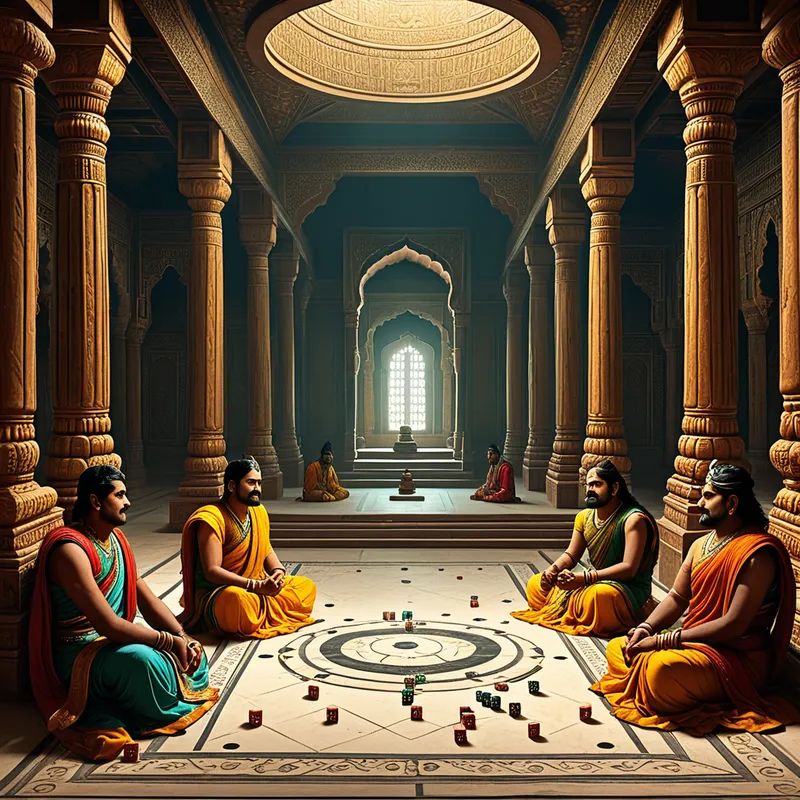
The Tale of The Game of Dice in the Mahabharata
Listen. The air in Hastinapura was thick with a poison no physician could cure: envy. It festered in the heart of Prince Duryodhana, a fire stoked each time he witnessed the glory of his cousins, the five Pandava brothers. They possessed a kingdom won by their own might, a dazzling hall that mirrored the heavens, and a virtue that shone like a polished shield. It was a light Duryodhana could not bear.
Into this tinderbox stepped his uncle, Shakuni, a man whose smile was a dagger sheathed in silk. “The strong arm is one path,” he whispered, his voice like dry leaves. “But the cunning mind is another. We shall not break them with a sword, but with a throw.” He produced the dice, carved from the bone of his own ancestors, imbued with a will that was not his own, but his nephew’s darkest desire.
An invitation was sent—not to war, but to sport. A friendly game of dice in the new assembly hall. The eldest Pandava, Yudhishthira, whose very soul was bound to truth and duty, could not refuse. It was a royal summons. Yet, as he crossed the threshold, the scent of blooming lotuses seemed to curdle. The hall was not filled with friends, but with silent, complicit elders. The dice clicked in Shakuni’s hand like the mandibles of a scorpion.
The game began. Yudhishthira, noble and steadfast, played the man he was. Shakuni played the shadow Yudhishthira refused to see. Gold, jewels, chariots—all slipped from the Pandava’s grasp with each fateful roll. A fever took him. The noble king was gone, replaced by a gambler possessed, his dharma unraveling with each cast. He staked his brothers, one by one. He lost them. He staked himself. He was lost.
Then, from the depths of this possession, came the final, unthinkable wager. “I stake Draupadi.”
The silence that followed was a living thing. It choked the hall. He had gambled his wife. The ultimate property, the final shred of his honor. A servant was sent to fetch her from her chambers. Draupadi, in a state of ritual impurity, her hair unbound, refused. “Ask the assembly,” her voice echoed back, clear as a bell. “If a king who has already lost himself can still possess a wife to wager?”
No one answered. The elders, like statues of salt, looked away. Duryodhana, drunk on victory, commanded his brother Dushasana to drag her in. The scene that followed tore the fabric of the world. Draupadi was pulled by her hair, her sari, into the hall of men. As Dushasana began to disrobe her, her prayer was not a whisper but a roar to Vishnu. And the divine answered. As cloth was pulled, more cloth appeared, a miraculous, endless stream of silk that shielded her dignity and shamed the entire lineage of Kuru.
In the terrible silence that followed the miracle, ominous portents filled the sky. Jackals howled within the palace walls. The blind king Dhritarashtra, finally stirred by the gods’ displeasure, granted Draupadi three boons. She freed her husbands. But the poison had been spilled. The final agreement was struck: thirteen years of exile for the Pandavas, with the thirteenth to be spent in complete concealment. If discovered, the cycle would begin anew. They walked out of the hall not as defeated princes, but as men forged in the fire of a humiliation that could only be cleansed by a war that would end an age.

Cultural Origins & Context
This episode is the narrative fulcrum of the immense Sanskrit epic, the Mahabharata, a text often described as the encyclopedia of dharma. Composed over centuries, likely between 400 BCE and 400 CE, it was not merely literature but itihasa—“thus indeed it happened.” It was the living memory of a culture, transmitted orally by bards and learned sutas and brahmins in royal courts and public gatherings.
The dice game served a critical societal function. In a culture deeply structured by the codes of dharma, kingship, and honor, the story presented the ultimate “what if.” What if the most righteous man faltered? What if the structures of law and assembly failed? It was a cautionary tale about the fragility of civilization itself, showing how the veneer of order could be shattered not by external monsters, but by the internal monsters of jealousy, addiction, and moral cowardice. It forced listeners to confront uncomfortable questions about duty, complicity, and the price of silence, making the epic a mirror for the collective conscience of the society that preserved it.
Symbolic Architecture
The dice game is not a game of chance, but a ritual of possession. It is the moment the conscious, daylight world of order (dharma) is invaded by the chaotic, compulsive shadow.
The dice are the manifest form of unspoken desire, rolling the abstract poison of the heart into the concrete ruin of the world.
Yudhishthira represents the ego identified solely with its noble persona. His fatal flaw is not wickedness, but a rigidity that cannot recognize the gambler within. He believes he is playing a game of skill and chance, but he is actually offering himself as a sacrifice to the unresolved envy (Duryodhana) of the family psyche. Shakuni is the trickster archetype, the personified cunning of the unconscious that knows the ego’s weakness perfectly and exploits its own rules to trap it.
The hall of elders, silent and paralyzed, symbolizes a collective superego that has become hollow. It knows right from wrong but has lost the courage of its convictions. The true hero of this scene is Draupadi. She represents the anima, the soul-force, and the voice of conscience that the possessed ego (Yudhishthira) has literally gambled away. Her violation is the violation of the psyche’s own integrity. Her miraculous salvation is the first spark of the Self’s intervention, a divine “no” from the deepest core of being that says the annihilation of the soul will not be permitted.
The Dreamer’s Resonance
When this myth stirs in the modern dreamer, it often manifests as dreams of being trapped in a rigged system—a fixed job interview, a corrupt court, a relationship where the rules keep changing. The somatic feeling is one of visceral powerlessness and hot shame. You are playing a game you cannot win, compelled to continue by a force you cannot name.
Psychologically, this signals a profound encounter with the shadow. The “Duryodhana” figure in the dream—a rival, a boss, a faceless institution—often carries the dreamer’s own disowned ambition, rage, or desire to dominate, projected outward. The “Shakuni” is the cunning, self-sabotaging logic of the unconscious that engineers situations where you are destined to lose, forcing a crisis. Dreaming of losing everything in a gamble speaks to a psyche that has over-identified with a persona (the good employee, the perfect partner, the responsible one) and is now being stripped bare by life circumstances, preparing the ground for a more authentic identity. The dream is a painful but necessary initiation into the reality of one’s own complexity.
Alchemical Translation
The alchemical journey modeled here is the nigredo, the blackening, the necessary descent into the shadow as the first, non-negotiable step of individuation. The glorious, conscious kingdom of the ego (Indraprastha) must be lost.
One does not choose the shadow; one is chosen by it, invited to a game where the only winning move is to lose one’s old self completely.
Yudhishthira’s compulsive gambling is the psyche’s brutal method of forcing a confrontation with what has been excluded. His rigid dharma must fail so that a deeper, more resilient dharma can be born from the ashes of experience. The thirteen-year exile that follows is the long, slow process of integration. It is a withdrawal from the collective “hall” of external validation and societal roles into the forest of the inner world. Here, the brothers (the various aspects of the psyche) and Draupadi (the soul-connection) must rely on each other and undergo trials, disguised and humbled.
The final year of concealment is the most crucial alchemical stage: the incubation of the new Self in complete secrecy, where it must not be recognized by the old, hostile consciousness (the Kauravas). This is the internal work that cannot be shown, the transformation that happens below the surface. The return from exile and the ensuing war represent the final, conscious confrontation with the projected shadow. One does not make peace with a Duryodhana; one must recognize him as a part of one’s own house and, with immense sorrow, engage in the sacred duty (svadharma) of overcoming him. The triumph is not a victory of good over evil, but the tragic, hard-won integration of the shadow into a larger, more conscious, and more compassionate whole. The dice game, therefore, is the catastrophic but sacred beginning of becoming whole.
Associated Symbols
Explore related symbols from the CaleaDream lexicon: