The Gae Bulg Myth Meaning & Symbolism
The story of a hero's cursed spear, born from a sea monster's bone, that seals his fate and embodies the terrible price of ultimate power.
The Tale of The Gae Bulg
Hear now the tale of the weapon that sang only one song—the death rattle. It was not forged in any earthly smithy, but in the cold, crushing depths of [the sea](/myths/the-sea “Myth from Greek culture.”/). Its name was the Gae Bulg, and its story is written in the salt of tears and the iron of fate.
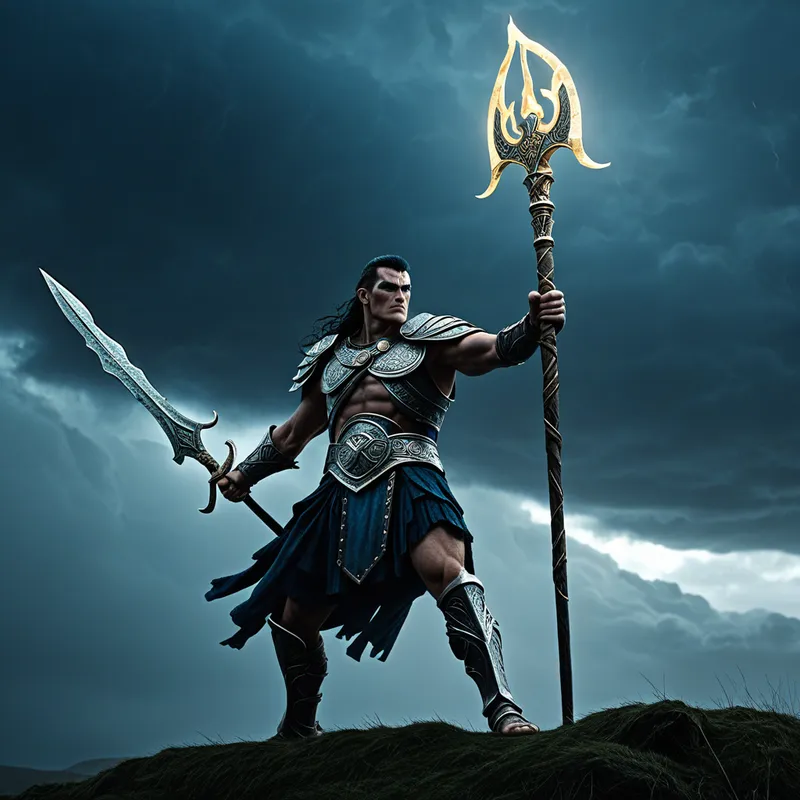
In the days when heroes walked the land of [Tír na nÓg](/myths/tr-na-ng “Myth from Celtic culture.”/) as easily as they walked Ulster, there lived a warrior maiden of shadow and skill, the woman-warrior Scáthach. On her Isle of Skye, where mists hid the gates to the lands of the dead, she trained the Hound of Ulster himself, Cú Chulainn. He learned all arts of war, but she held one secret back, a final gift and a final curse. It was a spear of grotesque craft, a shaft of wood tipped with the pelvic bone of a Curruid, a beast slain by Scáthach’s own hand. This bone was no simple point; it was a cage of barbs, a knot of death.
She taught him the terrible art of its use. It could not be thrown like a common spear. It must be cast from the fork of the foot, driven by the whole body’s fury, a low and ugly strike. And when it pierced a man, the barbs would open like a ghastly flower, hooking into bone and organ, making extraction a sentence of slow, certain agony. To remove it was to disembowel the victim. This was its law, its only purpose.
Years passed. The fate woven for Cú Chulainn grew taut. The great war of the Táin Bó Cúailnge raged, and at a ford on [the river](/myths/the-river “Myth from Buddhist culture.”/), he faced his greatest sorrow. His opponent was not a stranger, but his foster-brother and deepest friend, Ferdiad. For three days they fought, matched in skill, bound by love even as their blades clashed. They shared food and healing herbs at each day’s end, their laughter strained, their hearts breaking.
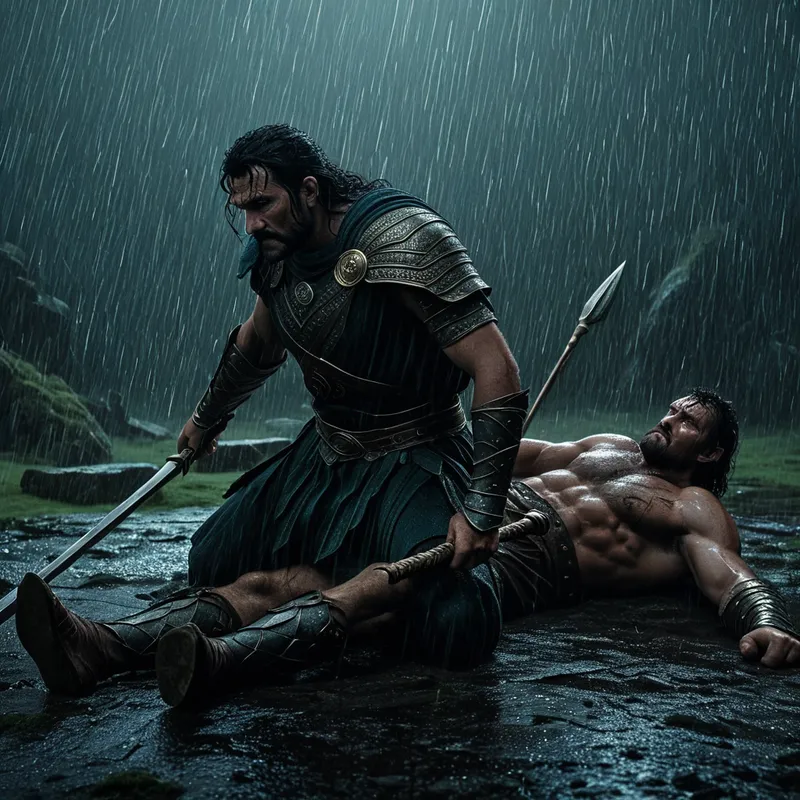
On the fourth day, Cú Chulainn saw he could not win. Honor, friendship, skill—all were equal. Only one [thing](/myths/thing “Myth from Norse culture.”/) remained unequal: the cursed gift in his arsenal. With a cry that was half a sob, he called for his charioteer, Láeg, to bring the Gae Bulg. The air grew cold. He set the spear against the stream’s bed, and with a move that was less a warrior’s throw and more a sacrifice to the gods of slaughter, he launched it from his foot.
It took Ferdiad low, piercing the strong iron apron that protected him, and bloomed its fatal barbs within. As Ferdiad fell, he asked for [water](/myths/water “Myth from Chinese culture.”/), and Cú Chulainn, cradling his dying brother, gave it to him with his own hands, their blood mingling in the ford. The spear had done its work. It sealed a victory that tasted of ash, and bound Cú Chulainn’s own fate to the doom he had delivered. The weapon returned to the depths of story, its single, terrible song now complete.
Cultural Origins & Context
This myth is a central thread in the Ulster Cycle, preserved by the filid, the poet-historians who were the memory-keepers of Gaelic society. These were not mere entertainments but narrative cornerstones of a warrior culture’s identity. Recited in the halls of kings, they encoded values of heroism (clú), the sacredness of geis (taboo), and the inescapable nature of geis.
The Gae Bulg episode functions as the tragic climax of Cú Chulainn’s arc within the Táin. It served a profound societal function: to illustrate the ultimate cost of the heroic ideal. The hero, the protector of the tribe, must sometimes destroy what he loves most to fulfill his duty, becoming a monster in the process. This was a warning and a catharsis, reminding listeners that even divine-like prowess is haunted by personal tragedy and moral ambiguity. The weapon’ Otherworldly origin—from Scáthach, a denizen of the liminal space between worlds, and from a sea monster—marks it as an object from outside the human social order, an intrusion of raw, amoral cosmic power into [the world](/myths/the-world “Myth from Tarot culture.”/) of human bonds and loyalties.
Symbolic Architecture
The Gae Bulg is not merely a [weapon](/symbols/weapon “Symbol: A weapon in dreams often symbolizes power, aggression, and the need for protection or defense.”/); it is the solidified [symbol](/symbols/symbol “Symbol: A symbol can represent an idea, concept, or belief, serving as a powerful tool for communication and understanding.”/) of inescapable consequence and the [shadow](/symbols/shadow “Symbol: The ‘shadow’ embodies the unconscious, repressed aspects of the self and often represents fears or hidden emotions.”/) of the [hero](/symbols/hero “Symbol: A hero embodies strength, courage, and the ability to overcome significant challenges.”/) himself.
The ultimate power is always a two-edged blade, and the handle is wrapped in the leather of one’s own soul.
Its [origin](/symbols/origin “Symbol: The starting point of a journey, often representing one’s roots, source, or initial state before transformation.”/) is telling: born from the bone of a sea [monster](/symbols/monster “Symbol: Monsters in dreams often symbolize fears, anxieties, or challenges that feel overwhelming.”/), the Curruid. The sea represents the unconscious, the chaotic, primordial [realm](/symbols/realm “Symbol: The symbol of ‘Realm’ often signifies the boundaries of one’s consciousness, experiences, or emotional states, suggesting aspects of reality that are either explored or ignored.”/). The [monster](/symbols/monster “Symbol: Monsters in dreams often symbolize fears, anxieties, or challenges that feel overwhelming.”/) is the untamed, destructive force within that unconscious. Thus, the [spear](/symbols/spear “Symbol: The spear often symbolizes power, aggression, and the drive to protect or conquer.”/) is literally fashioned from the [skeleton](/symbols/skeleton “Symbol: A skeleton symbolizes the foundational aspects of life and mortality, representing both the physical body and the spiritual essence of being.”/) of the repressed shadow. It is power excavated from the [depths](/symbols/depths “Symbol: Represents the subconscious, hidden emotions, or foundational aspects of the self, often linked to primal fears or profound truths.”/), lawful only in its own brutal, aquatic [logic](/symbols/logic “Symbol: The principle of reasoning and rational thought, often representing order, structure, and intellectual clarity in dreams.”/).
Its method of deployment—from the foot—is a profound symbolic inversion. The foot is the lowest part of the [body](/symbols/body “Symbol: The body in dreams often symbolizes the dreamer’s self-identity, personal health, and the relationship they have with their physical existence.”/), our [connection](/symbols/connection “Symbol: Connection symbolizes relationships, communication, and bonds among individuals.”/) to the [earth](/symbols/earth “Symbol: The symbol of Earth often represents grounding, stability, and the physical realm, embodying a connection to nature and the innate support it provides.”/), to instinct, to the “underhanded.” This is not the noble strike of a hand (conscious [action](/symbols/action “Symbol: Action in dreams represents the drive for agency, motivation, and the ability to take control of situations in waking life.”/)) but an [eruption](/symbols/eruption “Symbol: A sudden, violent release of pent-up energy or emotion from beneath the surface, often representing transformation or crisis.”/) from the muddy, chthonic realm of base necessity and [survival instinct](/symbols/survival-instinct “Symbol: The survival instinct represents primal intuition and the deep-seated drive to protect oneself and thrive in challenging circumstances.”/). It signifies an [action](/symbols/action “Symbol: Action in dreams represents the drive for agency, motivation, and the ability to take control of situations in waking life.”/) taken when all higher, conscious, and honorable methods have failed. It is the “last resort” that reveals the true, ugly [foundation](/symbols/foundation “Symbol: A foundation symbolizes the underlying support systems, values, and beliefs that shape one’s life, serving as the bedrock for growth and development.”/) of a conflict.
Finally, its barbed [nature](/symbols/nature “Symbol: Nature symbolizes growth, connectivity, and the primal forces of existence.”/) makes it irreversible. Once set in [motion](/symbols/motion “Symbol: Represents change, progress, or the flow of life energy. Often signifies transition, personal growth, or the passage of time.”/), its consequences cannot be taken back. It creates a wound that cannot be healed, a [separation](/symbols/separation “Symbol: A spiritual or mythic division between realms, states of being, or consciousness, often marking a transition or loss of connection.”/) that cannot be mended. It is the embodiment of the point of no return.

The Dreamer’s Resonance
When the pattern of the Gae Bulg surfaces in modern dreams, it rarely appears as a literal spear. It manifests as the inescapable consequence, the “point of no return” action the dreamer has taken or fears taking.
One might dream of a simple decision—sending an email, speaking a word—that then unfolds with monstrous, uncontrollable results, hooking into multiple areas of life (the barbs). The somatic feeling is often one of visceral dread in the gut, a cold certainty. Or, one may dream of being forced to use a skill or knowledge in a way that feels dishonorable or destructive to a relationship, a modern echo of Cú Chulainn using his ultimate martial art against his brother. The dream highlights a moment where the [psyche](/myths/psyche “Myth from Greek culture.”/) recognizes that to achieve a necessary goal (victory, survival, setting a boundary), something pure must be sacrificed, and a part of [the self](/myths/the-self “Myth from Jungian culture.”/) must become, however briefly, monstrous.
The psychological process is one of confronting [the shadow](/myths/the-shadow “Myth from Jungian culture.”/) weapon in one’s own arsenal: the talent turned toxic, the truth that destroys, the necessary betrayal. The dream asks the dreamer to acknowledge the cost of their own power.
Alchemical Translation
The alchemical journey modeled here is the [nigredo](/myths/nigredo “Myth from Alchemical culture.”/) of the hero’s path—the blackening, the confrontation with the shadow and the experience of profound guilt and sorrow as necessary precursors to integration.
Cú Chulainn’s journey with the Gae Bulg is a map of psychic transmutation. First, he acquires the shadow-tool (training with Scáthach). This is the stage of gaining potent but unconscious power—a repressed anger, a sharp intellect, a capacity for ruthlessness. It is kept in reserve, a secret.
Individuation requires we load our own Gae Bulg, acknowledge its presence in our hold, and understand the terrible price of its release.
Then comes the impossible conflict, where the conscious [persona](/myths/persona “Myth from Greek culture.”/) (the loyal friend, the honorable warrior) is pitted against a duty or fate that the persona cannot fulfill. The conscious mind is stalemated.
The release of the shadow-weapon is the critical alchemical act. It is [the ego](/myths/the-ego “Myth from Jungian culture.”/)‘s acquiescence to the necessity of the shadow. To move forward, to fulfill the destiny of the Self, the conscious self must employ the very thing it finds abhorrent. This is not a glorification of the shadow, but a tragic integration. The killing of Ferdiad symbolizes the sacrifice of a cherished complex—perhaps naive innocence, a codependent bond, or an idealized self-image.
The final stage is carrying the consequence. Cú Chulainn does not die immediately, but he is mortally wounded in spirit. He must live with the action. In alchemical terms, this is the putrefaction that follows [the nigredo](/myths/the-nigredo “Myth from Alchemical culture.”/), the stewing in the guilt and sorrow that will eventually, if borne consciously, lead to a new humility and a more complete, if wounded, personality. The [triumph](/myths/triumph “Myth from Roman culture.”/) is not victory, but the awful, transformative burden of self-knowledge. The modern individual’s “Gae Bulg moment” is that decisive, often painful, action taken in integrity to one’s deeper path that inevitably severs old ties and transforms the self, leaving barbs of grief and regret lodged in the soul, which become part of its new, more resilient architecture.
Associated Symbols
Explore related symbols from the CaleaDream lexicon: