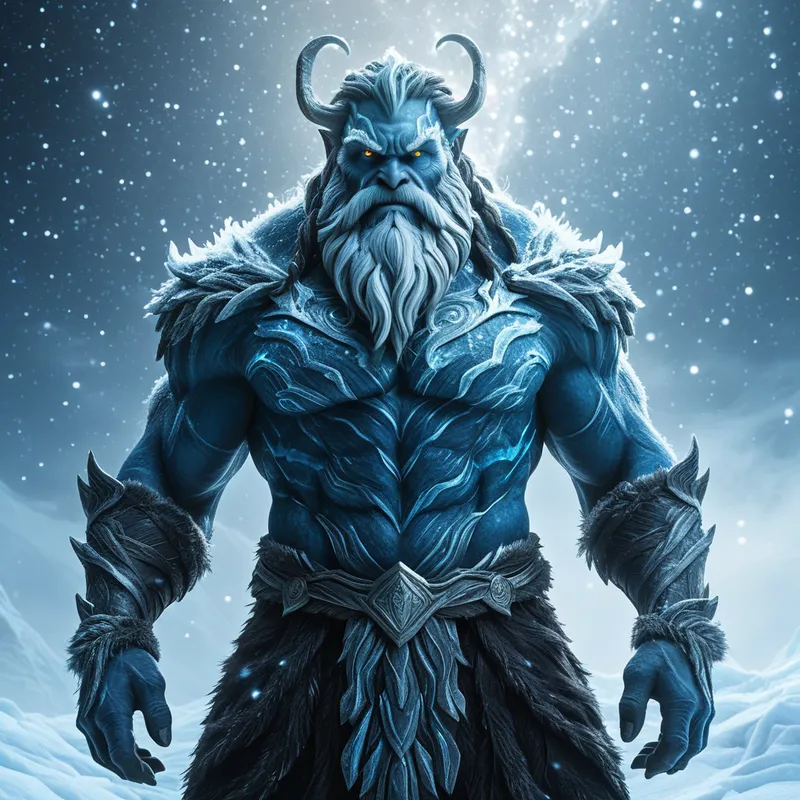
The Frost Giants of Norse myth Myth Meaning & Symbolism
Primordial beings of ice and chaos, the Jötnar embody the raw, untamed forces of nature and psyche that the gods must eternally confront and contain.
The Tale of The Frost Giants of Norse myth
Listen. Before the sun knew its path, before the first whisper of wind, there was only the gap. Ginnungagap. To the north, a realm of clawing cold, Niflheim, where rivers of venom froze into glaciers that groaned in the endless dark. To the south, a realm of consuming fire, Muspelheim, where sparks flew like dying stars. And in the center, the great, yawning, hungry void.
Where the fiery winds of Muspelheim licked at the ice of Niflheim, the frost dripped and hissed. From that weeping melt, from that agonized meeting of absolute opposites, life stirred. It was not a gentle birth. It was a coagulation, a slow, monstrous gathering. From the dripping rime formed a being: Ymir, the Aurgelmir, the Screamer. He was frost given flesh, a mountain of ice with a heart of ancient cold. As he slept, the sweat from his armpits bred more of his kind—a race of Jötnar. And from the melting ice also came a cow, Audhumla. Her licks upon a salty ice block revealed another form: Buri, fair and bright.
Thus the stage was set from the first breath of time: the Frost Giants, chaotic, prolific, embodiments of the raw, untamed world, and the lineage of the gods, who would call themselves the Æsir. The giants were the first rulers, Ymir their terrible patriarch. But from Buri came a son, Borr, and Borr took a giantess, Bestla, for a wife. Their children were Odin and his brothers, Vili and Vé.
The young gods looked upon the sprawling, chaotic dominion of the Frost Giants and saw not a home, but raw material. They saw a world that needed shaping, boundaries that needed raising, a cosmos that needed order wrested from primordial soup. And so, they did the unthinkable, the foundational act of all creation: they turned on their own ancestral kin. Odin, Vili, and Vé fell upon the sleeping Ymir and slew him. His blood gushed forth in such a torrent that it drowned all the frost giants save one, Bergelmir, who escaped with his wife in a hollowed-out tree trunk—a seed of chaos preserved.
Then the gods began their work. From Ymir’s flesh they molded the earth. From his unspilled blood they made the seas and lakes. His bones became the mountains, his teeth the cliffs and stones. They took his skull and set it aloft to form the dome of the sky, held up by four dwarfs at the cardinal points. They snatched sparks from Muspelheim and set them in the sky as stars, to give light and measure to the days. They built a fortress, Asgard, from his eyebrows, a wall against the surviving chaos.
But the Frost Giants were not gone. They retreated to the edges of the world, to Jötunheimr, a land of jagged peaks, eternal winters, and deep, shadowed forests. From there, they would forever press in. They are the storm that threatens the walls, the winter that kills the harvest, the avalanche that buries the path. The gods must be ever-vigilant. Thor rides out in his goat-drawn chariot, his hammer Mjölnir cracking giant skulls like ice. Odin wanders in disguise, seeking wisdom even from their seeresses, for the giants hold ancient knowledge older than the gods themselves. The Frost Giants are the eternal “other,” the chaos against which order defines itself, the frozen past from which the warm, structured present was painfully, violently, born.
Cultural Origins & Context
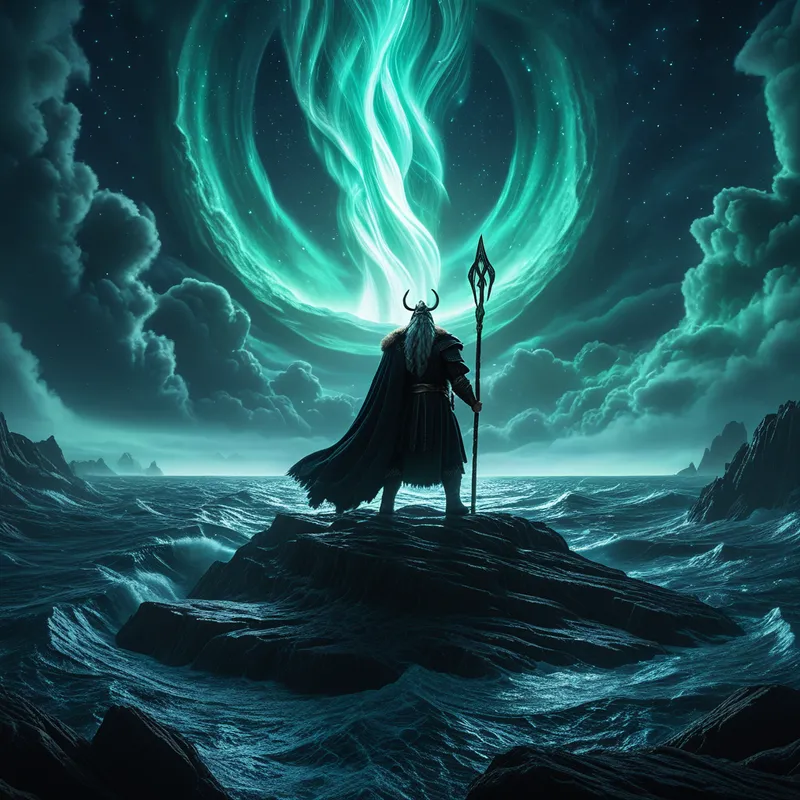
This mythic tapestry comes to us from the pre-Christian Norse world, a culture of farmers, sailors, and warriors living in intimate, brutal negotiation with a formidable natural environment. The myths were not scripture, but a living, breathing cosmology passed down orally through skalds (poets) and storytellers, primarily in the form of eddic and skaldic poetry, later preserved in manuscripts like the Poetic Edda and the Prose Edda.
The societal function was profound. The Frost Giants, or Jötnar, were not mere monsters in a fairy tale. They personified the very real, existential threats of the Norse world: the encroaching ice of a long winter, the destructive power of the sea and storm, the wild, untamable forests and mountains beyond the farmstead’s fence. The myth explained a cosmos that was not created from nothing by a benevolent deity, but was fashioned from the slaughtered body of a chaotic, primordial force. It reflected a worldview where order (ørlög) was a hard-won, temporary state, constantly under siege by entropy and chaos. The gods were not omnipotent creators, but managers and defenders of this fragile order, born from the very chaos they fought. This made the cosmos dynamic, perilous, and deeply interconnected.
Symbolic Architecture
The Frost Giants represent the primordial, unstructured ground of being from which consciousness (the gods) emerges. They are the psychic equivalent of the cold, undifferentiated unconscious—the realm of instinct, raw potential, and latent energy that exists before the ego forms.
The giant is not an enemy to be merely destroyed, but the primal substance from which the self is fashioned. To slay Ymir is to commit the necessary violence of differentiation, of saying “I am” against the backdrop of the undifferentiated “It is.”
Ymir, born from the meeting of fire and ice, symbolizes the first spark of existence born from the tension of opposites. His body becoming the world illustrates that our perceived, structured reality is built upon and from the substance of the primordial self. The surviving giants, like Bergelmir, signify that the unconscious can never be fully eradicated; it retreats to the periphery, from where it continually influences and challenges the conscious mind. The gods’ constant struggle with them is the eternal work of the ego: to integrate, manage, or defend against the contents of the unconscious. The giants are also holders of ancient wisdom (like the giant Mimir), showing that this primal layer of psyche contains not just terror, but profound, non-rational knowledge essential for wholeness.
The Dreamer’s Resonance
When the Frost Giants stride into modern dreams, they herald an encounter with the dreamer’s own frozen, primordial material. This is not the personal shadow of repressed desires, but something deeper: the collective, archetypal layer of cold inertia, ancient grief, or instinctual patterns that feel impersonal and vast.
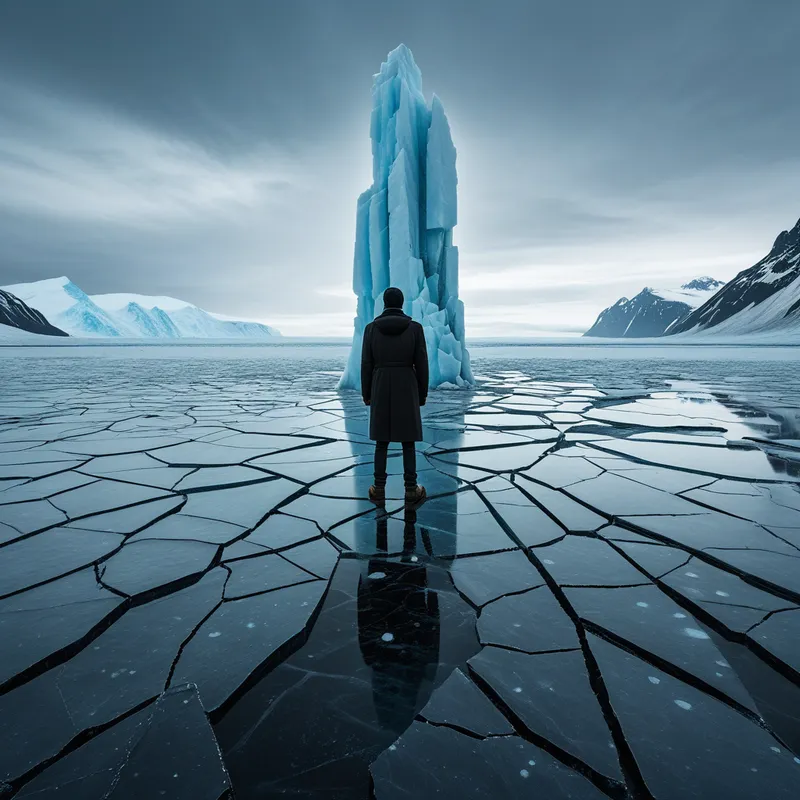
Dreaming of a frozen landscape where a giant form looms suggests a confrontation with a “cold” complex—a part of the psyche that has been frozen in time, perhaps from trauma or ancestral patterning, resistant to the warmth of feeling and relationship. The giant might be silent, imposing, and faceless, representing a somatic reality: a feeling of being emotionally frozen, of having one’s life force locked in ice. The dreamer may be experiencing a period of creative sterility, emotional numbness, or a sense of being besieged by impersonal, life-draining forces (a job, a system, a depression). The giant’s appearance signals that this frozen content is now thawing enough to enter awareness, demanding to be met, not with Thor’s hammer of repression, but with the conscious attention that begins the process of integration.
Alchemical Translation
The myth of the Frost Giants provides a stark map for the alchemical process of individuation. The first stage, nigredo (the blackening), is found in Ginnungagap itself—the void, the chaotic, undifferentiated state of psychic material. The meeting of fire (passion, libido) and ice (stasis, structure) causes the prima materia, Ymir, to coagulate. This is the emergence of a massive, unconscious content.
The slaying of Ymir by the god-brothers represents the crucial, often violent, act of conscious differentiation (separatio). The ego (the Æsir) must “kill” the state of unconscious identification with this primal mass to create a structured psyche (the world). This is a necessary, creative act of self-definition.
The individuation journey requires the courage to dismember the primordial giant within—to take apart the frozen, monolithic aspects of our inherited or instinctual self and use their substance to build a conscious world.
However, the alchemical work is not complete with the murder and the building of walls. The surviving giants in Jötunheimr represent the ongoing process of coniunctio oppositorum (the conjoining of opposites). The conscious ego (Asgard) must continually engage with these chaotic, “giant” elements—our unruly emotions, our cold intellects, our wild instincts—not to annihilate them, but to relate to them. Odin seeking wisdom from giantesses and Thor’s endless battles are two sides of the same coin: engagement. The goal is not a world without giants, but a psyche where the gods and giants are in dynamic, creative tension. The final transmutation is the realization that the gods themselves are born of giant stock; order is born of chaos, consciousness of the unconscious. To become whole is to acknowledge the frost giant as ancestor, as substance, and as the eternal, challenging ground of our own being.
Associated Symbols
Explore related symbols from the CaleaDream lexicon: