The Fravashis Guardian Spirits Myth Meaning & Symbolism
Celestial spirits of destiny and protection who guide souls, uphold cosmic order, and embody the eternal blueprint of all beings within Zoroastrian cosmology.
The Tale of The Fravashis Guardian Spirits
Listen, and let your soul remember. Before the mountains knew their names, before the first fire was kindled by human hands, the cosmos was a battlefield of light and absence. In the infinite expanse, [Ahura Mazda](/myths/ahura-mazda “Myth from Persian culture.”/) conceived not just the world, but its perfect, eternal essence. And from this divine thought, they were born: the Fravashis.
They are the rustle in the high cypress when no wind blows. They are the sudden certainty in the heart of the warrior before the charge. They are the unseen hand that steadies the child at the cliff’s edge. They are not born; they simply are—a shimmering host, countless as the stars, older than the sun.
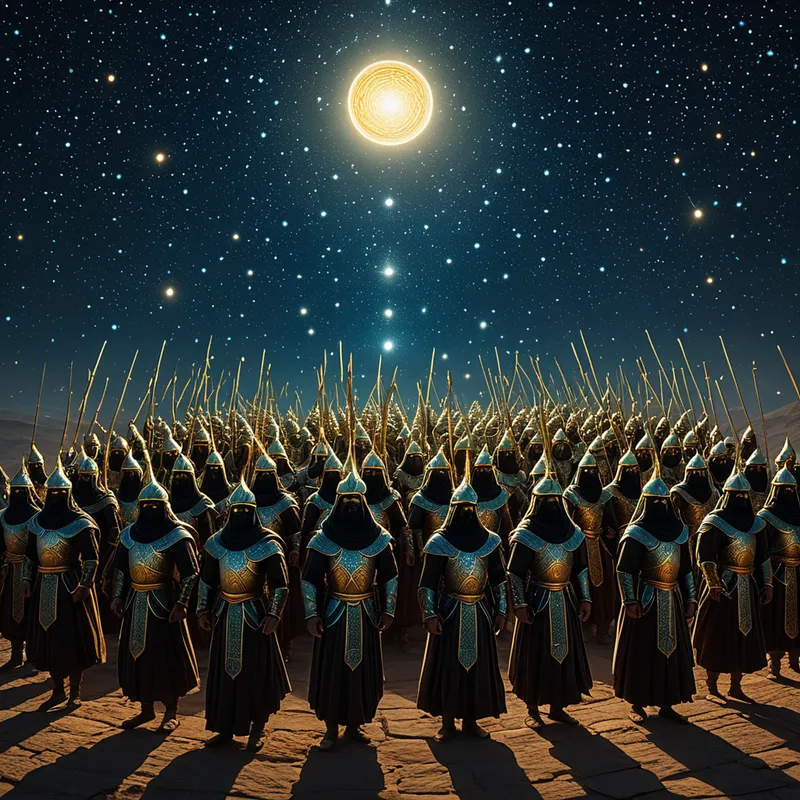
In the First Time, when the great Angra Mainyu spewed forth venom and darkness to stain creation, it was the Fravashis who answered the call. They did not wait to be summoned. As a great eagle plunges to defend its aerie, they descended from the highest realms of light, their forms like polished armor made of dawn. They arrayed themselves as a celestial militia around the vulnerable, newborn earth. With lances of pure intention and shields of unwavering order, they held back the creeping chaos. The rivers learned their courses from them. The seasons found their rhythm in their silent vigil.
But their guardianship is not only of the world; it is of the soul. For each living being—from the prophet to the sparrow, from the towering oak to you, listener, breathing now—has a Fravashi. It is your divine antecedent, your celestial twin, the perfect blueprint of what you are meant to be. It flies ahead of you on your life’s path, a beacon on a distant hill, calling you toward your own fulfillment. It remembers what you have forgotten. In the darkest night, when you feel utterly alone, it is the faint, persistent star by which you can, unknowingly, steer.
And when the year turns, when the veil between worlds grows thin at the festival of Hamaspathmaidyem, they return. Not as ghosts, but as mighty, welcomed warriors. They sweep down to the hearths and fire-temples, drawn by the prayers and offerings of the living. They bring the blessings of strength and continuity, and in return, they drink in the honor given, their power renewed by the memory of those they guard. For they are the chain of being, the golden thread connecting the divine thought to the lived life, the eternal guardian who is also the deepest, most forgotten part of the self.

Cultural Origins & Context
The myth of the Fravashis is a cornerstone of Zoroastrianism, the pre-Islamic religion of ancient Persia. Their lore is primarily preserved in the Avesta, particularly in the hymns dedicated to them, the Fravardin Yasht. This was not a mere folktale but a vital theological and cosmological concept, transmitted through priestly lineages and ritual practice.
Societally, the Fravashis functioned as the ultimate sanctifiers of order (Asha). They legitimized kingship, protected the community and its livestock, and upheld the moral fabric of the world. To honor one’s Fravashi was to align oneself with cosmic truth. The annual festival in their honor reinforced social cohesion, ancestral veneration, and the individual’s place within a vast, meaningful cosmos. They were the spiritual army of the righteous, making the ethical struggle of daily life part of a grand, eternal campaign.
Symbolic Architecture
The Fravashi is perhaps one of the most profound psychological archetypes: the [Guardian](/symbols/guardian “Symbol: A protector figure representing safety, authority, and guidance, often embodying parental, societal, or spiritual oversight.”/) of Potential. It represents the [soul](/symbols/soul “Symbol: The soul represents the essence of a person, encompassing their spirit, identity, and connection to the universe.”/)‘s pre-existent wholeness, the daimon of Socrates, the “true self” that guides from a place of completed [knowledge](/symbols/knowledge “Symbol: Knowledge symbolizes learning, understanding, and wisdom, embodying the acquisition of information and enlightenment.”/) we have yet to earn.
The Fravashi is the future self, perfected, reaching back through time to guide the present self, which is still becoming.
It symbolizes the [paradox](/symbols/paradox “Symbol: A contradictory yet true concept that challenges logic and perception, often representing unresolved tensions or profound truths.”/) of [destiny](/symbols/destiny “Symbol: A predetermined course of events or ultimate purpose, often linked to spiritual forces or cosmic order, representing life’s inherent direction.”/): we are born with a [pattern](/symbols/pattern “Symbol: A ‘Pattern’ in dreams often signifies the underlying structure of experiences and thoughts, representing both order and the repetitiveness of life’s situations.”/), a unique “song” to sing (our Fravashi), but we must freely choose to learn the notes and find our voice. The Fravashi does not compel; it calls. It is the internal compass pointing toward Asha—not as an external rule, but as the innate order of one’s own authentic being. Psychologically, it is the organizing principle of the psyche, the Self in its transcendent [aspect](/symbols/aspect “Symbol: A distinct feature, quality, or perspective of something, often representing a partial view of a larger whole.”/), which seeks to integrate the conscious ego with the unconscious totality.
The Dreamer’s Resonance
When the archetype of the Fravashi stirs in modern dreams, it often manifests as a profound experience of guidance from a numinous, authoritative source. You may dream of a radiant, unnamed figure who gives you a crucial object—a Key, a map written in light. You may find yourself in a vast library where one book on a shelf pulses with a soft glow, bearing your name. You might hear a clear, directive voice from a cloud or a star, not with words, but with a knowing that floods your being.
Somatically, this can feel like a sudden, inexplicable surge of courage, a “second wind” in a dream battle, or the sensation of being lifted or carried. Psychologically, this dream pattern signifies a critical moment of alignment. The ego is lost, facing a Door it fears to open, a Journey it doubts it can complete. The appearance of the guardian spirit represents the unconscious Self activating, providing the resources—confidence, insight, ancestral strength—needed to proceed. It is the psyche’s way of connecting you to your own inner treasury of untapped potential and destiny.

Alchemical Translation
The alchemical process modeled by the Fravashi myth is that of individuation through remembrance. The core struggle is not against a monster, but against forgetfulness—the amnesia of the incarnated soul that has lost touch with its own divine blueprint.
The first stage (nigredo) is the feeling of being lost, adrift, or incomplete, sensing a higher calling but seeing no path. This is the soul on earth, unaware of its Fravashi. The call to adventure is the faint, persistent longing for meaning and wholeness.
The crucial alchemical work (albedo) is the cultivation of inner attention—prayer, meditation, introspection, ethical living. This is the ritual that “invites” the Fravashi. As you strive for order (Asha) in your life, you begin to vibrate at a frequency that your guardian spirit can amplify.
The transmutation occurs when the ego stops seeking a guardian outside and realizes it is in dialogue with its own completed essence. The protector and the protected are one.
The final stage (rubedo) is not becoming the Fravashi, but achieving a conscious partnership with it. It is the integration of that celestial blueprint into your earthly life. You make choices aligned with your deepest truth. Your actions gain the weight and grace of destiny. You become, in your finite way, a guardian of the sacred order you once sought—a living bridge between the divine idea and the manifested world, just as the Fravashis are for all of creation.
Associated Symbols
Explore related symbols from the CaleaDream lexicon:
- Guardian — The primary archetype embodied by the Fravashis, representing protective, guiding spiritual forces that watch over individuals, lineages, and cosmic order itself.
- Spirit — The essential nature of the Fravashi as a non-corporeal, divine essence that exists prior to and alongside physical manifestation.
- Star — The Fravashis are often associated with the stars, seen as celestial beings who dwell in the heavens and descend from the firmament to aid the world.
- Destiny — They represent the pre-ordained, perfect pattern or blueprint for each being, the divine destiny that the soul is called to fulfill.
- Ancestral Spirits — In practice, the Fravashis of one’s ancestors were specifically venerated, linking the living to the spiritual power and wisdom of their lineage.
- Order — The Fravashis are fierce warriors for Asha (cosmic truth and order), fighting against chaos and decay to maintain the fundamental structure of a good creation.
- Light — They are beings of primordial, divine light, emanating from Ahura Mazda and opposing the darkness of Angra Mainyu.
- Soul — Each Fravashi is the pre-existing, celestial counterpart of an individual soul (urvan), its divine prototype and guardian.
- Army — They are described as a mighty, organized heavenly host, a militia of light that fights in a cosmic war against evil.
- Fire — As sacred agents of Ahura Mazda, they are closely linked to the divine element of fire, which represents light, truth, and purity in Zoroastrian ritual.
- Bridge — They function as a connecting bridge between the divine realm and the earthly one, and between an individual’s potential and their lived reality.