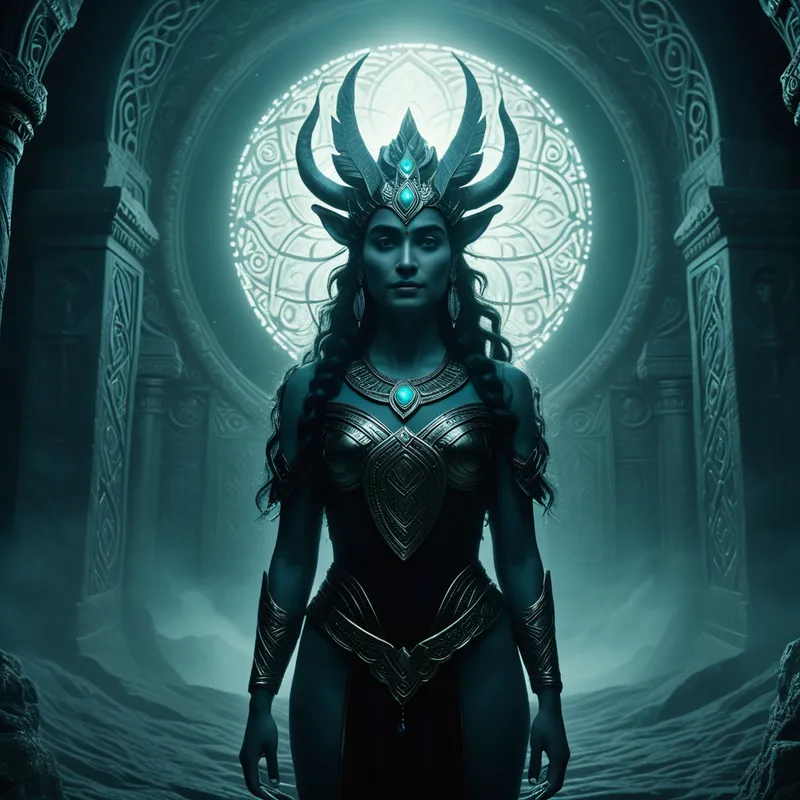
The Four Worlds of Kabbalah
A mystical framework describing four descending realms of existence, from the infinite divine to the physical world, outlining the soul's journey through creation.
The Tale of The Four Worlds of Kabbalah
In the beginning, before beginning, was the [Ein Sof](/myths/ein-sof “Myth from Kabbalistic culture.”/). A light so boundless, so complete, it could not be contained. In an act of profound love and radical self-withdrawal—a [tzimtzum](/myths/tzimtzum “Myth from Kabbalistic culture.”/)—the Infinite made space for something other than Itself. From that primordial emptiness, a single ray of [divine light](/myths/divine-light “Myth from Christian culture.”/) streamed forth, not as a creation, but as an [emanation](/myths/emanation “Myth from Neoplatonic/Gnostic culture.”/), a stepping-down of the infinite into the garments of finite being.
This is the journey of the Four Worlds: not a story of places, but of states of consciousness, of descending vessels crafted to hold the ineffable. The first world to emerge from that primal ray is Atzilut. Here, divine will and essence are one. There is no separation, only the pure presence of the emanator within the emanation. It is a world of unity so absolute that it is less a realm and more the divine breath itself, the archetypal blueprint whispered into [the void](/myths/the-void “Myth from Buddhist culture.”/). The ten Sefirot</ab title> here shine with undifferentiated light, a single, harmonious name of God.
From this unity flows the second world, Beriah. Here, the first distinction arises: the consciousness of a created being, separate from the Creator. This is the realm of the Throne, of archangels, and of the pure, unembodied intellect. In Beriah, the divine light is received as a blinding insight, a “creation from nothingness” (yesh me’ayin). The vessels are finer, but a shadow has fallen—[the shadow](/myths/the-shadow “Myth from Jungian culture.”/) of self-awareness, the first fragile sense of an “I” that contemplates the Divine “Thou.”
The stream continues its descent, cooling and coalescing into the third world, Yetzirah. If Beriah is the thought, Yetzirah is the emotion and the image. This is the vibrant, turbulent realm of the celestial choir, the lower angels, and the [psyche](/myths/psyche “Myth from Greek culture.”/) in its full emotional spectrum. Here, the divine attributes take on dynamic, relational forms. Love, judgment, compassion, and splendor interact in a complex dance. It is [the world](/myths/the-world “Myth from Tarot culture.”/) of the heart, of vision, and of the soul’s passionate longing. The vessels are now susceptible to rupture, for emotion can overflow its bounds.
Finally, the light reaches its most dense garment: the fourth world, Assiyah. But Assiyah is twofold. There is an upper Assiyah, a spiritual dimension of action and divine energy, and the lower Assiyah we inhabit: the world of matter, of bodies, of stones, trees, and stars. Here, the divine light is hidden, clothed in the coarse garments of physical law. It is the realm of deed and consequence, where the spark of the infinite lies buried within the shell of the finite, awaiting discovery. The journey from Atzilut to Assiyah is the great concealment, the divine play of hide-and-seek within the theater of existence.
Yet the tale is not one of exile alone. It is also the map of return. For the human soul, a microcosm containing all four worlds, is tasked with the tikkun, the repair. Through mindful action in Assiyah, inspired by the formative visions of Yetzirah, guided by the creative intellect of Beriah, and aligned with the essential unity of Atzilut, the light is gathered back up. The worlds are not floors of a prison, but steps of a ladder—and the ladder is planted firmly in [the earth](/myths/the-earth “Myth from Hindu culture.”/), its top reaching the heavens.
Cultural Origins & Context
The schematic of the Four Worlds (Arba Olamot) crystallized in the later strata of Jewish mystical thought, most prominently within the Zohar and the subsequent teachings of the 16th-[century](/myths/century “Myth from Biblical culture.”/) Kabbalists of Safed, particularly Rabbi [Isaac](/myths/isaac “Myth from Biblical culture.”/) Luria (the Ari). While earlier Jewish philosophy grappled with the gap between a transcendent God and a material world, the Kabbalists provided a dynamic, process-oriented model.
This framework did not emerge in an intellectual vacuum. It was a profound response to historical trauma, most acutely the Spanish Expulsion of 1492. The question of how the Divine could be present in a world of such palpable exile and fragmentation was existential. [The Lurianic Kabbalah](/myths/the-lurianic-kabbalah “Myth from Kabbalistic culture.”/), with its doctrines of tzimtzum (divine contraction), [the breaking of the vessels](/myths/the-breaking-of-the-vessels “Myth from Jewish culture.”/) (shevirat ha-kelim), and the subsequent gathering of sparks, used the architecture of the Four Worlds to explain both the catastrophe of creation and the path to its redemption. The worlds became stages in a cosmic drama of divine self-revelation and concealment, directly mirroring the Jewish experience of diaspora and the yearning for restoration.
The system is deeply intertwined with other core Kabbalistic concepts. [The ten Sefirot](/myths/the-ten-sefirot “Myth from Kabbalistic culture.”/) manifest uniquely in each world, acting as the specific channels of divine energy for that level of reality. Similarly, the four letters of the [Tetragrammaton](/myths/tetragrammaton “Myth from Kabbalistic culture.”/) (YHVH) are often mapped onto the four worlds, and the scheme corresponds to the four levels of biblical interpretation: Peshat (literal/Assiyah), Remez (allegorical/Yetzirah), Derash (homiletical/Beriah), and Sod (secret/Atzilut). Thus, the Four Worlds are not just a cosmology but a hermeneutic, a way of reading reality itself.
Symbolic Architecture
The Four Worlds form a living ontology, a symbolic [architecture](/symbols/architecture “Symbol: Architecture in dreams often signifies structure, stability, and the framing of personal identity or life’s journey.”/) of [consciousness](/symbols/consciousness “Symbol: Consciousness represents the state of awareness and perception, encompassing thoughts, feelings, and experiences.”/) and being. Each world represents a fundamental mode of [interaction](/symbols/interaction “Symbol: Interaction in dreams symbolizes communication, relationships, and connections with others, reflecting the dynamics of personal engagement and social settings.”/) between the infinite and the finite.
Atzilut (Emanation) is the world of pure identity, where the divine will and its expression are inseparable. It symbolizes the state of non-dual awareness, the ground of being before the subject-object split. Here, the soul experiences itself not as a creature, but as an undifferentiated expression of the divine breath.
Beriah (Creation) introduces the primal duality of Creator and created. It represents the birth of the separate self, the “I am” that stands in relation to a “Thou art.” This is the realm of pure form and archetype, the blueprint that exists in the mind of the architect before ground is broken.
Yetzirah (Formation) is the world of psyche and relationship. It symbolizes the emotional and imaginative life, where abstract ideas from Beriah take on color, sound, and dynamic form. This is the inner landscape of angels and demons, of passion and poetry, where the soul’s journey is felt most acutely.
Assiyah (Action) is the world of manifestation and consequence. It symbolizes the concrete reality of body, matter, and deed. The divine light here is most concealed, making it the realm of free will par excellence. It is in the gritty reality of Assiyah that the abstract ideals of the higher worlds are tested, embodied, and realized—or broken.
This architecture is not hierarchical in a simple, evaluative sense. While Atzilut is “closer” to the [source](/symbols/source “Symbol: The origin point of something, often representing beginnings, nourishment, or the fundamental cause behind phenomena.”/), Assiyah is the necessary completion, the stage where potential becomes actual. The flaw, in the Lurianic view, was not the descent itself, but a fragility in the vessels of Yetzirah and Beriah that could not contain the intensity of the light, causing a “breaking” that scattered divine sparks into the shells (kelipot) of Assiyah. Thus, the entire [system](/symbols/system “Symbol: A system represents structure, organization, and interrelated components functioning together, often reflecting personal or social order.”/) is one of dynamic [tension](/symbols/tension “Symbol: A state of mental or emotional strain, often manifesting physically as tightness, pressure, or unease, signaling unresolved conflict or anticipation.”/), a sacred process of [emanation](/symbols/emanation “Symbol: A spiritual or divine energy flowing outward from a source, often representing creation, influence, or the manifestation of the sacred into the material world.”/), [vessel](/symbols/vessel “Symbol: A container or structure that holds, transports, or protects something essential, representing the self, emotions, or life journey.”/)-making, [rupture](/symbols/rupture “Symbol: A sudden break or tear in continuity, often representing abrupt change, separation, or the shattering of established patterns.”/), and repair.
The Dreamer’s Resonance
To the depth psychologist, the Four Worlds are not distant cosmic realms but an internal cartography of the human psyche. They map the journey of an impulse from its unconscious origin to its conscious enactment.
Atzilut resonates with the primordial, unformed depths of the unconscious—what Jung might call the psychoid layer or [the collective unconscious](/myths/the-collective-unconscious “Myth from Jungian culture.”/) in its most undifferentiated state. It is the source of numinous experience, the “god-image” within, prior to any personal elaboration. A dream image that carries this quality feels utterly archetypal, fateful, and self-evident, beyond analysis.
Beriah corresponds to the moment an unconscious content first constellates as a recognizable form or idea in the psyche. It is the daimon or guiding thought that emerges with compelling authority. This is the realm of powerful inner figures (the Wise Old Man, [the Great Mother](/myths/the-great-mother “Myth from Jungian culture.”/)) and core, life-defining insights that structure one’s worldview.
Yetzirah is the rich tapestry of [the personal unconscious](/myths/the-personal-unconscious “Myth from Jungian Psychology culture.”/) and the imaginative faculty—the world of active imagination, complex emotion, and symbolic elaboration. Here, the archetypal forms of Beriah take on personal mythologies, conflicts, and affective charge. Our dreams, fantasies, and emotional complexes live here, in constant, fluid formation.
Assiyah is the world of ego-consciousness and physical reality. It is where the inner images and impulses from the higher worlds are either acted out, sublimated, repressed, or integrated into daily life. A psychological tikkun (repair) occurs when [the ego](/myths/the-ego “Myth from Jungian culture.”/) (Assiyah) consciously engages with the formative emotions (Yetzirah), understands their archetypal patterns (Beriah), and aligns with a deeper, transpersonal purpose (Atzilut), thereby healing the rupture between consciousness and the unconscious.

Alchemical Translation
The Kabbalistic process mirrors the alchemical opus with striking clarity. The journey through the Four Worlds is [the great work](/myths/the-great-work “Myth from Alchemical culture.”/) of distillation and coagulation, of solving and coagulating the spirit.
The descent from Atzilut to Assiyah is the solve—the divine unity dissolving itself into the multiplicity of creation. The hidden light buried in matter is the prima materia, the leaden state of unconsciousness, the divine spark trapped in the kelipah (shell) of the mundane ego.
The ascent through the worlds is the coagula—the gathering of scattered sparks. The work in Assiyah (the nigredo) involves confronting the shadow in one’s actions and circumstances. The emotional purifications of Yetzirah (the albedo) wash the psyche in the waters of reflection. The illuminating insights of Beriah (the citrinitas) provide the golden, guiding philosophy. Finally, the unitive experience of Atzilut (the rubedo) is the coniunctio, the marriage of the soul with its divine source, resulting in the philosopher’s stone—the fully realized, redeemed human who transforms base reality into gold.
The tzimtzum, the initial contraction, is the alchemical vessel itself—the necessary limitation that makes the work possible. The breaking of the vessels is the unavoidable mortificatio, the [death](/myths/death “Myth from Tarot culture.”/) and fragmentation that precedes new, more resilient integration. Thus, the Four Worlds provide a spiritual technology, a stepwise guide for the transformation of the soul from identification with the fragment (Assiyah) to participation in the whole (Atzilut).
Associated Symbols
Explore related symbols from the CaleaDream lexicon:
- Kabbalah — The mystical tradition and map of consciousness that articulates the journey of divine emanation and soul-return through structures like the Four Worlds and [the Tree of Life](/myths/the-tree-of-life “Myth from Kabbalistic culture.”/).
- Light — The fundamental substance of divine emanation, which descends, garments itself, and is ultimately hidden and sought after in the process of creation and redemption.
- Mirror — A symbol for each world, which reflects the divine light according to its own capacity and clarity, from the perfect reflection of Atzilut to the obscured glass of Assiyah.
- Tree — The [Tree of Life](/myths/tree-of-life “Myth from Kabbalistic culture.”/), whose ten Sefirot manifest distinctly in each of the Four Worlds, providing the connective structure for the flow of divine energy through all levels of reality.
- Vessel — The receptive structures of each world, which attempt to contain the divine light; their fragility and potential for breaking or repair is central to the cosmic drama.
- Journey — The soul’s descent into incarnation and its subsequent ascent back to source, mapped precisely onto the path through the Four Worlds.
- Bridge — The connective pathways, such as [the Sefirot](/myths/the-sefirot “Myth from Kabbalistic culture.”/) or righteous human action, that allow for communication and the flow of energy between the separate realms.
- Door — The transition point between each world, a liminal space of passage requiring specific qualities of consciousness to traverse.
- Key — The mystical knowledge, intention, or deed that unlocks understanding and facilitates movement from one level of reality to another.
- Soul — The human microcosm that contains all four worlds within it and is the primary agent for their repair and unification.
- Shadow — The “shells” or kelipot in Assiyah that conceal the divine sparks, representing the unintegrated, fragmented aspects of reality that must be redeemed.
- Rebirth — The ultimate goal of the process: the restoration (tikkun) of the worlds to their intended harmony, experienced by the soul as a return to its source in a new, integrated state.