The Four Thieves Myth Meaning & Symbolism
A tale of four cunning thieves who, facing plague, create a protective potion from stolen herbs, transforming theft into a paradoxical act of salvation.
The Tale of The Four Thieves
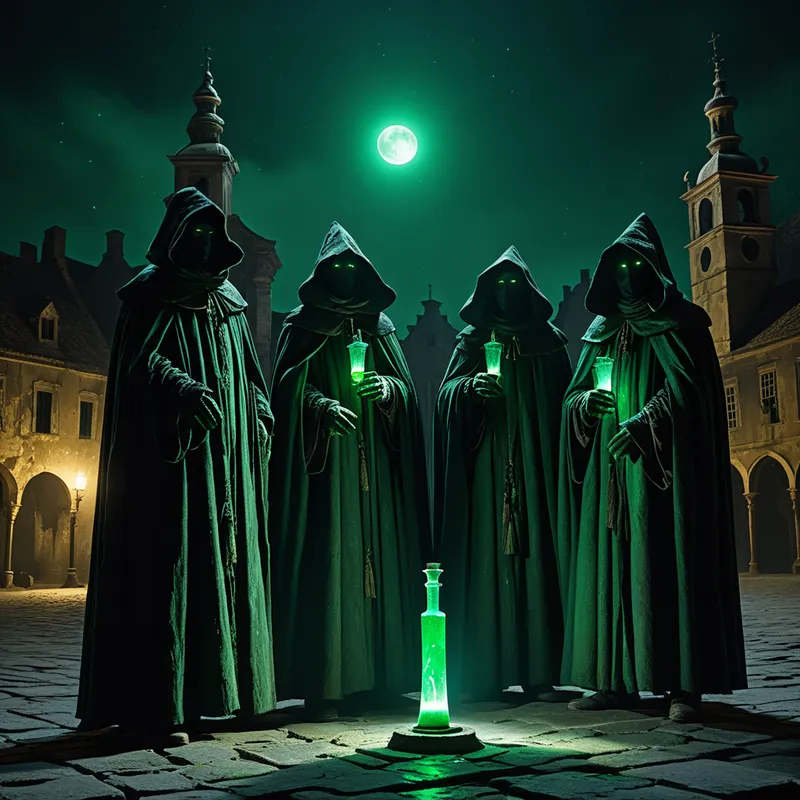
Listen, and hear a tale not of gods on high, but of men in the low places. A tale born in the reek of plague, when the bell tolled ceaselessly and the smoke of burning tar and flesh hung over the cities like a shroud. In such a time, when the living envied the dead, there walked four men. They were known only as shadows, as whispers: the Thieves.
While the righteous barricaded their doors, these four moved through the stricken streets like rats through a midden heap. Their trade was desperation’s currency—they pilfered from the homes of the dead and the dying, their fingers nimble with a terrible courage. The plague, the Black Death’s vengeful cousin, was their accomplice and their greatest foe. They saw strong men fall in hours, heard the weeping behind shuttered windows. They knew their luck was a fraying thread.
One night, gathered in a cellar that stank of earth and stolen wine, the eldest among them, a man with eyes like flint, spoke. “The Reaper takes our customers,” he said, his voice a dry rasp. “Soon he will come for the merchants. We must treat with him. Not with prayers, but with craft.”
And so, they turned their cunning from pure theft to a darker art. They became scavengers of a different sort. Under the cloak of moonless nights, they did not raid for silver, but for green, living things. From the walled gardens of abandoned monasteries, they took sprigs of sharp rosemary. From overgrown hedgerows, they snatched wild sage. They found lavender clinging to life in forgotten corners. These they bundled with other pungent herbs—wormwood, rue, meadowsweet.
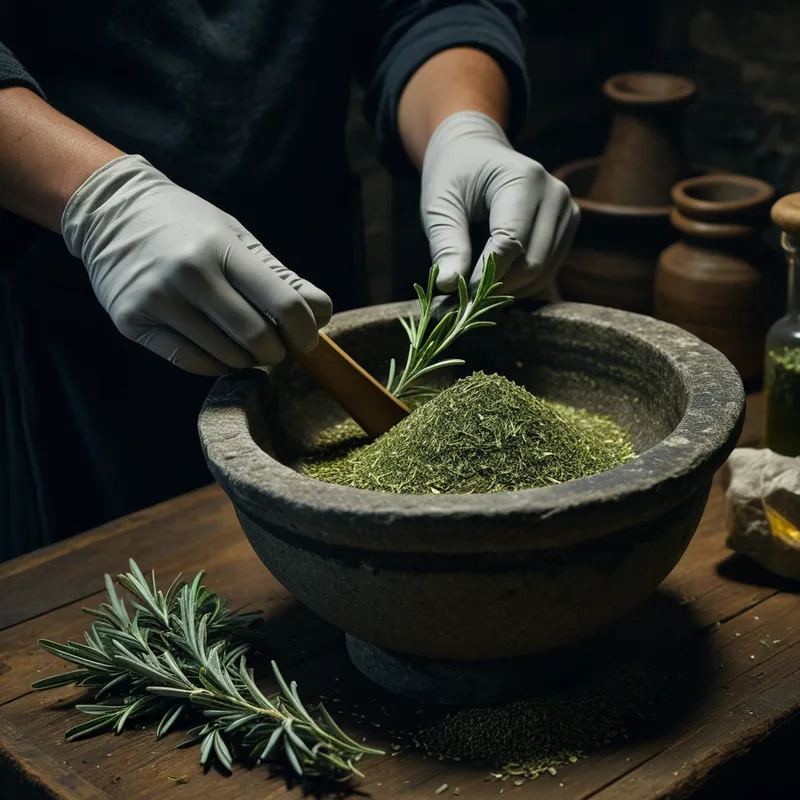
In their hidden den, they worked. They crushed the stolen herbs in a mortar, releasing fragrances that fought the stench of death. They drowned the mash in strong vinegar, stolen too from a merchant’s cask. They added handfuls of rough salt. For days they let it steep, until the liquid turned a murky, potent green. This, they strained through linen. This, they rubbed upon their hands, their throats, their temples. They soaked their masks in it. The acrid, herbal perfume became their second skin, their olfactory armor.
Thus anointed, they walked where no others dared. They entered plague houses not as specters of death, but as its strange challengers. They took what they wished, untouched by the miasma that felled others. The very act that defined them—theft—was now enabled by a potion born of stolen goods. They had not outrun death; they had bargained with it, using [the earth](/myths/the-earth “Myth from Hindu culture.”/)’s own secrets, procured by their own lawless hands. They survived not by grace, but by grim, ingenious theft from nature itself. When they were finally caught, their lives were spared not for their crimes, but for the secret of their vinegar. Theft was exchanged for recipe, a paradox sealed.
Cultural Origins & Context
This story lives in the borderlands between folklore and folk medicine, rooted not in ancient epics but in the gritty soil of early modern Europe, particularly in France during the plague outbreaks of the 17th century. It is not a myth of cosmic origin, but a legend of pragmatic survival. It was passed down not by bards in halls, but by apothecaries, herbalists, and “cunning folk” in market squares and country lanes. The tale served a dual societal function. Primarily, it was an etiological story explaining the provenance of a famous prophylactic remedy known as “Four Thieves Vinegar” (Vinaigre des Quatre Voleurs), a real historical formula documented in herbal pharmacopoeias.
Secondarily, it acted as a moral and psychological parable for a society repeatedly shattered by pandemic. It gave a human, albeit roguish, face to the struggle against an invisible, indiscriminate killer. The thieves embody the ultimate outsiders who, through applied knowledge and sheer audacity, achieve what the established order—the doctors, the church, the nobility—could not: a form of mastery over the terror. The story democratizes power, suggesting that salvation (or at least survival) could be concocted from common, if illicitly gathered, materials.
Symbolic Architecture
The myth’s power lies in its profound symbolic contradictions. The thieves are not heroes, yet they perform a heroic act of survival. They are not healers, yet they create a healing potion. They are agents of [chaos](/symbols/chaos “Symbol: In Arts & Music, chaos represents raw creative potential, uncontrolled expression, and the breakdown of order to forge new artistic forms.”/) (theft) who impose a unique order ([immunity](/symbols/immunity “Symbol: Represents psychological resilience, boundaries, and the capacity to resist external influences or internal vulnerabilities.”/)).
The greatest alchemy is not turning lead to gold, but transforming the base action of survival into the sacred knowledge of preservation.
The Four themselves are a potent [symbol](/symbols/symbol “Symbol: A symbol can represent an idea, concept, or belief, serving as a powerful tool for communication and understanding.”/). They represent a quaternity, a symbol of wholeness and earthly manifestation in Jungian thought ([the four elements](/myths/the-four-elements “Myth from Greek culture.”/), four directions, four functions of [consciousness](/symbols/consciousness “Symbol: Consciousness represents the state of awareness and perception, encompassing thoughts, feelings, and experiences.”/)). Their unified [action](/symbols/action “Symbol: Action in dreams represents the drive for agency, motivation, and the ability to take control of situations in waking life.”/) suggests that a complete, if shadowy, self is required to confront annihilation. The [Vinegar](/symbols/vinegar “Symbol: A sour, acidic liquid symbolizing bitterness, preservation, transformation, or purification. It often represents harsh truths or emotional sourness.”/), sharp and preservative, symbolizes the harsh, acidic [truth](/symbols/truth “Symbol: Truth represents authenticity, honesty, and the quest for knowledge beyond mere appearances.”/) of the [reality](/symbols/reality “Symbol: Reality signifies the state of existence and perception, often reflecting one’s understanding of truth and life experiences.”/) they face—the “bitter [medicine](/symbols/medicine “Symbol: Medicine symbolizes healing, transformation, and the pursuit of knowledge, addressing both physical and spiritual health.”/)” of existence itself. The Stolen Herbs represent [knowledge](/symbols/knowledge “Symbol: Knowledge symbolizes learning, understanding, and wisdom, embodying the acquisition of information and enlightenment.”/) and vitality pilfered from the cultivated, conscious world (the garden) and the wild, unconscious world (the hedgerow). They do not ask for these gifts; they take them, indicating that the deepest protective wisdom often must be seized, not given.
The core symbol is the Paradoxical Act: the theft that saves. This represents the psychological truth that elements of the [personality](/symbols/personality “Symbol: Personality in dreams often symbolizes the traits and characteristics of the dreamer, reflecting how they perceive themselves and how they believe they are perceived by others.”/) we deem “criminal” or “unacceptable” (the [Shadow](/symbols/shadow “Symbol: The ‘shadow’ embodies the unconscious, repressed aspects of the self and often represents fears or hidden emotions.”/)) can, when integrated with conscious craft (the recipe), become our greatest [source](/symbols/source “Symbol: The origin point of something, often representing beginnings, nourishment, or the fundamental cause behind phenomena.”/) of [resilience](/symbols/resilience “Symbol: The capacity to recover quickly from difficulties, adapt to change, and maintain strength through adversity.”/) and unique capability.

The Dreamer’s Resonance
To dream of the Four Thieves is to dream from a place of profound psychological threat. The dreamer is likely in a life phase where they feel a “plague” upon their spirit—a consuming anxiety, a toxic environment, a pattern of illness, or a feeling of moral or emotional contagion. The thieves in the dream are not external figures but archetypal representations of the dreamer’s own rogue capabilities.
Somatically, this dream may be accompanied by a sensation of needing to move stealthily, of holding one’s breath, or of a sharp, acrid smell. Psychologically, it signals a process of urgent, perhaps unconventional, self-preservation. The dreamer’s [psyche](/myths/psyche “Myth from Greek culture.”/) is assembling a “crew” of inner resources (the four thieves) that operate outside their normal moral code to procure what is needed to survive. It is a call to recognize and sanction one’s own cunning, to gather the scattered “herbs” of one’s experience and knowledge, however obtained, and to blend them into a protective identity. The dream warns against staying passive in the face of inner or outer decay; it advocates for a strategic, even rebellious, self-care.
Alchemical Translation
The myth of the Four Thieves is a perfect model for the alchemical stage of [Nigredo](/myths/nigredo “Myth from Alchemical culture.”/)—the blackening, the descent into the plague-stricken city of the soul, where all seems rotten and hopeless. In the journey of individuation, this is the confrontation with [the Shadow](/myths/the-shadow “Myth from Jungian culture.”/), with despair, and with the putrefaction of old, outworn identities.
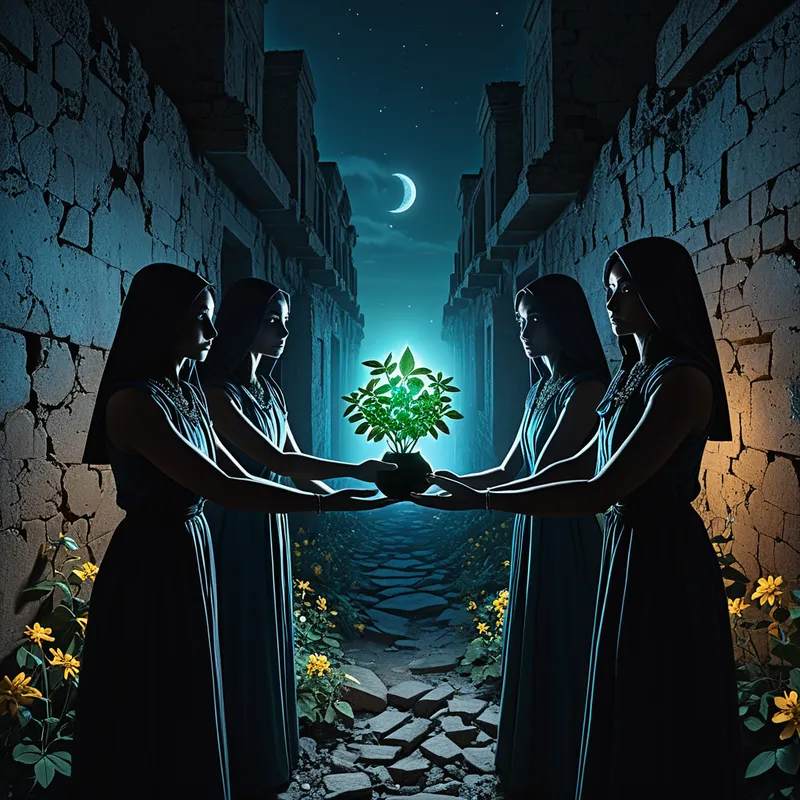
The thieves represent the latent, disowned parts of [the Self](/myths/the-self “Myth from Jungian culture.”/) that are willing to engage with this darkness. Their first operation is Stealing (Collectio): the conscious ego must “steal” insights from the unconscious, gathering fragmented aspects of oneself that have been neglected or repressed (the herbs). Their second operation is Blending (Coniunctio): these stolen elements—perhaps one’s anger (wormwood), one’s wisdom (sage), one’s compassion (lavender)—are crushed together. This is the painful integration, facilitated by the corrosive, truthful medium of vinegar (honest self-assessment).
The potion that protects you is always brewed in the vessel of your deepest vulnerability.
The final result is not a cure for death, but an Elixir of Context. The individual does not transcend their mortal, flawed nature (the thieves remain thieves). Instead, they create a unique formulation that allows them to move through the inevitable plagues of life—loss, failure, illness, despair—without being destroyed by them. They gain a “foul stench” to the psychic infections that felled their former, more naive self. The transformation is not from sinner to saint, but from passive victim to active, albeit unconventional, agent of one’s own fate. The myth teaches that wholeness is often forged in [the crucible](/myths/the-crucible “Myth from Alchemical culture.”/) of necessity, by the hands of the very parts of ourselves we were taught to disavow.
Associated Symbols
Explore related symbols from the CaleaDream lexicon: