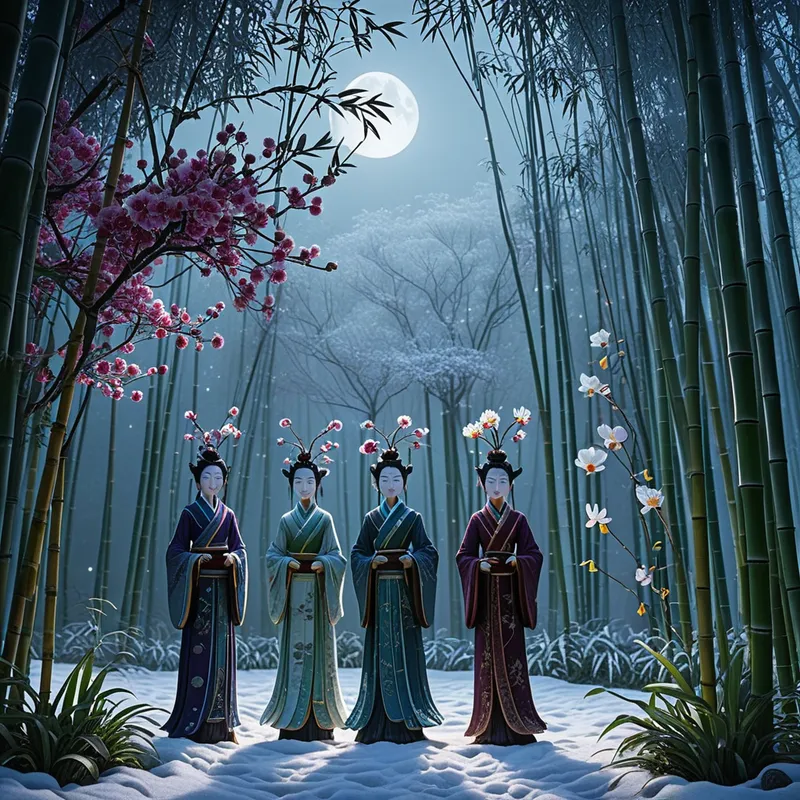
The Four Gentlemen Myth Meaning & Symbolism
A mythic quartet of plants embodying the seasons, whose sacrifice brings order to chaos, teaching the virtues of resilience, purity, integrity, and endurance.
The Tale of The Four Gentlemen
In the time before time, when the sky was a raw canvas and the earth a formless clay, chaos reigned. The seasons were a violent, clashing torrent—scorching heat would freeze in an instant, and gentle rains would turn to howling blizzards. The world knew no rhythm, no rest, no promise of return. The Celestial Emperor, gazing upon the suffering of all living things, felt a sorrow deeper than the oceans. A decree echoed through the halls of heaven: order must be born from this tumult, a cycle to cradle the world.
From the four corners of the spirit realm, they heard the call. They were not warriors of muscle and steel, but beings of essence and quiet fortitude. First, from the biting, silent north, came the spirit of the Plum Blossom. It did not march; it emerged, a defiant fragrance on the frozen wind. “I will hold the line,” it whispered, its voice the crack of ice. “When all is barren and hope seems dead, I will bloom.”
From the eastern mists, where shadows are long and the air is thick with potential, came the spirit of the Orchid. It moved with a grace that parted the fog. “I will breathe in the unseen places,” it murmured. “I will find beauty not in spectacle, but in hidden, fragrant depths.”
Answering from the vibrant, tumultuous south was the spirit of the Bamboo. It stood not as a single entity, but as a grove, its stems whispering together. “I will bend but not break,” they rustled. “I will provide shelter and song in the storm’s fury.”
Lastly, from the western slopes where light grows weary, came the spirit of the Chrysanthemum. Its gaze was steady, accepting the lengthening shadows. “I will stand when the brilliance fades,” it stated calmly. “I will find vigor not in the sun’s peak, but in its gentle decline.”
They presented themselves before the Celestial Emperor, not as petitioners, but as partners in a solemn pact. The Emperor offered no army, only a challenge: “To give the world its rhythm, you must give of your very nature. You must become the markers of time itself, enduring its extremes so that others may know peace.”
One by one, they consented. The Plum Blossom stepped into the void of deepest winter, allowing its delicate flowers to shiver open on bare, black branches against the white silence, becoming the heart of resilience in cold despair. The Orchid retreated into the damp, secluded valleys of early spring, its subtle perfume a secret for those who seek patiently, becoming the soul of humble integrity. The Bamboo anchored itself in the volatile rains and winds of summer, its hollow core singing with the gale, its roots holding fast against the flood, becoming the backbone of adaptable strength. The Chrysanthemum faced the withering dryness of autumn, blooming in brilliant clusters as the world turned gold and fell, becoming the spirit of joyous endurance in life’s later chapters.
Their sacrifice was not a single act, but an eternal vocation. They did not conquer chaos with force; they stitched order into the fabric of reality with the thread of their own enduring qualities. Where their spirits took root, the wild tempest of the seasons began to slow, to deepen, to become a dance. The world exhaled. Winter learned patience from the plum, spring learned depth from the orchid, summer learned resilience from the bamboo, and autumn learned grace from the chrysanthemum. The Four Gentlemen did not rule the seasons; they became their virtuous conscience, their enduring soul.
Cultural Origins & Context
The narrative of the Four Gentlemen, or Sì Jūnzǐ, is less a single, codified myth from a specific text and more a profound cultural archetype that coalesced over millennia. Its roots are deeply entwined with Confucian scholar culture, Daoist natural philosophy, and the ancient Chinese tradition of finding moral exemplars in the natural world. This “myth” was passed down not primarily by bards around a fire, but by scholars, poets, and painters in studios and gardens.
During the Song Dynasty (960–1279 CE), this concept crystallized. Scholar-officials, often facing political exile or disillusionment, turned to nature for solace and symbolic expression. They saw in these four plants not just beauty, but embodied virtues. The plum, orchid, bamboo, and chrysanthemum became the subjects of the “Four Gentlemen” genre in ink painting (shuǐmò) and poetry. By painting the plum that bloomed in adversity, they were painting their own unwavering integrity. By sketching the secluded orchid, they referenced their own refined humility away from courtly corruption.
Its societal function was multifaceted: it was a system of ethical education, a language of personal and political expression (often used to critique authority subtly), and a meditative practice. To paint the Four Gentlemen was to align oneself with their virtues, to participate in their mythic endurance. The myth was thus lived and re-enacted continuously in cultural practice, making it a living psychological and spiritual framework.
Symbolic Architecture
The power of the Four Gentlemen lies in their collective symbolism as a complete cycle of the soul’s virtues, each corresponding to a season and a fundamental human quality.
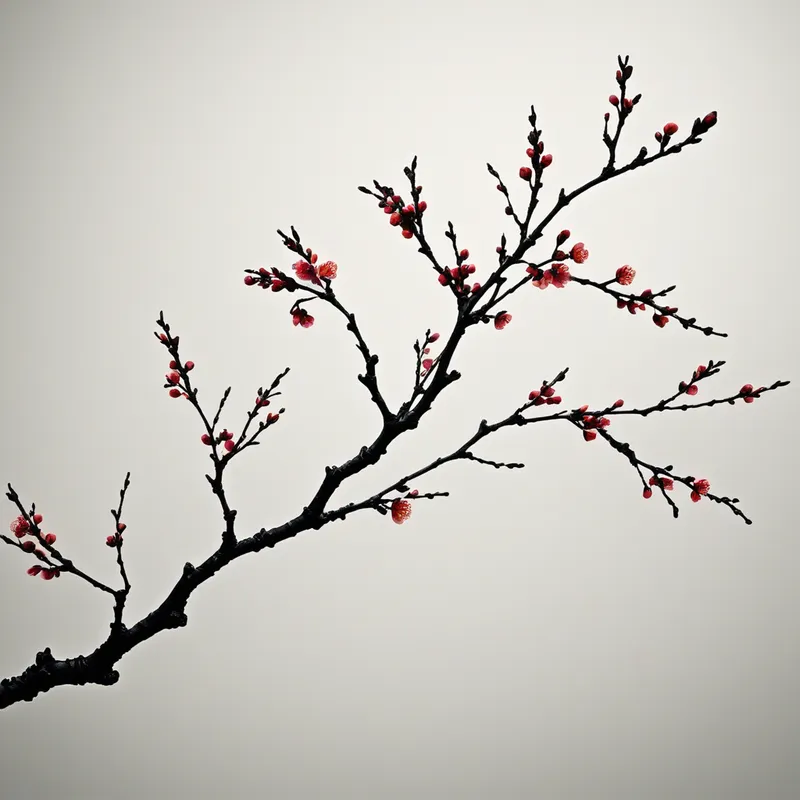
The Plum Blossom (Winter) symbolizes hope and perseverance against adversity. It blooms on bare branches, often through snow, making it the ultimate symbol of vitality emerging from barrenness, of beauty and fragrance born from harsh conditions. It represents the inner fortitude that activates when external support falls away.
True resilience is not the absence of winter, but the capacity to flower within it.
The Orchid (Spring) symbolizes humility, refinement, and inner worth. It often grows in secluded, shady valleys, its beauty subtle and its fragrance discovered rather than announced. It represents the virtue that does not need to proclaim itself, the integrity that remains constant in obscurity. It is the soul’s quiet confidence.
The Bamboo (Summer) symbolizes resilience, flexibility, and uprightness. Its hollow stem allows it to bend in the strongest wind without breaking, springing back upright. Its rapid growth and evergreen nature speak to adaptability and enduring strength. It represents the ego structure that can withstand life’s pressures through suppleness, not rigidity.
The Chrysanthemum (Autumn) symbolizes endurance, longevity, and noble retirement. It blooms last, often after the first frosts, celebrating maturity and the beauty of the later phases of life. Associated with the scholar enjoying his garden away from worldly strife, it represents the wisdom and contentment found in life’s natural autumn, a triumph of spirit over the inevitability of change.
Together, they form a quaternity—a symbol of wholeness in Jungian thought. They map the complete process of enduring a cycle: the initial defiance (Plum), the inward turning and cultivation (Orchid), the resilient engagement with the world’s forces (Bamboo), and the graceful, fruitful culmination (Chrysanthemum).
The Dreamer’s Resonance
When the pattern of the Four Gentlemen emerges in modern dreams, it rarely appears as a literal quartet of plants. Instead, it manifests as a somatic and psychological process of navigating a complete cycle of challenge and integration.
Dreaming of blooming in a frozen, lifeless landscape (Plum) suggests the dreamer is in a psychological “winter”—a period of isolation, depression, or creative barrenness. The psyche is activating its most foundational resilience, trying to prove that life and value persist even here. The somatic sense might be one of cold tension suddenly pierced by a warm, fragrant certainty.
A dream of discovering a subtle, beautiful object in a hidden, overlooked place (Orchid) indicates a process of valuing the neglected parts of the self. The dreamer may be recovering a sense of inherent worth that doesn’t require external validation. The feeling is one of quiet, private revelation.
Dreams of withstanding a great storm by bending elastically, or being part of a supportive, whispering community that sways together (Bamboo) point to current life pressures. The psyche is rehearsing adaptability, seeking the strength that comes from healthy boundaries (the hollow stem) and communal support, rather than brittle individualism.
Dreaming of vibrant celebration or diligent work as the environment visibly ages or declines (Chrysanthemum) speaks to the dreamer’s relationship with time, aging, or the culmination of a long project. It is the psyche’s work on finding joy and vitality within limitation and maturity, combating the fear of fading relevance.

Alchemical Translation
The myth of the Four Gentlemen is a precise alchemical map for the process of psychic transmutation, or individuation. It models how the ego, faced with the chaos of the unconscious and the outer world, can integrate opposing states to achieve a more complete Self.
The initial Chaos is the prima materia—the raw, undifferentiated state of psychic suffering, where emotions and life events have no rhythm or meaning. The call of the Celestial Emperor is the summons from the Self, the central archetype of wholeness, to begin the work.
Individuation is not about becoming perfect, but about becoming whole by consciously enduring the full cycle of one’s nature.
The Plum Blossom stage is the nigredo, the blackening. This is the confrontation with the shadow, with despair and cold isolation. The alchemical work here is calcinatio—burning in the cold fire of adversity. The triumph is not escaping winter, but producing the “flower” of conscious awareness from within it. One discovers the core identity that exists apart from favorable conditions.
The Orchid stage is the albedo, the whitening. After the confrontation, the soul retreats inward for purification. This is the sublimatio—a distillation of essence. In the hidden valley of introspection, one refines their values, separates the authentic (the subtle fragrance) from the ego’s noise, and cultivates inner purity without fanfare.
The Bamboo stage is the citrinitas, the yellowing. The integrated insight now faces the test of the outer world. This is the solutio—being dissolved in the waters of emotion and relationship, and the coagulatio—re-forming with greater flexibility. The ego learns to bend to life’s winds without losing its essential uprightness, building a resilient structure for the psyche.
The Chrysanthemum stage is the rubedo, the reddening. This is the culmination, the production of the philosophical gold. It is the conscious enjoyment and embodiment of the completed cycle. The individual carries the virtues of all previous stages, finding vitality and color in the autumn of life or endeavors. The work is complete when one can stand in the fading light, not with regret, but with the enduring, golden bloom of a Self that has consciously participated in its own seasons. The chaos is not defeated; it is transformed into a virtuous, living cycle.
Associated Symbols
Explore related symbols from the CaleaDream lexicon: