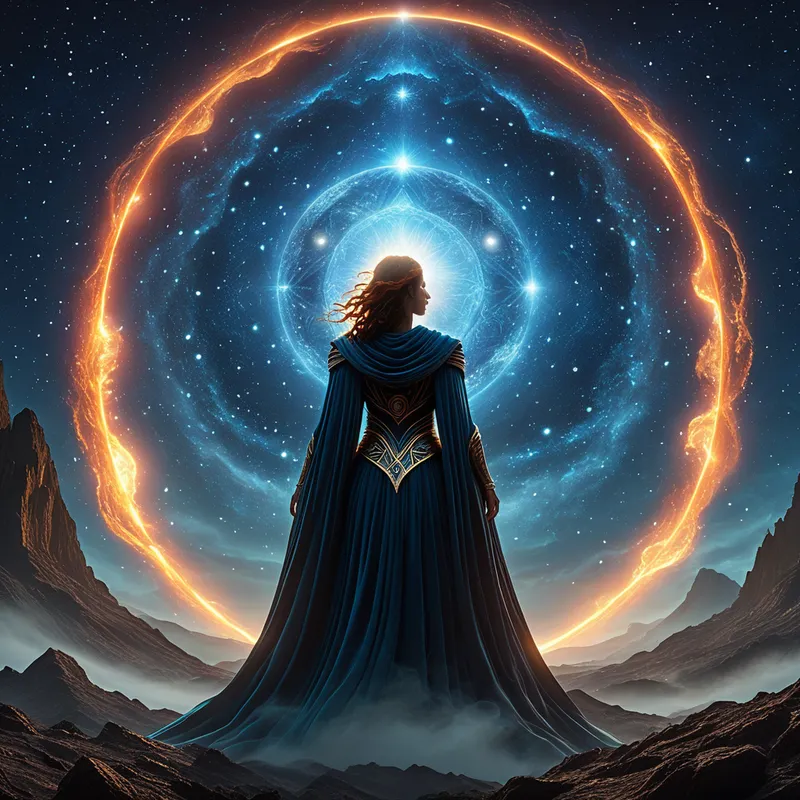
The Four Elements Myth Meaning & Symbolism
The primordial struggle of Earth, Air, Fire, and Water, born from Chaos, forming the cosmos and the foundation of all existence and psyche.
The Tale of The Four Elements
In the beginning, there was only Chaos—a yawning, breathless, silent dark. It was not emptiness, but a seething potential, a womb of unformed things. From this abyss, without mating, without cause, the first beings emerged.
First came Gaia, the broad-breasted one. She rose, not as soil and stone, but as the very idea of the solid, the reliable, the enduring. She was the foundation, the lap of all life to come. Next from Chaos swelled Eros, the golden-winged force of binding desire, whose shimmering light would set all things in motion, drawing them together. Then came Tartarus, the misty pit of the deep down, and Nyx, the night itself, cloaked in starless shadow.
But Gaia, alone and vast, desired an equal. From her own boundless body, she brought forth Ouranos, the starry sky. He arched over her completely, a perfect, glittering vault, and with the urging of Eros, they lay together. Their union was the first marriage, the embrace of Heaven and Earth.
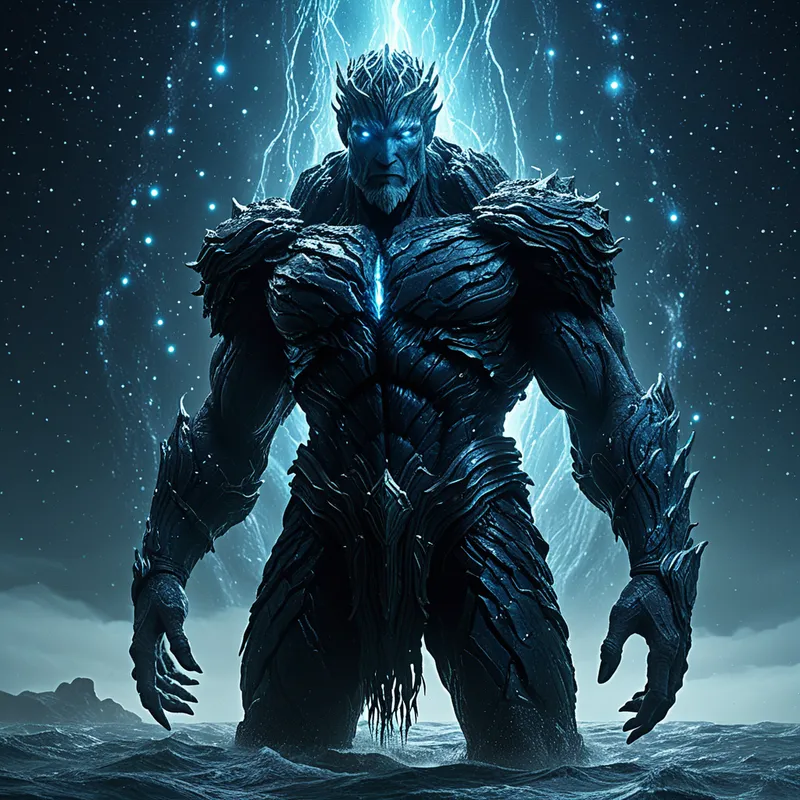
From this embrace, the first children were born—not men, not gods as we later knew them, but the Titans, vast and elemental. There was Okeanos, the great river that encircled the world, his waters the source of all seas and springs. There was Mnemosyne, from whose depths all thought would flow. But also born were the wilder, more formidable forces: Koios, Krios, Themis, and others, each a facet of the raw cosmos.
Yet Ouranos looked upon his children with loathing and fear. He saw their power, their potential to challenge him. As each was born, he refused to let them leave the womb of Gaia, forcing them back into her dark depths. The Earth groaned under the weight of this oppression, her children trapped within her. The solid ground was pregnant with fury.
In her agony, Gaia fashioned a sickle of adamant, grey and sharp. She called to her children, and only the youngest Titan, Kronos, bold and cunning, answered her call. He lay in ambush when Ouranos descended to lie with Gaia once more. As the sky lowered himself, Kronos struck with the jagged blade, severing his father’s member and casting it into the sea.
From the blood that fell upon Gaia, the Erinyes (Furies), the Giants, and the Meliai (ash-tree nymphs) sprang forth—the spirits of vengeance, strength, and nature. But from the seed that fell upon the foaming sea, stirred by the waves, arose Aphrodite, beauty born from a violent act.
With Ouranos wounded and receding, the Titans were finally free. Kronos claimed the throne. But the castrated sky, now forever separate from the earth, created a space between them—a chasm of air, of atmosphere, where light could play and winds could roam. The elements, born of conflict and separation, now had their domains: the solid Earth beneath, the flowing Waters upon and within her, the radiant Fire of the sun and stars in the distant Sky, and the breathable Air of the gap between. The cosmos, once a suffocating unity, was now a differentiated, dynamic, and living whole, poised for the drama of the gods and the age of mortals to come.
Cultural Origins & Context
This primordial narrative is not a single myth from one source, but the foundational layer of Greek cosmogony, pieced together primarily from Hesiod’s Theogony (c. 700 BCE). Hesiod, a poet claiming inspiration from the Muses, provided the most systematic account of the birth of the gods and the universe. This story was not mere entertainment; it was a sacred history, recited to explain the very nature of reality. It served a societal function by establishing a divine order—a genealogy of power from Chaos to the Olympians—that mirrored and legitimized patriarchal structures and the cycles of conflict and succession.
The myth was passed down orally by bards and poets long before Hesiod, evolving in the telling. It functioned as an answer to profound questions: Why is the sky separate from the earth? Where do storms, seas, and mountains come from? The answer lay in a familial drama of staggering scale, making the forces of nature intelligible as personified beings with motives and emotions. This narrative provided a psychological container for the terrifying and sublime experiences of the natural world, transforming random chaos into a story with a logic, however brutal.
Symbolic Architecture
The myth is a profound allegory for the process of creation through differentiation. The initial state of Chaos represents the undifferentiated psyche—the unconscious potential before the birth of ego or distinct complexes.
The One must become Two to become Many. Consciousness is born from a primal act of separation.
Gaia symbolizes the archetype of the Great Mother, the matrix of all form and substance. She is the body, the physical world, and the unconscious ground of being. Ouranos represents the archetypal Father, the principle of order, structure, and spirit. His initial oppressive unity with Gaia is a state of unconscious containment where no independent life is possible. The violent separation enacted by Kronos is a necessary, if traumatic, act of psychic emancipation. It creates the space for consciousness—the Air—to exist.
The Four Elements, therefore, are not just physical substances but fundamental psychological principles. Earth is stability, sensation, and the physical self. Water is emotion, intuition, and the flow of the unconscious. Air is intellect, thought, and communication. Fire is energy, desire, will, and transformative spirit. Their birth from conflict signifies that our differentiated faculties—our ability to think, feel, sense, and act—emerge from the necessary breakdown of a primal, unconscious wholeness.
The Dreamer’s Resonance
When this mythic pattern stirs in modern dreams, it often signals a process of elemental differentiation or reintegration within the psyche. A dream of being trapped underground may reflect an Earth-heavy state—feeling burdened, stuck, or overly identified with the material world. Dreams of tsunamis or stagnant pools speak to a Water element in turmoil—emotions that are either flooding consciousness or have become toxic and still.
Dreams of violent storms or suffocation can point to an Air element in crisis—a mind racing uncontrollably or a feeling of being unable to express oneself. Dreams of consuming wildfires or, conversely, a complete lack of warmth, illuminate the state of one’s Fire—the libido, passion, and vital energy. To dream of all four elements in chaotic conflict suggests a psyche in the throes of a major reorganization, a personal cosmogony where the old, suffocating order (a job, identity, or relationship) is being violently cut away to make space for a new, more conscious structure to form.
Alchemical Translation
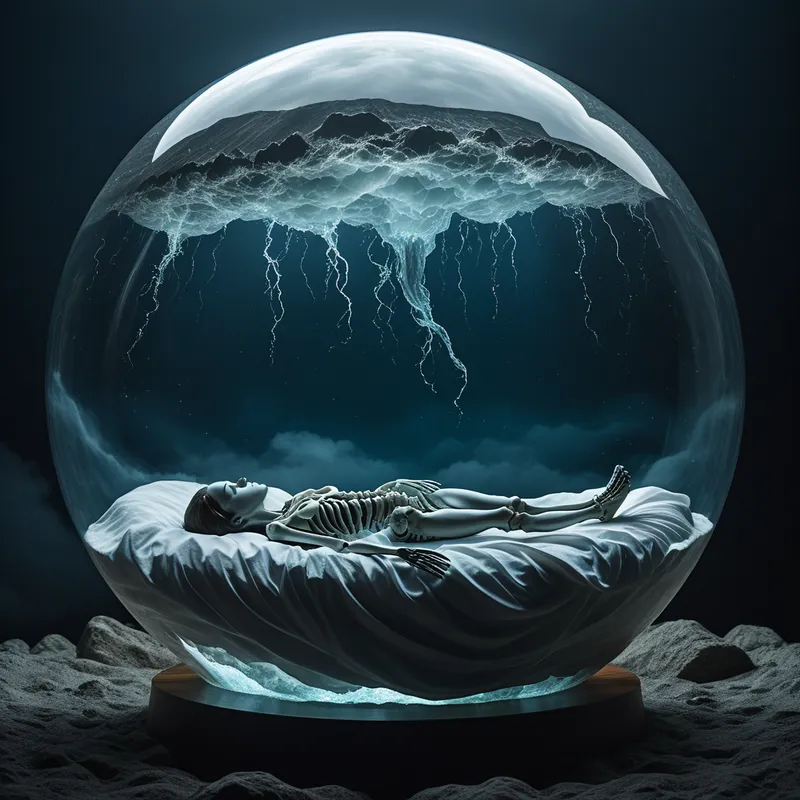
The journey from oppressive unity (Gaia and Ouranos locked together) to differentiated harmony (the Four Elements in their separate but interacting domains) is the model for individuation. The initial, unconscious state is one where our potentials are trapped. We may be fused with parental complexes or societal expectations (Ouranos’s oppression), unable to let our own “Titanic” strengths see the light of day.
The sickle of adamant is the cutting edge of consciousness. It is the painful, decisive act of discernment that severs us from what smothers our growth.
The act of Kronos—though itself leading to further cycles of violence—is a necessary shadow work. It represents the courage to confront and cut away the over-arching, spiritualized authority (a rigid belief, a perfectionistic ideal) that prevents our earthy, embodied, emotional, and fiery natures from emerging. The resulting “wound” and separation create the psychic space (Air) where reflection, choice, and relationship become possible.
The ultimate alchemical goal mirrored here is not to return to the primal unity, but to achieve a conjunctio oppositorum—a conscious union of opposites. After the differentiation into Earth, Water, Air, and Fire, the mature work is to honor and integrate all four. This is the wisdom later hinted at in the figure of Hestia (the centered fire) or the balanced humors of classical medicine. To become whole is not to be undifferentiated Chaos, but to be a cosmos—a beautifully ordered, dynamic, and living system where all elemental parts of the self have their rightful place and voice.
Associated Symbols
Explore related symbols from the CaleaDream lexicon: