The Four Directions Aztec Myth Meaning & Symbolism
A myth of four failed world ages, each destroyed by primal forces, culminating in a fifth age sustained by divine sacrifice and human duty.
The Tale of The Four Directions Aztec
Listen. Before this sun, there was darkness. Not empty darkness, but a darkness teeming with potential, a primordial sea where the gods themselves were formless and restless. They gathered at the sacred city of Teotihuacan, not a city of men, but a divine forge. Their breath was the wind in the void, their thoughts the first sparks of light.
The first to step forward was Tezcatlipoca. Proud and fierce, he demanded the honor. He leapt into the great, cold hearth of the sky and became the Sun. A jaguar sun. His light was weak, a half-light that cast long, predatory shadows. For 676 years, this first age endured. The earth was peopled by giants who ate only pine nuts and roots. But Tezcatlipoca, struck from the sky by his rival Quetzalcoatl, fell. The sky collapsed. The jaguars of the earth, embodiments of his power, rose and devoured every last giant. The First Sun, Nahui Ocelotl, was destroyed.
Then, Quetzalcoatl took his turn. He grasped the sun and hurled it into the firmament. The Second Sun, Nahui Ehēcatl, dawned. Its light was strong, clear, and carried on mighty winds. The people of this age ate the seeds of the mesquite tree. But Tezcatlipoca, seeking vengeance, transformed himself into a great jaguar and tore the sun from the sky. A catastrophic hurricane scoured the world, tearing the very mountains apart. The people were lifted and dashed, those who survived transformed into monkeys, chattering in the shattered trees.
The gods, undeterred, tried again. The lord of rain, Tlaloc, claimed the sun. The Third Sun, Nahui Quiahuitl, was a sun of water and fire, of torrential rains lit by lightning. Its people ate a water-based grain. But Quetzalcoatl, in a great rain of fire, judged this world imperfect. He summoned a rain not of water, but of flame that fell for years. The earth melted, and in a final cataclysm, Tlaloc wept a global flood. The world drowned, and its people became the fish and birds of the sea.
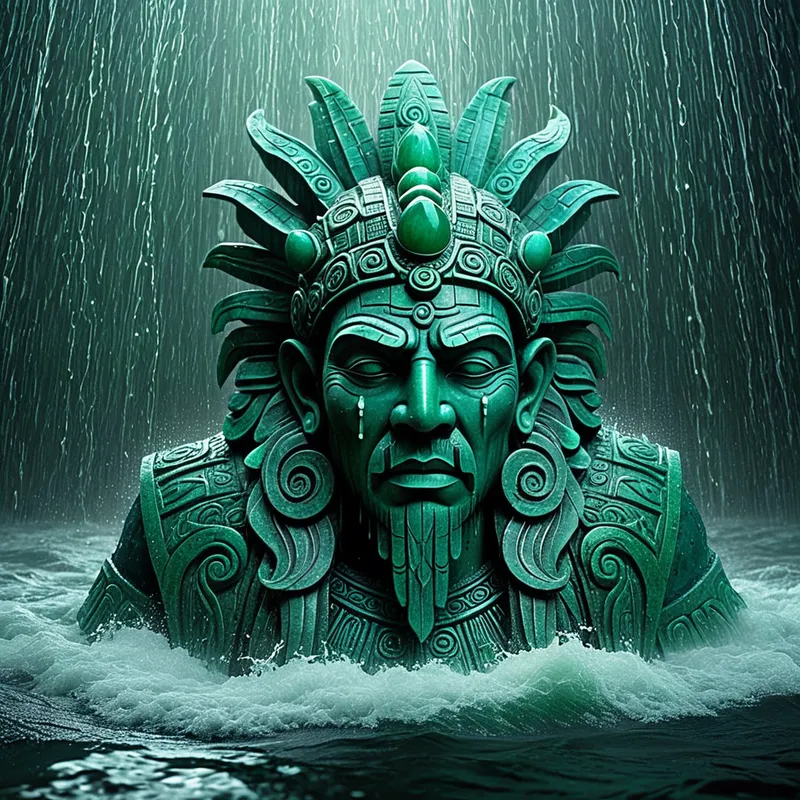
A fourth attempt. The goddess of streams and beauty, Chalchiuhtlicue, sister-wife of Tlaloc, raised the sun. The Fourth Sun, Nahui Atl, began. For 676 years, she nourished the world with her waters, and its people ate a seed called cihuacocatl. But Tezcatlipoca sowed discord. He accused her of feigning kindness only to devour humanity. In her profound grief and shame, Chalchiuhtlicue wept. She wept for 52 years without cease. Her tears became a universal flood that swallowed the sky and the earth. Humanity was lost, transformed into fish.
The cosmos was dark, silent, and waterlogged. The gods convened once more at Teotihuacan, weary and despairing. Who would bear the burden? A humble, pustule-covered god, Nanahuatzin, covered in sores, offered himself. Across from him stood the proud Tecuciztecatl, adorned in gold and quetzal feathers. For four days they fasted and did penance. They built a great pyre. Tecuciztecatl approached first, but faltered four times before the terrible heat. Nanahuatzin, without hesitation, closed his eyes and threw himself utterly into the flames, burning with a brilliant, pure light. Shamed, Tecuciztecatl followed.
From the ashes, two suns rose. The gods, fearing a world with two equal suns, threw a rabbit at the face of Tecuciztecatl, dimming his light, making him the Moon. Nanahuatzin rose as the Fifth Sun, Nahui Ollin. But he did not move. To set the sun in motion, to begin this precarious, final age, the gods had to make the ultimate payment. They offered their own blood, their own lives. The wind god Ehecatl sacrificed them all, and with their sacred energy, he blew the sun into its trembling, oscillating path across the sky. The age of movement began, sustained by debt and duty, balanced on the edge of a knife.
Cultural Origins & Context
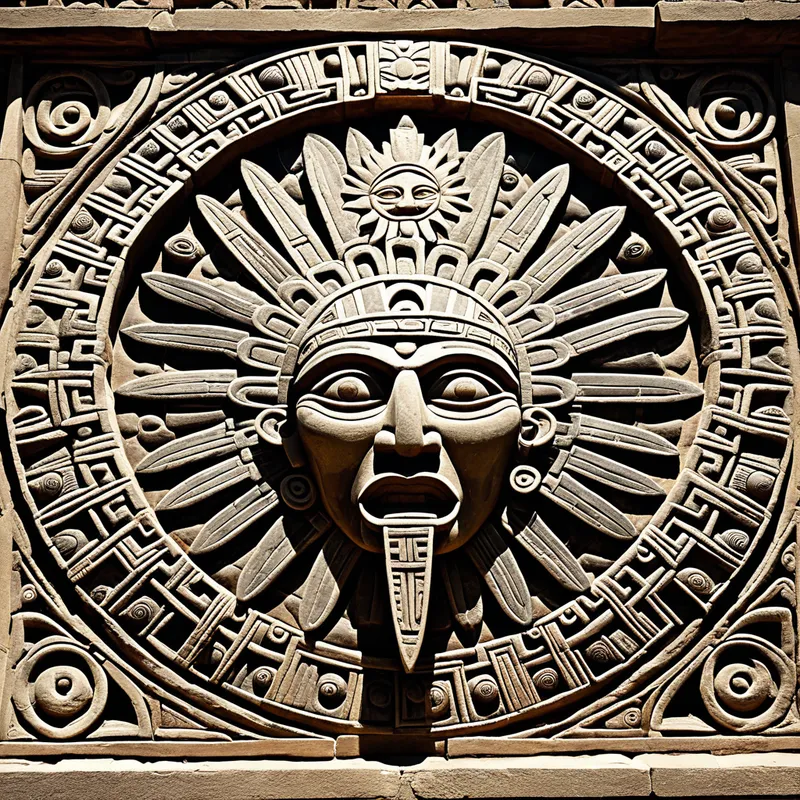
This myth, known as the Legend of the Five Suns, was the central cosmogonic narrative of the Mexica (Aztec) people. It was not merely a story of the past but the living, breathing framework of their universe. It was recited by priests (tlamatinime, “knowers of things”) during major festivals and encoded in sacred texts like the Codex Chimalpopoca and depicted on monuments like the famed Piedra del Sol.
Its societal function was profound. It explained the inherent instability and preciousness of the present world—the Fifth Sun, the Sun of Movement. It justified the core Aztec worldview: the cosmos was tonacayotl, “our flesh,” a sacred entity perpetually on the brink of collapse, requiring constant nourishment. This nourishment was chalchihuath (precious water)—a metaphor for the most precious liquid: human blood offered in sacrifice (nextlahualli, “the debt payment”). The myth established why the Mexica practiced large-scale ritual sacrifice; it was not cruelty, but a sacred duty to feed the sun with tonalli (solar, animating force) and stave off the final, eternal cataclysm. It was a contract written in divine blood at the dawn of time.
Symbolic Architecture
The myth is a masterclass in symbolic thought. The Four Directions are not merely cardinal points but successive states of being, each ruled by a different elemental and psychological principle. Each failed sun represents a world built on an [imbalance](/symbols/imbalance “Symbol: A state of disharmony where opposing forces are unequal, often representing internal conflict or external instability.”/), a totality that becomes its own doom.
The cosmos does not seek perfection, but dynamic, sacrificial balance. Each age is a thesis destroyed by its own antithesis, until a synthesis emerges from humble ash.
Tezcatlipoca’s [Jaguar](/symbols/jaguar “Symbol: The jaguar symbolizes strength, power, and stealth, often associated with transformation and the spiritual journey.”/) Sun represents the world of brute instinct and shadowy power. Quetzalcoatl’s Wind Sun is the intellect and [spirit](/symbols/spirit “Symbol: Spirit symbolizes the essence of life, vitality, and the spiritual journey of the individual.”/), ungrounded and prone to scattering. Tlaloc’s Rain Sun is [emotion](/symbols/emotion “Symbol: Emotion symbolizes our inner feelings and responses to experiences, often guiding our actions and choices.”/) and [fertility](/symbols/fertility “Symbol: Symbolizes creation, growth, and abundance, often representing new beginnings, potential, and life force.”/), which can drown in its own [abundance](/symbols/abundance “Symbol: A state of plentifulness or overflowing resources, often representing fulfillment, prosperity, or spiritual richness beyond material needs.”/). Chalchiuhtlicue’s [Water](/symbols/water “Symbol: Water symbolizes the subconscious mind, emotions, and the flow of life, representing both cleansing and creation.”/) Sun is the nurturing principle, which can collapse under the [weight](/symbols/weight “Symbol: Weight symbolizes burdens, responsibilities, and emotional loads one carries in life.”/) of [shame](/symbols/shame “Symbol: A painful emotion arising from perceived failure or violation of social norms, often involving exposure of vulnerability or wrongdoing.”/) and perceived failure. Each is a one-sided archetypal force, incapable of sustaining a whole world.
The Fifth Sun, born from Nanahuatzin—the diseased, humble [outcast](/symbols/outcast “Symbol: A person or entity excluded from a group or society, often representing feelings of rejection, alienation, or non-conformity.”/)—symbolizes [the principle](/symbols/the-principle “Symbol: A fundamental truth, law, or doctrine that serves as a foundation for a system of belief, behavior, or reasoning, often representing moral or ethical standards.”/) of transformative sacrifice. His act is not one of pride or power, but of total surrender. The sun’s [movement](/symbols/movement “Symbol: Movement symbolizes change, progress, and the dynamics of personal growth, reflecting an individual’s desire or need to transform their circumstances.”/), powered by the [death](/symbols/death “Symbol: Symbolizes transformation, endings, and new beginnings; often associated with fear of the unknown.”/) of the gods themselves, symbolizes the fundamental law: [life](/symbols/life “Symbol: The symbol of ‘Life’ represents a journey of growth, interconnectedness, and existential meaning, encompassing both the joys and challenges that define human experience.”/) and order are purchased only through the conscious offering of life-force. The oscillating [path](/symbols/path “Symbol: The ‘path’ symbolizes a journey, choices, and the direction one’s life is taking, often representing individual growth and exploration.”/) (ollin) signifies this precarious, dynamic [equilibrium](/symbols/equilibrium “Symbol: A state of balance, stability, or harmony between opposing forces, often representing inner peace or external order.”/)—a world not of [static](/symbols/static “Symbol: Static represents interference, disruption, and the breakdown of clear communication or signal, often evoking feelings of frustration and disconnection.”/) [peace](/symbols/peace “Symbol: Peace represents a state of tranquility and harmony, both internally and externally, often reflecting a desire for resolution and serenity in one’s life.”/), but of earned, continuous becoming.
The Dreamer’s Resonance
When this myth stirs in the modern psyche, it often manifests in dreams of cyclical destruction and fragile rebirth. A dreamer may experience sequences of four failed attempts—a project dissolving, a relationship ending in familiar, elemental ways (through conflict (jaguar), misunderstanding (wind), emotional flood (rain), or nurturing turned toxic (water)). These are the “previous suns” of one’s personal psychology, outdated structures of being that could not hold.
The core somatic sensation is one of standing in a center that feels both empty and charged, surrounded by the ruins of past “worlds” or identities. The emergence of the fifth element—often a small, humble, yet radiant object or a demanding call to a difficult duty—signals the dreamer’s confrontation with the Nanahuatzin principle. It is the part of the self that must be willingly “burned,” the humble, shameful, or neglected aspect whose sacrifice is necessary to set a new life in motion. The dream is an indicator of a profound death-rebirth process where the ego’s grand plans (Tecuciztecatl) must give way to the transformative surrender of the authentic self.
Alchemical Translation
For the modern individual, the myth models the alchemical process of individuation—the forging of a coherent Self from the fragmented elements of the psyche. The “four previous suns” are the one-sided identifications we cling to: the powerful persona (Jaguar), the spiritual seeker (Wind), the emotional victim or caregiver (Rain/Water). We build worlds upon them, but they are doomed to cataclysm because they exclude their opposites.
Individuation is the creation of the Fifth Sun within: an age sustained not by the repression of elements, but by the sacrificial integration of the humble shadow.
The “divine council” at Teotihuacan is the inner symposium where all psychic forces convene. The ego (often playing Tecuciztecatl) believes it must shine with gold and feathers—achievement, perfection, pride. But the work demands Nanahuatzin: the conscious, painful acknowledgment of one’s wounds, inadequacies, and humble origins. Throwing this “diseased” part into the purifying fire is the act of shadow integration—burning away the identification with the wound to release its latent energy.
The final, crucial step is the “sacrifice of the gods.” This translates to the de-integration of the archetypes themselves. We must sacrifice our identification with inner powers (the inner ruler, lover, sage, etc.) as possessions of the ego. We offer them back to the greater Self. Only then, powered by this released libido, does the inner sun—the conscious, moving center of the personality—begin its true, balanced orbit. We move from being a static, doomed “world” to becoming a dynamic, sacrificing, and thus sustainable, universe in miniature.
Associated Symbols
Explore related symbols from the CaleaDream lexicon:
- Sun — The central symbol of cosmic order, divine sacrifice, and the animating life-force (tonalli) that must be fed to sustain reality.
- Sacrifice — The core principle of the myth: the necessary offering of precious life-energy (divine or human) to maintain cosmic and psychic balance.
- Direction — Represents the four failed world ages and the four cardinal points, but also the fifth, central direction of movement (ollin) that defines the present, precarious age.
- Water — The destructive and nurturing element, embodying the floods of the Third and Fourth Suns, as well as the primordial sea from which all creation emerges.
- Wind — The scattering, intellectual force of the Second Sun, and the sacred breath (Ehecatl) that set the Fifth Sun in motion.
- Fire — The transformative agent, both destructive (the rain of fire) and purifying (the pyre of Nanahuatzin), essential for alchemical change.
- Earth — The stage for each cosmic drama, populated, destroyed, and remade, representing the physical plane subject to these cyclical spiritual laws.
- Circle — The eternal cycle of creation, destruction, and rebirth embodied in the five suns, and the form of the Aztec Sun Stone itself.
- Rebirth — The fundamental promise after each cataclysm; not a repetition, but a new, though perilous, opportunity for existence.
- Order — The fragile state achieved through sacrifice, represented by the precise, oscillating movement of the Fifth Sun, constantly threatened by chaos.
- Heart — The symbolic seat of the most precious offering, as human hearts were ritually offered to feed the sun, translating to the courage needed for inner sacrifice.
- Destiny — The predetermined, cyclical nature of the ages, governed by the gods, yet hinging on the free, courageous choice of Nanahuatzin to leap.