The Founding of Tenochtitlan Myth Meaning & Symbolism
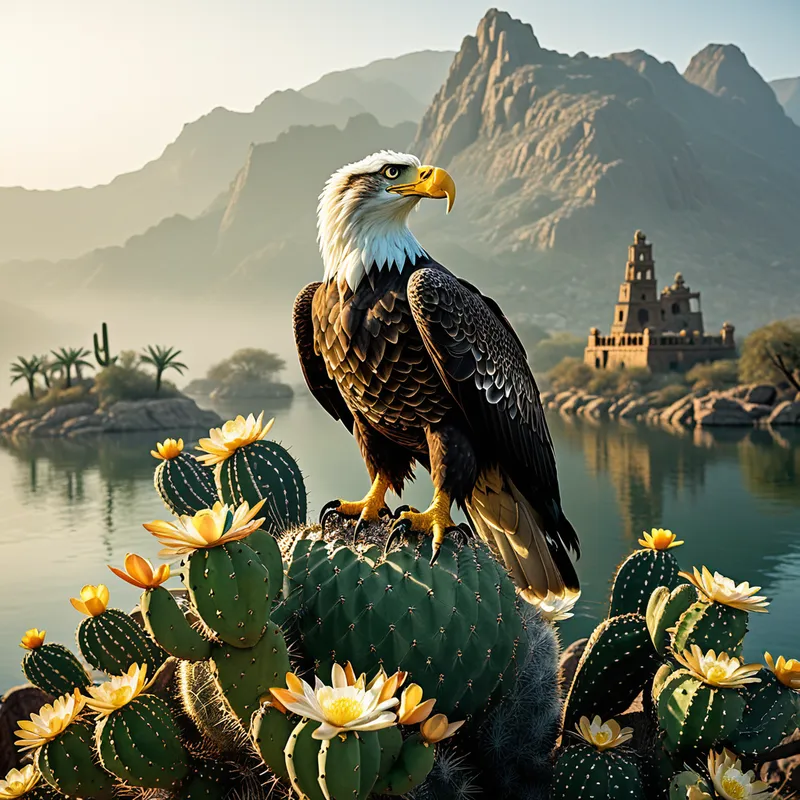
A wandering tribe, guided by a god's prophecy, finds their destined home: an eagle on a cactus, devouring a serpent, in the middle of a lake.
The Tale of The Founding of Tenochtitlan
Listen. The story begins not on solid earth, but in the dust of exile. For generations, they were the Mexica, a people without a home. Their feet were worn from wandering, their backs bent under the scorn of settled kingdoms who saw them as barbarians, as unwanted guests. They carried with them a sacred burden: the voice of their patron god, Huitzilopochtli. He spoke through his priests, a whisper in the wind, a fire in the heart. His command was their only compass: Keep moving. Your destiny is not here.
They traversed deserts that stole their breath and mountains that tested their spirit. They built temporary temples of reeds, only to tear them down again at the god’s urging. Years bled into decades. Doubt was a constant companion, a serpent coiling in the belly of the tribe. Had the god abandoned them? Was their suffering for nothing? The elders remembered the prophecy, a promise etched in memory: You will know your true home when you see an eagle, perched on a cactus, devouring a serpent.
Then came the day they beheld the Valley of Anahuac. Before them lay a vast, shimmering expanse of water—Lake Texcoco. In its center, a cluster of swampy islands, insignificant, desolate. To the weary eye, it was no paradise. It was a challenge written in mud and reeds. But the priests felt a stirring. The air was different here; it hummed with a potential, a silent waiting.
They pushed their canoes into the brackish waters, their hearts a tumult of hope and fear. And then, they saw it. On a small, rocky islet, a tenacious nopal cactus grew from a stone. Upon it, a magnificent eagle, its feathers like captured sunlight, stood triumphant. In its powerful beak, a serpent writhed its last. The sun crowned the scene in a blaze of gold. A cry went up, a sound born of a hundred years of longing released in a single moment. This was the sign. This was the promise fulfilled.
But the land was water. The foundation was mud. The god’s next command was not one of rest, but of creation. With their own hands, they began the impossible. They drove stakes into the lakebed, wove walls of wattle and daub, piled earth upon reed mats to create chinampas—floating gardens. They built a humble shrine to Huitzilopochtli on the very spot of the vision. Stone by stone, canal by canal, they wrested a city from the lake. They named it Tenochtitlan. From the vision of the eagle, the city of the Aztecs was born, not given, but forged from will and water.
Cultural Origins & Context
This foundational narrative was the sacred charter of the Aztec Triple Alliance. It was not mere folklore but a political, religious, and social cornerstone. The story was recited during coronations, etched into codices, and performed in rituals. It served a crucial function: to legitimize Aztec sovereignty. It transformed their history from one of desperate migration to a divinely ordained destiny. They were not lucky squatters on a swamp; they were the chosen people of Huitzilopochtli, fulfilling a celestial prophecy. The myth justified their rise to power and their subsequent imperial demands for tribute, framing their dominance as the natural outcome of a sacred pact.
Symbolic Architecture
The myth’s power lies in its potent [triad](/symbols/triad “Symbol: A grouping of three representing spiritual unity, divine completeness, and cosmic balance across many traditions.”/) of symbols. The [eagle](/symbols/eagle “Symbol: The eagle is a symbol of power, freedom, and transcendence, often representing a person’s aspirations and higher self.”/) represents the soaring [spirit](/symbols/spirit “Symbol: Spirit symbolizes the essence of life, vitality, and the spiritual journey of the individual.”/), divine [favor](/symbols/favor “Symbol: ‘Favor’ represents the themes of acceptance, goodwill, and the desire for approval from others.”/), and the ruthless, solar [consciousness](/symbols/consciousness “Symbol: Consciousness represents the state of awareness and perception, encompassing thoughts, feelings, and experiences.”/) necessary for empire. The cactus signifies the harsh, unwelcoming [reality](/symbols/reality “Symbol: Reality signifies the state of existence and perception, often reflecting one’s understanding of truth and life experiences.”/) of the [human](/symbols/human “Symbol: The symbol of a human represents individuality, complexity of emotions, and social relationships.”/) [condition](/symbols/condition “Symbol: Condition reflects the state of being, often focusing on physical, emotional, or situational aspects of life.”/)—the “rock” from which [life](/symbols/life “Symbol: The symbol of ‘Life’ represents a journey of growth, interconnectedness, and existential meaning, encompassing both the joys and challenges that define human experience.”/) must tenaciously grow. The [serpent](/symbols/serpent “Symbol: A powerful symbol of transformation, wisdom, and primal energy, often representing hidden knowledge, healing, or temptation.”/) embodies the chthonic, the untamed, the chaotic waters of the unconscious and the physical world.
The founding is not a discovery, but a confrontation. It is the moment the soaring spirit (eagle) decisively engages with and masters the chaotic, earthly forces (serpent) upon the ground of one’s own difficult, thorny reality (cactus).
Psychologically, this is the archetypal [moment](/symbols/moment “Symbol: The symbol of a ‘moment’ embodies the significance of transient experiences that encapsulate emotional depth or pivotal transformations in life.”/) of orientation. After a prolonged [period](/symbols/period “Symbol: Periods in dreams can symbolize cyclical patterns, renewal, and the associated emotions of loss or change throughout life.”/) of wandering in the psychic desert—a time of depression, [confusion](/symbols/confusion “Symbol: A state of mental uncertainty or disorientation, often reflecting internal conflict, lack of clarity, or overwhelming choices in waking life.”/), or [loss](/symbols/loss “Symbol: Loss often symbolizes change, grief, and transformation in dreams, representing the emotional or psychological detachment from something or someone significant.”/) of [identity](/symbols/identity “Symbol: Identity represents the sense of self, encompassing personal beliefs, cultural background, and social roles.”/)—the ego finally receives a symbolic [image](/symbols/image “Symbol: An image represents perception, memories, and the visual narratives we create in our minds.”/) of stunning [clarity](/symbols/clarity “Symbol: A state of mental transparency and sharp focus, often representing resolution of confusion or attainment of insight.”/) from the Self. This [image](/symbols/image “Symbol: An image represents perception, memories, and the visual narratives we create in our minds.”/) provides irrevocable [direction](/symbols/direction “Symbol: Direction in dreams often relates to life choices, guidance, and the path one is following, emphasizing the importance of navigation in personal journeys.”/). The “promised land” is never a ready-made [paradise](/symbols/paradise “Symbol: A perfect, blissful place or state of being, often representing ultimate fulfillment, harmony, and transcendence beyond ordinary reality.”/); it is always a [swamp](/symbols/swamp “Symbol: Represents the subconscious mind, emotions, and the complexities of personal issues.”/) that demands to be made sacred through immense [effort](/symbols/effort “Symbol: Effort signifies the physical, mental, and emotional energy invested toward achieving goals and personal growth.”/).
The Dreamer’s Resonance
When this myth appears in modern dreams, it speaks to the psyche in the throes of a foundational crisis. The dreamer may be experiencing a profound sense of displacement, of being an eternal wanderer in their own life—in career, relationships, or identity. They are searching for their “true place.”
Dreams might feature endless journeys, being lost in marshes or lakes, or seeing potent but confusing animal symbols. The somatic feeling is one of deep fatigue coupled with a flicker of insistent hope. The psyche is at the threshold. It has endured the exile and is now scanning the horizon for its own “eagle on a cactus.” This dream pattern signifies that the unconscious is ready to deliver the orienting image, the core symbol around which a new psychic structure can be built. The struggle is in having the courage to recognize it and, more dauntingly, to commit to building on that marshy, uncertain ground.

Alchemical Translation
The alchemical process mirrored here is coagulatio—the making solid. It is the phase following the solutio (the dissolution of old forms in the waters of exile). The vision provides the lapis, the philosopher’s stone or foundational idea.
The individuation journey requires us to found our Tenochtitlan. We must take the golden, fleeting vision from the Self and, with the leaden weight of daily effort, build a habitable psyche in the middle of our own unresolved conflicts and emotional swamps.
First, one must accept the long migration—the necessary period of suffering and uncertainty that strips away false identities. Then, one must learn to heed the inner guide (Huitzilopochtli), the voice of destiny that often contradicts conventional logic. The moment of vision is grace, but it is only the beginning. The true work is the decades-long labor of building the chinampas of habit, the canals of relationship, and the temples of value, all upon that initially inhospitable spot. The myth teaches that destiny is not a destination you find, but a city you are obligated to construct from the mud of your own experience, under the sign of your most sacred symbol.
Associated Symbols
Explore related symbols from the CaleaDream lexicon:
- Eagle — The celestial spirit and solar consciousness, representing the divine mandate, clarity of vision, and the soaring aspect of the Self that identifies the destined place.
- Serpent — The chthonic, chaotic force of the unconscious and the untamed earth; its conquest symbolizes the ordering of primal chaos to create a foundation for consciousness.
- Water — The realm of the unconscious, emotion, and potential; Lake Texcoco represents the fertile yet dangerous psychic medium from which the conscious ego-structure must emerge.
- Journey — The long, arduous migration of the Mexica mirrors the necessary psychological wandering and suffering that precedes any authentic founding of the Self.
- Destiny — The core theme of the myth, portraying destiny not as a fixed point but as a divine promise that must be recognized and actualized through immense effort.
- Stone — The hard, seemingly barren reality (the rock under the cactus) upon which the vision appears and the future city is built, representing inescapable fact and foundation.
- Temple — The sacred center built on the site of the vision, symbolizing the inner sanctum of the psyche constructed around a core, numinous experience.
- Sacrifice — The decades of tribulation endured by the Mexica, representing the necessary price paid in comfort and security to fulfill a higher calling.
- Vision — The prophetic image of the eagle and serpent, a direct communication from the Self that provides irreversible orientation and meaning.
- Root — The tenacious hold of the cactus on the stone, symbolizing the deep, anchoring connection to one’s destined, if difficult, ground of being.
- City — The ultimate creation, Tenochtitlan itself, representing the complex, ordered, and thriving psychic totality built from a single symbolic insight.
- Aztec Sun Stone — Though a later artifact, it embodies the cosmological order the Aztecs imposed from their founding myth, a stone mandala reflecting a universe centered on their divinely-won place.