The Forty Rules of Love Myth Meaning & Symbolism
A seeker's journey to receive forty sacred rules, a map for dissolving the ego in the boundless ocean of divine love.
The Tale of The Forty Rules of Love
Listen, and let the tale be told. In a time when the world was a veil and the heart a locked chest, there lived a seeker whose thirst was a desert inside him. His name is lost to the wind, for in this story, he is every one of us. He had walked a thousand paths—through the cold mountains of scripture and the arid plains of debate—yet his soul remained parched, a bird with no song.
Whispers came to him on the caravan winds, speaking of a master who dwelled beyond the seventh dune, in a place where the map ends and the journey truly begins. They said this master did not teach with words but with a silence that spoke, and that he held the secret of the Haqiqah, the true essence of love. Driven by a fire that consumed all other desires, the seeker left everything behind. For forty days and forty nights, he crossed the desolate expanse, his shadow his only companion, his doubt a constant whisper.
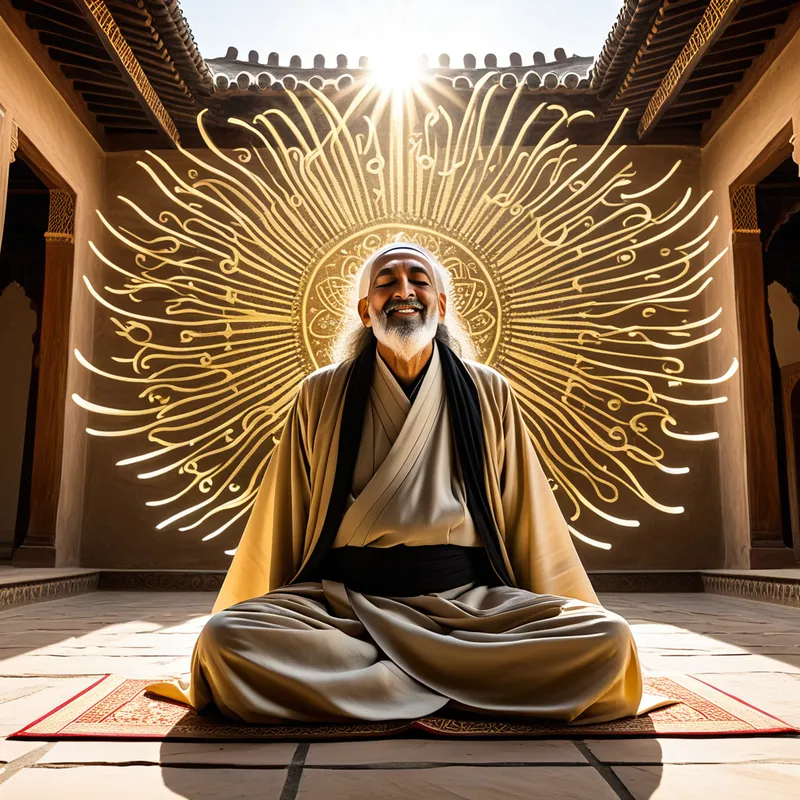
He arrived at a place of profound stillness, a simple khanqah built of sun-baked clay, open to the sky. There, under an ancient, sheltering tree, sat the master. His eyes were like deep wells, holding not water, but the reflection of the infinite sky. The seeker fell to his knees, his dust mingling with the earth of the courtyard. “I have come for the truth,” he gasped, his voice cracked from the journey.
The master smiled, a gesture that seemed to soften the very air. “The truth is not a thing to be given,” he said, his voice like a low, distant river. “It is a fire to be kindled. You have crossed the desert of the self. Now you must cross the ocean within. I will give you forty rules. They are not commands, but mirrors. They are not a path, but the removal of stones from the path. Each rule is a key to a lock you carry inside your own chest.”
And so it began. Not with a lecture, but with a cup of water shared in silence. Not with a scroll, but with a glance. Each day, as the seeker performed the humblest of tasks—sweeping the courtyard, drawing water from the well—the master would offer a single sentence, a fragment of light. “The path to the Truth is a labor of Ishq,” he would say while mending a sandal. Or, gazing at the sunset, “If you want to change the way others treat you, you must first change the way you treat yourself.”
The rules were paradoxical, shattering the seeker’s logic. They spoke of becoming nothing to become everything, of finding strength in surrender, of seeing the Beloved in every face, especially the broken ones. With each rule, a layer of the seeker’s old identity—his pride, his fear, his certainties—was stripped away, like husk from grain. He wept rivers of grief for the man he thought he was. He laughed in sudden joy at the freedom of being nobody.
On the fortieth day, the master looked at him, and the seeker saw not an old man, but his own essence reflected back. “The forty rules are complete,” said the master. “They are not mine. They were always written on your heart; the dust of the world had only obscured them. Go now. You are not a disciple who has learned rules. You are a lover who has remembered the language of love. Be a cup, empty and full. Be a door, closed and open.”
The seeker bowed his head, not to the master, but to the truth that now lived within him. He walked back into the world, but the desert was now a garden, for he carried the spring inside.

Cultural Origins & Context
The myth of the Forty Rules, while popularized in modern literature, draws deeply from the well of classical Sufism. It is not a single, codified tale from one text, but a crystallization of a core teaching narrative found in the lives and sayings of great Sufi masters like Rumi, Ibn Arabi, and Hafez. Historically, such teachings were transmitted orally within the master-disciple (Murshid-Murid) relationship, the very heart of Sufi practice.
The number forty is profoundly significant in Islamic and Sufi tradition, symbolizing a period of preparation, purification, and transformation—from the forty days of Musa’s (Moses) communion on Mount Sinai to the forty-day spiritual retreat (Chilla) common in Sufi practice. The “rules” themselves are akin to the Isharat (pointers) or spiritual counsels found in manuals of Sufi conduct. Their societal function was, and is, initiatory. They provide a map for navigating the Tariqa, the path that leads from the law (Sharia) to the ultimate truth (Haqiqa). They are a technology of the soul, designed to dismantle the ego (Nafs) and polish the heart (Qalb) into a mirror reflecting the divine.
Symbolic Architecture
At its core, the myth is an [allegory](/symbols/allegory “Symbol: A narrative device where characters, events, or settings represent abstract ideas or moral qualities, conveying deeper meanings through symbolic storytelling.”/) for the [soul](/symbols/soul “Symbol: The soul represents the essence of a person, encompassing their spirit, identity, and connection to the universe.”/)’s [journey](/symbols/journey “Symbol: A journey in dreams typically signifies adventure, growth, or a significant life transition.”/) from [separation](/symbols/separation “Symbol: A spiritual or mythic division between realms, states of being, or consciousness, often marking a transition or loss of connection.”/) to union. The [seeker](/symbols/seeker “Symbol: A person actively searching for meaning, truth, or a higher purpose, often representing the dreamer’s own quest for identity or fulfillment.”/) represents the individual [human](/symbols/human “Symbol: The symbol of a human represents individuality, complexity of emotions, and social relationships.”/) [consciousness](/symbols/consciousness “Symbol: Consciousness represents the state of awareness and perception, encompassing thoughts, feelings, and experiences.”/), identified with its limited [story](/symbols/story “Symbol: The symbol of ‘Story’ represents the narrative woven through our lives, embodying experiences, lessons, and emotions that shape our identities.”/)—the Nafs al-Ammara (the commanding self). The [vast desert](/symbols/vast-desert “Symbol: The vast desert represents emptiness, isolation, and the journey of self-discovery amidst barren landscapes.”/) is the [barren landscape](/symbols/barren-landscape “Symbol: A barren landscape often represents feelings of desolation, emptiness, or a sense of lost potential.”/) of a [life](/symbols/life “Symbol: The symbol of ‘Life’ represents a journey of growth, interconnectedness, and existential meaning, encompassing both the joys and challenges that define human experience.”/) lived solely through the intellect and ego, devoid of the [water](/symbols/water “Symbol: Water symbolizes the subconscious mind, emotions, and the flow of life, representing both cleansing and creation.”/) of spiritual meaning.
The journey through the desert is not a punishment, but a necessary emptying. One must become truly lost in the world to begin the search for the world’s source.
The master symbolizes the awakened consciousness, the Insan al-Kamil, or the inner Murshid that emerges when one is ready. He does not reside in a [palace](/symbols/palace “Symbol: A palace symbolizes grandeur, authority, and the pursuit of one’s ambitions or dreams, often embodying a desire for stability and wealth.”/) but a simple lodge, indicating that [truth](/symbols/truth “Symbol: Truth represents authenticity, honesty, and the quest for knowledge beyond mere appearances.”/) is found in humility and [presence](/symbols/presence “Symbol: Presence in dreams often signifies awareness or acknowledgment of something significant in one’s life.”/), not in worldly grandeur. The forty rules are the [alchemical process](/symbols/alchemical-process “Symbol: A symbolic transformation of base materials into spiritual gold, representing inner purification, integration, and the journey toward wholeness.”/) itself. Each rule is a Jihad al-Nafs, a confrontation with a specific illusion of the separate self. They are the hammer and chisel that sculpt the raw [stone](/symbols/stone “Symbol: In dreams, a stone often symbolizes strength, stability, and permanence, but it may also represent emotional burdens or obstacles that need to be acknowledged and processed.”/) of the soul into a [vessel](/symbols/vessel “Symbol: A container or structure that holds, transports, or protects something essential, representing the self, emotions, or life journey.”/) fit to receive the infinite.
The Dreamer’s Resonance
When this myth pattern stirs in the modern psyche, it often manifests in dreams of instruction, pilgrimage, or encountering a wise figure. One might dream of finding a list of enigmatic instructions, of being late for a crucial meeting with a teacher, or of desperately trying to cross a threshold that keeps receding. These are somatic signals of the psyche’s readiness for a deeper ordering principle, a move from chaos to a more authentic, soul-centered structure.
The somatic experience can be one of acute longing—a tightness in the chest, a feeling of spiritual homesickness. Conversely, upon integrating an aspect of the “rules,” the dreamer may experience dreams of flowing water, opening doors, or immense relief. The psychological process is one of deconstruction. The egoic identity, built for survival in the external world, is being gently (or sometimes forcefully) dismantled to make room for the Self. The dream-ego’s confusion and resistance mirror the seeker’s struggle in the desert; its moments of clarity and connection reflect the moments of reception in the courtyard.

Alchemical Translation
For the modern individual, the myth models the complete arc of individuation. The first alchemical stage, Nigredo, is the painful, arid journey through the personal desert—the midlife crisis, the depression, the feeling that one’s worldly achievements are dust. This is the necessary dissolution of the persona.
The forty rules are the Albedo—the careful, rule-by-rule purification of the soul. Each insight washes away a projection, integrates a shadow, and clarifies intention.
The reception of the rules in the humble lodge represents the stage of Citrinitas, where the light of consciousness begins to illuminate the inner world. The master-disciple relationship mirrors the dialogue between the conscious ego and the archetypal Self. Finally, the seeker’s return to the world as a transformed being signifies Rubedo—the culmination where the transformed individual embodies the union of opposites (human and divine, finite and infinite) and operates in the world from a place of integrated, compassionate wisdom. The “rules” are no longer external dictates but the innate, flowing expression of one’s true nature.
Associated Symbols
Explore related symbols from the CaleaDream lexicon:
- Love — The ultimate destination and the path itself, represented not as romantic emotion but as the foundational, unifying force of existence that the rules seek to unveil.
- Water — The quenching of spiritual thirst, the fluidity of true wisdom, and the dissolving agent that washes away the rigid structures of the ego during the seeker’s transformation.
- Door — The threshold between the desert of the ego and the courtyard of the heart, symbolizing the moment of readiness and surrender required to begin the inner journey.
- Heart — The polished mirror and the locked chest, representing both the seat of divine connection and the vessel that must be cleansed and opened by the forty rules.
- Journey — The essential movement from a state of lack and seeking to a state of fulfillment and being, mirroring the soul’s progression through spiritual stages.
- Mirror — The core teaching tool of the rules, each one designed to reflect the seeker’s inner state back to them, revealing both beauty and distortion.
- Cup — The seeker’s own soul, which must be emptied of the self to be filled with the boundless wine of divine love and awareness.
- Key — Each of the forty rules functions as a key, unlocking a specific chamber of the heart where a particular illusion or attachment is held prisoner.
- Desert — The barren landscape of the unexamined life, a necessary crucible where attachments are burned away to create space for authentic growth.
- Fire — The burning longing that drives the seeker forward and the transformative power of love that consumes all false identities in its blaze.
- Union — The silent goal behind every rule, the state of non-dual awareness where the seeker, the path, and the Beloved are realized as one.
- Shadow — The unintegrated aspects of the self that are brought to light and dissolved through the honest reflection demanded by the rules of love.