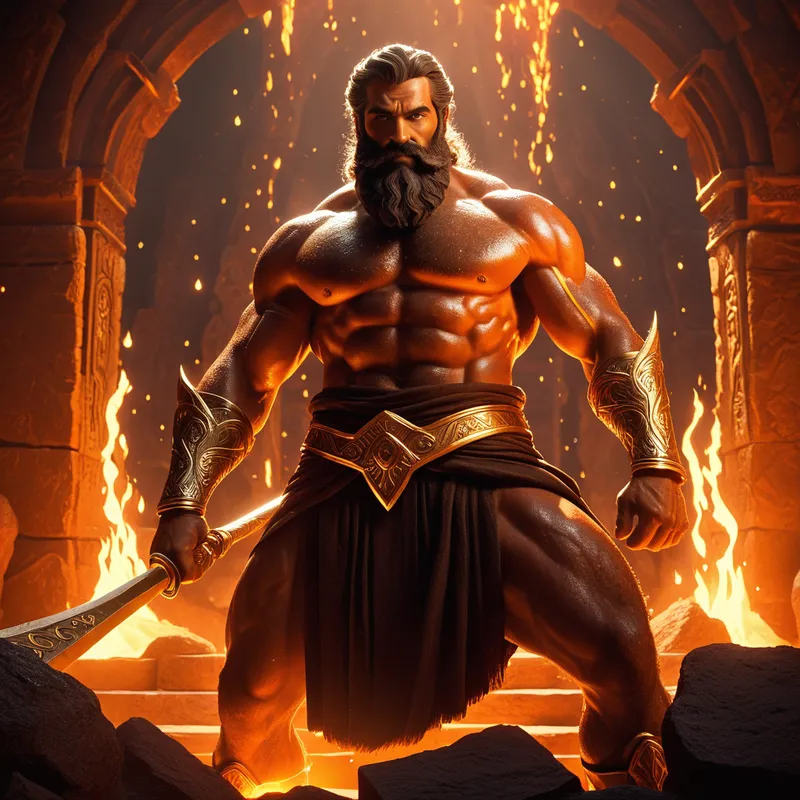
The Forge of Hephaestus Myth Meaning & Symbolism
The myth of the divine, crippled smith who transforms raw elements into divine artifacts within his volcanic forge, embodying creation born from limitation and fire.
The Tale of The Forge of Hephaestus
Beneath the sun-drenched marble and gossamer of Olympus, in [the world](/myths/the-world “Myth from Tarot culture.”/)’s deep, trembling bones, fire finds its master. Hear the tale not of a god born in grace, but forged in falling.
He was cast out at birth, [Hephaestus](/myths/hephaestus “Myth from Global/Universal culture.”/), for his mother Hera saw only imperfection in his form. His descent from the heavenly heights was long, a tumbling star of flesh and divine spark, until [the sea](/myths/the-sea “Myth from Greek culture.”/) received him with a cold, merciful crash. There, in the sunless deeps, the sea-[nymphs](/myths/nymphs “Myth from Greek culture.”/) [Thetis](/myths/thetis “Myth from Greek culture.”/) and Eurynome lifted his broken body. For nine years, they sheltered him in a vault of coral, where the only light was the bioluminescent pulse of abyssal creatures. In that silent, pressing dark, his hands learned their purpose. With shells and hardened seep-stone, he began to craft—first trinkets of solace, then wonders that captured the faint, filtered light of a world above he could no longer see.
His return to Olympus was not a plea, but a declaration wrought in gold. He sent a gift to Hera: a throne of unparalleled beauty, inlaid with jewels that held the memory of starlight. She sat, and instantly, invisible fetters of his cunning craft held her fast. The laughter of the gods died in their throats. Only Dionysus, with wine-loosened tongue and a clever bargain, descended to the smith’s new domain to parley.
For Hephaestus had chosen his kingdom. Not in the open sky, but within the sacred, sweating womb of [the earth](/myths/the-earth “Myth from Hindu culture.”/) itself. On the isle of Lemnos, and later in a great bronze dome upon Olympus itself, he built his forges. Here was the axis of transformation. Volcanoes breathed for him, their molten heart-blood flowing into channels of his design. The air shimmered with a heat that could unmake reality. Bellows, worked by automated bellows of his own invention, sighed like great bronze lungs.
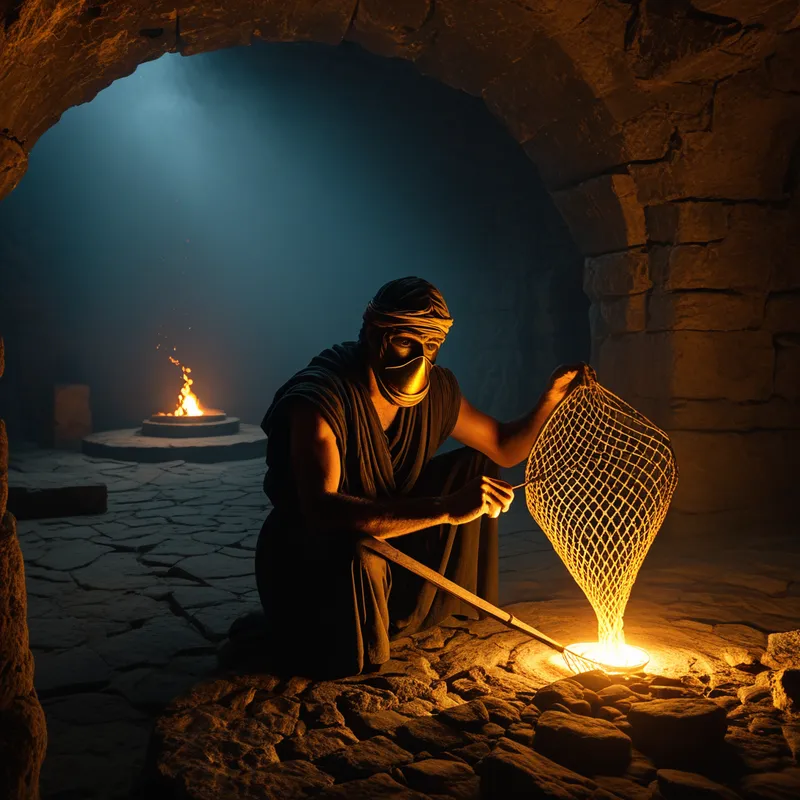
And here, the crippled god became the unrivalled creator. His hammer fell in a rhythm older than the gods, a primordial heartbeat. From the anvil sprang Aegis, fearsome and crackling with storm. From golden nets so fine they were like solidified intention, he ensnared adulterers. He built towering automata of bronze to guard and to serve, their footsteps ringing like fate. He fashioned Aphrodite, given to him as a wife, jewellery that pulsed with a captive light, yet he could not forge her love. His greatest work was not a weapon, but a support: the golden, articulated braces that allowed his own twisted leg to bear the weight of a god. In the flare of [the crucible](/myths/the-crucible “Myth from Alchemical culture.”/), in the strike of hammer on metal, the pain of the outcast was alchemized into the power that upheld the cosmos. The forge was his body, and his creations were its speech.
Cultural Origins & Context
The myth of Hephaestus springs from the bedrock of Greek society, a culture that venerated physical perfection and martial prowess in its gods and heroes. Hephaestus is the profound, necessary exception. His tales are woven into the epic poetry of [Homer](/myths/homer “Myth from Greek culture.”/), where in the Iliad he is a pivotal, peace-making figure, and his lineage is detailed in the theogonic works like Hesiod’s. He was not merely a story, but a central cult figure, particularly on Lemnos and in Athens, where he shared a temple with Athena at the Hephaesteion.
His myth served a crucial societal function. In a world dependent on the transformative arts of the blacksmith—for weapons, tools, and wealth—Hephaestus sanctified the craft. He connected the soot-covered artisan in his workshop to the divine. Furthermore, his lameness and rejection provided a mythic container for the experience of the disabled, the un-beautiful, and the socially marginalized, granting them a potent, divine patron. His myth acknowledged that supreme skill and cultural necessity could arise from, and even because of, profound personal suffering and exclusion.
Symbolic Architecture
The Forge of Hephaestus is not merely a workplace; it is a complete symbolic [universe](/symbols/universe “Symbol: The universe symbolizes vastness, interconnectedness, and the mysteries of existence beyond the individual self.”/). It represents the vas or sacred [vessel](/symbols/vessel “Symbol: A container or structure that holds, transports, or protects something essential, representing the self, emotions, or life journey.”/) of alchemical transformation, located in the [underworld](/symbols/underworld “Symbol: A symbolic journey into the unconscious, representing exploration of hidden aspects of self, transformation, or confronting repressed material.”/) of the unconscious, where base materials—ore, [trauma](/symbols/trauma “Symbol: A deeply distressing or disturbing experience that overwhelms the psyche, often manifesting in dreams as unresolved emotional wounds or psychological injury.”/), raw instinct—are subjected to the purifying fires of suffering and focused [effort](/symbols/effort “Symbol: Effort signifies the physical, mental, and emotional energy invested toward achieving goals and personal growth.”/).
The true forge is not in the mountain, but in the tension between the hammer of circumstance and the anvil of the self.
Hephaestus himself is the [archetype](/symbols/archetype “Symbol: A universal, primordial pattern or prototype in the collective unconscious that shapes human experience, behavior, and creative expression.”/) of the wounded [creator](/symbols/creator “Symbol: A figure representing ultimate origin, divine power, or profound authorship. Often embodies the source of existence, innovation, or personal destiny.”/). His lameness symbolizes a fundamental [rift](/symbols/rift “Symbol: A deep division or separation, often representing conflict, disconnection, or fundamental disagreement within relationships, groups, or society.”/), a “fall” from idealized wholeness. His [exile](/symbols/exile “Symbol: Forced separation from one’s homeland or community, representing loss of belonging, punishment, or profound isolation.”/) is the necessary descent into the [depths](/symbols/depths “Symbol: Represents the subconscious, hidden emotions, or foundational aspects of the self, often linked to primal fears or profound truths.”/) of the [psyche](/myths/psyche “Myth from Greek culture.”/), where [the ego](/myths/the-ego “Myth from Jungian culture.”/) is shattered and the conscious [identity](/symbols/identity “Symbol: Identity represents the sense of self, encompassing personal beliefs, cultural background, and social roles.”/) is forced to reconstitute itself around its core creative faculty, not its [appearance](/symbols/appearance “Symbol: Appearance in dreams relates to self-image, perception, and how you present yourself to the world.”/) or social standing. The golden net, perhaps his most psychologically potent creation, symbolizes the intricate, binding patterns of the complex—be it a trauma, an [obsession](/symbols/obsession “Symbol: An overwhelming fixation on a person, idea, or object that consumes mental energy and disrupts balance.”/), or a brilliant, inescapable [idea](/symbols/idea “Symbol: An ‘Idea’ represents a spark of creativity, innovation, or realization, often emerging as a solution to a problem or a new outlook on life.”/). It is both a trap and a work of sublime art. His automata represent the psychic structures and defenses we construct autonomously, often unconsciously, to navigate a world for which we feel ill-equipped.
The Dreamer’s Resonance
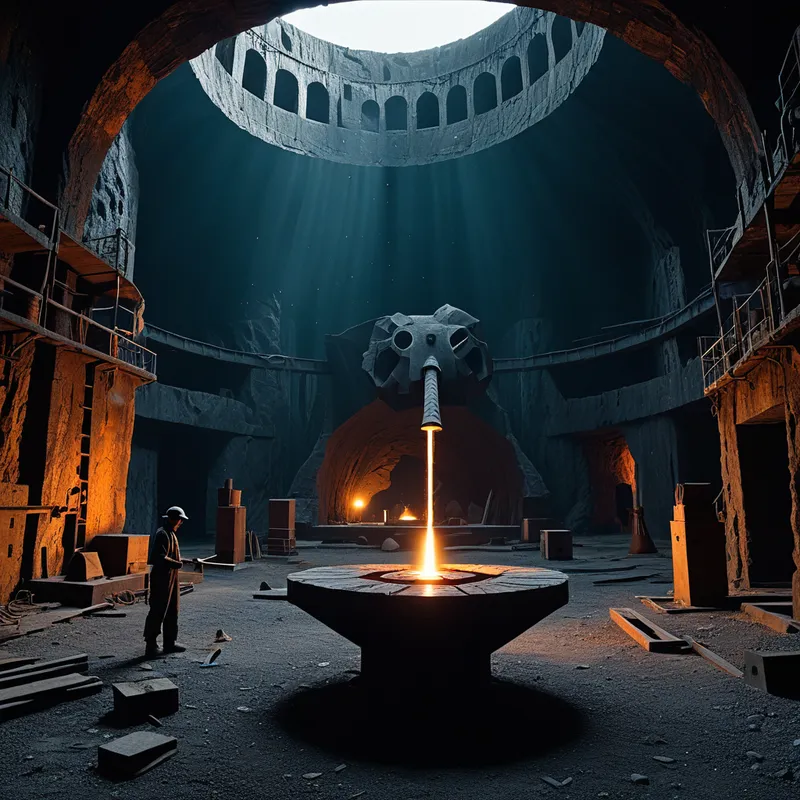
To dream of Hephaestus’s forge is to dream of a profound somatic and psychological process underway. The dreamer may find themselves in a basement workshop, a fiery cavern, or a industrial plant that feels deeply personal and ancient. The overwhelming sensations are of intense, contained heat, the rhythmic, inescapable sound of hammering, and the smell of ozone and hot metal.
This is the psyche’s workshop where the “crippled” or rejected parts of [the self](/myths/the-self “Myth from Jungian culture.”/) are being worked upon. The hammer-strike is the impact of life’s pressures and insights. The anvil is the resilient core of the personality that must hold its shape under that impact. Dreaming of forging a specific object—a key, a weapon, a brace—points directly to what the psyche is attempting to create to meet a current challenge. The process is often solitary, gritty, and physically felt in the dream body, indicating deep, pre-verbal psychic restructuring. It is the dream of active, painful integration, not passive analysis.
Alchemical Translation
The myth of Hephaestus models the individuation process as one of creative redemption through skilled suffering. The initial [nigredo](/myths/nigredo “Myth from Alchemical culture.”/), the blackening, is his violent ejection from Olympus and his broken body. The albedo, the whitening or purification, occurs in his underwater sanctuary, where he begins his craft in isolation, washing his identity in the waters of the unconscious.
The core of the process is the citrinitas, the yellowing or fiery operation, embodied by the forge itself. Here, the conscious ego (Hephaestus) must willingly engage with the fiery, transformative emotions (rage, shame, passion) and the raw material of [the shadow](/myths/the-shadow “Myth from Jungian culture.”/). The hammer is conscious discipline and repeated effort; the bellows are the breath that fuels the process, the alternating cycles of inspiration and expiration.
Individuation is not about becoming perfect, but about becoming operational—crafting a functional, authentic self from the very flaws that seemed to disqualify you.
The final stage, [rubedo](/myths/rubedo “Myth from Alchemical culture.”/), the reddening or creation of the philosopher’s stone, is seen in his divine artifacts. They are not just objects, but new, operational capacities of the psyche: the shield (Aegis) of empowered boundaries, the golden braces of self-support, the intricate net of conscious understanding that can finally capture and hold a complex pattern. He returns to Olympus not as a healed son, but as an indispensable artisan. The goal is not to erase the lameness, but to build a life of profound creativity and purpose upon it. The alchemy is complete when the pain has been fully transmuted into the power to shape one’s own world.
Associated Symbols
Explore related symbols from the CaleaDream lexicon: