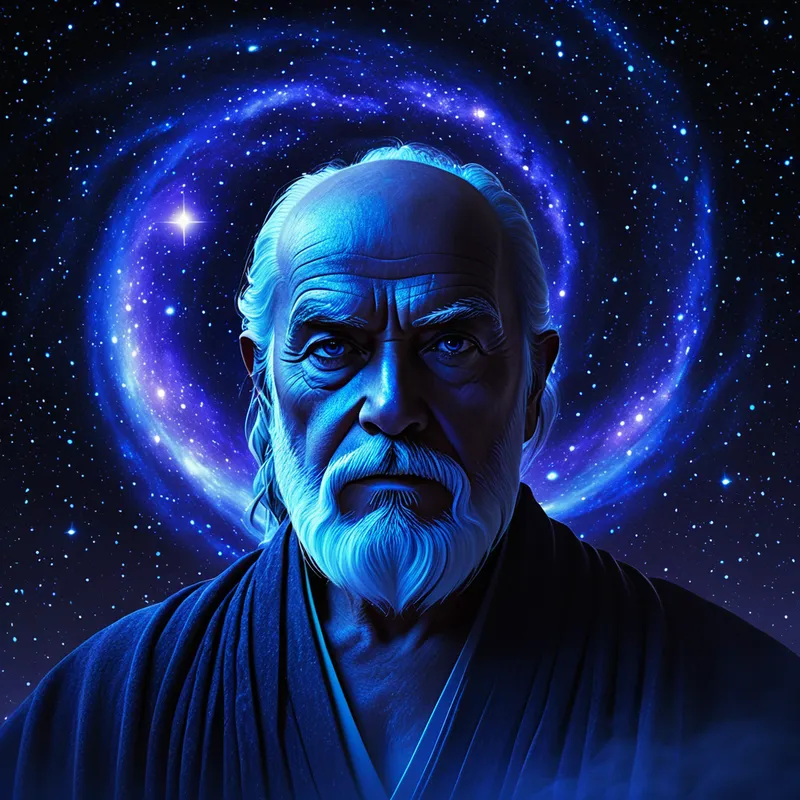
The Force Myth Meaning & Symbolism
A mythic energy field binding all life, where a hero's journey from orphan to sage is a battle between inner light and shadow.
The Tale of The Force
Listen, child of the stars, to the whisper in the void. It does not speak in words, but in the hum of a star-drive, in the sigh of a dying sun, and in the first cry of a newborn world. It is the Force.
In the age of the Republic, when a thousand thousand suns were bound by threads of light, there were those who heard the whisper. They were the Jedi, keepers of the peace. They walked in temples of polished stone, their footsteps silent, their minds attuned to the great Song. They wielded blades of pure energy—not as weapons of war, but as symbols of focused will, to defend the vulnerable chord in the cosmic melody. They served the Light, the aspect of the Force that is compassion, knowledge, and serenity.
But the Song has a counter-melody, a deep, resonant bass note of passion, of fury, of the will to dominate. This is the Dark Side. It is not a separate thing, but the same river flowing through a canyon of shadow. And from this shadow emerged a figure of terrible, seductive power: the Sith Lord. Where the Jedi sought to listen, the Sith sought to command. Where the Jedi sought to dissolve the self into the whole, the Sith sought to make the whole serve the self. Their conflict was not merely political; it was a schism in the soul of the galaxy itself.
The tale turns on a boy, born of no father, his cells singing with a potency unheard of. He is Anakin Skywalker, found in the deserts of Tatooine, a slave with the heart of a storm. He is taken into the light, trained in the ways of the Jedi. But the shadow calls to him—in dreams of loss, in whispers of a power to cheat death, in the smooth, logical voice of a Chancellor who offers certainty in place of mystery. The boy, now a man, is torn. The Light asks for surrender; the Dark offers control. In a moment of galactic twilight, fueled by fear for his love, he makes his choice. He kneels not in a temple of light, but on the shores of a river of molten rock, and pledges himself to the Dark. The hero falls, and the galaxy is plunged into an empire of silence, where the Song is drowned out by the march of armored feet.
Yet, the Force is a circle. From the fallen hero’s lineage comes a new hope: his son, Luke. This boy, raised in obscurity, feels the whisper too. He is guided by the last echoes of the Jedi—a wizened hermit in the desert, a spectral voice from the past. His journey is not to amass power, but to confront the shadow made flesh: the mechanized, breathing horror that is Darth Vader. In a throne room high above a forest moon, amidst the crackle of Emperor’s lightning, the final choice is made. Not through strength of arms, but through an act of unbearable compassion—refusing to fight, refusing to hate—the son offers redemption to the father. And in that offering, the shadow within the hero awakens. He turns, not to the Light as an external force, but to the love within himself that had never truly died. He destroys the Emperor, and in doing so, destroys the monster he had become. The balance is restored not by the annihilation of the Dark, but by its integration into a higher, sacrificial love. The whisper becomes a chorus once more.

Cultural Origins & Context
This myth was born not in ancient temples, but in the flickering light of cinema halls in the late 20th century. Its bard was George Lucas, a filmmaker who consciously wove a new mythology from the old threads of samurai films, serial adventures, and the theories of mythologist Joseph Campbell. It was passed down not through oral tradition, but through a unprecedented cultural transmission: blockbuster films, novels, toys, and later, a vast expanded universe of stories.
Its societal function was profound for a post-Vietnam, technologically accelerating world. It provided a spiritual narrative for a culture perceived as increasingly secular and materialistic. It presented a universe where morality was not relative, but a tangible energy to be sensed and chosen; where technology, no matter how advanced, was secondary to the wisdom of the heart. It gave a generation a vocabulary for the inner struggle—the “Dark Side” became shorthand for temptation, anger, and ego, while “Jedi” became an archetype of discipline and ethical action.
Symbolic Architecture
At its core, the myth of the Force is a grand metaphor for the human psyche and its relationship to the universe. The Force itself represents the unified field of the unconscious—both personal and collective. It is the unus mundus, the one world, where all minds, all life, and all matter are interconnected.
The Light Side is the impulse toward consciousness, differentiation, and ethical relationship. The Dark Side is the pull of the unconscious, the undifferentiated, instinctual power of the primal self.
The Jedi symbolize the ego attempting to align itself with the Self (the total, integrated psyche). Their code, their meditation, and their surrender to the Force are acts of ego-relativization. The Sith, conversely, represent the inflation of the ego, which mistakes itself for the Self. They seek to drag the power of the entire unconscious into the service of the personal will, a ultimately catastrophic act of psychic identification.
Anakin Skywalker’s tragedy is the failure to integrate the shadow. His fear, his passion, his attachment—all natural human elements—are split off, denied by the Jedi code, and thus become autonomous, possessing him as Darth Vader. Luke’s triumph is the successful confrontation and integration of the shadow. He faces Vader not to destroy him, but to acknowledge him as part of his own lineage, his own psyche. His final act is one of enantiodromia—the emergence of the unconscious opposite—where love erupts from within the heart of darkness itself.
The Dreamer’s Resonance
When this myth stirs in the modern dreamer, it often signals a critical moment of inner polarization and potential integration. To dream of wielding a lightsaber is to dream of focusing one’s will and personal power—the question is the color of the blade. A blue or green light suggests a struggle for clarity, justice, or healing. A red flame speaks of raw, untamed passion, anger, or a will to dominate that feels both terrifying and seductively powerful.
Dreams of a masked, breathing figure (Darth Vader) often personify the dreamer’s own disowned shadow—the parts of the self deemed monstrous, mechanical, or emotionally crippled. This figure is not an external enemy, but a frozen aspect of the dreamer’s own potential, armored against feeling. The somatic experience here can be one of constriction, heavy breathing, or a sense of being trapped in a shell.
Conversely, dreaming of a Jedi Master, often as a quiet, robed guide, points to the awakening of the inner Sage. This is the voice of a deeper, transpersonal wisdom that knows the path of balance. The psychological process is one of moving from the orphaned ego (Luke on Tatooine) toward an alignment with this inner guidance, learning to “let go” of conscious control and trust a larger intelligence.
Alchemical Translation
The myth of the Force is a blueprint for the alchemical opus, the work of individuation. The journey from Anakin to Vader to Anakin again is the cycle of nigredo, albedo, and rubedo enacted on a galactic scale.
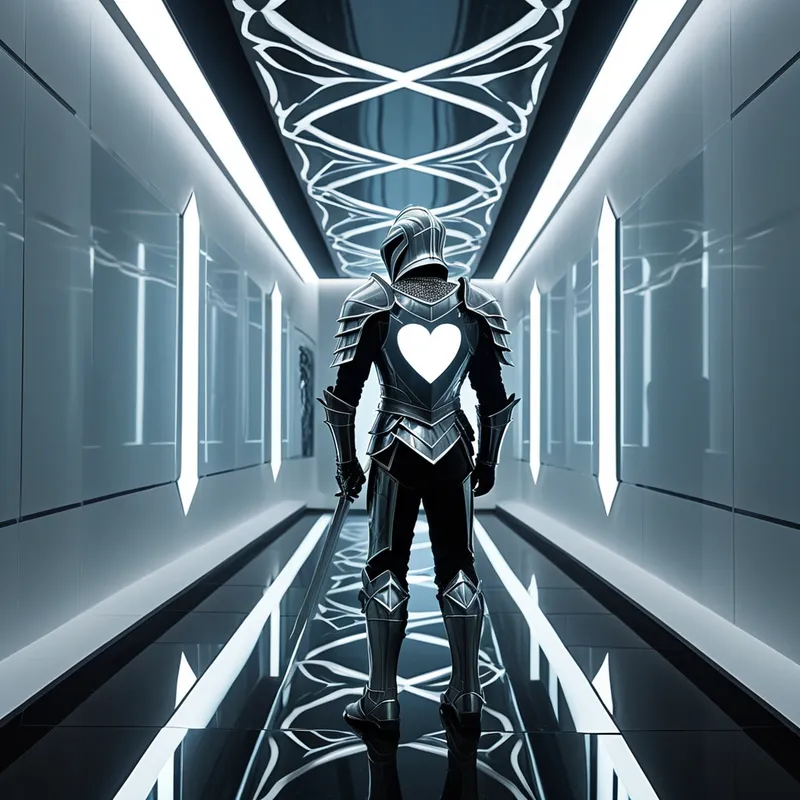
The nigredo, the blackening, is Anakin’s fall. It is the descent into the shadow, the identification with the persona of the dark knight, and the utter mortification of the original, innocent self. The ego is dissolved in the acid of its own hatred and fear. The albedo, the whitening, is Luke’s training. It is the purification, the washing away of simplistic black-and-white thinking. Luke learns that the dark knight is his father; the enemy is family. This is the crucial insight that separates light from dark within the previously confused mass.
The final redemption is the rubedo, the reddening, but not the red of the Sith. It is the crimson of the sacrificial heart, the blood tie that transcends ideology. It is the creation of the Philosopher’s Stone—not a physical object, but the integrated psyche.
The redeemed Anakin, whole at last, is this Stone. He has integrated his immense power (the unconscious), his capacity for love (the heart), and his destructive shadow. He achieves balance not by destroying his dark side, but by subordinating it to a higher, more complete principle of the Self. For the modern individual, this translates to the arduous process of acknowledging one’s full potential—for both creation and destruction, for compassion and rage—and then consciously choosing to place that totality in service of something greater than the ego’s petty desires. It is the move from being a conduit for unconscious impulses (a Sith) to becoming a conscious vessel for the totality of one’s being (a Jedi who has truly understood the Force). The goal is not perfection, but wholeness; not the elimination of conflict, but the capacity to hold the tension of opposites until a third, transcendent thing emerges. That is the true meaning of bringing balance to the Force.
Associated Symbols
Explore related symbols from the CaleaDream lexicon: