The Flyting Myth Meaning & Symbolism
A sacred, ritualized verbal duel where insults become a crucible for truth, forcing gods and mortals to confront their deepest shadows and hidden power.
The Tale of The Flyting
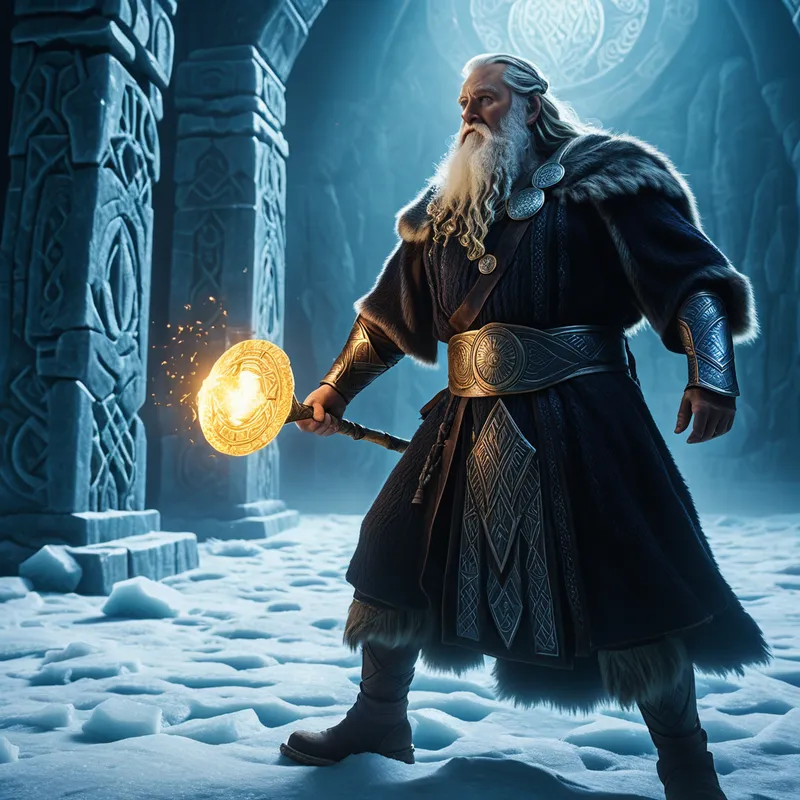
Hear now, and listen well, for the fire is low and the night is deep. This is not a tale of swords, though the wounds cut deeper. This is a tale of words—words sharpened on the whetstone of the soul, words that can unmake a king or birth a god.
In the high hall of [the sea](/myths/the-sea “Myth from Greek culture.”/)-lord Ægir, a feast was laid. The Æsir gods gathered, their laughter echoing from walls hung with shimmering gold. Mead flowed like a river, but a poison seeped into the cup. For among them sat Loki, his smile a thin blade, his eyes holding a storm. The feast was his doing, a peace offering for a past crime, yet peace was a garment that did not fit him.
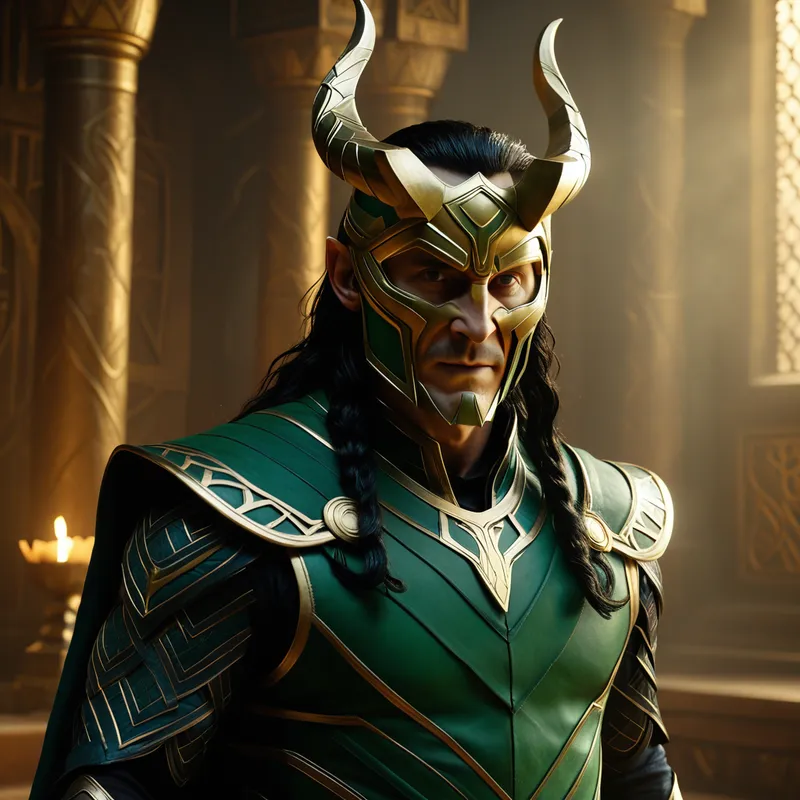
The air grew thick with satisfaction, a smug warmth that Loki could not abide. He rose. Not with a roar, but with a voice like cracking ice. He began to speak. He did not shout; he unveiled. To Thor, he spoke of clumsy strength and foolish journeys. To [Freyja](/myths/freyja “Myth from Norse culture.”/), he whispered tales of whispered indiscretions. To Odin, the All-Father himself, he laid bare the broken oaths and the blood-price paid for wisdom. Each verse was a perfectly aimed dart, feathered with poetic meter and tipped with a truth too ugly to deny.
The hall fell silent, the warmth leaching from the stones. The gods sputtered, threatened, but their retorts were blunt hammers against Loki’s razor-wire. He danced around them, a serpent of syllables, exposing every hidden cowardice, every vain pride, every secret shame they buried beneath their divine mantles. He named the unnameable: Odin’s practice of seiðr, the goddesses’ whispered lies, the blood that stained the foundations of Asgard itself.
The conflict rose, a tempest contained by timber and rage. Finally, Thor, his knuckles white on [Mjölnir](/myths/mjlnir “Myth from Norse culture.”/)‘s handle, bellowed a threat that shook the rafters. Loki’s laughter was the last sound—a cold, sharp [thing](/myths/thing “Myth from Norse culture.”/). He looked at their furious, red faces, saw his work complete. [The mirror](/myths/the-mirror “Myth from Various culture.”/) had been held up, and the glorious gods saw not their splendor, but their shadows, grinning back. With a final, contemptuous verse, he turned and fled the hall, leaving behind a silence heavier than any battle’s din, a feast forever spoiled by the raw truth served as its final course.
Cultural Origins & Context
The [flyting](/myths/flyting “Myth from Norse culture.”/), or senna (quarrel) and mannjafnaðr (comparison of men), was far more than mere insult comedy in the Norse world. It was a formalized, ritualistic verbal duel, a recognized form of contest with its own rules and high stakes. Found in eddic poetry like Lokasenna (Loki’s Flyting) and the wisdom-contest Vafþrúðnismál, its preservation in the Poetic Edda tells us it was considered a vital expression of cultural intelligence.
These poems were not mere stories; they were the core curriculum of a worldview, performed by skalds and storytellers. The function was multifaceted. On one level, it was a test of hugr (mind, courage) and quick wit, essential virtues for a leader. On another, it served as a societal pressure valve—a sanctioned space for the airing of grievances and the challenging of authority through poetic skill rather than immediate violence. Most profoundly, it was a mechanism for truth-telling. In a culture built on honor and reputation (orðstírr), public speech had tangible power. A successful flyting could dismantle a reputation as effectively as a sword, forcing hidden truths into the communal space where they had to be acknowledged.
Symbolic Architecture
At its [heart](/symbols/heart “Symbol: The heart symbolizes love, emotion, and the core of one’s existence, representing deep connections with others and self.”/), the flyting is the mythic enactment of the confrontation with the [Shadow](/symbols/shadow “Symbol: The ‘shadow’ embodies the unconscious, repressed aspects of the self and often represents fears or hidden emotions.”/). Loki, the eternal outsider, the bound [trickster](/symbols/trickster “Symbol: A boundary-crossing archetype representing chaos, transformation, and the subversion of norms through cunning and humor.”/), is the personified [Shadow](/symbols/shadow “Symbol: The ‘shadow’ embodies the unconscious, repressed aspects of the self and often represents fears or hidden emotions.”/) of the Æsir [pantheon](/myths/pantheon “Myth from Roman culture.”/). He embodies all they must deny to maintain their self-[image](/symbols/image “Symbol: An image represents perception, memories, and the visual narratives we create in our minds.”/): [chaos](/symbols/chaos “Symbol: In Arts & Music, chaos represents raw creative potential, uncontrolled expression, and the breakdown of order to forge new artistic forms.”/), deceit, pettiness, and the ambiguous, “unmanly” magic of seiðr.
The Shadow does not lie; it reveals. Its accusations are brutal because they are precise.
The golden hall of Ægir represents the curated, conscious ego—the seat of [identity](/symbols/identity “Symbol: Identity represents the sense of self, encompassing personal beliefs, cultural background, and social roles.”/), fellowship, and celebrated [achievement](/symbols/achievement “Symbol: Symbolizes success, mastery, or reaching a goal, often reflecting personal validation, social recognition, or overcoming challenges.”/). Loki’s intrusion is the [eruption](/symbols/eruption “Symbol: A sudden, violent release of pent-up energy or emotion from beneath the surface, often representing transformation or crisis.”/) of repressed [material](/symbols/material “Symbol: Material signifies the tangible aspects of life, often representing physical resources, desires, and the physical world’s influence on our existence.”/) into this sanctum. His verses are not random slander; they are symbolic truths. When he accuses Odin of practicing seiðr, he is not just pointing out hypocrisy; he is stating that the All-[Father](/symbols/father “Symbol: The father figure in dreams often symbolizes authority, protection, guidance, and the quest for approval or validation.”/)’s famed wisdom is inextricably woven with forces his own culture deems shameful. The power of the flyting lies in its poetic form. The insults are structured, artful, and thus undeniable. They force a recognition that the despised “other” (Loki) is, in fact, an integral part of the whole.
The gods’ initial [reaction](/symbols/reaction “Symbol: A reaction in a dream signifies the subconscious emotional responses to situations we face, often revealing our coping mechanisms and fears.”/)—denial, bluster, [threat](/symbols/threat “Symbol: A threat in dreams often reflects feelings of vulnerability, anxiety, or fear regarding one’s safety or well-being. It can indicate unresolved conflicts or the presence of external pressures.”/)—is [the ego](/myths/the-ego “Myth from Jungian culture.”/)’s standard [defense](/symbols/defense “Symbol: A protective mechanism or barrier against perceived threats, representing boundaries, security, and resistance to external or internal challenges.”/) against shadow content. The myth shows that true [integration](/symbols/integration “Symbol: The process of unifying disparate parts of the self or experience into a cohesive whole, often representing psychological wholeness or resolution of internal conflict.”/) is rarely achieved in the [moment](/symbols/moment “Symbol: The symbol of a ‘moment’ embodies the significance of transient experiences that encapsulate emotional depth or pivotal transformations in life.”/) of confrontation; often, it begins with the painful, silent acknowledgment that the [accusation](/symbols/accusation “Symbol: A formal or informal charge of wrongdoing, often implying guilt, blame, or responsibility placed upon the dreamer or another figure.”/) has struck home.
The Dreamer’s Resonance
When the archetypal pattern of the flyting manifests in modern dreams, it signals a critical phase of psychological differentiation. You may dream of being in a meeting, a family gathering, or a peaceful setting that is suddenly disrupted by a figure—a stranger, a mocking version of yourself, or even a voice from the shadows—who begins to catalog your failures, hypocrisies, and hidden fears with devastating accuracy.
The somatic experience is key: a hot flush of shame, a tightening in the gut, a feeling of paralysis as you try and fail to form a rebuttal. This is not a nightmare of external monsters, but of exposure. The dream-Loki is an autonomous complex, a personified bundle of all you have disowned: your ambition labeled as greed, your sensitivity seen as weakness, your past mistakes you’ve tried to bury. The dream setting is your conscious life, and the eruption is the [psyche](/myths/psyche “Myth from Greek culture.”/)’s insistence that this material be heard. The process underway is not destruction, but a brutal, necessary honesty. The ego is being challenged to expand, to incorporate these truths rather than continue the exhausting work of repression.

Alchemical Translation
The alchemical journey of individuation requires the [nigredo](/myths/nigredo “Myth from Alchemical culture.”/)—the blackening, the descent into the dark matter of [the self](/myths/the-self “Myth from Jungian culture.”/). The flyting is a mythic model for this first, crucial operation.
The crucible for psychic gold is not built of comfort, but of searing, verbal truth.
In our lives, this translates to those moments of uncomfortable feedback, the friend who names our pattern of self-sabotage, the therapist who reflects our contradictions, or the inner voice that finally breaks through denial. These are modern flytings. The instinct is to play the outraged god—to dismiss, to counter-accuse, to flee the hall. The alchemical work begins when we stay, and listen.
Loki’s verses, though venomous, contain the raw [prima materia](/myths/prima-materia “Myth from Alchemical culture.”/) for transformation. The accusation of “cowardice” might hide a disowned need for boundaries. The taunt of “fraud” may point to an unlived potential. The task is to sift the venom from the vitamin, to extract the kernel of truth from the shaming delivery. By enduring this symbolic flaying, the individual does not collapse; they are stripped of an illusory self-image. What remains is more authentic, more complex, and paradoxically, more resilient. The integrated self is not the god who silenced Loki, but the one who could eventually acknowledge, “There is a part of me that is like him.” In that acknowledgment, [the shadow](/myths/the-shadow “Myth from Jungian culture.”/)’s chaotic energy is not eliminated, but potentially harnessed as creativity, insight, and a more complete, embodied wisdom. The feast is ruined, but a truer sustenance is found in the ashes of the old [persona](/myths/persona “Myth from Greek culture.”/).
Associated Symbols
Explore related symbols from the CaleaDream lexicon: