
The Flying Ship Arabian Myth Meaning & Symbolism
A mortal crafts a ship that sails the skies, undertaking a perilous journey to win a princess, guided by impossible helpers and celestial will.
The Tale of The Flying Ship Arabian
Listen, and let the desert wind carry you to a time when the impossible was merely a test of faith. In a kingdom where the sands whispered of forgotten empires, there lived a humble youth, the youngest of three brothers, whose spirit was as vast and untamed as the Rub’ al Khali. While his elder brothers sought fortune through cunning and trade, he spent his days dreaming under the sun, his hands idle but his heart full of visions of the sky.
A proclamation echoed from the Sultan’s court, carried by criers and carved into stone: the Sultan’s daughter, a princess of peerless beauty and wisdom, would marry the man who could arrive at the palace in a flying ship. The elder brothers scoffed, for who could command the air? But the youngest felt a strange stirring in his soul, as if the command were a key meant for a lock only he possessed. With nothing but a simple axe and the blessing of his aged mother, he walked into the deep forest.
For days he chopped and shaped, guided not by knowledge of shipwrights, but by an intuition that flowed from the grain of the wood itself. He built not a vessel for the sea, but a curious craft with wings of woven reed and a hull of fragrant cedar. As he sat in despair before his seemingly foolish creation, an old man with eyes like polished onyx appeared from between the trees. “Why do you grieve, my son?” he asked. Upon hearing the tale, the old man smiled. “Faith is the wind that fills unseen sails. Enter your ship and say, ‘Ship, fly! Carry me to the Sultan’s palace.’”
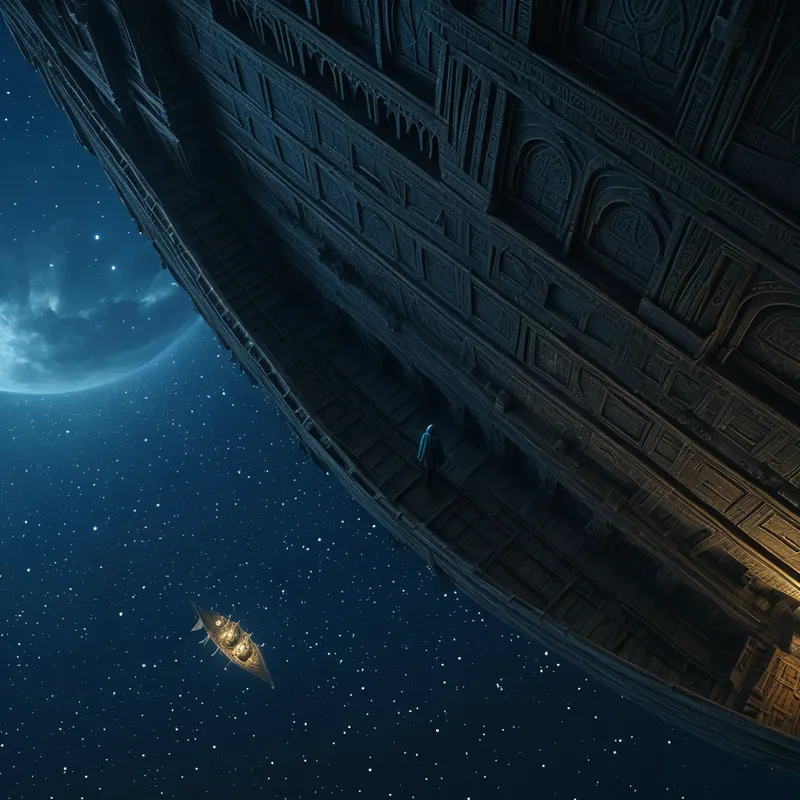
The youth did so. With a groan of ancient timber and a sigh of gathered air, the ship lifted from the forest floor, piercing the canopy and ascending into the vault of heaven. His journey was not solitary. From the clouds, he gathered a crew of the impossible: a man who could hear whispers across continents, another who could run faster than sunlight, one who could drink an ocean dry, and a final companion who could shoot an arrow with such precision it could find a single hair in a world of shadows.
They sailed over mountains that scraped the stars and deserts that held the bones of leviathans. Below, the Sultan’s palace glittered, a jewel of impossible geometry. The Sultan, a man bound by pride and law, was terrified by the sight of the ship descending from the firmament. Seeing a mere peasant at its helm, he devised cruel tests: to eat a mountain of bread and drink a lake of wine, to fetch a lost ring from the depths of the sea, and finally, to identify the true princess from among forty identical veiled maidens.
Through the miraculous aid of his celestial crew—the drinker, the listener, the runner, the archer—the youth met each impossible demand. When the archer’s arrow found the true princess by the unique pearl upon her brow, the Sultan’s resistance shattered like a clay pot. The youth, no longer a dreamer but a proven hero, took the princess’s hand. And the flying ship, its purpose fulfilled, became a constellation in the night sky, a reminder that the most profound journeys begin with a heart brave enough to believe in the absurd.
Cultural Origins & Context
The tale of the Flying Ship Arabian is a beloved strand in the vast tapestry of Arabian folklore, often collected alongside the more famous One Thousand and One Nights. It belongs to the genre of the “impossible task” folktale (ATU 513), a narrative structure found across cultures, but here it is infused with the specific textures of its setting. These stories were not mere entertainments; they were the psychological and moral compasses of the community, told in majlis, around campfires in the desert, or in the shadowed corners of bustling souks.
The storyteller, the hakawati, was a keeper of collective wisdom. In telling this tale, he reinforced core societal values in a palatable, wondrous form: the virtue of humility over arrogant pride (the youngest son versus his brothers and the Sultan), the supreme importance of barakah (divine blessing or grace, represented by the old man), and the belief that destiny (qadar) favors the sincere and pure of heart. The story functions as a narrative salve for a rigidly hierarchical society, offering a fantasy where the lowliest individual, through innate goodness and supernatural aid, can ascend to the very pinnacle of social order—marrying royalty itself. It is a myth of radical vertical mobility, achieved not through force, but through faith, cleverness, and the alliance with the extraordinary.
Symbolic Architecture
The myth’s power lies in its perfect symbolic [architecture](/symbols/architecture “Symbol: Architecture in dreams often signifies structure, stability, and the framing of personal identity or life’s journey.”/), each element a cog in a [machine](/symbols/machine “Symbol: Machines in dreams often represent systems, control, and the mechanization of life, highlighting issues of productivity and efficiency.”/) of psychic transformation.
The ship that flies is the soul that has learned its element is not the mud of convention, but the air of potential.
The Flying Ship itself is the central [symbol](/symbols/symbol “Symbol: A symbol can represent an idea, concept, or belief, serving as a powerful tool for communication and understanding.”/) of the [vehicle](/symbols/vehicle “Symbol: Vehicles in dreams often symbolize the direction in life and the control one has over their journey, reflecting personal agency and decision-making.”/) of [consciousness](/symbols/consciousness “Symbol: Consciousness represents the state of awareness and perception, encompassing thoughts, feelings, and experiences.”/). It is not a natural object; it is a crafted [synthesis](/symbols/synthesis “Symbol: The process of combining separate elements into a unified whole, representing integration, resolution, and the completion of a personal journey.”/) of earthly [material](/symbols/material “Symbol: Material signifies the tangible aspects of life, often representing physical resources, desires, and the physical world’s influence on our existence.”/) ([wood](/symbols/wood “Symbol: Wood symbolizes strength, growth, and the connection to nature and the environment.”/)) and heavenly aspiration ([flight](/symbols/flight “Symbol: Flight symbolizes freedom, escape, and the pursuit of one’s aspirations, reflecting a desire to transcend limitations.”/)). It represents the individuated psyche—a unique construct built by the ego (the [youth](/symbols/youth “Symbol: Youth symbolizes vitality, potential, and the phase of life associated with growth and exploration.”/)) under [guidance](/symbols/guidance “Symbol: The act of receiving or seeking direction, advice, or leadership in a dream, often representing a need for clarity, support, or a higher purpose on one’s life path.”/) from the unconscious (the old man), capable of navigating realms beyond the ordinary world. The Old Man is the archetypal personification of the Self, the inner guide who appears when the ego is in a state of sincere [despair](/symbols/despair “Symbol: A profound emotional state of hopelessness and loss, often signaling a need for transformation or surrender to deeper truths.”/) and openness, offering the key (the incantation) that activates latent potential.
The [crew](/symbols/crew “Symbol: A crew often symbolizes collaboration, teamwork, and collective purpose, suggesting a need for shared goals and support from others in one’s journey.”/) of miraculous helpers are the personified daimons or specialized faculties of the unconscious psyche. The listener, runner, drinker, and archer represent supernormal capacities of [intuition](/symbols/intuition “Symbol: The immediate, non-rational understanding of truth or insight, often described as a ‘gut feeling’ or inner knowing that bypasses conscious reasoning.”/), will, containment, and discernment, respectively. They are not developed by the youth; they are gathered. This is critical. It signifies that the resources needed for the heroic [journey](/symbols/journey “Symbol: A journey in dreams typically signifies adventure, growth, or a significant life transition.”/) are not built through conscious [effort](/symbols/effort “Symbol: Effort signifies the physical, mental, and emotional energy invested toward achieving goals and personal growth.”/) alone, but are attracted and integrated from the boundless [depths](/symbols/depths “Symbol: Represents the subconscious, hidden emotions, or foundational aspects of the self, often linked to primal fears or profound truths.”/) of the psyche when one embarks on the true [path](/symbols/path “Symbol: The ‘path’ symbolizes a journey, choices, and the direction one’s life is taking, often representing individual growth and exploration.”/).
The Sultan embodies the complex of entrenched worldly power, collective norms, and skeptical rationality—the “old [king](/symbols/king “Symbol: A symbol of ultimate authority, leadership, and societal order, often representing the dreamer’s inner power or external control figures.”/)” who must be confronted and transformed. His impossible tasks are the initiatory ordeals required to prove one’s worth not to him, but to the deeper order of [reality](/symbols/reality “Symbol: Reality signifies the state of existence and perception, often reflecting one’s understanding of truth and life experiences.”/) he inadvertently serves.

The Dreamer’s Resonance
When this myth stirs in the modern dreamer, it often manifests as dreams of improbable vehicles—cars that drive up walls, bicycles that soar, or rooms that become spacecraft. The somatic sensation is one of exhilarating, terrifying lift, a queasy disorientation from the pull of gravity (the weight of the familiar). To dream of building such a vessel indicates a nascent, creative phase of individuation; the ego is actively constructing a new mode of being from raw, personal material.
Dreams of gathering a strange crew, or meeting figures with impossible abilities, signal the psyche’s readiness to integrate powerful but previously unconscious complexes. The feeling is one of relief and bolstered strength. Conversely, dreaming of facing a daunting, bureaucratic authority figure (a CEO, a judge, a faceless panel) who sets absurd demands mirrors the Sultan’s tests. The psychological process here is one of confronting the internalized “father” or societal superego, the voice that says “you are not enough” and “that is impossible.” The anxiety in the dream is the friction of the emerging Self pressing against the rigid structures of the adapted personality.
Alchemical Translation
The myth of the Flying Ship Arabian is a precise blueprint for the alchemical process of psychic transmutation, or individuation.
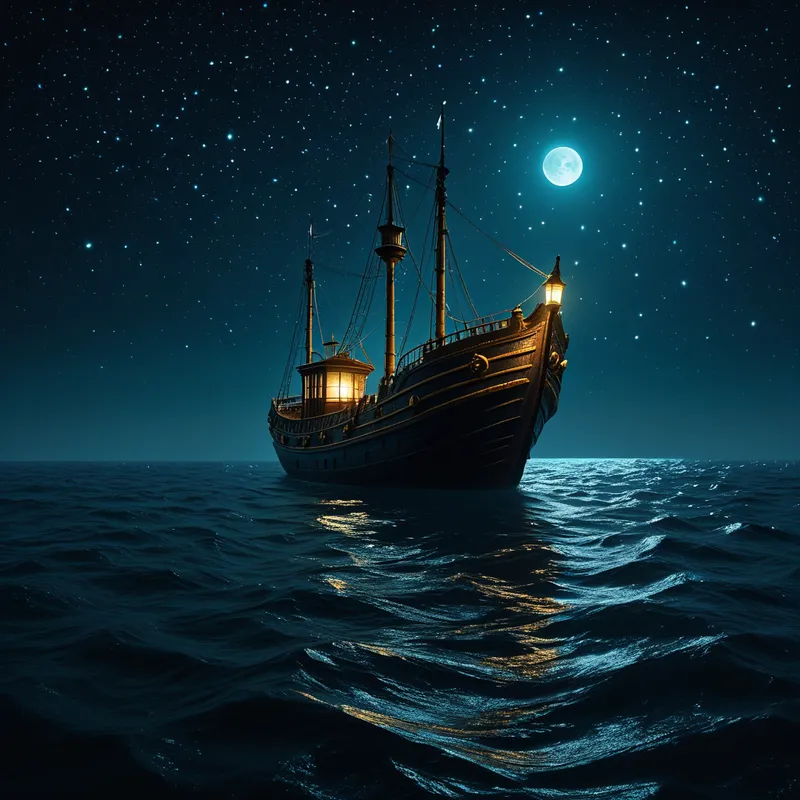
The journey begins in the nigredo, the blackening: the youth’s state of foolish despair in the forest, his “idle” nature scorned by the world. This is the necessary dissolution of old identities. The act of building the ship from intuition is the albedo, the whitening—a work of conscious purification and dedication to an inner image. The appearance of the old man is the infusion of the lapis philosophorum, the philosopher’s stone, the transformative substance (here, the word of power).
The impossible task is the crucible; the miraculous helper is the hidden reagent within the soul’s own substance.
The flight itself is the citrinitas, the yellowing or illumination, as consciousness ascends to a panoramic view of its own life. The gathering of the crew is the integration of opposites, uniting disparate psychic functions into a cohesive, operational whole. The Sultan’s palace represents the hardened, crystallized world of collective consciousness. The three tasks are the final, fiery trials of the rubedo, the reddening. To eat and drink impossibly large quantities is to demonstrate an ability to assimilate and contain overwhelming psychic content (the shadow, the anima). To retrieve the ring from the sea is a dive into the unconscious to reclaim a symbol of wholeness (the circle). To identify the true princess is the ultimate act of discriminatio—the ability to recognize the authentic anima, the soul-image, amidst a crowd of plausible false selves.
The marriage is the coniunctio, the sacred marriage of the now-kingly conscious mind (the hero) with the soul (the princess), resulting in a new, stable, and fertile psychic regime. The ship becoming a constellation signifies that the vehicle of transformation, once its work is done, recedes into the permanent background of the psyche as an enduring archetypal pattern, a guiding light for future voyages.
Associated Symbols
Explore related symbols from the CaleaDream lexicon:
- Ship — The primary vessel of journey and consciousness, transformed from a sea-bound craft into a celestial one, representing the transcendence of natural limits.
- Sky — The domain of the flying ship, symbolizing the realm of spirit, potential, higher thought, and divine aspiration beyond earthly concerns.
- Journey — The core narrative structure of the myth, representing the archetypal path of the hero from obscurity to fulfillment through trials and aid.
- Hero — The humble youth who answers the call to the impossible, embodying the archetype of transformation through faith, perseverance, and integration.
- Key — The magical command given by the old man, which unlocks the latent power of the ship and, symbolically, the dreamer’s own potential.
- Destiny — The invisible force that guides the youth to the forest, to the old man, and through the trials, suggesting a pre-ordained path for the sincere heart.
- Mountain — One of the obstacles overflown by the ship, representing monumental challenges and earthly burdens that are transcended from a higher perspective.
- Star — The final form of the ship as a constellation, symbolizing eternal guidance, achieved destiny, and the myth’s permanent imprint on the collective imagination.
- Forest — The place of isolation and raw materials where the ship is built, representing the unconscious, fertile source of creativity and the unknown.
- Pride — The flaw of the Sultan and the elder brothers, the psychological obstacle that must be overcome by the humility and faith of the true hero.
- Flying — The central miraculous action, representing liberation, ascension, and the ability to operate on a plane beyond conventional reality and logic.
- Vision — The inner sight possessed by the youth that allows him to conceive of the flying ship, representing intuition and connection to archetypal blueprints.