The Flying Carpet of King Solomon Myth Meaning & Symbolism
A myth of King Solomon's magical carpet, woven by djinn, that carries his throne across the heavens, embodying divine wisdom and cosmic sovereignty.
The Tale of The Flying Carpet of King Solomon
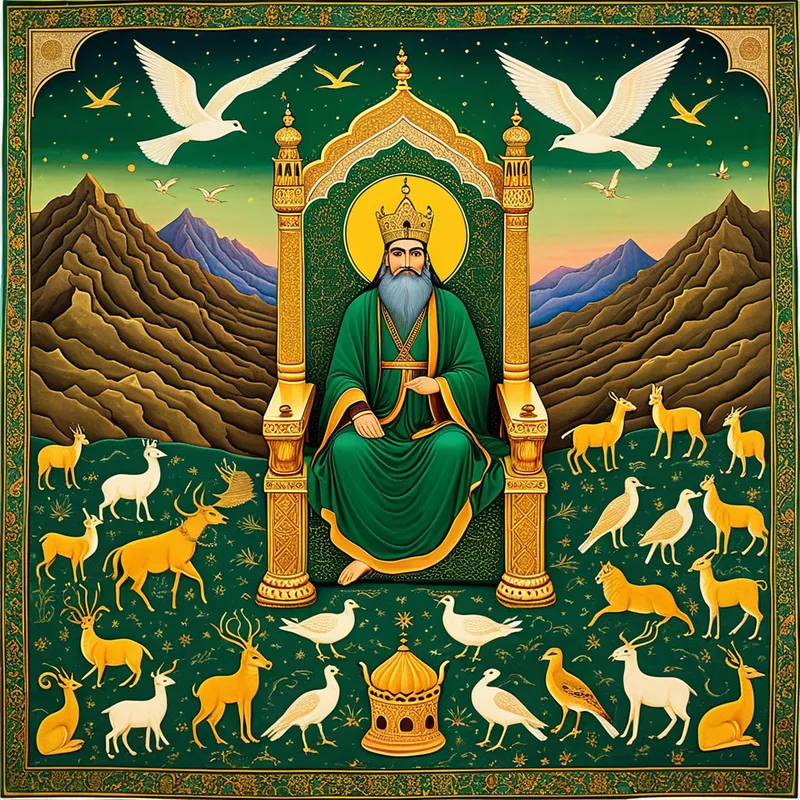
Hear now a tale spun on the loom of time, when the boundary between earth and heaven was as thin as a [spider](/myths/spider “Myth from Native American culture.”/)’s silk. It begins not with a man, but with a king who was also a prophet, whose very name, Sulayman ibn Dawud, was a whisper of [the wind](/myths/the-wind “Myth from Various culture.”/) and a command to the stone. [Solomon](/myths/solomon “Myth from Biblical culture.”/), to whom God granted dominion over all things—over the tongues of men and the secrets of beasts, over the marching armies and the silent, growing things. But his greatest throne was not of gold or ivory; it was [the sky](/myths/the-sky “Myth from Persian culture.”/) itself.
For Solomon desired a court that could move with the speed of his thought, a dominion that could touch the farthest corners of his realm in the blink of an eye. He summoned the djinn, those beings of smokeless fire and capricious will. To the greatest among them, he issued a decree that was both a wish and a test of their loyalty: “Weave me a throne that can ride the wind. Weave me a carpet that can hold [the world](/myths/the-world “Myth from Tarot culture.”/).”
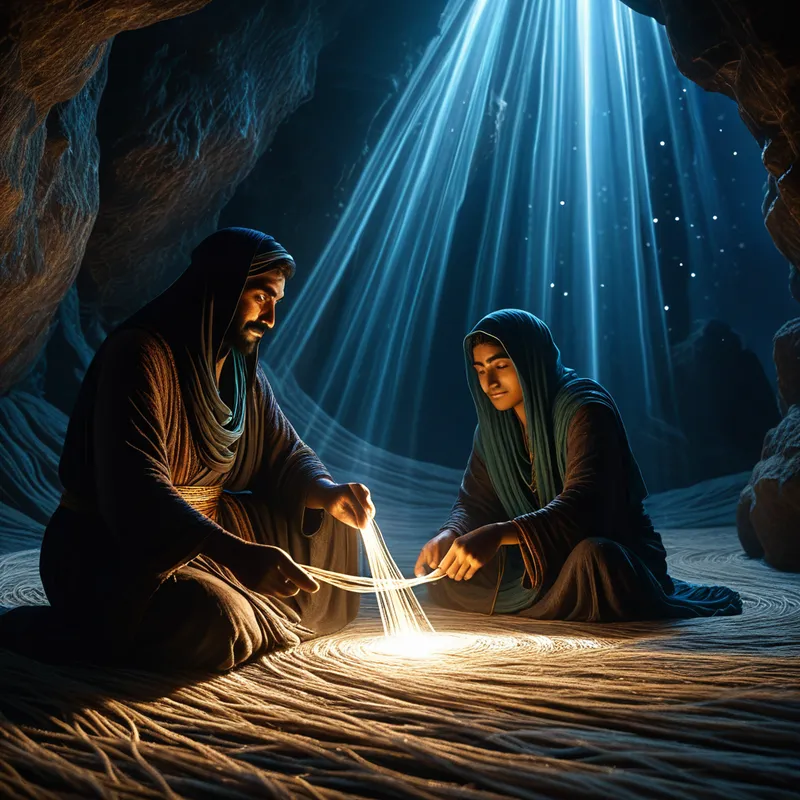
And so, in hidden valleys where the light of day never fully reached, the djinn gathered. The greatest weavers among them, their fingers like tongues of blue flame, took up threads not of wool or silk, but of essence itself. They spun the green of the deepest forests and the gold of the setting sun. They wove in the patience of mountains and the swiftness of rivers. Some say they captured the very whispers of the wind to make it buoyant, and plucked strands from the [Primum Mobile](/myths/primum-mobile “Myth from Medieval Cosmology culture.”/) to grant it direction. For forty days and forty nights they labored, until they presented to the king a tapestry of such majesty it stole the breath from human lungs.
It was a carpet of impossible dimensions, vast enough to host his entire court. At its center sat Solomon’s throne of sandalwood and [pearl](/myths/pearl “Myth from Chinese culture.”/). At his command, the four winds would gather beneath its fringes. The east wind, [Zephyrus](/myths/zephyrus “Myth from Greek culture.”/), would lift it with a gentle sigh. The west wind would steady it, the north wind would cool it, and the south wind would speed it on its way. With a thought, Solomon would ascend. His viziers, his warriors, his scribes would take their places. And then would come the true court: the animals. The lion would pad to his right, the eagle would perch on the throne’s pinnacle, the serpent would coil respectfully at a distance. All the creatures of [the earth](/myths/the-earth “Myth from Hindu culture.”/), recognizing the seal of Solomon upon his ring, would gather in peaceful assembly upon that flying land.
One day, soaring high above the lands of Persia, Solomon heard a proud whisper from the carpet itself, boasting of the mighty load it bore. In that moment of hubris, the king’s divine focus wavered. The command to the winds faltered. The great carpet shuddered, dipped, and began to fall. A cry rose from the thousands upon its back. But Solomon, his wisdom instantly restored, struck his staff upon the throne and called out to God. The command was reissued, more humble now. The winds rushed back to their stations, and the carpet righted itself, continuing its journey with a newfound reverence woven into its very threads. It was a reminder that even the most miraculous power is but a loan from a greater source, and sovereignty is stewardship, not possession.
Cultural Origins & Context
This myth finds its most elaborate expressions in the rich tapestry of Persianate literature, particularly within the works of poets and scholars who synthesized Islamic prophetic stories with ancient Persian cosmological imagination. It is prominently featured in works like the Makhzan al-Asrar (The Treasury of Secrets) and other mystical texts. The story was not merely a fantastical anecdote; it was a functional myth for a civilization deeply concerned with order, [justice](/myths/justice “Myth from Tarot culture.”/), and the cosmic role of the righteous king.
The tale was passed down through multiple channels: in the ornate verses of court poets who used it to illustrate ideal kingship, in the allegorical teachings of Sufi masters for whom the carpet represented the soul’s vehicle, and in the oral folklore of the bazaar and caravan, where it became a symbol of boundless travel and wonder. Societally, it served to model the concept of Farr-e Izadi (Divine Grace or Royal Glory)—the idea that legitimate sovereignty is a divine mandate that brings harmony between the human, natural, and spiritual worlds. Solomon’s ability to command djinn and animals alike symbolized the ruler’s responsibility to integrate and govern all elements of the realm, from the unruly forces of nature (the djinn) to the base instincts (the animals), through wisdom and divine authority.
Symbolic Architecture
At its [heart](/symbols/heart “Symbol: The heart symbolizes love, emotion, and the core of one’s existence, representing deep connections with others and self.”/), the flying [carpet](/symbols/carpet “Symbol: Represents the foundation upon which life experiences are built.”/) is not a [vehicle](/symbols/vehicle “Symbol: Vehicles in dreams often symbolize the direction in life and the control one has over their journey, reflecting personal agency and decision-making.”/) of mere travel, but of [integration](/symbols/integration “Symbol: The process of unifying disparate parts of the self or experience into a cohesive whole, often representing psychological wholeness or resolution of internal conflict.”/). It represents the conscious ego (Solomon’s [throne](/symbols/throne “Symbol: A seat of authority, power, and sovereignty, representing leadership, divine right, or social hierarchy.”/)) that has successfully assembled and commands the disparate, often chaotic forces of the [psyche](/myths/psyche “Myth from Greek culture.”/).
The carpet itself is the fabric of the integrated Self. Woven by the [djinn](/symbols/djinn “Symbol: A powerful supernatural being from Middle Eastern and Islamic traditions, often associated with wish-granting, trickery, and elemental forces.”/)—the psychic forces of the unconscious, our raw instincts, creativity, and [shadow](/symbols/shadow “Symbol: The ‘shadow’ embodies the unconscious, repressed aspects of the self and often represents fears or hidden emotions.”/) elements—it becomes a [vessel](/symbols/vessel “Symbol: A container or structure that holds, transports, or protects something essential, representing the self, emotions, or life journey.”/) only when those forces are directed by the ring of wisdom (conscious [intention](/symbols/intention “Symbol: Intention represents the clarity of purpose and direction in one’s life and can symbolize motivation and commitment within a dream context.”/) and moral [authority](/symbols/authority “Symbol: A symbol representing power structures, rules, and control, often reflecting one’s relationship with societal or personal governance.”/)). The threads of [forest](/symbols/forest “Symbol: The forest symbolizes a complex domain of the unconscious mind, representing both mystery and potential for personal growth.”/), sun, wind, and star speak to the [synthesis](/symbols/synthesis “Symbol: The process of combining separate elements into a unified whole, representing integration, resolution, and the completion of a personal journey.”/) of elemental forces: [earth](/symbols/earth “Symbol: The symbol of Earth often represents grounding, stability, and the physical realm, embodying a connection to nature and the innate support it provides.”/), fire, air, and [spirit](/symbols/spirit “Symbol: Spirit symbolizes the essence of life, vitality, and the spiritual journey of the individual.”/).
The true throne is not where one sits, but what one carries: the integrated kingdom of the soul, airborne on the loom of will and wisdom.
The animals gathering in [peace](/symbols/peace “Symbol: Peace represents a state of tranquility and harmony, both internally and externally, often reflecting a desire for resolution and serenity in one’s life.”/) are a potent [symbol](/symbols/symbol “Symbol: A symbol can represent an idea, concept, or belief, serving as a powerful tool for communication and understanding.”/) of the taming of the instincts. The [lion](/symbols/lion “Symbol: The lion symbolizes strength, courage, and authority, often representing one’s inner power or identity.”/) (rage, pride), the [eagle](/symbols/eagle “Symbol: The eagle is a symbol of power, freedom, and transcendence, often representing a person’s aspirations and higher self.”/) (spiritual ambition, sometimes arrogance), and the [serpent](/symbols/serpent “Symbol: A powerful symbol of transformation, wisdom, and primal energy, often representing hidden knowledge, healing, or temptation.”/) (earthly wisdom, cunning, poison) are not destroyed or banished, but given a dignified place within the whole. This is the psyche in a state of inner [peace](/symbols/peace “Symbol: Peace represents a state of tranquility and harmony, both internally and externally, often reflecting a desire for resolution and serenity in one’s life.”/), where no part of [the self](/myths/the-self “Myth from Jungian culture.”/) is at war with another. The carpet’s momentary faltering upon its own boast is a critical [piece](/symbols/piece “Symbol: A ‘piece’ in dreams often symbolizes a fragment of the self or a situation that requires integration, reflection, or understanding.”/) of symbolic [architecture](/symbols/architecture “Symbol: Architecture in dreams often signifies structure, stability, and the framing of personal identity or life’s journey.”/): it represents the peril of identification with the tool. When [the ego](/myths/the-ego “Myth from Jungian culture.”/) (Solomon) becomes inflated by the power of the integrated Self (the carpet), it risks a catastrophic fall. True sovereignty, the myth insists, requires perpetual humility before the transcendent [source](/symbols/source “Symbol: The origin point of something, often representing beginnings, nourishment, or the fundamental cause behind phenomena.”/) of that power.
The Dreamer’s Resonance
When this myth surfaces in modern dreams, it rarely appears as a literal, miniature-painting scene. Instead, it manifests as a pattern of integration and elevated perspective. To dream of a carpet that lifts you off the ground, or a rug that unfolds into a vast landscape, signals a somatic and psychological process of synthesis.
You may be in a phase where disparate parts of your life—career, relationships, personal history, creative drives—are beginning to coalesce into a workable whole. The “djinn” (your own unconscious industry, perhaps felt as anxiety, intense brainstorming, or nocturnal creativity) have been weaving a new foundation beneath you. The dream of ascent on such a vessel is the psyche’s representation of achieving a meta-position. You are no longer mired in the conflicts of the individual elements (the arguing animals); you are gaining a sovereign view from above, where patterns become clear and governance is possible.
Conversely, dreaming of a carpet that is frayed, too small, or unable to lift off may indicate a feeling that the “weaving” is incomplete. The forces of the unconscious (djinn) may feel rebellious or uncooperative. A dream of falling from the carpet mirrors the myth’s warning: it often follows a period of psychological inflation, where one has taken personal credit for what was actually a gift of the unconscious or a grace of circumstance, leading to a necessary and humbling correction.
Alchemical Translation
The myth of Solomon’s carpet is a near-perfect allegory for the Jungian process of individuation, or psychic alchemy. The [prima materia](/myths/prima-materia “Myth from Alchemical culture.”/)—the raw, chaotic stuff of the psyche—is represented by the unruly djinn and the scattered animals. Solomon’s divine wisdom and ring are the alchemist’s intent, the guiding consciousness that seeks order.
The operation is the weaving. This is the long, often unconscious work of relating to our inner demons (djinn) and instincts (animals), not to exterminate them, but to engage them in a creative act. We must persuade our inner djinn to weave for us, to transform their fiery, chaotic energy into the structured beauty of the carpet. This is the integration of [the shadow](/myths/the-shadow “Myth from Jungian culture.”/).
Individuation is the art of convincing your demons to become your most skilled weavers.
The finished carpet is the alchemical vessel, the [vas hermeticum](/myths/vas-hermeticum “Myth from Alchemical culture.”/), now capable of containing the totality of the self and undertaking the [magnum opus](/myths/magnum-opus “Myth from Alchemical culture.”/)—[the great work](/myths/the-great-work “Myth from Alchemical culture.”/). The flight is the transcendent function in action. It symbolizes the ability to operate from a unified self, to navigate life’s challenges not from a fragmented, reactive place, but from a centered, sovereign perspective that can see the larger pattern.
The final, crucial stage of this alchemy is the carpet’s stumble. This represents the [rubedo](/myths/rubedo “Myth from Alchemical culture.”/), the reddening, often associated with suffering or humiliation in the alchemical process. It is the necessary dissolution of ego-inflation. The integrated self is not a trophy for the ego to possess; it is a living relationship that requires continual submission to a reality greater than itself. The true gold produced is not the power of flight, but the wisdom of humble sovereignty—the realization that one is both the ruler on the throne and the servant of the wind that carries it. This completes the transmutation: the leaden, earthbound psyche becomes the golden, airborne Self, forever in dialogue with the divine.
Associated Symbols
Explore related symbols from the CaleaDream lexicon: