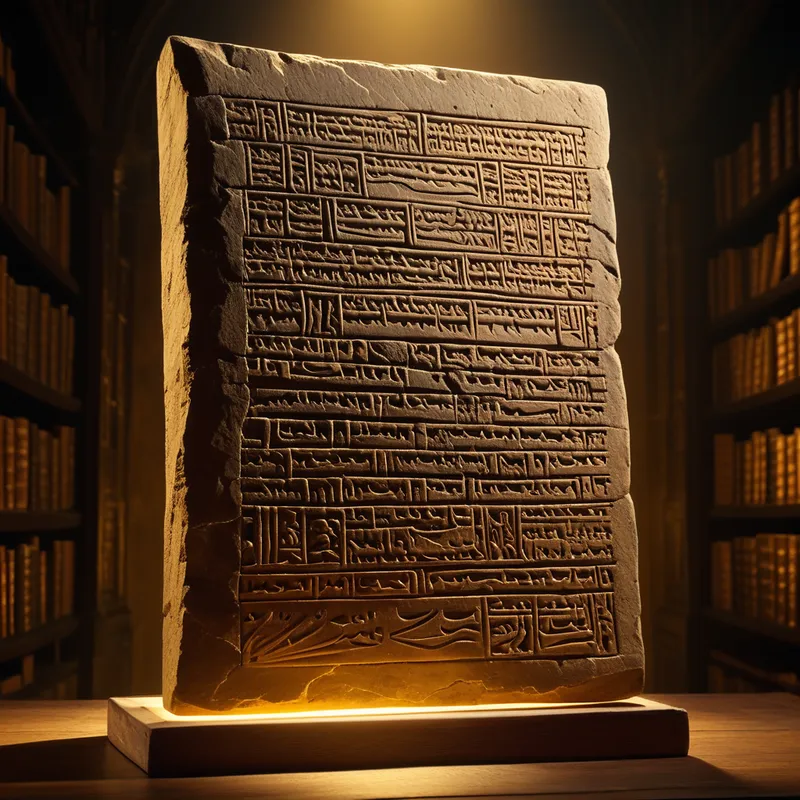
The Flood Tablet Myth Meaning & Symbolism
A god-sent deluge wipes humanity from the earth, sparing only one righteous man, his family, and the seed of all life, preserved in a great boat.
The Tale of The Flood Tablet
Hear now the words pressed into the clay, the story older than kings, whispered by the river reeds and carried on the dust-laden wind. It is a tale not from the lips of Gilgamesh himself, but from one who walked before time was measured—Utnapishtim, the Far-Away.
In the before-time, when cities multiplied and the clamor of humankind rose like smoke to the vault of heaven, the great gods grew restless in their council. Their sleep was shattered by the din from below. “The noise of mankind is too great!” roared Enlil, his voice the gathering storm. “Their uproar deprives us of rest!” In their celestial assembly, a terrible decree was sealed. To silence the earth, they would unleash the Apsu and the fury of the skies. They would send a flood to return all flesh to clay, to wipe the slate of the world clean.
But one god dissented. Ea, the clever one, whose heart held a secret compassion for his creation, could not bear the final silence. He did not break the divine oath, oh no. He went to the reed wall of Utnapishtim’s house and spoke not to the man, but to the wall itself. “Reed wall, reed wall! Listen and understand! Dismantle your house, abandon your wealth. Build a boat, a perfect cube, with a roof strong as the vault of heaven. Seal it with bitumen, inside and out. Bring into it the seed of all living things.”
Utnapishtim, hearing the wall’s whispered wisdom, did not hesitate. He gathered pitch and timber, and his family labored. Neighbors mocked: “Why build a boat where no river flows?” He offered only riddles, speaking of a divine favor that would rain down. For seven days, the hammering echoed, a strange heartbeat against the coming silence.
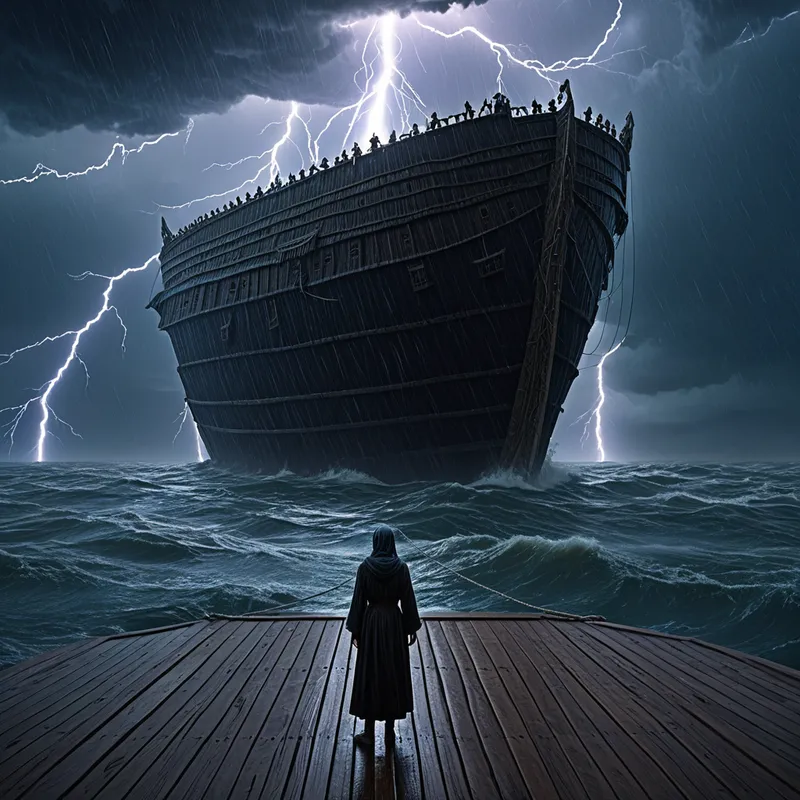
Then the weather changed. The horizon grew dark, not with cloud, but with the shadow of unleashed chaos. Adad thundered forth. The flood came not as rain alone, but as a breaking of all boundaries. The dikes of the world burst. The Apsu surged upward, the storm winds howled like a dying beast, and a darkness so complete fell that brother could not see brother. For six days and seven nights, the tempest walked the earth, scouring it clean. The gods themselves, seeing the devastation they had wrought, cowered like dogs, shrinking back against the walls of heaven. Ishtar wailed, her voice a lament: “Have I, in the council of the gods, ordered such evil? Now, like spawn of fish, my people clutter the sea!”
On the seventh day, the storm, spent, withdrew. Utnapishtim opened a window. Silence. A flat, terrible sea of mud stretched to every horizon. No life. No sound. His boat ground to a halt on the peak of Mount Nimush. He waited. On the seventh day of their grounding, he released a dove. It flew and returned, finding no perch. He released a swallow. It, too, returned. He released a raven. The raven saw the waters had receded, it ate, it circled, and it did not come back.
Then Utnapishtim knew. He stepped out upon the mud of the new world. He built an altar of stones and offered a sweet-smelling sacrifice of reed, cedar, and myrtle. The gods, starved for the savor of offering, gathered like flies to the feast. Enlil arrived last, furious to see life preserved. But Ea spoke wisdom: “Punish the sinner for his sin, the wrongdoer for his wrongdoing, but be merciful, lest he be cut off!” And so, Enlil, his wrath appeased, took Utnapishtim and his wife by the hand. He touched their foreheads and blessed them. “Before, you were human. Now, you and your wife shall be like us, gods. You shall live at the source of the rivers, at the mouth of the waters, in the Far-Away.”
Cultural Origins & Context
This narrative is the eleventh tablet of the Standard Babylonian version of the Epic of Gilgamesh, inscribed in the seventh century BCE for the library of the Assyrian king Ashurbanipal. Its roots, however, sink deep into Sumerian soil, with earlier fragments found in the city of Nippur. It was not a story for common firesides, but a text of immense prestige, copied by scribal apprentices and housed in royal and temple libraries. Its primary societal function was not merely to explain a cataclysm, but to explore profound theological and existential questions: the capricious nature of the divine, the fragility of human endeavor, and the possibility of transcending mortal limits through wisdom and piety. It served as a foundational myth of renewal, justifying the king’s role as the mediator between the chaotic will of the gods and the ordered survival of civilization.
Symbolic Architecture
The Flood is the ultimate [symbol](/symbols/symbol “Symbol: A symbol can represent an idea, concept, or belief, serving as a powerful tool for communication and understanding.”/) of divine, unconscious retribution—a psychic purge of unbearable intensity. It represents the ego’s catastrophic encounter with contents of the [collective unconscious](/symbols/collective-unconscious “Symbol: The Collective Unconscious refers to the part of the unconscious mind shared among beings of the same species, embodying universal experiences and archetypes.”/) so vast they threaten to dissolve [identity](/symbols/identity “Symbol: Identity represents the sense of self, encompassing personal beliefs, cultural background, and social roles.”/) entirely. The ark is not a ship of escape, but a sealed [vessel](/symbols/vessel “Symbol: A container or structure that holds, transports, or protects something essential, representing the self, emotions, or life journey.”/) of transformation, a conscious container built through obedience to inner wisdom (Ea). Its cubic shape symbolizes perfect order and [stability](/symbols/stability “Symbol: A state of firmness, balance, and resistance to change, often represented by solid objects, foundations, or steady tools.”/), a [mandala](/symbols/mandala “Symbol: A sacred geometric circle representing wholeness, the cosmos, and the journey toward spiritual integration.”/) held against the formless [chaos](/symbols/chaos “Symbol: In Arts & Music, chaos represents raw creative potential, uncontrolled expression, and the breakdown of order to forge new artistic forms.”/).
The ark is the psyche itself in its containing function—the fragile, crafted vessel of consciousness that must hold all opposing seeds of life while the world drowns.
Utnapishtim is the [archetype](/symbols/archetype “Symbol: A universal, primordial pattern or prototype in the collective unconscious that shapes human experience, behavior, and creative expression.”/) of the one who listens. He heeds the voice from the “[reed](/symbols/reed “Symbol: A flexible plant symbolizing resilience, adaptability, and vulnerability. It bends without breaking, representing survival through yielding.”/) [wall](/symbols/wall “Symbol: Walls in dreams often symbolize boundaries, protection, or obstacles in one’s life, reflecting the dreamer’s feelings of confinement or security.”/)”—the liminal, mediating [space](/symbols/space “Symbol: Dreaming of ‘Space’ often symbolizes the vastness of potential, personal freedom, or feelings of isolation and exploration in one’s life.”/) between the divine and the [human](/symbols/human “Symbol: The symbol of a human represents individuality, complexity of emotions, and social relationships.”/), the unconscious and [consciousness](/symbols/consciousness “Symbol: Consciousness represents the state of awareness and perception, encompassing thoughts, feelings, and experiences.”/). His [journey](/symbols/journey “Symbol: A journey in dreams typically signifies adventure, growth, or a significant life transition.”/) is not one of [action](/symbols/action “Symbol: Action in dreams represents the drive for agency, motivation, and the ability to take control of situations in waking life.”/), but of endurance and preservation. The birds he releases are symbolic functions of the psyche: the dove (feeling) and swallow ([intuition](/symbols/intuition “Symbol: The immediate, non-rational understanding of truth or insight, often described as a ‘gut feeling’ or inner knowing that bypasses conscious reasoning.”/)) find no place in the devastated [landscape](/symbols/landscape “Symbol: Landscapes in dreams are powerful symbols representing the dreamer’s emotional state, personal journey, and the broader context of life situations.”/), but the [raven](/symbols/raven “Symbol: The raven is often seen as a messenger of the divine and a symbol of transformation, wisdom, and the mysteries of life and death.”/) (instinct, cunning) finds sustenance and does not return, signaling that the raw, instinctual world is ready to be re-inhabited.
The Dreamer’s Resonance
To dream of this myth is to be in a state of profound psychic inundation. The dreamer may experience tsunamis, rising basement waters, or relentless rains that threaten to dissolve the foundations of their life. This is the somatic signature of an ego overwhelmed by repressed emotional material, unresolved grief, or a life structure that has become too noisy, too burdensome, and is being dismantled by the Self. The dream is not forecasting literal disaster, but enacting a necessary, if terrifying, purification.
The critical symbol in such dreams is often the ark or its modern equivalents: a fortified room, a basement safe, a locked chest. Finding and securing this container in the dream is the work of the Ea principle—the inner wisdom that instructs one on what must be saved (core values, essential talents, genuine relationships) and what must be released to the waters. The aftermath of such a dream is often a feeling of eerie calm, a stark, mud-flat landscape within, which is the fertile ground for the next beginning.

Alchemical Translation
The alchemical process mirrored here is solutio—dissolution in the primordial waters. The old, inflated, or corrupt persona (the “noisy” civilization of the ego) is utterly dissolved. This is not a gentle cleansing, but a near-total annihilation, a return to the massa confusa or primal mud. The goal is not to avoid the flood, but to build the vessel that can survive it.
Individuation requires a flood. It is the non-negotiable dissolution of the world you have built, so that the world you are meant to inhabit can emerge from the silent deep.
Utnapishtim’s apotheosis—being made “like the gods” and dwelling at the source of the rivers—is the alchemical reward. It symbolizes achieving a standpoint of the Self. One no longer lives in the psychic currents (the rivers of emotion, instinct, and thought) but at their source, with a perspective that comprehends their origin and flow. This is the “Far-Away” place of inner objectivity and wisdom, the Sage archetype made permanent. The individual does not escape life but gains the capacity to contain its full, chaotic potential without being destroyed by it, having internalized the containing function of the ark itself.
Associated Symbols
Explore related symbols from the CaleaDream lexicon:
- Flood — The overwhelming, purgatorial force of the unconscious that dissolves the old order, representing both divine wrath and the necessary chaos preceding rebirth.
- Water — The primordial, formless medium of the unconscious itself, capable of both sustaining life and enacting total dissolution.
- Boat — The crafted vessel of consciousness and containment, the ego-structure built to preserve the essential seeds of the Self during psychic upheaval.
- Mountain — The peak of consciousness and revelation where the vessel comes to rest, the stable ground that emerges after the floodwaters of emotion recede.
- Bird — The messengers of the psyche (dove, swallow, raven) sent to reconnoiter the new inner landscape and test its readiness for the return of instinct and life.
- Rain — The persistent, eroding aspect of the flood, symbolizing the steady drip of anxiety, grief, or insight that gradually undermines the old world.
- Sacrifice — The offering made after survival, the gratitude and recognition owed to the divine (the Self) for the ordeal, which transforms the survivor’s status.
- Stone — The enduring altar of remembrance and the tablets upon which the wisdom of the experience is inscribed for future generations of the psyche.
- God — The capricious, collective forces of the unconscious (the divine council) whose decrees can upend the conscious world, demanding obedience and respect.
- Dream — The medium through which the “reed wall” speaks, the liminal space where warnings of impending psychic floods are first received.
- Seed — The essential potential of life and psyche preserved within the ark, containing the blueprint for all future growth after the dissolution.
- Destiny — The fate of transformation bestowed upon Utnapishtim, representing the individuated endpoint of surviving the flood: a timeless, wise existence at the source of being.