The Flood Myth Meaning & Symbolism
A divine judgment washes the world clean, sparing a righteous man and his ark. From the deep waters, a new covenant of mercy and human responsibility emerges.
The Tale of The Flood
In the deep, forgotten time when the world was young and thick with violence, a sound rose to the heavens. It was not a song, but a cacophony—the groaning of the earth under the weight of human corruption, the weeping of the innocent, the roar of blood spilled upon the ground. The Creator saw that the wickedness of humankind was great, and that every imagination of the thoughts of their hearts was only evil continually. And the heart of the Divine was grieved, filled with a profound, sorrowful pain.
But in that generation, there was one man, Noah, who walked with the Divine. He was a man of the soil, his hands calloused, his spirit upright. A voice, terrible and intimate, spoke to him in the silence: “The end of all flesh has come before me. Make for yourself an ark of gopher wood.”
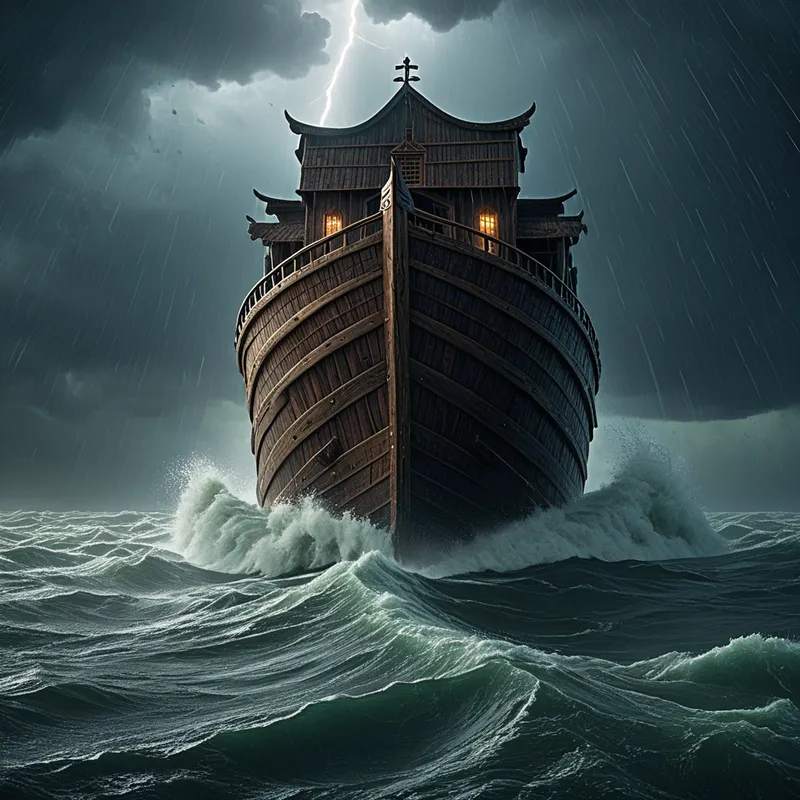
And so began the great labor. For years, under a sun that knew nothing of the coming storm, Noah and his sons hewed and planed. The ark rose, a monstrous silhouette against the horizon, a vessel of absurd proportions—three hundred cubits long, sealed inside and out with pitch. Neighbors mocked. The world carried on with its feasting and fighting. But Noah, a righteous man in a crooked generation, gathered. He gathered his wife, his three sons and their wives. And he gathered the breath of the world itself: two of every living thing, of flesh and fowl and creeping thing, male and female, their eyes wide with instinctual fear, their scents mingling in the dark hold.
Then the fountains of the great deep burst forth. Not with rain at first, but with a shuddering from below, as if the bones of the earth cracked open. And the windows of the heavens were opened. The rain fell—not in drops, but in great, solid sheets, a deluge that erased the line between sky and sea. The waters rose and swelled, lifting the colossal ark from the earth. It groaned, but it floated. And outside, the screaming was swallowed by the roar of the waters. Mountains vanished. Every living thing that moved on the earth perished—bird, cattle, beast, swarming creature, and all mankind. Only the ark, that wooden womb, drifted on the face of the waters.
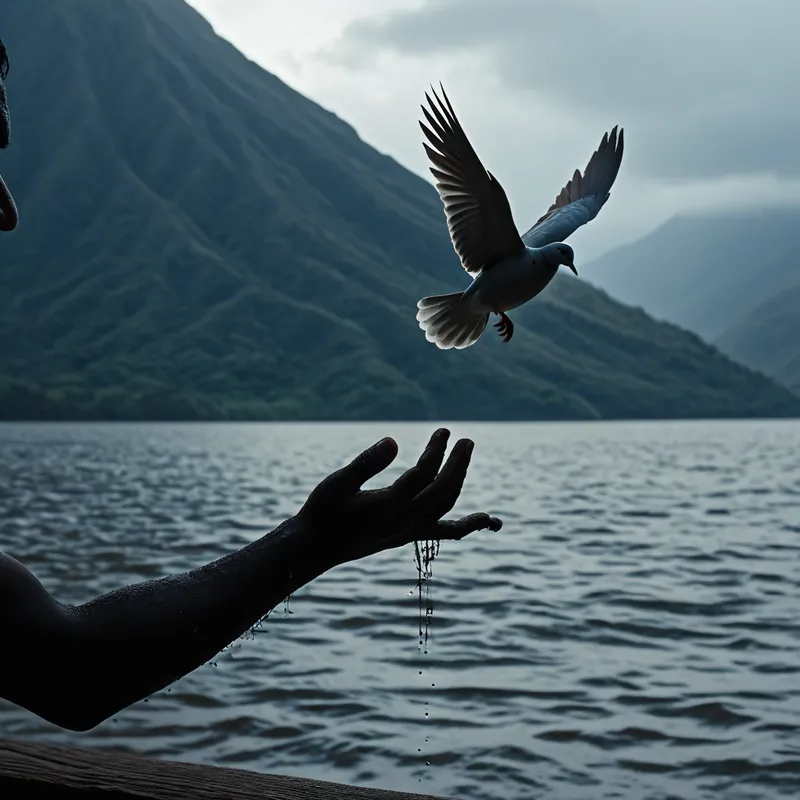
For forty days and forty nights, the cataclysm reigned. Then, for one hundred and fifty days, the waters held the world in a watery grave. But the Divine remembered Noah. A wind passed over the earth, and the waters assuaged. The ark came to rest on the mountains of Ararat. Noah opened the window and sent out a raven. It flew to and fro, finding no rest. He sent a dove. It returned, for the waters still covered the face of the whole earth. He waited seven days, and sent the dove again. This time, it returned at evening, and in its beak was a freshly plucked olive leaf. Hope, green and tender. He waited again, sent the dove once more, and it did not return.
Then the voice spoke: “Go out from the ark, you and your wife, and your sons and your sons’ wives with you. Bring out with you every living thing.” And they emerged, blinking, onto a raw, washed-clean world. The first thing Noah did was build an altar and make an offering. And the Divine smelled the pleasing aroma and spoke a promise to His own heart: “I will never again curse the ground because of man… While the earth remains, seedtime and harvest, cold and heat, summer and winter, day and night, shall not cease.”
Then He set His bow in the cloud—a rainbow—a weapon of war laid down in the sky, its arc now a bridge of mercy. A covenant was established, not just with Noah, but with every living creature for all generations: never again would a flood destroy all flesh. The slate was wiped clean. The story could begin again.
Cultural Origins & Context
The Biblical Flood narrative is not an isolated tale but a profound chapter in a larger theological history. It is embedded within the Torah, serving as a pivotal point between the primeval history of Genesis and the stories of the patriarchs. Scholars widely recognize its literary composition as weaving together earlier traditions, possibly with roots in Mesopotamian flood myths like the Epic of Gilgamesh. However, within the Biblical context, it is thoroughly transformed. The polytheistic squabbles of Mesopotamian gods are replaced by the solemn, moral drama of a singular, relational God whose actions are framed by grief, justice, and ultimately, covenantal love.
This story was told and retold not as mere history, but as foundational theology. It functioned to explain the character of the world—a world that knows both catastrophic suffering and steadfast promises. It established the Biblical understanding of divine justice responding to human corruption, and more importantly, divine grace choosing a path of preservation and renewal. It served as a societal anchor, reinforcing the idea of righteous living (exemplified by Noah) within a covenant framework that now included all of creation. The rainbow was not just a natural phenomenon; it was a communal symbol of God’s restraint, a visible reminder that the stability of the world rests on a promise.
Symbolic Architecture
At its core, the Flood is the archetype of cosmic cleansing. The waters represent the undifferentiated, chaotic Tehom from which the world was originally drawn in Genesis 1. The flood is a symbolic un-making, a return to the primal state, necessitated by the moral entropy of creation. It is a divine reset button.
The flood is not merely punishment; it is the painful, necessary dissolution that precedes any true renewal. The old self, corrupted and rigid, must be drowned so the new can emerge.
The Ark is the vessel of consciousness amidst this dissolution. It is the contained ego, the principle of order and preservation, navigating the overwhelming waters of the unconscious and collective shadow. Noah, the righteous one, represents the part of the psyche that remains connected to the Self (the Divine) even when the entire inner world is in rebellion. He is the caretaker archetype, tasked with preserving the fragile sparks of life and instinct (the animals) through the storm.
The sequence of the birds—the raven, then the dove—maps the process of psychic reconnaissance. The raven, a scavenger, flies into the unknown and does not return, symbolizing an initial, unresolved engagement with the depths. The dove, a symbol of peace and the Spirit, returns twice, finally bringing evidence of new life. This is the slow, patient testing of reality after a profound inner crisis, seeking solid ground for the soul to stand upon.

The Dreamer’s Resonance
When the Flood myth erupts into modern dreams, it rarely manifests as a literal Biblical scene. Instead, it appears as the somatic and emotional pattern of catastrophic cleansing. One may dream of their childhood home being slowly submerged by rising, dark water. They may be on a small boat in a vast, stormy ocean, or watching tsunami waves approach from a cliff. The key is the feeling of an overwhelming, impersonal force erasing the known world.
Psychologically, this signals a profound process of emotional or psychic dissolution. The dreamer is likely undergoing a period where old identities, coping mechanisms, or life structures are being violently washed away. This is not a gentle transformation but a crisis. The ego feels like Noah in the ark: isolated, tasked with holding things together, waiting in the dark for a sign that the deluge will end. The dream is an expression of the unconscious, applying the ultimate pressure to force a surrender of outworn attitudes. The presence of an “ark”—a room, a car, a sealed container in the dream—is crucial. It shows the psyche’s innate capacity to preserve a core of sanity and life even amidst total upheaval.

Alchemical Translation
The alchemical journey is one of solve et coagula—dissolve and coagulate. The Flood myth is the ultimate solve stage. For the modern individual on the path of individuation, the story models the necessary, terrifying death of the provisional personality.
To find the covenant, one must first endure the flood. The promise of the rainbow is written in the language of the survived storm.
The “corruption of the earth” represents the accumulated complexes, neuroses, and shadow material that have come to dominate the psyche. The conscious mind (Noah) heeds the call from the Self (the Divine) to prepare for the inundation. Building the ark is the hard, practical work of therapy, introspection, or spiritual practice—creating a container strong enough to hold consciousness through the coming breakdown.
The forty days and nights in the ark symbolize the incubation period. This is the dark night of the soul, where one must float in the uncertainty, tending to the basic instincts (the animals) of survival, with only faith as a guide. The sending out of the dove is the act of tentative hope, testing if the outer life or inner state can yet support new growth.
Emergence onto Ararat is the coagula—the beginning of re-formation. The first act is sacrifice (the altar), symbolizing the surrender of the old ego that survived the flood to the greater Self. Only then does the covenant appear. The rainbow is the symbol of the new relationship between the conscious individual and the vast, powerful unconscious. It is a promise that the psyche will not annihilate itself, that chaos and order are now in a conscious relationship. The individual emerges not just saved, but in covenant—responsible, humble, and carrying the memory of the deep waters within a world now forever touched by grace.
Associated Symbols
Explore related symbols from the CaleaDream lexicon: