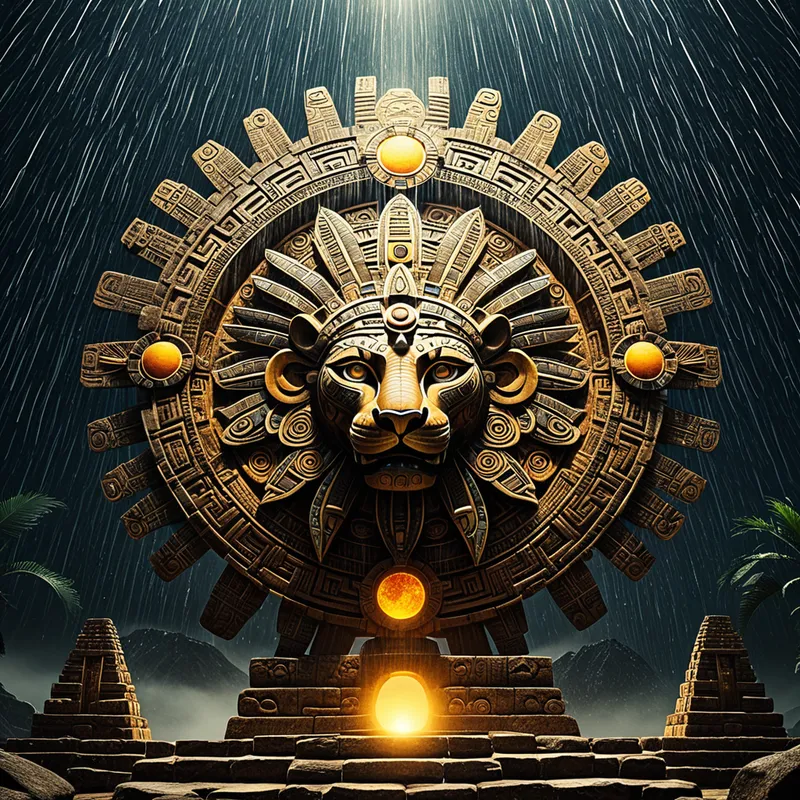
The Five Suns Aztec Myth Meaning & Symbolism
An ancient Aztec cosmology where successive worlds are created and destroyed by the gods, culminating in our fragile, precious present age.
The Tale of The Five Suns Aztec
Listen. Before time had a name, there was only the black, starless water and the two primordial ones, Ometecuhtli and Omecihuatl, dreaming in the void. From their dream, the first gods were born, hungry and restless. They gathered in the darkness at Teotihuacan, and a question hung in the air, heavier than stone: who would light the first sun? Who would bear the unbearable burden of motion, of time?
The proud Tecuciztecatl stepped forward, adorned in quetzal feathers and gold. Then, from the shadows, the humble, pustule-covered Nanahuatzin offered himself. A great pyre was built, a mountain of logs that burned for four nights. When the flames roared to the sky, Tecuciztecatl faltered, his courage turning to ice. Nanahuatzin did not hesitate. He closed his eyes, gathered his resolve, and walked steadily into the heart of the inferno, his body becoming light. Shamed, Tecuciztecatl followed. Two suns now blazed in the sky, but the world was not made for such brilliance. The gods, in desperation, threw a rabbit at the face of the second sun, dimming its fire into the cool, reflective face of the Meztli. The First Sun, Nahui Ocelotl, had dawned.
But this world was not destined to last. The sun of Nahui Ocelotl was devoured by the monstrous jaguars of the earth, and all beings were torn apart. The gods began again. The Second Sun, Nahui Ehecatl, was ruled by Quetzalcoatl. Its people were transformed, but this age was swept away by colossal hurricanes, the people turned to monkeys clinging to the vanishing trees. Again, darkness.
The Third Sun, Nahui Quiahuitl, was presided over by the god of rain, Tlaloc. It ended in a rain of fire, a torrent of molten rock and ash that consumed everything, leaving only the birds and the butterflies. The Fourth Sun, Nahui Atl, belonged to Chalchiuhtlicue. For fifty-two cycles, it endured, until the sky itself collapsed, and a great flood drowned the world, leaving only those who became the fish.
Then, in the profound silence after the deluge, the gods gathered once more at Teotihuacan. The earth lay dead, a bloated corpse: the goddess Tlaltecuhtli. To create a new world, a foundation was needed. Quetzalcoatl and his twin, the shadowy Tezcatlipoca, transformed into great serpents. They coiled around her limbs and, with a cosmic heave, tore her body in two. One half became the sky, the other the earth. Her hair became trees and grass, her eyes springs and caves, her mouth rivers and caverns. From this sacrifice, the Fifth World was born.
But this new world was dark and still. To move, it needed a heart, a sun. The gods knew the price. They needed not just divine sacrifice, but the most precious offering of all: themselves. Tonatiuh, the Fifth Sun, refused to move without nourishment. And so, the gods performed the ultimate act. They cut their own breasts, their own bodies, and offered their sacred blood, their life-force, to the sun. Only with this divine fuel did Tonatiuh begin his journey across the sky. And the gods decreed that to keep this fragile, precious sun in motion, humans must also feed it. The cosmos was founded on a covenant of sacred debt, written in the ink of sacrifice. This is our world, Nahui Ollin, the Sun of Movement, destined one day to be destroyed by earthquakes. We live in the borrowed, trembling light between creations.
Cultural Origins & Context
This cosmology was the bedrock of the Mexica (Aztec) worldview, recorded in post-Conquest texts like the Historia de los Mexicanos por sus pinturas and the Codex Chimalpopoca. It was not a simple story but a living, breathing framework encoded in the Piedra del Sol, recited by priestly historians (tlamatinime), and performed in the staggering, public rituals of the Templo Mayor. The myth served multiple vital functions: it explained the origin and inevitable end of the current world, justified the necessity of ritual warfare and human sacrifice (nextlahualli, “the debt payment”), and placed the Mexica at the terrifying, sacred center of cosmic responsibility. To know the myth was to understand one’s purpose: to live with teotl (divine energy), to participate in the struggle against entropy through ritual, and to accept the profound fragility of existence.
Symbolic Architecture
The myth is a masterclass in symbolic thought. Each Sun is not merely a historical age but a complete [paradigm](/symbols/paradigm “Symbol: A fundamental model or framework in arts and music that shapes creative expression, perception, and cultural understanding.”/) of existence, a tonalpohualli (count of days) of the [cosmos](/symbols/cosmos “Symbol: The entire universe as an ordered, harmonious system, often representing the totality of existence, spiritual connection, and the unknown.”/) itself, each destroyed by the elemental force that defined it. The [sequence](/symbols/sequence “Symbol: The symbol of ‘sequence’ often signifies the order of events and the progression towards a desired outcome or goal.”/)—[Jaguar](/symbols/jaguar “Symbol: The jaguar symbolizes strength, power, and stealth, often associated with transformation and the spiritual journey.”/) ([Earth](/symbols/earth “Symbol: The symbol of Earth often represents grounding, stability, and the physical realm, embodying a connection to nature and the innate support it provides.”/)), Wind, Rain of Fire, [Water](/symbols/water “Symbol: Water symbolizes the subconscious mind, emotions, and the flow of life, representing both cleansing and creation.”/), [Movement](/symbols/movement “Symbol: Movement symbolizes change, progress, and the dynamics of personal growth, reflecting an individual’s desire or need to transform their circumstances.”/)—maps a cycle of elemental [dominance](/symbols/dominance “Symbol: A state of power, control, or influence over others, often reflecting hierarchical structures, authority, or social positioning.”/) and collapse.
The central, terrifying truth of the myth is that creation is not an act of benign generosity, but a violent, sacrificial negotiation between order and chaos, paid for in divine and human substance.
The humble, diseased Nanahuatzin becoming the sun is the ultimate [alchemy](/symbols/alchemy “Symbol: A transformative process of purification and creation, often symbolizing personal or spiritual evolution through difficult stages.”/): the despised, the wounded, the pus of existence transformed into the [source](/symbols/source “Symbol: The origin point of something, often representing beginnings, nourishment, or the fundamental cause behind phenomena.”/) of all [life](/symbols/life “Symbol: The symbol of ‘Life’ represents a journey of growth, interconnectedness, and existential meaning, encompassing both the joys and challenges that define human experience.”/). Psychologically, he represents the part of the self that must be surrendered—our pride, our egoic perfection—to ignite true [consciousness](/symbols/consciousness “Symbol: Consciousness represents the state of awareness and perception, encompassing thoughts, feelings, and experiences.”/). The tearing apart of Tlaltecuhtli is the primordial act of [differentiation](/symbols/differentiation “Symbol: The process of distinguishing or separating parts of the self, emotions, or identity from a whole, often marking a developmental or psychological milestone.”/), the necessary violence that separates sky from earth, [consciousness](/symbols/consciousness “Symbol: Consciousness represents the state of awareness and perception, encompassing thoughts, feelings, and experiences.”/) from the unconscious, creating the [space](/symbols/space “Symbol: Dreaming of ‘Space’ often symbolizes the vastness of potential, personal freedom, or feelings of isolation and exploration in one’s life.”/) where [life](/symbols/life “Symbol: The symbol of ‘Life’ represents a journey of growth, interconnectedness, and existential meaning, encompassing both the joys and challenges that define human experience.”/) can occur. Our current age, Nahui Ollin, symbolizes the psyche in a state of dynamic, precarious balance, constantly in [motion](/symbols/motion “Symbol: Represents change, progress, or the flow of life energy. Often signifies transition, personal growth, or the passage of time.”/), requiring continual [effort](/symbols/effort “Symbol: Effort signifies the physical, mental, and emotional energy invested toward achieving goals and personal growth.”/) and sacrifice to maintain its integrity against the pull of [dissolution](/symbols/dissolution “Symbol: The process of breaking down, dispersing, or losing form, often representing transformation, release, or the end of a state of being.”/).
The Dreamer’s Resonance
When this myth stirs in the modern dreamer, it often manifests as dreams of cyclical catastrophe—tsunamis, earthquakes, skies falling—or of being tasked with an impossible, sacred duty. To dream of feeding a starving sun, or of watching worlds decay in sequence, is to experience the somatic weight of a psychic paradigm shift. The dreamer is undergoing what the myth describes: the death of an old “sun,” a foundational way of being (a relationship, an identity, a belief system) that has run its course and is being consumed by its own elemental nature. The grief, terror, and awe in such dreams are the feelings of the gods at Teotihuacan. The process is one of ego dissolution, where the constructed self must be offered up to fuel a broader, more conscious existence. The dream is the nepantla—the liminal, in-between space—where one world has ended and the next has not yet begun.

Alchemical Translation
For the individual on the path of individuation, the Five Suns model the process of psychic transmutation. We do not have one “self,” but a succession of psychic organizations, each with its own ruling complex (its own “sun”). The First Sun might be the naive, instinctual self, destroyed by the shadowy “jaguars” of repressed desire. The Second could be the intellectual, airy self, scattered by the winds of doubt. The Third, the passionate, fiery self, consumed by its own intensity. The Fourth, the emotional, watery self, drowned in feeling.
The work is to become the gods at Teotihuacan: to consciously participate in the sacrifice of outmoded psychic structures, not out of guilt, but out of necessity for the birth of a more conscious world.
The Fifth Sun, Nahui Ollin, represents the integrated, moving center—the conscious ego that understands its role is not to rule statically, but to move dynamically, requiring constant nourishment. This nourishment is the “sacrifice”—the ongoing, voluntary offering of our limited perspectives, our defensive pride, our infantile wishes to the greater purpose of consciousness itself. We feed our inner sun through honest self-reflection, creative action, and the courage to bear the anxiety of being a fragile, temporary world-builder, destined for transformation. Our destiny is not permanence, but meaningful movement within the great cycle.
Associated Symbols
Explore related symbols from the CaleaDream lexicon:
- Sun — The central symbol of cyclical creation, sacrifice, and the fragile, moving consciousness of the current age, Nahui Ollin.
- Sacrifice — The foundational act of the cosmos; the offering of divine and human essence required to fuel the sun and maintain cosmic order.
- Earth — Represented by the torn body of Tlaltecuhtli, it is the physical world born from violent sacrifice and the domain of the jaguar that ended the First Sun.
- Water — The primordial element from which all emerges and the destructive force of the Fourth Sun, Nahui Atl, which ended in a great flood.
- Serpent — The form taken by Quetzalcoatl and Tezcatlipoca to tear apart the earth goddess, symbolizing transformative, primordial power.
- Circle — The eternal cycle of creation and destruction, the five ages, and the form of the Piedra del Sol which encodes the myth.
- Death — Not an end, but a necessary phase in the cosmic cycle, the prelude to each new creation and the fate awaiting the current world.
- Rebirth — The inevitable promise following each destruction; the new sun, the new world, and the continuous renewal of the cosmos.
- Blood — The sacred currency of life and energy, offered by the gods to animate the Fifth Sun, establishing the covenant of sacrifice.
- God — The collective of deities whose interactions, conflicts, and sacrifices drive the entire cosmic drama of the five ages.
- Destiny — The predetermined, yet sacredly maintained, path of the sun and the world, moving towards an inevitable, cataclysmic transformation.
- Aztec Sun Stone — The physical, monumental embodiment of the entire myth, a stone calendar and cosmic map detailing the five suns and their destinies.