
The Fisher King's Wasteland Myth Meaning & Symbolism
A wounded king's suffering renders his kingdom a barren wasteland, healed only when a questing knight asks a compassionate, transformative question.
The Tale of The Fisher King’s Wasteland
Listen, and hear the tale of the Wasteland.
There was a king, a guardian of the most sacred of mysteries. His name was Pelles, or sometimes Amfortas. He was the Fisher King, so called not for sport, but for the slow, patient agony of his days, spent fishing the sluggish waters of a dying land. A grievous wound marred him, a spear thrust to the thigh that would not close, that festered and wept with the sorrow of the world. His kingdom, once a realm of surpassing bounty, mirrored his torment. The rivers ran thick and slow, the forests stood leafless and silent, the fields lay fallow and hard as stone. No child laughed in the courtyards of his castle, Carbonek; only the wind mourned through its empty towers. The land and the king were one: a single, suffering entity.
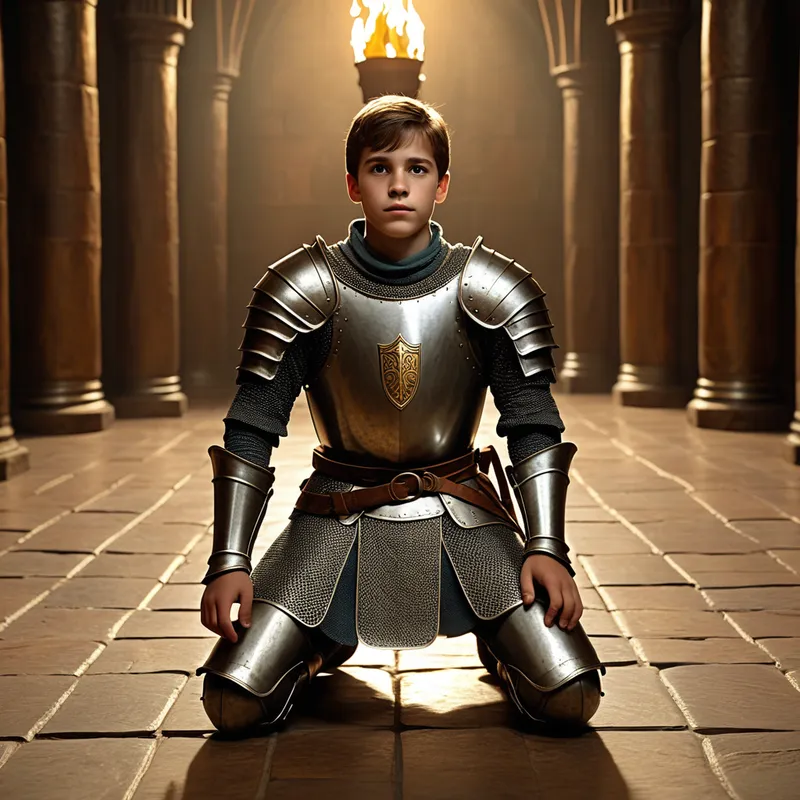
Into this blighted realm came a youth, pure of heart but untested in wisdom. Perceval, raised in the forest, ignorant of knightly custom but burning with a desire to serve. After many trials, guided by fate or grace, he found himself at the bank of a mournful river. There sat the Fisher King in his small boat, pale and regal in his pain, who beckoned the knight to follow him to his castle for shelter.
That night, in the great hall of Carbonek, a silence heavier than any stone hung in the air. The king reclined on his couch, his face grey with agony. Then, a marvel: a procession entered the hall. A squire bore a spear from whose tip a single drop of blood fell with a solemn tap into a silver cup. Then came a maiden holding aloft a Grail, which shone with a light that fed the soul. Another maiden carried a platter of silver. They passed before the wounded king and the rapt knight, and vanished.
Perceval’s heart swelled with awe. A thousand questions danced on his tongue—Whom does the Grail serve? What ails you, my lord?—but the rules of courtesy he had hastily learned sealed his lips. To ask of another’s pain seemed an intrusion. So he sat in polite, devastating silence. The moment passed. The king was borne away to his chambers with a sigh deeper than the foundations of the world. The next morning, Perceval awoke to an empty castle, the gates shut, the kingdom seeming even more desolate than before. He had failed. He rode out, and learned from a crone that because he asked not the healing question, the Wasteland would endure, the king would suffer, and many knights would die. The weight of his silent omission became his lifelong wound.
Years later, a wiser, humbled Perceval returned. Again, he witnessed the solemn procession. This time, his heart broken open by compassion, he spoke. “My lord,” he asked, his voice trembling not with fear, but with shared sorrow, “what is it that troubles you?”
With those words, the spell was broken. The king cried out, a sound of release. His wound closed. The springs burst forth from the earth outside, clear and singing. The grey trees budded with emerald fire. The stone soil softened, and the scent of flowers drowned the old scent of decay. The king was healed, and the land was healed with him. The Wasteland bloomed.
Cultural Origins & Context
The myth of the Fisher King is not a single story, but a haunting motif woven through the later tapestry of Arthurian romance. Its most famous iterations are found in Chrétien de Troyes’ unfinished 12th-century poem Perceval, or the Story of the Grail and in the subsequent Didot Perceval and the vast Lancelot-Grail (Vulgate) Cycle. It represents a profound shift in the Arthurian world, moving from tales of martial prowess and courtly love to a deeper, more spiritual and psychological quest.
The story was told in courtly circles, a blend of Christian mysticism, Celtic otherworld lore (like the cauldron of Dagda), and feudal symbolism. Its societal function was multifaceted: it was a narrative of divine grace, a critique of empty chivalric form over true compassion, and a metaphor for the spiritual sterility that could afflict both an individual and a kingdom. The keeper of the myth was the storyteller or poet, who served as a bridge between the worldly court and the mysterious, numinous realm of the Grail, challenging listeners to look beyond mere appearance to the deeper question of meaning and service.
Symbolic Architecture
At its core, the Wasteland is the externalized landscape of a wounded psyche. The Fisher King is the archetype of the Animus or ruling principle that has been struck by a fragment of untransformed life—the spear, often linked to desire or a traumatic violation of boundaries. His thigh wound, symbolic of generative power and vitality, renders him impotent, unable to creatively rule his inner kingdom.
The Wasteland is the soul’s ecology in crisis; where the king cannot flow, the rivers cannot run.
The Grail is the symbol of the transcendent Self, the vessel of wholeness and healing that is present but inaccessible. Perceval’s initial failure is the failure of the conscious ego, educated in superficial “rules,” to engage the deep, suffering core of the unconscious. His silence is a refusal of relationship, a denial of the call to profound empathy.
His ultimate, healing question represents the turning point in individuation: the ego’s willingness to approach the wounded, regal depths of the psyche not with solutions, but with a sincere, compassionate inquiry. The question itself is the key. It acknowledges the suffering, makes it relational, and in doing so, initiates the alchemy of healing.

The Dreamer’s Resonance
When this myth stirs in the modern dreamer, it often manifests as landscapes of sterility or haunting repetition. One may dream of a once-beloved home now empty and decaying, a workplace that is a labyrinth of dead ends, or a relationship that feels emotionally parched. The somatic sense is one of heaviness, stagnation, and a peculiar guilt—the feeling that one is responsible for this barrenness but cannot name why.
The figure of the wounded king may appear as a distant, sad authority (a boss, a father, an older self), often seen but not approached. The Grail may manifest as a missed opportunity, a glowing object that passes by, or a phone that rings with an urgent but ignored call. The dreamer, in the role of Perceval, experiences the paralysis of the first visit: knowing something is deeply wrong, but feeling bound by internalized rules (“don’t be intrusive,” “don’t show vulnerability,” “figure it out yourself”) that prevent the engaged, compassionate question. This dream pattern signals a critical impasse where an old wound (the king) is draining the psyche’s vitality (the land), and the conscious mind is being summoned to finally address it with heartfelt curiosity, not just analysis.

Alchemical Translation
The myth models the complete cycle of psychic transmutation. The initial state is nigredo—the blackening, the Wasteland, the depression and spiritual dryness that follows a soul-wound. The Fisher King is the complex at the center of this blackness, holding both the pain and the latent royalty of the Self.
Perceval’s journey is the albedo, the whitening or purification. His initial failure is necessary; it is the burning away of naive innocence and the inflation of the heroic ego. His subsequent wanderings in guilt and seeking represent the arduous work of gathering the scattered pieces of the psyche.
The healing is not in the answer, but in the quality of the asking. The question is the catalyst that allows the leaden silence to transmute into golden dialogue.
The culminating question is the rubedo, the reddening, the moment of integration. When the ego turns toward the suffering Self with “What troubles you?” it performs the sacred marriage of consciousness and the unconscious. The question is an act of love and recognition. The resulting healing is not a cure bestowed from outside, but a restoration of the natural flow of life energy (libido) within the psychic system. The land blooms because the inner king can rule again from a place of connected wholeness. For the modern individual, the myth instructs that our personal Wastelands—periods of creative sterility, emotional numbness, or relational failure—are not curses to be escaped, but sacred geographies calling for the most courageous and simple of acts: to approach our deepest wound and, with humility, ask it to speak.
Associated Symbols
Explore related symbols from the CaleaDream lexicon: