The Fisher King & The Wasteland Myth Meaning & Symbolism
A wounded king's unhealing injury blights his kingdom into a wasteland, awaiting a hero who can ask the right question to restore life and sovereignty.
The Tale of The Fisher King & The Wasteland
Listen, and hear a tale of a wound that became a world.
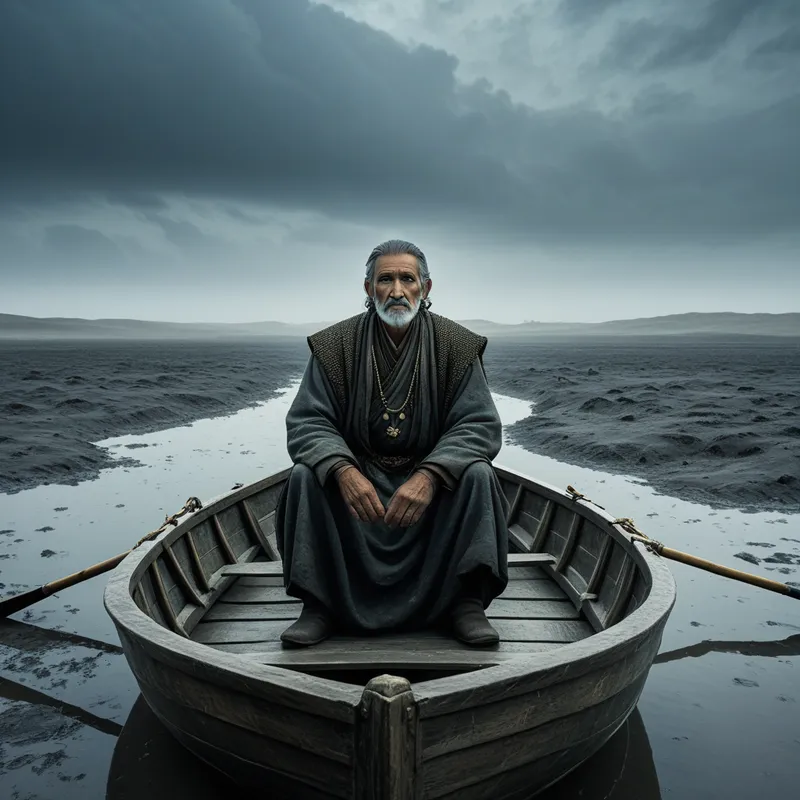
In the dim, forgotten marches of Logres, there lies a land that has forgotten the taste of rain. The Wasteland is a kingdom of perpetual twilight, where rivers run thick and slow as grief, where trees stand as skeletal sentinels clutching at a grey sky, and the earth itself is hard and cold, refusing seed. The people move through the gloom like shades, their voices hushed, their hopes as dry as the dust that coats their doorways. At the heart of this desolation stands the Castle of the Grail, a fortress of shadows and echoes.
Within its silent halls lies the king, The Fisher King. He is called this for on days when the pain lessens, he is taken to the listless river to fish, a solitary activity for a solitary ruler. But his fishing is no pastime; it is a portrait of profound incapacity. A wound, dealt by a poisoned spear in a long-ago battle, festers in his thigh. It will not close. It will not heal. It bleeds slowly, eternally, sapping his vitality and, mysteriously, the vitality of his realm. The king and his land are one: his unhealed pain is the land’s barrenness.
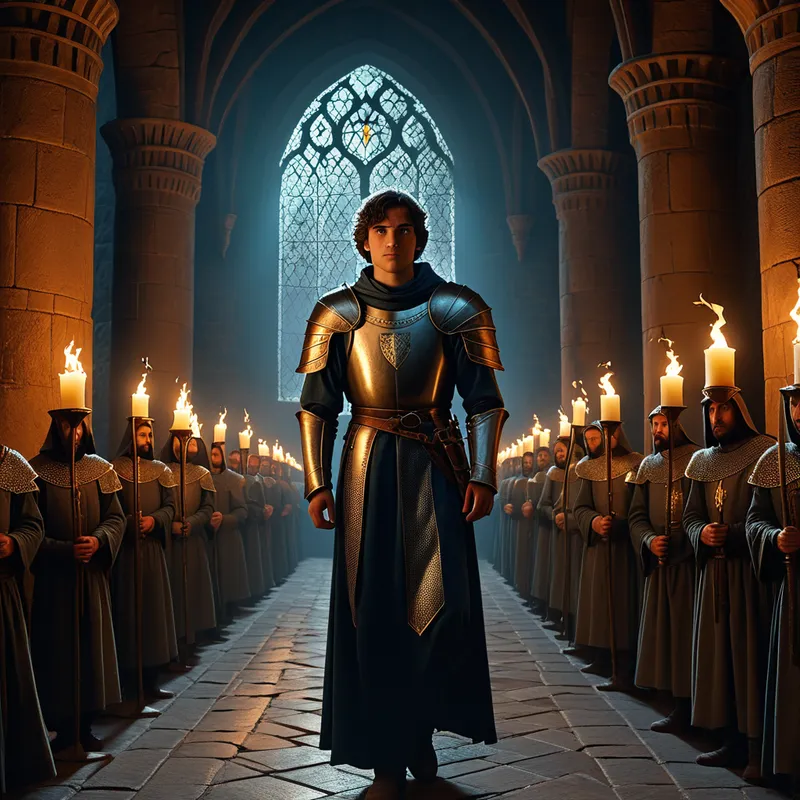
Into this stagnant realm comes a youth, pure of heart but untested in wisdom. He is Percival. Lost and seeking adventure, he is guided by a lone fisherman to the castle. Inside, he witnesses a strange and solemn procession: maidens and youths pass through the hall bearing wondrous relics—a spear that drips blood, candelabras of blinding light, and finally, a radiant vessel, the Holy Grail itself. It passes before the wounded king, who gazes upon it with a look of infinite longing and exhaustion.
A feast is laid, but the air is thick with unspoken ritual. The Grail moves through the hall, serving each person according to their deepest desire, yet the king eats nothing. He suffers. Percival, trained in knightly courtesy but not in compassion’s courage, burns with questions: Whom does the Grail serve? Why does the spear bleed? What ails you, King? But he remains silent, fearing to be thought rude. The moment stretches, taut as a bowstring, and then snaps. The procession vanishes. The castle falls into deeper silence. Percival wakes the next morning on a barren mound, the castle gone, the opportunity lost.
Because he failed to ask the healing question, the Wasteland remains. The king continues his agony. The spell holds. The tale tells us that only when a knight arrives who is brave enough to ask the compassionate question—to see the suffering and dare to inquire into its nature—will the wound be healed, the land made fertile, and the sovereignty restored.
Cultural Origins & Context
This haunting narrative is woven into the vast tapestry of the Arthurian cycle, finding its most elaborate forms in the 12th and 13th centuries. Its primary tellers were the courtly poets Chrétien de Troyes and, later, Wolfram von Eschenbach. These were not folk tales told around a fire, but sophisticated literary works composed for aristocratic audiences, blending Celtic mythology, Christian symbolism, and the emerging code of chivalry.
The myth functioned on multiple levels. For a feudal society, it was a parable about the health of the kingdom being directly tied to the moral and physical health of its ruler—a “king and land are one” cosmology. For the knightly class, it presented the ultimate spiritual adventure, elevating the quest beyond martial prowess to one of interior virtue and wisdom. It served as a narrative vessel for exploring profound questions about suffering, grace, and the conditions required for healing, positioning the Grail not merely as a physical object but as an experience of transformative grace accessible only through empathetic engagement.
Symbolic Architecture
The myth’s power lies in its perfect symbolic architecture, where every element is a facet of a profound psychological truth.
The Wound in the Thigh is never merely physical. Symbolically located between the generative and locomotive centers of the body, it represents a crippling of life force, creativity, and the ability to move forward. It is a wound to sovereignty—the king’s ability to rule his own being and, by extension, his realm.
The unhealed wound is not a private affair; it radiates its desolation outward, blighting every relationship and creative endeavor, creating a kingdom in its own image.
The Wasteland is the externalized landscape of internal stagnation. It is depression, burnout, creative block, or relational aridity—the felt reality of a life where the symbolic “waters of life” have ceased to flow. The Fisher King himself is the archetype of the wounded masculine, the ruler who has the sacred vessel (the Grail, symbolic of the feminine principle of vessel and nurture) within his castle but cannot access its healing power because of his own injury.
The Grail transcends a Christian relic. It is the symbol of wholeness, the Self. It is the source of “what one most needs.” Percival’s failure to ask The Question—“Whom does the Grail serve?” or “What ails you?”—is the failure of the immature ego. It represents a disconnect between consciousness (the questing knight) and the suffering unconscious (the wounded king). Healing begins not with a sword, but with a question born of compassionate observation.

The Dreamer’s Resonance
When this myth stirs in the modern dreamer’s psyche, it signals a profound encounter with a core wound. To dream of a barren landscape—a dead garden, a dried-up office, an empty house—alongside a figure who is injured, waiting, or fishing in a shallow pool, is to dream of the Fisher King complex.
The somatic feeling is often one of heaviness, paralysis, or being stuck in a loop. Psychologically, the dreamer is confronting an aspect of themselves that has been wounded, often in relation to vitality, authority, or creativity, and has been left unattended. This wounded part has, in turn, created a “wasteland” in some domain of life—a career that feels sterile, a relationship devoid of nourishment, a creative spirit that has gone mute. The dream is a summons from the Self, presenting the wound and the sterile landscape together, urging the dreamer’s conscious ego to finally ask the question: What is the true nature of this pain? What have I refused to feel or acknowledge?

Alchemical Translation
The myth of the Fisher King is a master map for the individuation process. The alchemical work it describes is the transmutation of leaden suffering into golden consciousness.
The first stage is recognizing the wasteland—the conscious acknowledgment that a part of one’s life is barren. This is the “call to the quest.” The journey to the Grail Castle is the descent into the unconscious, where the wound (the King) and the healing principle (the Grail) reside together. Percival’s initial failure is crucial; it represents the inevitable first attempt where the ego, still identified with its persona (“the silent, polite knight”), fails the test of authentic connection.
The healing question is an act of psychic bravery. It means turning toward the pain with curiosity instead of away from it with fear, thereby forging a connection between the ego and the wounded Self.
The final, successful return—the act of asking “What ails you?”—is the moment of integration. It is not about providing an answer, but about offering the quality of attention that makes healing possible. In that moment, the ego aligns itself in service to the greater Self (“Whom does the Grail serve?”). The wound closes because it is finally seen and included. The life waters flow again because consciousness has made contact with the deep, nourishing waters of the unconscious. The kingdom is restored because the ruler within—the integrated psyche—has reclaimed his full sovereignty. The quest ends not with the possession of the Grail, but with the realization that one must learn to serve it, to let its transformative grace flow into the once-wasted realms of one’s own life.
Associated Symbols
Explore related symbols from the CaleaDream lexicon: