The First Toolmaker Myth Meaning & Symbolism
A primal myth of the first being who, through a shattering act of will, transformed inert stone into a tool, forever altering the relationship between consciousness and matter.
The Tale of The First Toolmaker
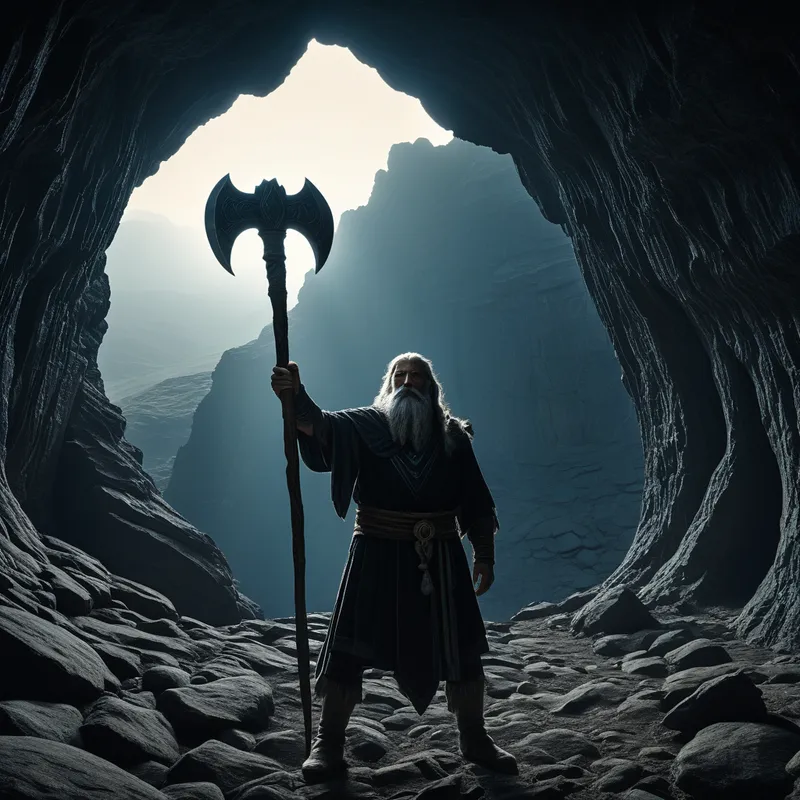
Listen. Before the names of things were fixed, when the world was a great, breathing body of stone and wind and water, there was a being. Not a god, not yet a human as we know, but a creature of deep silence and profound watching. It lived in the long shadow of the Cave, its eyes tracing the flight of the Bird, its hands knowing only the weight of a berry, the pull of a root from the Earth.
But in its chest, a new kind of hunger stirred—not for food, but for a shape that did not exist. It watched the River polish stones smooth, saw the Fire of lightning split a great Tree. A tension grew, a pressure in the mind and in the palm. The world was full of things, but none were for something. They simply were.
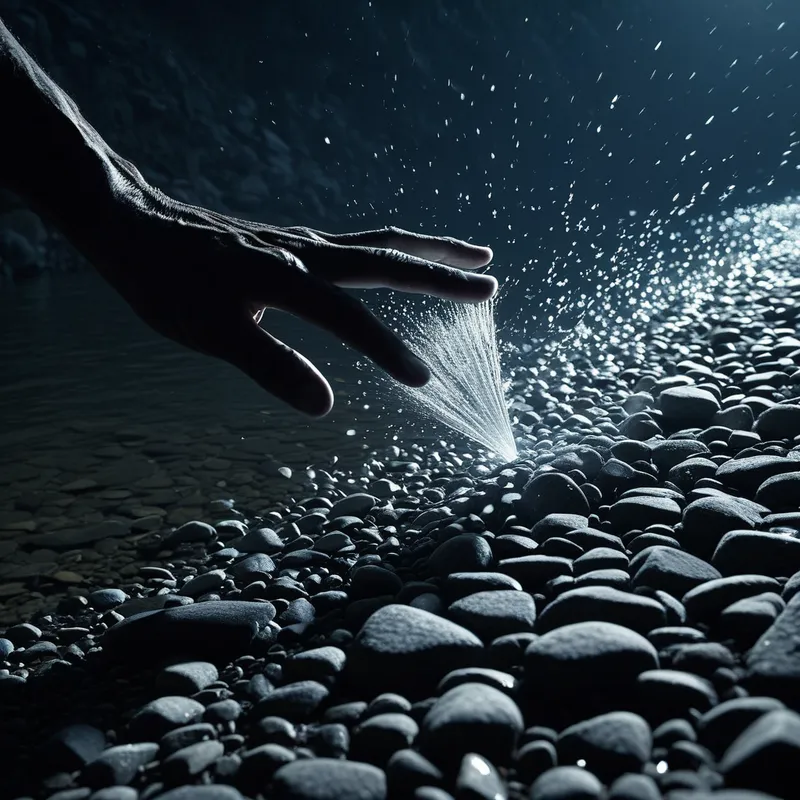
One evening, as the Moon cast its cold silver on the Sky, the being crouched by the riverbank. In its hand was a river cobble, round and stubborn as a closed fist. In its other hand, another stone. The air grew still. The night creatures hushed. This was not an act of gathering, but of breaking. Of demanding a new form from the old body of the world.
It struck.
The sound was not loud, but it was a sound the world had never heard before—the crisp, decisive knock of intellect meeting matter. A sharp flake, thinner than a leaf, sharper than a tooth, flew free and fell to the mud. The being stared. In its hand, the core stone was now different. It had a ridge, a plane, an intention. It was no longer just a stone. It was a possibility.
Again and again, through the night, the strikes fell. Not in rage, but in a terrible, focused rhythm—a Ritual of becoming. Sweat and effort became one with the flying dust. With each blow, the being was not just shaping flint; it was being shaped. Its consciousness, once a passive mirror of the world, was now a force upon it. By the time the first hint of Sun gilded the eastern Mountain, it held in its bleeding, trembling hand a sharp-edged tool. The world looked the same, but everything had changed. The long sleep was over. The Journey had begun.
Cultural Origins & Context
This is not a myth from a single tribe or a named people. It is a story woven into the very fabric of the “Multiple (Paleolithic)“—a psychic inheritance from the hundreds of millennia when our ancestors lived by the hunt and the gather. It was never written, never fixed. It was told in the flickering light of hearths, in the silent language of gesture around the work of flintknapping. It was passed from elder to youth not as a fable, but as a somatic memory embedded in the act of creation itself.
The societal function was profound: to sanctify the act of technology. To frame the making of a hand-axe or a spear point not as mere utility, but as a recapitulation of the primordial, world-altering moment. It served as a charter myth for the artisan, granting spiritual significance to skill and patience. It answered the terrifying question that must have arisen with self-awareness: “Why are we different? Why do we make?” The myth provided an origin: we are the children of that first, deliberate strike.
Symbolic Architecture
At its core, this myth is about the [birth](/symbols/birth “Symbol: Birth symbolizes new beginnings, transformation, and the potential for growth and development.”/) of [human](/symbols/human “Symbol: The symbol of a human represents individuality, complexity of emotions, and social relationships.”/) [consciousness](/symbols/consciousness “Symbol: Consciousness represents the state of awareness and perception, encompassing thoughts, feelings, and experiences.”/) from the [womb](/symbols/womb “Symbol: A symbol of origin, potential, and profound transformation, representing the beginning of life’s journey and the unconscious source of creation.”/) of instinctual [nature](/symbols/nature “Symbol: Nature symbolizes growth, connectivity, and the primal forces of existence.”/). The First Toolmaker is the archetypal Individuation figure, separating itself from the undifferentiated “just-so” of the natural world through an act of willed [differentiation](/symbols/differentiation “Symbol: The process of distinguishing or separating parts of the self, emotions, or identity from a whole, often marking a developmental or psychological milestone.”/).
The first tool was not an object, but an event—the moment the psyche realized it could leave a mark on the world, and in doing so, receive a mark in return.
The two stones represent the duality of consciousness: the passive, perceiving mind (the core [stone](/symbols/stone “Symbol: In dreams, a stone often symbolizes strength, stability, and permanence, but it may also represent emotional burdens or obstacles that need to be acknowledged and processed.”/)) and the active, willing mind (the hammer stone). The act of striking is the painful but necessary [friction](/symbols/friction “Symbol: Friction represents resistance, conflict, or the necessary tension required for movement and transformation in dreams.”/) required for consciousness to emerge. The sharp flake that flies free is the first truly human thought—a thought that has edge, that can cut, define, and separate. The resulting tool is the nascent Ego, a [structure](/symbols/structure “Symbol: Structure in dreams often symbolizes stability, organization, and the framework of one’s life, reflecting how one perceives their environment and personal life.”/) born of conflict now capable of interacting with the world in a new, purposeful way.
The Cave as the setting is critical. This awakening does not happen in the bright, [open field](/symbols/open-field “Symbol: The open field symbolizes freedom, potential, and possibilities, representing a space where one can explore new opportunities.”/) of pure consciousness, but at its murky threshold. It is a psychoid [event](/symbols/event “Symbol: An event within dreams often signifies significant life changes, transitions, or emotional milestones.”/), rooted in the [body](/symbols/body “Symbol: The body in dreams often symbolizes the dreamer’s self-identity, personal health, and the relationship they have with their physical existence.”/) (the strain, the bleeding hand) and in the [depths](/symbols/depths “Symbol: Represents the subconscious, hidden emotions, or foundational aspects of the self, often linked to primal fears or profound truths.”/) of the instinctual world.
The Dreamer’s Resonance
When this myth stirs in the modern Dream, it often manifests as dreams of intense, frustrating crafting or building. The dreamer may be trying to shape a resistant material—clay that won’t hold form, wood that splinters wrongly, a stone that refuses to break. The somatic feeling is one of immense tension, effort, and often, a profound sense of isolation.
This dream pattern signals that the psyche is engaged in a fundamental act of self-definition. The “resistant material” is often an aspect of the dreamer’s own nature or life circumstance that feels inert, stubborn, or useless. The dream is rehearsing the primordial drama: applying the pressure of conscious will (the Hammer of attention) to that inner core in order to release a new capability, a sharp insight (the flake), and forge a more functional structure of self (the tool). It is the pain of giving birth to one’s own agency.
Alchemical Translation
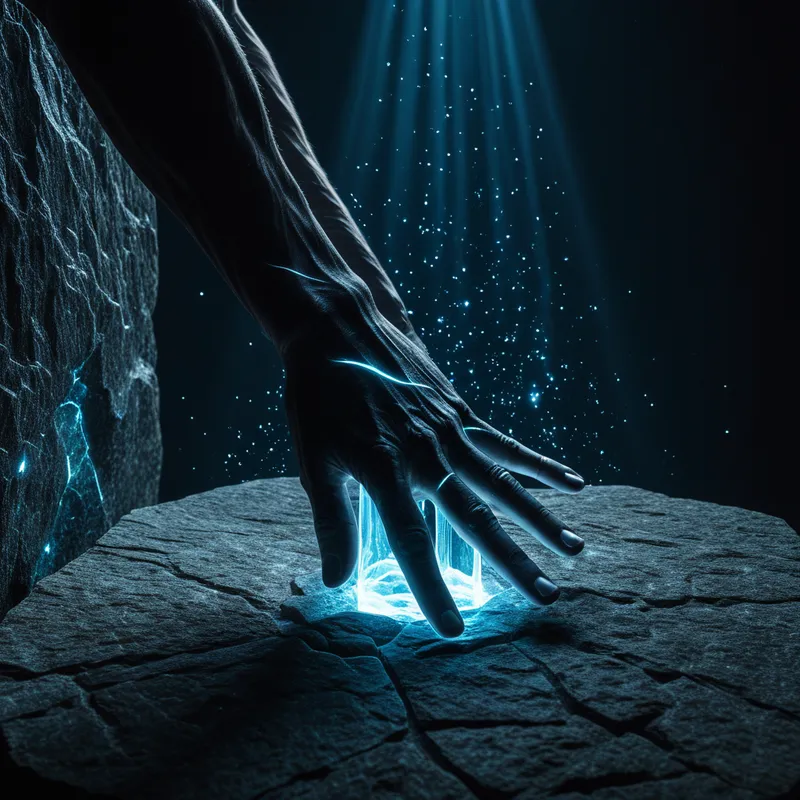
The alchemical process mirrored here is solve et coagula—dissolve and coagulate. The perfect, self-contained “stone” of the old, instinctual identity must be shattered (the solve). This is a necessary Sacrifice of wholeness for the potential of utility. The useful element—the sharp flake of insight, talent, or truth—is then separated out. Finally, through repeated effort, these fragments are reconstituted into a new, purposeful form (the coagula), the hand-axe of the conscious personality.
To become a toolmaker for your own soul is to accept the sacrifice of innocent wholeness for the hard-won power of conscious form.
For the modern individual, this myth models the journey from passive suffering to active shaping. It speaks to anyone stuck in a “stone-like” state—depression, stagnation, a sense of uselessness. The call is to find the “other stone” within—the will, the anger, the focused desire—and to strike. The first attempts will be messy. The hands will be bloodied (psychic pain, anxiety). But the process itself is the initiation. We do not discover who we are by gazing at the unworked stone of our nature, but by engaging with it, demanding a form from it, and in the process, discovering we are the shaper and the shaped, the toolmaker and the tool.
Associated Symbols
Explore related symbols from the CaleaDream lexicon:
- Stone — The primal, unformed Self and the raw material of reality; its fracturing represents the necessary break from unconscious wholeness to create conscious identity.
- Fire — The catalytic spark of consciousness, the transformative will, and the creative drive that animates the act of making.
- Hand — The instrument of agency, will, and intimate contact with the world; the wounded hand signifies the cost of creation.
- Cave — The womb of the unconscious where this primordial drama unfolds, a place of both shelter and profound, shaping darkness.
- Journey — The eternal human passage from a state of nature to a state of culture, and from unconsciousness to self-aware being.
- Sacrifice — The surrender of instinctual, animal wholeness required to gain the power of conscious tool-use and symbolic thought.
- Mountain — The enduring, seemingly immovable obstacle (the old way of being) that must be confronted and ultimately shaped by the new consciousness.
- Blood — The life-force and vitality invested in the act of creation, and the tangible proof of the cost of differentiating oneself from the world.
- Shadow — The unrecognized, instinctual power and skill latent within the being, which is made manifest through the focused, repetitive action.
- Ritual — The patterned, sacred nature of the act of striking, transforming a physical process into a world-making psychological event.
- Stone Scraper