
The First Tool-Makers Myth Meaning & Symbolism
An ancient myth of beings who stole fire from the earth and shaped stone, birthing the first tools and the dawn of human consciousness.
The Tale of The First Tool-Makers
Listen. Before the names of things, when [the world](/myths/the-world “Myth from Tarot culture.”/) was a great, breathing animal of stone and root and [water](/myths/water “Myth from Chinese culture.”/), the people walked softly. They were part of the herd, the flock, the rustling leaves. Their hands were for gathering, for holding, for the gentle touch. But the night was a mouth, and the cold was a bone. Hunger was a hollow stone in the belly.
It began not with a shout, but with a noticing. A being—call them The One Who Watches—saw a branch break under the weight of a storm. It fell, and its sharp end pierced the soft earth. The Watcher did not see a broken branch. They saw a point. They saw a possibility. Their hands, which knew only the shapes given by the world, trembled with a new knowing: the world could be asked a question, and it might answer.
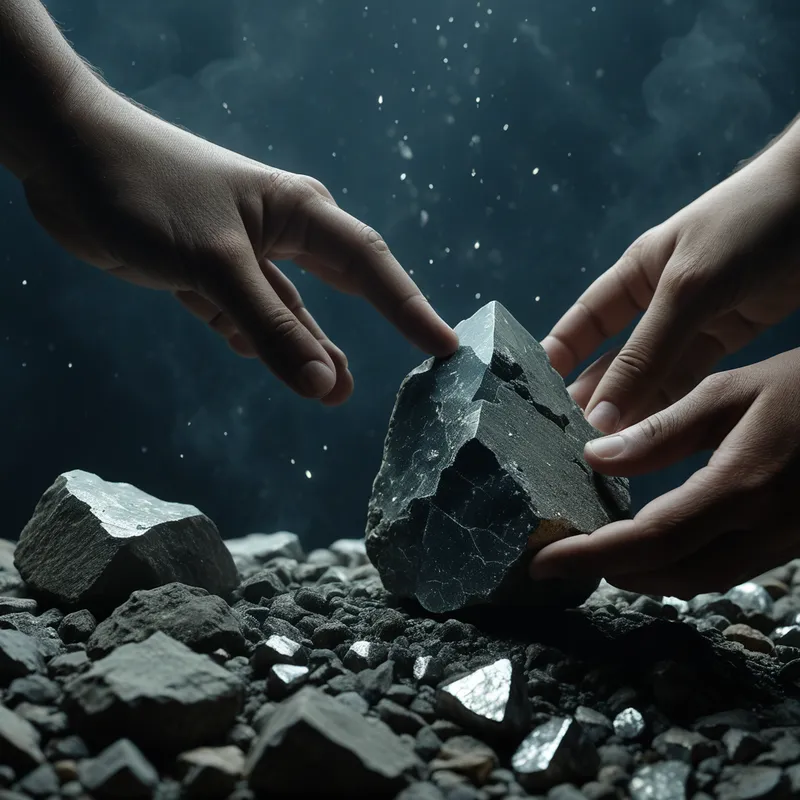
But the first answer was a failure. A broken nail. A bruised palm. The Watcher’s companion, The One Who Feels, wept in frustration, clutching a useless stone. In their despair, they hurled it against a greater rock. And the world spoke back with a sound that was not natural: a sharp clack, and a sliver of stone flew free, sharper than a thorn, colder than ice.
This was the first theft. Not from a god, but from [the earth](/myths/the-earth “Myth from Hindu culture.”/)’s own body. They had taken a piece of its bone and made it into something else. The sliver could cut. It could pierce. It could separate meat from bone, hide from flesh. It was power, and it was terrifying.
The second theft was fire. They had seen [the sky](/myths/the-sky “Myth from Persian culture.”/)-fire strike a tree and birth a beast of light and heat that devoured wood. They had felt the earth-fire, the warm breath from certain stones. The One Who Dreams took a stone that held the sun’s memory (iron pyrite) and a stone that slept (flint). For days, they struck them, a futile, rhythmic prayer. Until one strike, born of exhaustion and rage, released a tiny, falling star. It kissed dry moss and bloomed.
Fire was not a tool; it was a living spirit they now held captive. It warmed the terrifying dark. It hardened the point of a spear. It transformed the flesh of beasts into something new. But it demanded constant feeding. It could turn on its keeper. In its light, their shadows danced on [the cave](/myths/the-cave “Myth from Platonic culture.”/) wall, giant and strange—the first glimpse of a self separate from the world.
They were no longer just within the world. They were in conversation with it. A dangerous, sacred dialogue of strike and spark, of force and form. [The first tool](/myths/the-first-tool “Myth from Various culture.”/)-makers stood between the animal past and the human future, their hands stained with earth and soot, holding the first question and the first answer, forever changed.
Cultural Origins & Context
This is not a myth from a single tribe, but a story written in the collective bones of humanity. Its “culture” is the Paleolithic epoch itself—a vast, deep-time canvas spanning hundreds of millennia across Africa, Europe, Asia, and beyond. It was never written, only enacted and remembered in the body and the ritual.
The myth was passed down in the most fundamental way: through the apprenticeship of the hand. A master knapper teaching a child to strike flint was not just teaching a skill; they were re-enacting the primordial moment of creation. The story was in the posture, the focused silence, the reverence for the material, and the shared, breath-held moment when a perfect flake fell away. It was told around the captive spirit of [the hearth](/myths/the-hearth “Myth from Norse culture.”/)-fire, its light animating faces, its crackle providing the rhythm for tales of that first, impossible spark. Its societal function was foundational: to sanctify the technology that ensured survival, to frame human ingenuity as a sacred, stolen partnership with the raw materials of the cosmos, and to instill the profound responsibility that comes with such power.
Symbolic Architecture
At its core, this myth is about the [birth](/symbols/birth “Symbol: Birth symbolizes new beginnings, transformation, and the potential for growth and development.”/) of [human](/symbols/human “Symbol: The symbol of a human represents individuality, complexity of emotions, and social relationships.”/) [consciousness](/symbols/consciousness “Symbol: Consciousness represents the state of awareness and perception, encompassing thoughts, feelings, and experiences.”/) itself. The tool is not merely an object; it is the first concrete [symbol](/symbols/symbol “Symbol: A symbol can represent an idea, concept, or belief, serving as a powerful tool for communication and understanding.”/). It is an [idea](/symbols/idea “Symbol: An ‘Idea’ represents a spark of creativity, innovation, or realization, often emerging as a solution to a problem or a new outlook on life.”/) made manifest in matter, a bridge between the inner world of [intention](/symbols/intention “Symbol: Intention represents the clarity of purpose and direction in one’s life and can symbolize motivation and commitment within a dream context.”/) and the outer world of substance.
The first tool is the physical incarnation of the question “What if?” It is the moment the psyche externalizes itself, creating a mirror in which it can see its own potential for transformation.
The figures in the tale are not individual gods but archetypal facets of a single awakening mind. The One Who Watches represents observation and [pattern](/symbols/pattern “Symbol: A ‘Pattern’ in dreams often signifies the underlying structure of experiences and thoughts, representing both order and the repetitiveness of life’s situations.”/) recognition—the [dawn](/symbols/dawn “Symbol: The first light of day, symbolizing new beginnings, hope, and the transition from darkness to illumination.”/) of intellect. The One Who Feels represents [frustration](/symbols/frustration “Symbol: A feeling of being blocked or hindered from achieving a goal, often accompanied by irritation and powerlessness.”/), embodiment, and the intelligence of the hands—the [role](/symbols/role “Symbol: The concept of ‘role’ in dreams often reflects one’s identity or how individuals perceive their place within various social structures.”/) of failure and somatic learning. The One Who Dreams represents [intuition](/symbols/intuition “Symbol: The immediate, non-rational understanding of truth or insight, often described as a ‘gut feeling’ or inner knowing that bypasses conscious reasoning.”/) and the liminal [space](/symbols/space “Symbol: Dreaming of ‘Space’ often symbolizes the vastness of potential, personal freedom, or feelings of isolation and exploration in one’s life.”/) where unlike things ([stone](/symbols/stone “Symbol: In dreams, a stone often symbolizes strength, stability, and permanence, but it may also represent emotional burdens or obstacles that need to be acknowledged and processed.”/) and stone) are brought together to create a third, entirely new [thing](/myths/thing “Myth from Norse culture.”/) (spark).
The “theft” is critical. Consciousness does not emerge politely; it takes. It separates itself from the unconscious, unified state of [nature](/symbols/nature “Symbol: Nature symbolizes growth, connectivity, and the primal forces of existence.”/). This [separation](/symbols/separation “Symbol: A spiritual or mythic division between realms, states of being, or consciousness, often marking a transition or loss of connection.”/) is both a glorious [achievement](/symbols/achievement “Symbol: Symbolizes success, mastery, or reaching a goal, often reflecting personal validation, social recognition, or overcoming challenges.”/) and a primal [crime](/symbols/crime “Symbol: Crime in dreams often symbolizes guilt, inner conflict, or societal rules that are being challenged or broken.”/), bringing [knowledge](/symbols/knowledge “Symbol: Knowledge symbolizes learning, understanding, and wisdom, embodying the acquisition of information and enlightenment.”/), power, and the eternal burden of self-[awareness](/symbols/awareness “Symbol: Conscious perception of self, surroundings, or internal states. Often signifies awakening, insight, or heightened sensitivity.”/)—the “fire” that both illuminates and consumes.
The Dreamer’s Resonance
When this myth stirs in the modern dreamer, it often surfaces during periods of nascent creativity or a desperate need for agency. To dream of clumsily shaping stone, of futilely striking rocks in the dark, speaks to a [psyche](/myths/psyche “Myth from Greek culture.”/) grappling with a raw, unformed potential. The frustration in the dream is somatic; it is the feeling of having the matter of a new skill, relationship, or idea but lacking the form.
Dreams of making a first, crude tool mirror the early, awkward stages of psychological differentiation—trying to “cut away” what is no longer needed (a job, a habit, an old self-concept) to survive. The fire-starting dream, especially one filled with anxiety about tending the fragile flame, resonates with the struggle to nurture a new insight, a fragile passion, or a creative project against the “cold” of internal doubt or external indifference. The dream is the psyche’s workshop, where we, like the first makers, learn through failure and sudden, illuminating success.

Alchemical Translation
The myth of the First Tool-Makers is a perfect map for the alchemical process of individuation. The [prima materia](/myths/prima-materia “Myth from Alchemical culture.”/)—the worthless, base substance—is our unexamined life, our raw instincts, and our latent potentials. The first strike of flint on pyrite is the initial, often frustrating, engagement with this material through therapy, artistic practice, or deep introspection.
The spark that ignites is the coniunctio, the sacred marriage of conscious effort and unconscious inspiration. It is the moment of insight that transforms brute experience into meaningful symbol.
The process is one of repeated striking (effort, focus) and knapping (refining, shaping). We must remove the unnecessary flakes of [persona](/myths/persona “Myth from Greek culture.”/), social expectation, and outdated self-images to reveal the sharp, useful tool of our authentic nature. The “fire” we steal and tend is the liberated libido or life energy, now under the partial guidance of [the ego](/myths/the-ego “Myth from Jungian culture.”/), used to “cook” and transform our inner world. The ultimate creation is not just a tool for outer survival, but the Self—the integrated, conscious being who can both shape their world and respect its primordial mystery. We become, at last, the conscious tool-maker of our own soul.
Associated Symbols
Explore related symbols from the CaleaDream lexicon: