The First Shaman Myth Meaning & Symbolism
A myth of a wounded boy chosen by the spirits to become the first mediator between the human and spirit worlds, forging the path of the shaman.
The Tale of The First Shaman
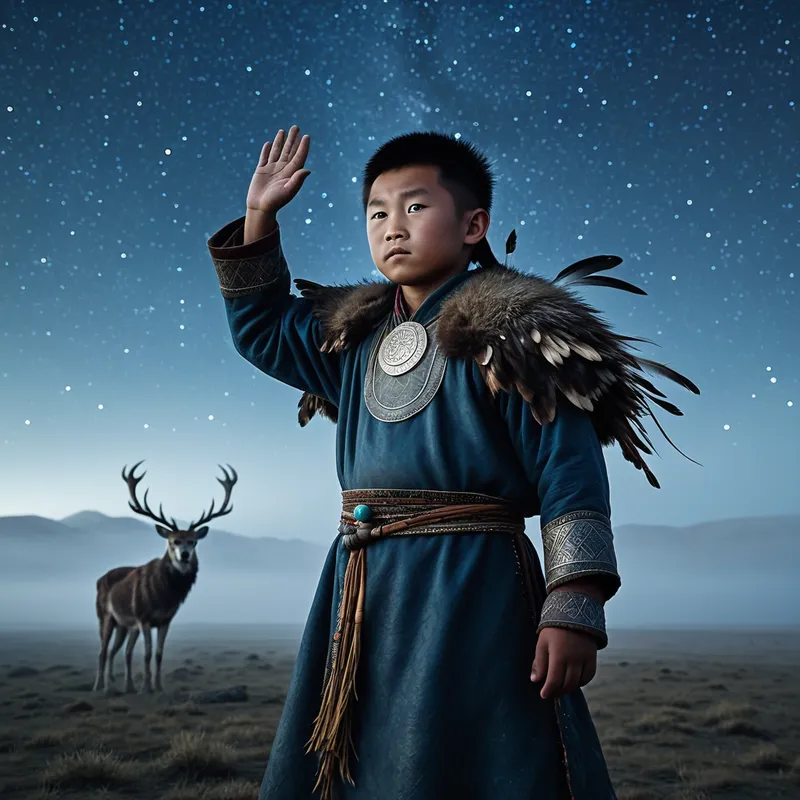
Listen. Before time was counted in horse-hooves crossing the plains, when the sky was closer and the spirits spoke in the wind’s whistle, there lived a boy. He was not the strongest, nor the fastest, but his eyes held the quiet depth of a mountain lake. His name is lost to the wind, remembered only as the One Who Was Broken and Made Whole.
One harsh winter, when the Tengri’s breath was a blade of ice, a great sickness fell upon the boy’s tribe. It began as a cough, a weakness in the limbs, a shadow in the soul. The people grew thin, their fires low. In desperation, the boy’s father, the clan’s hunter, ventured far into the skeletal forest seeking game or a sign. He did not return.
Driven by a grief that burned hotter than fear, the boy followed his father’s trail. He found him at the foot of a sacred birch, his body cold, taken by the unseen plague. As the boy wept, a great white wolf emerged from the trees. It did not snarl, but gazed at him with ancient, knowing eyes. Then it turned and vanished into the thicket. Taking this as an omen, the boy began the solemn task of preparing his father’s spirit for its journey skyward.
But as he worked, a numbness crept into his own leg. By the time he stumbled back to the camp’s edge, the sickness had him in its jaws. He collapsed, his right leg swelling, turning the color of storm clouds, useless and searing with pain. The tribe, fearing the contagion, built a small, isolated ger for him at the edge of the camp. There, he was left with only a skin of water, waiting for death or mercy.
For nine days and nine nights, he burned with fever. The world dissolved. The felt walls of the ger breathed. In his delirium, he was visited. First came the spirits of the Etugen, whispering through the cracks in the earth beneath him. Then the messengers of Tengri: a golden eagle that perched on the smoke hole, its shadow falling across his chest. Finally, on the ninth night, she appeared.
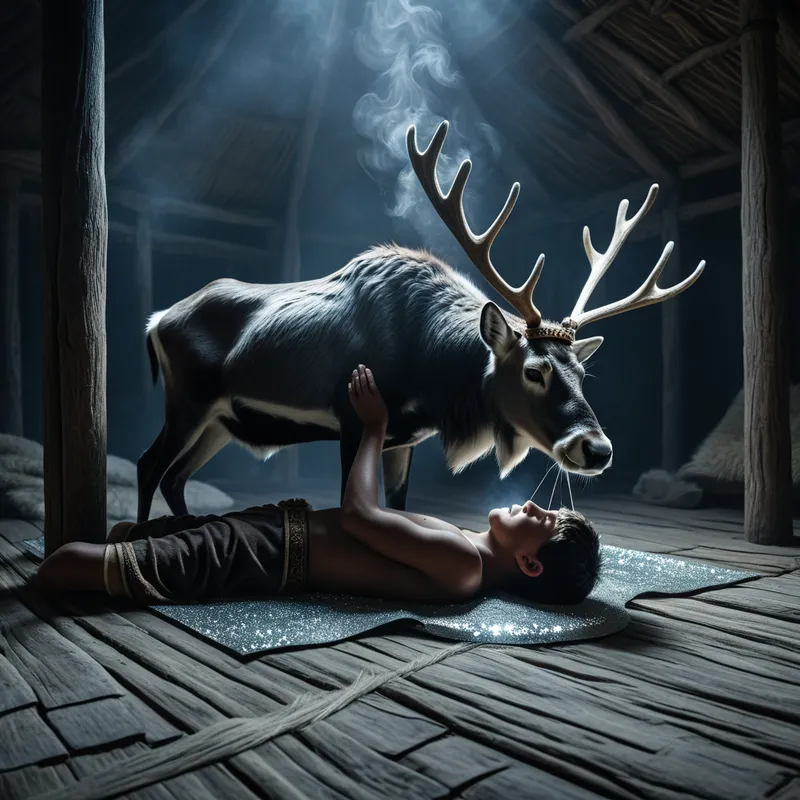
She was Udgan, the primal shamaness. Her form was both woman and reindeer, antlers crowned with star-moss, her eyes pools of bottomless night. She did not speak with a mouth, but her voice echoed in the hollows of his bones. “The people perish because the bridge is broken,” she intoned. “The worlds have drifted apart. The songs are forgotten. You have been chosen to mend it.”
“But I am broken,” the boy gasped, gesturing to his poisoned leg.
“All bridges are built from what is broken,” Udgan replied. “To heal the tribe, you must first be dismantled.”
She approached. With a touch that was both ice and fire, she grasped his afflicted leg. There was no gentle healing, but a terrible, necessary violence. She took the leg apart—bone from bone, sinew from sinew—not to destroy, but to see its essence. She scattered the pieces: the femur to the north, the kneecap to the east, the tibia to the south, the small bones to the west. His very skeleton became a map of the sacred directions.
Where his leg had been was now a void, a howling wind-tunnel between worlds. Into this emptiness, Udgan began to sing. From her song, new bones grew—not of human marrow, but of iron and sacred birch. Muscles of woven horsehair and sinews of resilient wolf tendon formed. She replaced his blood with a mixture of river water and lightning sap. His new leg was a thing of power, a tool forged in the spirit forge.
When it was done, she breathed into his mouth the first suld, the spirit of a shaman. “Now,” she said, her form beginning to fade into the dawn light seeping through the smoke hole, “you are no longer of one world. You walk in both. You are the bridge. Rise. Drum. Call back the lost souls. Heal your people.”
The boy—now the first Böö—stood. He took the hide of the drum offered by a spirit-deer that appeared at the door, and the first beat echoed across the steppe, a heartbeat restored to the world. Limping, yet stronger than any whole man, he walked back into the camp of the living and began his work.
Cultural Origins & Context
This foundational myth, existing in many variations across Siberian and Mongolian shamanic traditions, is not a story of the distant, impersonal past. It is the living blueprint of the shamanic vocation. It was traditionally recounted by practicing shamans during initiations or communal gatherings, not as mere folklore, but as a direct transmission of ontological truth. The teller was often the one who had, in their own way, lived it.
Its societal function was multifaceted. It explained [the origin of the shaman](/myths/the-origin-of-the-shaman “Myth from Siberian culture.”/)’s crucial role as psychopomp, healer, and weather-intercessor for the community. It legitimized the shaman’s often-traumatic calling—their “shamanic sickness”—by framing it as a divine, if brutal, election. Most importantly, it established the core tenet of Böö Mörgöl: that true healing power is not born of perfection, but of a sacred wound that becomes a conduit to the numinous. The shaman’s authority came not from political power, but from this authenticated, transformative suffering.
Symbolic Architecture
The myth is a profound map of a specific psychological and spiritual transformation. The boy represents the nascent, potential self, whole in a naive way, but impotent against the deeper maladies of existence—the “sickness” of disconnection. The [loss](/symbols/loss “Symbol: Loss often symbolizes change, grief, and transformation in dreams, representing the emotional or psychological detachment from something or someone significant.”/) of the [father](/symbols/father “Symbol: The father figure in dreams often symbolizes authority, protection, guidance, and the quest for approval or validation.”/) signifies the necessary collapse of old structures of [authority](/symbols/authority “Symbol: A symbol representing power structures, rules, and control, often reflecting one’s relationship with societal or personal governance.”/) and [identity](/symbols/identity “Symbol: Identity represents the sense of self, encompassing personal beliefs, cultural background, and social roles.”/).
The wound is not an obstacle to the path; it is the path itself. The shaman’s dismemberment is the ultimate alchemical solve: the reduction of the ego-self to its constituent parts so that it may be reconstituted by a higher order.
The leg, the means of [locomotion](/symbols/locomotion “Symbol: The act of moving from one place to another, symbolizing life’s journey, personal progress, or the drive to change one’s circumstances.”/) in the physical world, is sacrificed. In its place, the iron and birch leg is forged. Iron symbolizes unyielding [strength](/symbols/strength “Symbol: ‘Strength’ symbolizes resilience, courage, and the ability to overcome challenges.”/), endurance, and [connection](/symbols/connection “Symbol: Connection symbolizes relationships, communication, and bonds among individuals.”/) to the [earth](/symbols/earth “Symbol: The symbol of Earth often represents grounding, stability, and the physical realm, embodying a connection to nature and the innate support it provides.”/)’s core. Birch is the world [tree](/symbols/tree “Symbol: In dreams, the tree often symbolizes growth, stability, and the interconnectedness of life.”/), the [axis](/symbols/axis “Symbol: A central line or principle around which things revolve, representing stability, orientation, and the fundamental structure of reality or consciousness.”/) mundi, linking earth, middle world, and sky. Thus, the [shaman](/symbols/shaman “Symbol: A spiritual mediator who bridges the human and spirit worlds, often through altered states, healing, and guidance.”/)’s new [foundation](/symbols/foundation “Symbol: A foundation symbolizes the underlying support systems, values, and beliefs that shape one’s life, serving as the bedrock for growth and development.”/) is both utterly grounded and mystically connected—allowing travel not just across the steppe, but between the worlds. Udgan represents the deep, instinctual, archetypal feminine wisdom of the unconscious that performs this radical [surgery](/symbols/surgery “Symbol: A dream symbol representing transformation, healing, or intervention, often tied to emotional or psychological processes needing attention or change.”/). She is the psychopomp of the psyche itself.
The Dreamer’s Resonance
When this myth stirs in the modern dreamer, it often manifests as dreams of radical bodily transformation or repair by non-human forces. One might dream of surgeons who are animals, of trees growing through one’s chest, or of replacing a damaged limb with a crystalline or mechanical prosthesis. The somatic experience is key: a profound feeling of being taken apart in the dream, accompanied not always by terror, but by a eerie, awe-filled necessity.
Psychologically, this signals a profound initiation into the wounded healer archetype. The dreamer is undergoing a process where a core aspect of their identity or capability—often related to how they “stand in the world” or move forward (the leg)—has been rendered dysfunctional by life’s traumas or illnesses. The psyche is now orchestrating a dismantling of the old, ego-based structure of that wound. It is a terrifying but sacred process, indicating that the person’s deepest self is preparing to rebuild that function not on the shaky ground of mere coping, but on a foundation integrated with transpersonal resources and spiritual insight.
Alchemical Translation
For the individual, the myth of the First Shaman is a manual for the alchemy of individuation. The “sickness of the tribe” is the inner feeling of fragmentation, depression, or meaninglessness—the soul’s cry that the bridge between our conscious ego and the nourishing depths of the unconscious has collapsed.
The first stage is Sacrificial Dismemberment. This is the conscious acknowledgment and surrender of the wounded part. We must stop trying to simply bandage our psychological and spiritual injuries. Instead, we must, with brutal honesty, allow them to be seen in their full, dissected reality—to scatter the bones of our grief, shame, or trauma and acknowledge their separate, painful existence.
The second stage is Spirit-Reconstruction. Here, we do not rebuild ourselves alone. We must invite the “Udgan” of our own psyche—the deep, guiding wisdom of the unconscious, often accessed through active imagination, dream work, or creative expression. We ask: what “iron” (enduring strength) and what “sacred birch” (spiritual connection) can be forged from the essence of this wound? The new “limb” is a new faculty: perhaps the wound of grief becomes the capacity for profound empathy; the trauma of betrayal becomes unshakeable discernment.
The final stage is Return and Drumming. The healed/healer must return to their own inner “community”—the various aspects of their personality—and to the outer world, to use their newfound, spiritually-integrated faculty. They become a bridge within themselves, and thus can serve as a bridge for others. Their “drum,” their unique voice or creative act, becomes the rhythm that calls their own scattered soul-parts home and restores harmony to their inner world.
Associated Symbols
Explore related symbols from the CaleaDream lexicon:
- Shaman — The central archetype of the wounded healer, the mediator who travels between worlds, forged in the fires of personal disintegration and rebirth.
- Wound — The sacred site of initiation; the rupture in the ordinary self that becomes the gateway for transpersonal power and healing knowledge.
- Dismemberment — The symbolic process of being taken apart, representing the necessary deconstruction of the old ego-identity to allow for a more authentic, spirit-integrated self to be assembled.
- Bridge — The core function of the shaman and the integrated psyche; a structure built from the wound that connects the conscious and unconscious, the human and the divine.
- Bone — The essential, indestructible framework of identity and spirit; in myth, bones are scattered to map a new reality and reassembled to create a new being.
- Drum — The shaman’s vehicle for journeying, representing the heartbeat of the world and the rhythmic tool that alters consciousness to traverse inner landscapes.
- Tree — The axis mundi, or world tree; symbolizes the connection between all realms of existence and the sacred material from which the shaman’s new self is forged.
- Spirit — The invisible, animating force of all things; the shaman’s allies and the essential energy they learn to negotiate with and channel.
- Journey — The essential movement, not across land, but into the depths of the self and the spirit world, requiring courage and a guide.
- Healing — The ultimate purpose, which is not merely the cessation of pain, but the transmutation of suffering into wisdom and service.
- Sacrifice — The voluntary or forced surrender of a part of the self, which is the non-negotiable price for acquiring spiritual power and wholeness.
- Iron — Symbolizes resilience, endurance, and the strength forged in ordeal; the unyielding core of the shaman’s reconstituted power.