
The First Rain African Myth Meaning & Symbolism
A primal myth of a being who journeys into the earth's core, sacrificing its form to become the first rain and awaken the slumbering world.
The Tale of The First Rain African
In the time before time, when the sun was a jealous tyrant and the sky was an empty, polished bowl of brass, the world lay silent. The earth was a great, cracked hide, stretched taut over the bones of mountains. No leaf unfurled. No root drank. The air did not move, save for the shimmering waves of heat that rose from the ground like pleading ghosts. All things that could live slept a deep, stone sleep within the womb of the dust.
Among the sleeping, one consciousness stirred. It was not a god, nor a spirit of the air, but a being formed from the longing of the earth itself—The First Rain African. It awoke not with eyes, but with a deep, resonant feeling: a thirst so vast it was a hollow mountain in its chest. It looked upon the sleeping seeds, the silent beasts, the rivers that were only scars in the rock, and its being ached.
The First Rain African walked the blistered land, its feet leaving no print on the iron-hard ground. It called to the Sky, but the sky was deaf, a relentless, blue furnace. It pleaded with the Earth, but the earth was exhausted, her deep waters locked away in a secret, feverish dream. The conflict was not of clashing spears, but of profound absence. Life was a promise unkept, a song unsung.
Then, from the deepest memory of stone, a whisper came. It spoke of the Cave at the world’s navel, a throat leading down into the dark heart where the waters of the world’s birth still churned, hot and imprisoned. To go there was not to journey, but to unravel. It was a path of un-becoming.
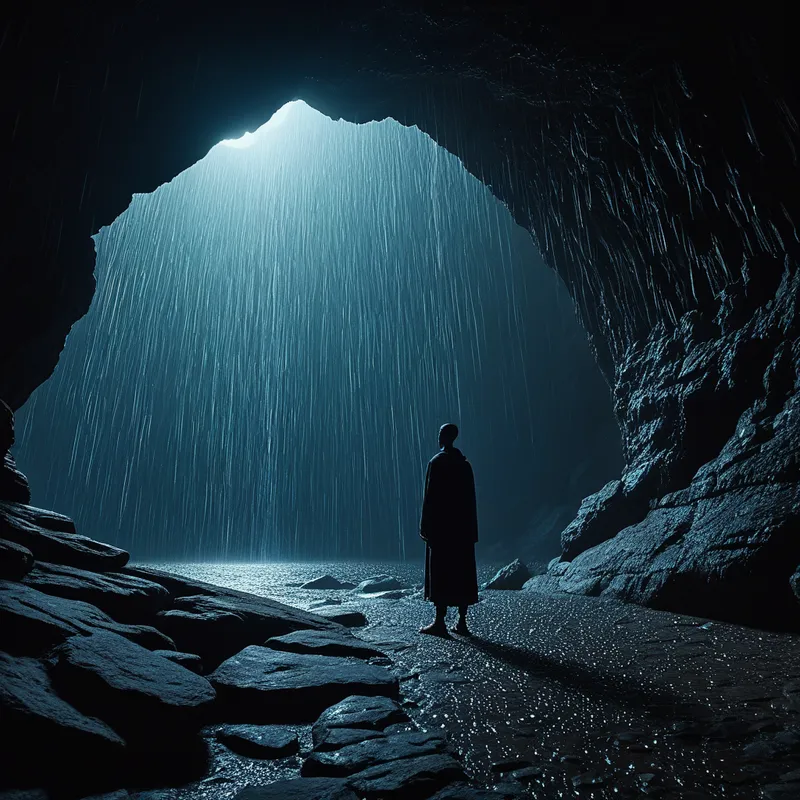
Without hesitation, The First Rain African turned toward the place of swallowing darkness. It found the cave mouth, breathing out a sigh of warm, mineral breath. With a final look at the silent, waiting world—a look that held all the love and despair of a first and last glance—it stepped into the gloom. Down it went, into the belly of the Earth. The heat grew immense, a pressure that sought to compress it into just another layer of rock. The darkness was absolute, a weight upon the soul.
In that core, there was no form, only a roaring, liquid fire and the imprisoned waters, screaming in their captivity. The First Rain African did not fight. It offered itself. It let the heat dissolve its gathered form. It let its own yearning hollow mix with the scream of the trapped waters. In a great, silent explosion of will, it did not take the water—it became the water’s cry for the sky.
Its sacrifice was the key. The pressurized grief of the earth, now fused with the conscious love of the Rain African, found its voice. It rushed upward, not as a flood, but as a rising vapor, a spirit leaving the tomb of stone. It climbed through the Cave, through layers of sleep, until it burst into the blinding world.
The brass bowl of the sky shuddered. For the first time, something gathered within it—cool, heavy, and grey. Then, a sound never before heard: a soft, pattering sigh. A single drop fell, striking the forehead of the sleeping earth like a kiss. Then another, and another. The rain did not pour; it wept. It was the First Rain African, returned, its body scattered into a billion loving fragments, each one a Blessing. Where the drops fell, the hard shell of the earth softened. Green pierced the grey. The world drew its first breath in a mist of steam and promise. The long silence was broken by the sound of life drinking.
Cultural Origins & Context
This myth finds its roots in the oral traditions of several Bantu-speaking peoples across the savannas and plateaus of Central and Southern Africa, particularly in regions where the seasonal rains are not a gentle certainty but a dramatic, life-or-death event. It was not a story for casual telling, but a sacred narrative recited by elders and ritual specialists during ceremonies at the end of the long dry season, or at the initiation of young adults into the responsibilities of the community.
Its societal function was multifaceted. Primarily, it was a Etiological Myth, explaining the cosmic origin of rain itself, framing it not as a mere weather pattern but as the conscious, sacrificed essence of a primordial being. This instilled a profound reverence for water and the rainy season. Secondly, it served as a foundational ethic of sacrifice. The well-being of the whole (the community, the land) was shown to depend on the courageous self-giving of the individual (the Rain African). It modeled the ideal that leadership and responsibility require moving toward the source of suffering, not away from it.
Symbolic Architecture
At its core, the myth is a masterful depiction of the alchemy of consciousness transforming circumstance. The First Rain African represents the emergent ego or conscious self that awakens to a state of lack—a psychic drought. The parched Earth symbolizes a life devoid of meaning, emotion, or connection, where potentials lie dormant.
The journey into the Cave is the ultimate descent into the unconscious. It is not an attack on the problem, but a surrender to the process.
The trapped, boiling waters are the repressed emotional and vital life force—what Carl Jung called the libido—that has become pathological through confinement. It is grief, passion, creativity, and instinct all bound together under immense pressure. The hero’s action is not to steal this energy, but to merge with it, to consciously become the vessel for its transformation. The dissolution of form is the death of the old, isolated self. The ascent as vapor and the fall as Rain is the return of this now-sacralized energy to nourish the entire psyche (the world). The rain is consciousness that has been tempered by the depths; it is wisdom that can only be earned through compassionate dissolution.

The Dreamer’s Resonance
When this myth stirs in the modern Dream, it often manifests as dreams of profound thirst in a barren landscape, of discovering hidden springs or wells, or of transformative journeys underground. The dreamer may find themselves in a vast, empty house (the parched psyche) searching for a hidden basement or plumbing. They may dream of their own body cracking like dry soil, or of crying tears that become rivers.
Somatically, this points to a process of re-hydrating a desiccated emotional life. Psychologically, it signifies a call to engage with a deep, internal “drought”—a period of depression, creative sterility, or spiritual aridity. The dream is urging a Descent. The conflict is between the ego’s fear of dissolution (entering the cave) and the Self’s imperative for growth. To dream of the rain beginning to fall is a powerful sign of impending psychic renewal, indicating that a period of difficult inner work is starting to yield the nourishing waters of insight, feeling, and new life.

Alchemical Translation
In the vessel of individuation, this myth maps the process of solve et coagula—dissolve and coagulate. The initial state is nigredo, the blackening: the psychic drought, the feeling of being burnt out, brittle, and lifeless.
The First Rain African’s awakening is the first stirring of the Self, recognizing this state as untenable. The conscious decision to descend represents a willing engagement with the shadow and the depths of the personal and collective unconscious (descensus ad inferos). The dissolution in the earth’s core is the mortificatio or putrefactio, the necessary death of the ego’s current configuration. This is not annihilation, but the breaking down of rigid structures to release bound energy.
The Rain is the aqua vitae, the divine water, the coagulatio of the spirit into a new, life-giving form. It is the transcendent function made manifest.
For the modern individual, this translates to the courage to face one’s deepest, most pressurized pains and passions—the “hot, trapped waters” of unresolved grief, rage, or desire. The alchemical work is to hold that material consciously, to suffer its heat without fleeing, and to allow it to transform you. The outcome is not simply a return to the old self, but a rebirth. The individual becomes a source of nourishment, their once-paralyzing emotions now transformed into empathy, their burnt-out intellect now cooled into wisdom, their personal Sacrifice yielding a capacity to bless the world around them. They become, in their own sphere, a bringer of the rain.
Associated Symbols
Explore related symbols from the CaleaDream lexicon:
- Rain — The ultimate symbol of the myth, representing the returned and transformed essence of the hero, a blessing of emotional and spiritual nourishment that awakens dormant life.
- Water — The primal, trapped life force and emotion within the earth’s core, which must be consciously engaged with and transmuted to end the psychic drought.
- Cave — The passage into the underworld of the unconscious, the place of necessary dissolution where the old self is sacrificed to release new potential.
- Earth — The parched, dormant world representing a state of psychic aridity, and also the containing womb that holds the secret waters of renewal deep within.
- Sacrifice — The central act of the myth; the voluntary dissolution of individual form for the sake of a greater, life-giving transformation.
- Journey — The archetypal path of descent and return, moving from the conscious world of lack into the unconscious source of abundance.
- Rebirth — The core promise of the myth; the awakening of the world and the hero’s own return in a new, nourishing form after the ordeal of dissolution.
- Drought — The initial state of profound lack, sterility, and thirst that catalyzes the entire heroic quest for transformative water.
- Heart — Symbolizes both the deep, pressurized core of the earth where waters are trapped and the seat of the courage and compassion required for the sacrificial descent.
- Spirit — The vapor into which the hero transforms, representing the sublimated essence that bridges the underworld and the sky, matter and blessing.
- Seed — The dormant potential within the parched earth, awaiting the catalytic touch of the rain to begin its own journey of growth and manifestation.