
The First Kayak Myth Meaning & Symbolism
A myth of a grieving mother who, through immense sacrifice, transforms her son's body into the first kayak, a vessel of survival and connection.
The Tale of The First Kayak
In the time before time, when the world was all ice and the long night held the sky, the People suffered. The great sea, Sedna, was angry, and her children—the seal, the walrus, the whale—stayed hidden in the black depths. Hunger was a constant companion, a sharp-toothed spirit that gnawed at the belly and dimmed the eyes. Men would venture onto the treacherous ice, but the sea would not give. They returned with empty hands and heavier hearts.
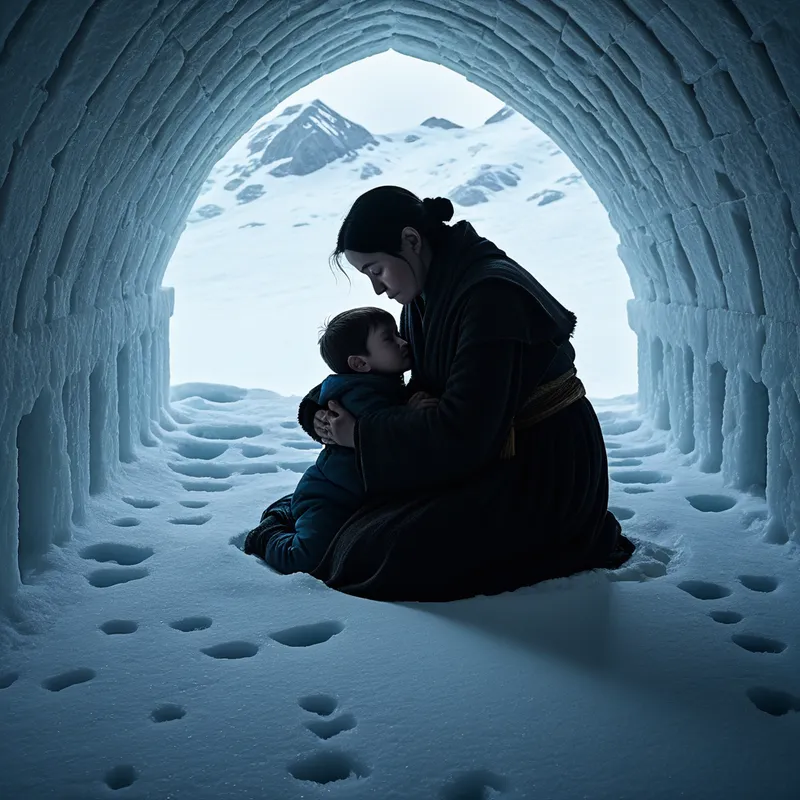
In one snow-house, a mother sat with a grief colder than the winter wind. Her son, a strong hunter with a laugh that could melt frost, had ventured out and not returned. The sea had taken him. For days, she keened, her sorrow a sound so pure it made the aurora shiver. She called to Sedna, she called to the spirits of the air and ice, but only silence answered.
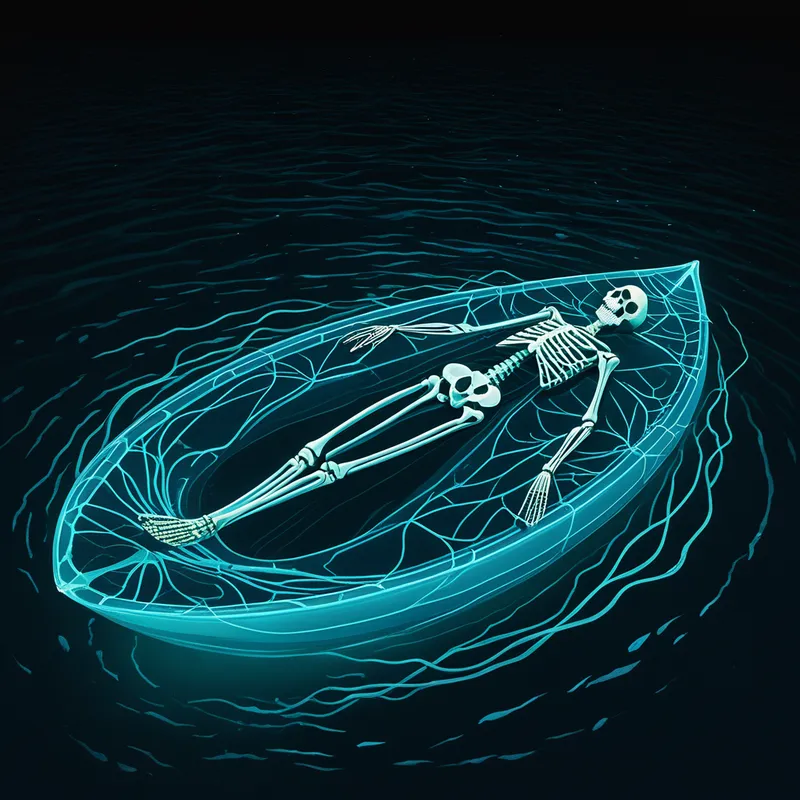
Then, in the deepest hour of the night, a vision came. Not in a dream, but in the waking stillness of her despair. She saw the skeleton of her son, clean and white, resting on the ocean floor. She saw the curve of his ribs, the length of his limbs. And a voice, perhaps her own, perhaps the sea’s, whispered from the marrow of the world: Make a vessel.
The resolve that filled her was not of this world. It was the hard, clear ice that forms at the core of a glacier. She walked out onto the shore where the ice met the dark, chanting water. She called his name into the void. And the sea, in a moment of strange mercy, yielded. The waves gently laid his body at her feet.
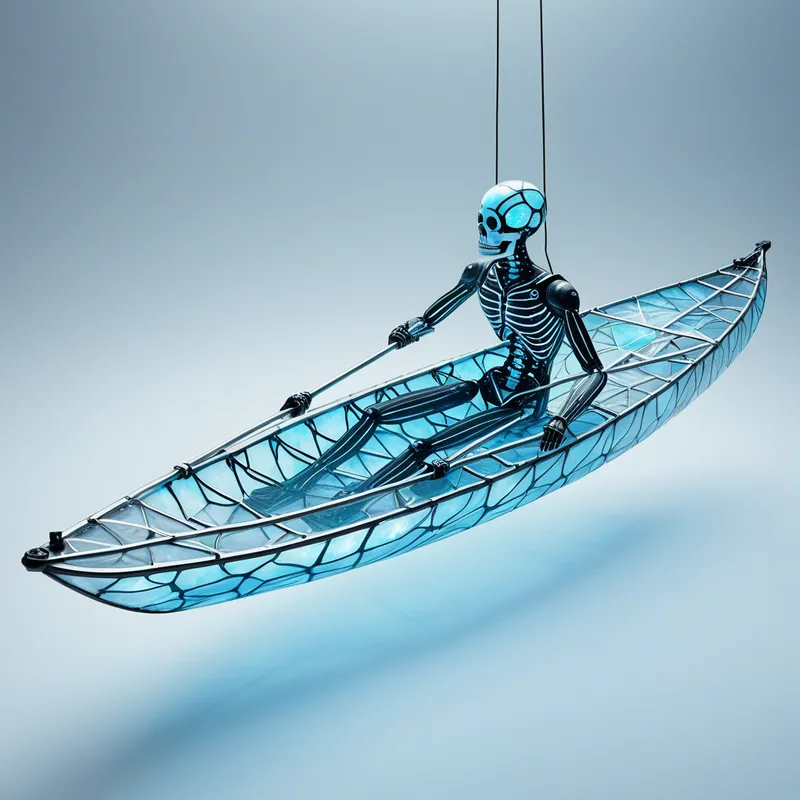
Her tears froze upon her cheeks. With hands that did not feel their own trembling, she began the sacred, terrible work. She did not see her child, but the shape of survival. She carefully separated bone from flesh, tendon from ligament. She cleaned each long bone, each rib, with a reverence beyond mourning. From his skeleton, she fashioned a frame—the spine became the keel, the ribs the gunwales, the arm and leg bones the struts. She wept as she worked, and her tears salted the wood-like bone.
Then, she took the sealskins she had saved. With sinew thread, she stretched the skin taut over the bone frame, stitching with a precision born of love and desperation. She sang his spirit into every stitch, a song of remembrance and purpose. As the last stitch was tied, the thing she had created was no longer a corpse, nor merely an object. It lay on the stones: slender, taut, perfect. The first qajaq.
She pushed it into the water. It did not sink. It sat upon the waves as naturally as a seal upon ice. She climbed in, and it became an extension of her own body. With the first dip of her paddle, crafted from a remaining bone, she slipped into the silent world. She became a ghost on the water, a part of the sea itself. The seals, curious, approached. They saw not a hunter, but something new—a creature both of the land and the water, a being of profound sacrifice. And they gave themselves.
She returned to her people not with a corpse, but with food, and with the knowledge that would define them forever. The kayak was not a tool of conquest, but a covenant. A promise forged from loss, a way to move between worlds without breaking them.
Cultural Origins & Context
This myth, in its many variations, is central to the Inuit worldview. It was not a story told for mere entertainment around the qulliq (stone lamp), but a foundational narrative of technology, ecology, and the human spirit. Passed down through generations by elders and storytellers, it served as the sacred charter for the most vital piece of material culture: the kayak.
The story functioned on multiple levels. Practically, it encoded the profound respect required for hunting—the kayak was not just a boat, but a living partnership with the animal world, born from a sacrifice that demanded reciprocal respect from the hunter. Spiritually, it explained the origin of a technology so perfect it seemed divinely inspired, rooting it not in random invention, but in a moment of transcendent, tragic necessity. Societally, it reinforced the values of resilience, ingenuity, and the transformative power of grief channeled into communal survival. The mother in the story is the ultimate Creator archetype, modeling how humanity must creatively adapt to the most severe realities, using what is at hand—even the bones of loss—to ensure continuity.
Symbolic Architecture
The myth is a masterclass in symbolic [alchemy](/symbols/alchemy “Symbol: A transformative process of purification and creation, often symbolizing personal or spiritual evolution through difficult stages.”/). The [kayak](/symbols/kayak “Symbol: A kayak symbolizes adventure, independence, and the journey of navigating life’s waters.”/) is the ultimate [symbol](/symbols/symbol “Symbol: A symbol can represent an idea, concept, or belief, serving as a powerful tool for communication and understanding.”/) of the psychic [skin](/symbols/skin “Symbol: Skin symbolizes the boundary between the self and the world, representing identity, protection, and vulnerability.”/)—a constructed [boundary](/symbols/boundary “Symbol: A conceptual or physical limit defining separation, protection, or identity between entities, spaces, or states of being.”/) that allows the conscious self to navigate the perilous, nutrient-rich [depths](/symbols/depths “Symbol: Represents the subconscious, hidden emotions, or foundational aspects of the self, often linked to primal fears or profound truths.”/) of the unconscious (the sea).
The vessel is not built to conquer the deep, but to relate to it. It is a membrane of consciousness stretched over the bones of personal history.
The [mother](/symbols/mother “Symbol: The symbol of ‘Mother’ represents nurturing, protection, and the foundational aspect of one’s emotional being, often associated with comfort and unconditional love.”/)’s horrific yet sacred act represents the necessary deconstruction of a prior [identity](/symbols/identity “Symbol: Identity represents the sense of self, encompassing personal beliefs, cultural background, and social roles.”/) (the son as a separate being) to serve a larger, [life](/symbols/life “Symbol: The symbol of ‘Life’ represents a journey of growth, interconnectedness, and existential meaning, encompassing both the joys and challenges that define human experience.”/)-sustaining function. The son’s [body](/symbols/body “Symbol: The body in dreams often symbolizes the dreamer’s self-identity, personal health, and the relationship they have with their physical existence.”/)—the literal bone [structure](/symbols/structure “Symbol: Structure in dreams often symbolizes stability, organization, and the framework of one’s life, reflecting how one perceives their environment and personal life.”/) of her old [life](/symbols/life “Symbol: The symbol of ‘Life’ represents a journey of growth, interconnectedness, and existential meaning, encompassing both the joys and challenges that define human experience.”/)—becomes the hidden [framework](/symbols/framework “Symbol: Represents the underlying structure of one’s identity, emotions, or life. It signifies the mental or emotional scaffolding that supports or confines the self.”/) for a new mode of being. The sealskin represents the adaptable, resilient ego that must be stretched taut over this framework, making it seaworthy. The entire process is an [archetypal image](/symbols/archetypal-image “Symbol: A universal, primordial symbol from the collective unconscious that transcends individual experience and carries profound spiritual or mythic meaning.”/) of [sublimation](/symbols/sublimation “Symbol: Transforming base impulses into creative or socially acceptable outlets, often seen in artistic expression.”/): the raw, overwhelming [energy](/symbols/energy “Symbol: Energy symbolizes vitality, motivation, and the drive that fuels actions and ambitions.”/) of [grief](/symbols/grief “Symbol: A profound emotional response to loss, often manifesting as deep sorrow, yearning, and a sense of emptiness.”/) and [trauma](/symbols/trauma “Symbol: A deeply distressing or disturbing experience that overwhelms the psyche, often manifesting in dreams as unresolved emotional wounds or psychological injury.”/) is not repressed, but painstakingly redirected into the creation of a [vessel](/symbols/vessel “Symbol: A container or structure that holds, transports, or protects something essential, representing the self, emotions, or life journey.”/) for future [life](/symbols/life “Symbol: The symbol of ‘Life’ represents a journey of growth, interconnectedness, and existential meaning, encompassing both the joys and challenges that define human experience.”/) and meaning.
The sea, ruled by Sedna, is the Great Mother in her dual [aspect](/symbols/aspect “Symbol: A distinct feature, quality, or perspective of something, often representing a partial view of a larger whole.”/)—the [source](/symbols/source “Symbol: The origin point of something, often representing beginnings, nourishment, or the fundamental cause behind phenomena.”/) of all life ([food](/symbols/food “Symbol: Food in dreams often symbolizes nourishment, both physical and emotional, representing the fulfillment of basic needs as well as deeper desires for connection or growth.”/)) and the [realm](/symbols/realm “Symbol: The symbol of ‘Realm’ often signifies the boundaries of one’s consciousness, experiences, or emotional states, suggesting aspects of reality that are either explored or ignored.”/) of [death](/symbols/death “Symbol: Symbolizes transformation, endings, and new beginnings; often associated with fear of the unknown.”/) and [dissolution](/symbols/dissolution “Symbol: The process of breaking down, dispersing, or losing form, often representing transformation, release, or the end of a state of being.”/). The kayak is the [hero](/symbols/hero “Symbol: A hero embodies strength, courage, and the ability to overcome significant challenges.”/)’s answer to this [paradox](/symbols/paradox “Symbol: A contradictory yet true concept that challenges logic and perception, often representing unresolved tensions or profound truths.”/): a crafted [consciousness](/symbols/consciousness “Symbol: Consciousness represents the state of awareness and perception, encompassing thoughts, feelings, and experiences.”/) that can interface with the terrifying, nourishing depths without being swallowed by them.
The Dreamer’s Resonance
When this myth stirs in the modern dreamer, it signals a profound process of psychic reframing. To dream of building a vessel from bones, especially the bones of a loved one or a past version of oneself, points to a time when a deep loss or a shattered identity is being metabolized into a new structure for the psyche.
The somatic feeling is often one of grim, focused determination amidst deep sorrow—a “wintering” of the soul. The dreamer may feel the cold clarity of necessity. They are in the process of taking the immutable facts of their life—their traumas, their inheritances, their “bones”—and, with great effort, fashioning them into a framework for survival and purpose. It is not about “getting over” a loss, but about integrating it so completely that it becomes the very architecture of one’s forward motion. The dream asks: What must you dismantle with love? What framework of your old life can be repurposed? Over what structure of experience must you stretch a new, resilient skin to navigate the world?
Alchemical Translation
In the journey of individuation, the myth of the First Kayak models the stage where the ego, faced with a catastrophic encounter with the unconscious (the death of the son to the sea), does not retreat but engages in a radical act of re-creation.
The alchemical solve et coagula—dissolve and coagulate—is enacted not in a laboratory, but in the crucible of the heart. The old form is dissolved by grief; a new form is coagulated by intentional, sacred work.
The “son” can represent an outmoded complex, a cherished ideal, or a life role that has died. The conscious mind (the mother) must courageously engage with this “corpse,” not to bury it, but to salvage its essential structure. This is the painful work of shadow integration—taking aspects of ourselves or our history that we wish were dead and finding their functional use. The resulting “kayak” is the transcendent function: a new psychological attitude born from the tension between irreconcilable opposites (life/death, land/sea, grief/hope). This new attitude allows the individual to navigate the inner and outer worlds with greater agility, depth, and sustainability. One becomes a hunter of meaning, moving silently and respectfully through the depths of one’s own soul, sustained by the nourishment found there.
The ultimate teaching is that our most profound tools for survival and meaning are not found in escape from our wounds, but are fashioned, with unbearable care, from their very substance.
Associated Symbols
Explore related symbols from the CaleaDream lexicon:
- Bone — The immutable structure of experience, the enduring framework of identity and memory upon which new life must be carefully built.
- Water — The primordial, unconscious realm of emotion, potential, and dissolution, both the source of all nourishment and the greatest danger to the isolated self.
- Mother — The archetypal force of creation and sacrifice, who engages with loss not passively but as the active, painful architect of a new reality.
- Sacrifice — The necessary surrender of a previous form or attachment, not as a meaningless loss, but as the essential raw material for a transformative act.
- Vessel — The constructed boundary of the self, the crafted identity or consciousness that allows one to carry life and purpose through perilous depths.
- Journey — The essential movement from a state of helpless stasis to one of dynamic, purposeful navigation through the challenges of existence.
- Sea — The vast, unknown dimension of the psyche and the external world, home to both nurturing and terrifying forces with which one must learn to relate.
- Grief — The profound emotional and spiritual catalyst that, when fully engaged, provides the energy and the imperative for world-rebuilding transformation.
- Spirit — The animating force of memory, love, and intention that is woven into a new creation, ensuring it is more than mere material.
- Transformation — The core alchemical process of changing the state and function of a substance, turning death into a vehicle for life, and loss into a means of navigation.