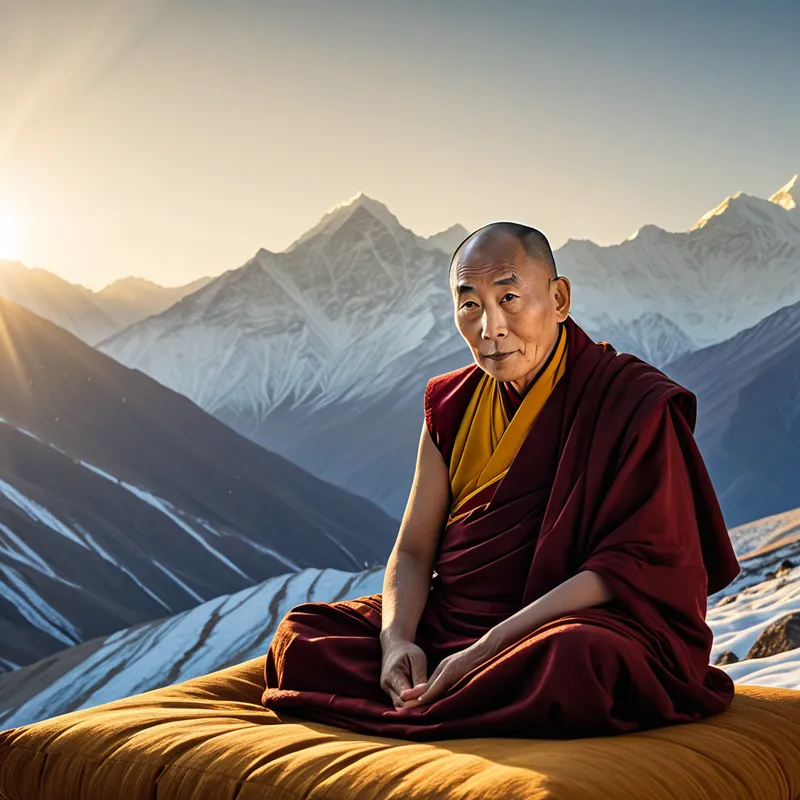
The First Dalai Lama Myth Meaning & Symbolism
The story of Gendun Drup, a humble monk whose life and legacy became the foundation for a sacred lineage of enlightened consciousness.
The Tale of The First Dalai Lama
Listen. In the high, thin air where the world touches the sky, a story was born not of a single birth, but of a river finding its source. It begins not with a king’s decree, but with the quiet scratch of a pen on parchment in the flickering light of a butter lamp.
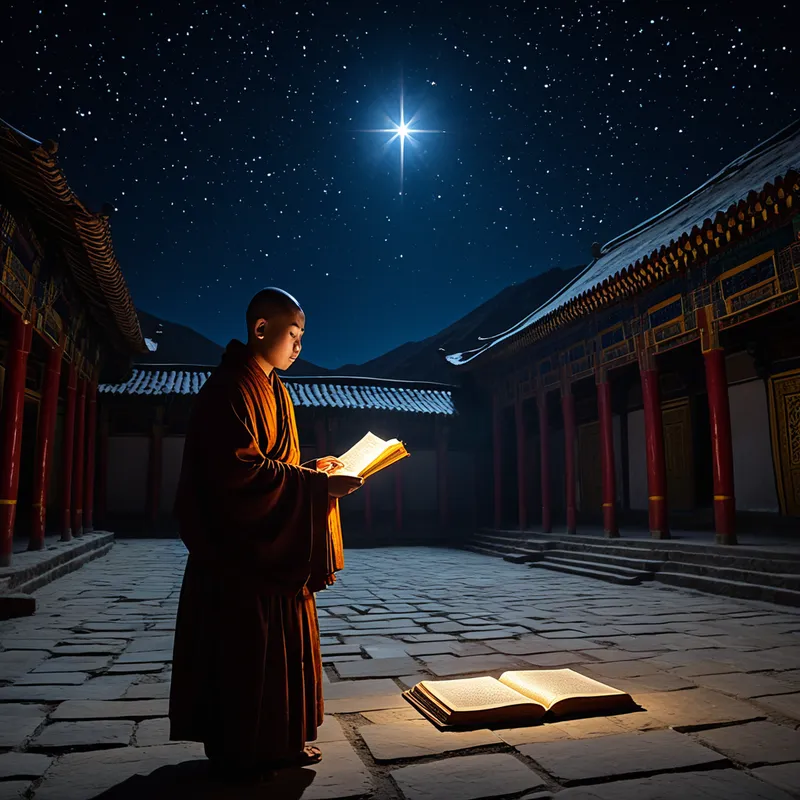
In the land of snows, in the monastery of Narthang, there lived a monk named Gendun Drup. His world was one of profound silence, broken only by the murmur of mantras and the turning of prayer wheels. He was a scholar, a translator, his mind a vessel for the ocean of Dharma. His hands, stained with ink, copied sacred texts, each character a seed planted for future harvest. He built not with stone, but with words—a monastery of the mind named Tashilhunpo, which rose from the earth as a testament to his devotion.
Yet, the true story lies in what happened after his body returned to the elements. For in the moment of his passing, a profound intention, a samaya forged over a lifetime of practice, did not dissipate. It condensed. It became a beacon. The compassion of Avalokiteshvara, who weeps for the suffering of all beings, had found a steadfast anchor in this humble monk’s life. And so, the consciousness that was Gendun Drup, refined and directed by boundless love, chose not to vanish into the luminous void. It chose to return.
A child was born. In him, the elders saw not just a new life, but the unmistakable echo of an old one. He recognized the rosary of his previous form. He spoke of Tashilhunpo as his home. The river of his being had found a new channel. This child, named Gendun Gyatso, was recognized as the tulku, the intentional rebirth, of Gendun Drup. The lamp had not been extinguished; its flame had been transferred to a new vessel. Thus, the lineage was born—not from a divine proclamation at the beginning, but from a conscious choice at the end of a life well-lived. The First was recognized in retrospect, by the undeniable continuity of his Second.
Cultural Origins & Context
This is not a myth of prehistoric antiquity, but a sacred history that lives in the very breath of Tibetan culture. The narrative of Gendun Drup (1391–1474) as the First Dalai Lama is a foundational story of the Gelug tradition, solidified in the centuries after his death. It was passed down through monastic chronicles, the oral histories of reincarnation lineages, and the living testimony of recognition.
The story’s primary function is to establish and sanctify the Dalai Lama institution. It moves the concept of enlightenment from the abstract to the intimately continuous. It answers a profound cultural and psychological need: the assurance that wisdom and compassionate guidance are not lost to time, but are perpetually renewed, accessible in human form. The tale legitimizes spiritual authority not through hereditary rule, but through the evidence of conscious continuity, verified by the monastic community and the signs perceived in a child. It transforms a biographical fact into a cosmological principle—the principle of the unbroken mindstream.
Symbolic Architecture
At its [heart](/symbols/heart “Symbol: The heart symbolizes love, emotion, and the core of one’s existence, representing deep connections with others and self.”/), this myth is not about the coronation of a [king](/symbols/king “Symbol: A symbol of ultimate authority, leadership, and societal order, often representing the dreamer’s inner power or external control figures.”/), but the recognition of a [pattern](/symbols/pattern “Symbol: A ‘Pattern’ in dreams often signifies the underlying structure of experiences and thoughts, representing both order and the repetitiveness of life’s situations.”/)—a pattern of [consciousness](/symbols/consciousness “Symbol: Consciousness represents the state of awareness and perception, encompassing thoughts, feelings, and experiences.”/) choosing engagement over [dissolution](/symbols/dissolution “Symbol: The process of breaking down, dispersing, or losing form, often representing transformation, release, or the end of a state of being.”/).
The greatest act of compassion may not be to leave the world behind, but to turn back towards it, again and again, with a heart made wise by release.
Gendun Drup represents the [archetype](/symbols/archetype “Symbol: A universal, primordial pattern or prototype in the collective unconscious that shapes human experience, behavior, and creative expression.”/) of the Bodhisattva perfected. His [life](/symbols/life “Symbol: The symbol of ‘Life’ represents a journey of growth, interconnectedness, and existential meaning, encompassing both the joys and challenges that define human experience.”/) as a scholar and builder symbolizes the establishment of a stable, structured container—a Sangha, a philosophy, a physical seat—for the Dharma. His “first-ness” is paradoxical; he is the root because of the [fruit](/symbols/fruit “Symbol: Fruit symbolizes abundance, nourishment, and the fruits of one’s labor in dreams.”/) he intentionally produced: his own return. The recognition [ceremony](/symbols/ceremony “Symbol: Ceremonies in dreams often symbolize transitions, rituals of passage, or significant life events.”/) is the critical symbolic act. It represents the [community](/symbols/community “Symbol: Community in dreams symbolizes connection, support, and the need for belonging.”/)’s—and by extension, the culture’s—[ability](/symbols/ability “Symbol: In dreams, ‘ability’ often denotes a recognition of skills or potential that one possesses, whether acknowledged or suppressed.”/) to perceive the invisible: the continuity of essence beneath the change of form. The Chenrezig identification elevates the individual [story](/symbols/story “Symbol: The symbol of ‘Story’ represents the narrative woven through our lives, embodying experiences, lessons, and emotions that shape our identities.”/) to a universal one, connecting a specific monk to the boundless compassionate [energy](/symbols/energy “Symbol: Energy symbolizes vitality, motivation, and the drive that fuels actions and ambitions.”/) of the [cosmos](/symbols/cosmos “Symbol: The entire universe as an ordered, harmonious system, often representing the totality of existence, spiritual connection, and the unknown.”/).
Psychologically, this is a myth about [legacy](/symbols/legacy “Symbol: What one leaves behind for future generations, encompassing values, achievements, possessions, and memory.”/) and conscious [identity](/symbols/identity “Symbol: Identity represents the sense of self, encompassing personal beliefs, cultural background, and social roles.”/). It asks: What part of us is so essential, so purposeful, that it seeks to persist beyond the [death](/symbols/death “Symbol: Symbolizes transformation, endings, and new beginnings; often associated with fear of the unknown.”/) of the ego? It symbolizes the [birth](/symbols/birth “Symbol: Birth symbolizes new beginnings, transformation, and the potential for growth and development.”/) of the Self from the conscious work of the [personality](/symbols/personality “Symbol: Personality in dreams often symbolizes the traits and characteristics of the dreamer, reflecting how they perceive themselves and how they believe they are perceived by others.”/).
The Dreamer’s Resonance
When this myth stirs in the modern dreamer, it often signals a process of profound psychic integration and the confrontation with continuity. To dream of meeting an old sage who feels intimately familiar, or of discovering that you have lived in a place you’ve never visited, touches this archetypal pattern.
Somatically, one might feel a deep, resonant pull—a sense of “knowing” that bypasses intellect. Psychologically, this dream pattern emerges when the individual is grappling with questions of purpose that transcend a single lifetime. It may appear during life transitions where one feels they are “picking up a thread” from a past phase of life, or when engaging in work that feels like a destined vocation. The dream is not a literal suggestion of past lives, but a metaphor from the deep psyche: you are part of a longer story. Your current struggles, talents, and affinities are not random; they are chapters in an ongoing narrative of the soul’s development. The dream invites you to recognize your own “tulkus”—the recurring patterns, gifts, and core challenges that reincarnate in your life across different relationships, jobs, and creative endeavors.

Alchemical Translation
The alchemical process modeled here is the transmutation of a life lived (the prima materia) into a conscious legacy (the lapis philosophorum). For the modern individual, the myth outlines a path of psychic individuation in three stages.
First, the Stage of the Builder (Gendun Drup as Monk): This is the often arduous, disciplined work of ego-construction and skill acquisition. We build our “Tashilhunpo”—our career, our knowledge base, our character. This is necessary labor, creating a stable vessel.
Second, the Crucible of Dissolution (The Parinirvana): This is the inevitable death—not physical, but psychological. It is the end of a major life chapter: a career, a primary identity, a long-held self-concept. The ego-vessel cracks. The myth suggests that at this point, a choice is possible: to cling to the shattered form, or to consciously offer the essence of what was learned and loved back to the psyche.
Individuation is not about becoming someone new, but about discovering who has always been returning.
Third, the Recognition and Return (The Tulku): This is the rebirth of meaning. The values, wisdom, and core purpose distilled from the first life are recognized in a new form—a new career path, a creative pursuit, a mode of service. You don’t “start over”; you continue. The “child” (new project, relationship, phase) is recognized because it bears the unmistakable marks (joy, deep interest, sense of rightness) of your essential self. The alchemical gold is this realized continuity of purpose. The individual becomes a lineage unto themselves, where each ending is consciously crafted to be a seed for a wiser beginning. You become both the departing lama and the searching committee, learning to recognize your own soul’s handwriting across the pages of your life.
Associated Symbols
Explore related symbols from the CaleaDream lexicon:
- Mountain — The enduring, stable foundation of spiritual practice and wisdom that Gendun Drup established, representing the unwavering ground of being from which compassion arises.
- Mirror — The tool of recognition, reflecting the essential nature of consciousness from one life to the next, revealing the true face beneath the mask of form.
- River — The continuous, flowing mindstream of the Dalai Lama lineage, forever moving yet always itself, carving its path through the landscape of time.
- Seed — The profound intention (samaya) planted by Gendun Drup, which fructified after his death into the enduring lineage, representing cause and effect on a soul-level.
- Bridge — The tulku, or incarnate lama, who forms a living bridge between the wisdom of the past and the needs of the present, between the absolute and the relative world.
- Light — The undying lamp of wisdom and compassion passed from vessel to vessel, illuminating the path to liberation for all beings.
- Circle — The endless cycle of compassionate return, the Bodhisattva vow made manifest, where the end of one life is the deliberate beginning of the next.
- Temple — The physical and spiritual institution of the Dalai Lama, built first by Gendun Drup, which serves as a container and beacon for the sacred.
- Dream — The visionary space where past and future lives are perceived, and where the community “dreams” the identity of the next incarnation into being.
- Destiny — Not as a fixed fate, but as a consciously chosen path of service, repeatedly embraced across lifetimes, shaping a legacy of liberation.