The Firebird Myth Meaning & Symbolism
A magical bird of radiant light is stolen, sparking a perilous quest that transforms a simple hero through trials of cunning, courage, and sacrifice.
The Tale of The Firebird
In the time when the world was older and its bones lay closer to the skin of things, in a kingdom under a sky so deep it drank the light, there lived a Tsar. He had three sons: two who were clever as foxes and proud as hawks, and a third, Ivan Tsarevich, whom men called simple. His kingdom was vast, but his heart was a cramped and shadowed room, for he coveted a beauty not meant for mortal keeping.
In his royal orchard grew a tree with apples of pure gold, the treasure of his line. But night after night, a thief came on silent wings and stole the fruit. The Tsar, in a fury, set his sons to watch. The elder brothers, lulled by mead and arrogance, saw nothing but their own dreams. But Ivan, wrapped in the patient cloak of night, kept watch.
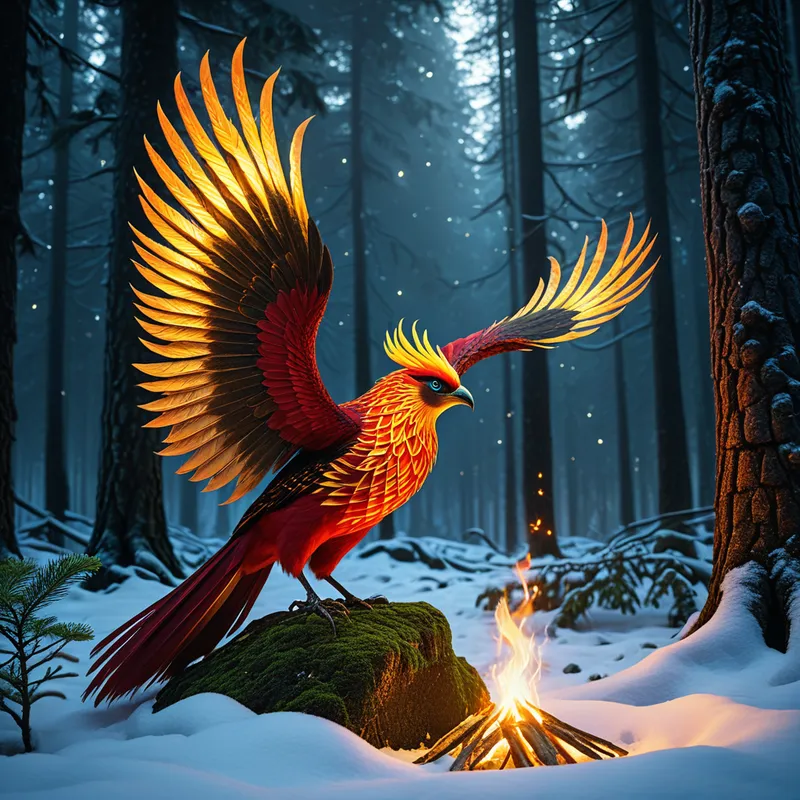
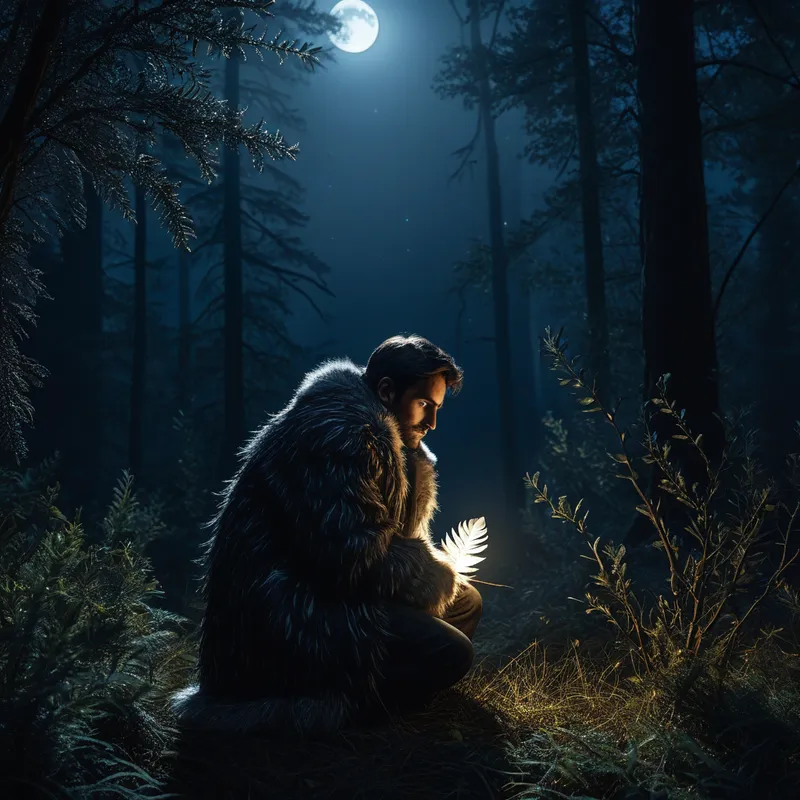
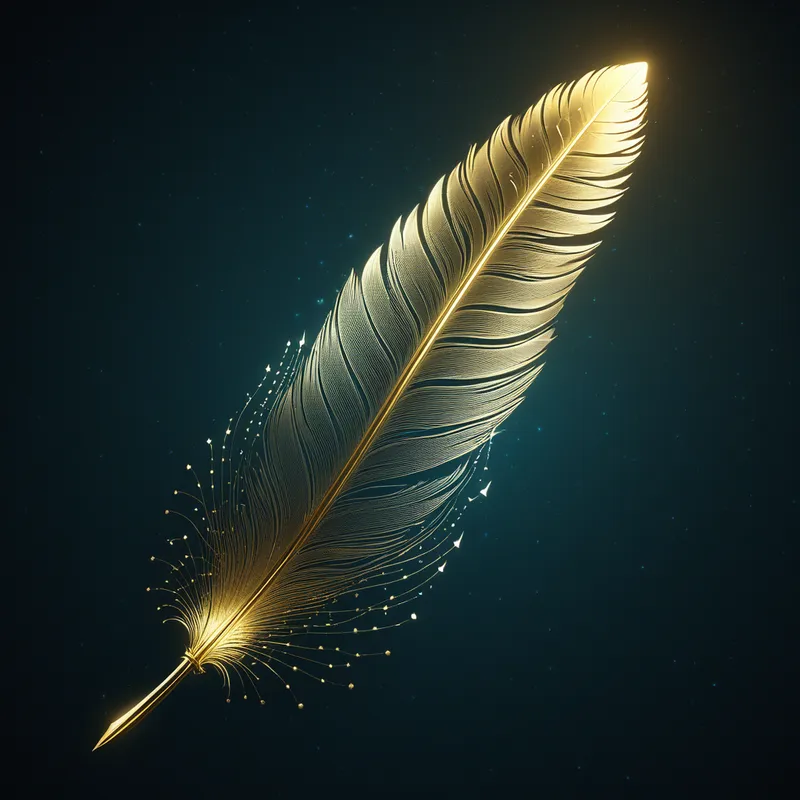
Then it came. Not with sound, but with a sudden dawn in the heart of darkness. The Firebird. Its feathers were not mere plumage but captured sunsets and banked hearth-fires, each one a lick of living flame that cast no smoke, only light. It moved like a falling star given purpose, and where its light fell, the shadows fled and the very apples on the tree seemed to blush into being. As it plucked a single fruit, a feather, brighter than a comet’s tail, loosened and drifted down. Ivan caught it, and the light of it flooded his senses, a warmth that spoke of distances beyond the edge of any map.
That feather, presented to the furious Tsar, became not a clue but a curse of desire. “Bring me the bird itself,” commanded the father, his eyes reflecting the feather’s greedy glow. So the sons rode out, the elder two toward tavern and tall tale, Ivan toward the whispering, ancient Forest.
His journey was a descent into the world’s soul. He met a great Grey Wolf, who, seeing the fate woven into Ivan’s thread, devoured his horse not out of malice, but to break his mortal pace. “Your path is not of muscle, but of mystery,” the Wolf seemed to say, and offered his own back. Guided by this wild wisdom, Ivan arrived at a wall of stone that pierced the clouds. Upon it, in a cage of gold, sat the Firebird. But the Wolf warned: “Take the bird, but touch not the cage.” Ivan, his mind clouded by the sight, took both. The cage screamed a silent alarm, and he was captured by its guardian, another Tsar of a distant realm.
To win his life, Ivan was set three impossible tasks: fetch the horse with the golden mane from the ends of the earth, and then, from beyond the River of Fire, bring the Tsarevna, the princess of unearthly beauty. Each time, the Grey Wolf performed the feat, shape-shifting, cunning, a force of primal instinct serving a destined end. And each time, Ivan, following the Wolf’s counsel, won the prize only to face the treachery of his returning brothers, who stole his spoils and left him for dead. And each time, the faithful Wolf revived him with the Water of Life.
In the final return, with the true princess by his side, the truth blazed forth. The Tsar, confronted with the living Firebird, the golden-maned horse, and the radiant princess, saw the worth of his youngest son. Justice, swift and final, fell upon the deceitful brothers. Ivan did not keep the Firebird in a cage. It remained a free wonder, a periodic visitor whose light now blessed the kingdom, not as a possession, but as a covenant between the human realm and the realm of miraculous beauty. Ivan Tsarevich, the simple son, had journeyed into the dark and returned, not with a trophy, but transformed into a king who understood that the greatest treasures are not held, but honored.
Cultural Origins & Context
The myth of the Firebird, known as [Zhar-ptitsa](/myths/zhar-ptitsa “Myth from Slavic culture.”/), is a cornerstone of East Slavic folklore, with roots that likely intertwine with ancient Slavic paganism. It was not a single, canonical text, but a living, breathing story passed down through the oral tradition of skomorokhi (itinerant performers) and village elders during the long winter nights. Its primary collectors in the 19th century, like Alexander Afanasyev, captured it from this vibrant oral stream.
The tale functioned as more than entertainment. In a societal context defined by harsh winters, deep forests, and the capricious power of nobility (the Tsar), the story served multiple purposes. It reinforced the value of perseverance, humility, and listening to instinct (the Wolf) over brute force or arrogant cunning. The youngest, seemingly least capable son succeeding where his elders fail is a universal folkloric motif, offering hope and validating inner qualities over birthright. Furthermore, the Firebird itself may be a folk memory of solar symbolism, a descendant of a pagan sun deity or spirit, transformed into a narrative symbol of unattainable, life-giving beauty that must be approached with respect, not brute force.
Symbolic Architecture
The Firebird is no ordinary animal. It is the incarnation of the numinous, the mysterium tremendum et fascinans—the awe-inspiring and fascinating [mystery](/symbols/mystery “Symbol: An enigmatic, unresolved element that invites curiosity and exploration, often representing the unknown or hidden aspects of existence.”/) that pulls the [soul](/symbols/soul “Symbol: The soul represents the essence of a person, encompassing their spirit, identity, and connection to the universe.”/) from its slumber.
The Firebird is the soul’s own brilliant and restless image, glimpsed in a moment of grace, whose pursuit becomes the only meaningful journey.
The radiant [bird](/symbols/bird “Symbol: Birds symbolize freedom, perspective, and the connection between the earthly and spiritual realms, often representing the soul’s aspirations or personal growth.”/) represents the transcendent function in nascent form: a dazzling, unconscious content that erupts into a [life](/symbols/life “Symbol: The symbol of ‘Life’ represents a journey of growth, interconnectedness, and existential meaning, encompassing both the joys and challenges that define human experience.”/) grown stale (the Tsar’s [kingdom](/symbols/kingdom “Symbol: A kingdom symbolizes authority, belonging, and a sense of identity within a larger context or community.”/)). Its stolen [feather](/symbols/feather “Symbol: A feather represents spiritual elevation, lightness, and the freedom of the spirit. It often symbolizes messages from the divine and connection to ancient wisdom.”/) is the first hint of vocation, the “[glimpse](/symbols/glimpse “Symbol: A fleeting, partial view or moment of insight that suggests more lies beyond immediate perception, often hinting at hidden truths or future possibilities.”/) of the sublime” that makes ordinary [life](/symbols/life “Symbol: The symbol of ‘Life’ represents a journey of growth, interconnectedness, and existential meaning, encompassing both the joys and challenges that define human experience.”/) thereafter feel intolerably dim. The Tsar, representing the stagnant ruling [consciousness](/symbols/consciousness “Symbol: Consciousness represents the state of awareness and perception, encompassing thoughts, feelings, and experiences.”/), demands to possess it outright, initiating the [crisis](/symbols/crisis “Symbol: A crisis symbolizes turmoil, urgent challenges, and the need for immediate resolution or change.”/).
Ivan is the nascent ego, the conscious self that must undertake the [hero](/symbols/hero “Symbol: A hero embodies strength, courage, and the ability to overcome significant challenges.”/)’s [journey](/symbols/journey “Symbol: A journey in dreams typically signifies adventure, growth, or a significant life transition.”/). His simplicity is his saving grace—an openness to the non-rational. The Grey [Wolf](/symbols/wolf “Symbol: Wolves in dreams symbolize instinct, intelligence, freedom, and a deep connection to the wilderness and primal instincts.”/) is the guide, the embodiment of the deep, instinctual Self. It is the [Wolf](/symbols/wolf “Symbol: Wolves in dreams symbolize instinct, intelligence, freedom, and a deep connection to the wilderness and primal instincts.”/), not Ivan’s conscious will, that accomplishes the tasks. Ivan’s repeated failures (touching the cage, being betrayed) are necessary initiations, deaths of his naivety, each followed by a resurrection (via the [Water](/symbols/water “Symbol: Water symbolizes the subconscious mind, emotions, and the flow of life, representing both cleansing and creation.”/) of Life). The golden cage, horse, and [princess](/symbols/princess “Symbol: The symbol of a princess embodies themes of power, privilege, and feminine grace, often entailing a journey of self-discovery.”/) are progressively deeper integrations of the divine feminine ([anima](/symbols/anima “Symbol: The feminine archetype within the male unconscious, representing soul, creativity, and connection to the inner world.”/)) and spiritual power, which cannot be taken without sacrifice and the overcoming of inner treachery (the brothers).
The Dreamer’s Resonance
To dream of the Firebird is to experience a somatic call from the depths. You may dream of a distant, mesmerizing light in a profound darkness, a single glowing object in an ordinary room, or a beautiful, untouchable creature that flees as you approach. The somatic signature is often one of aching longing mixed with awe—a tightening in the chest, a quickening of the pulse.
Psychologically, this dream marks a moment when the psyche is announcing a necessary disruption. The comfortable, gold-apple orchard of your current life is being pilfered by a force of greater beauty and purpose. You are being invited, or compelled, to follow. The feeling of the feather in the hand—that tangible proof of magic—translates in modern terms as a sudden insight, a creative spark, or a moment of profound love that changes everything and demands everything. The dream is the first stage of the call. To ignore it is to court a psychic winter; to heed it is to accept a perilous, transformative Journey.
Alchemical Translation
The myth of the Firebird is a perfect allegory for the alchemical process of individuation. The initial state (nigredo) is the Tsar’s kingdom: a ruling consciousness that is rich but stagnant, symbolized by the static, metallic gold of the apples. The arrival of the Firebird is the coniunctio, the shocking marriage of opposites—the mundane with the celestial—that sets the process in motion.
The quest is not to capture the light, but to allow the light to capture you, burning away all that is not essential until only the authentic self remains.
Ivan’s journey through the forest is the descent into the unconscious (solutio), dissolution of the old ego. The Grey Wolf represents the prima materia, the raw, instinctual guide. The impossible tasks are the stages of purification and conjunction (albedo, citrinitas). Each betrayal by the brothers is a necessary confrontation with the Shadow—the parts of the self that would steal the hard-won treasures for shallow glory. The final return with the princess and the free Firebird symbolizes the rubedo, the red dawn of the integrated Self. The Firebird, now a visitor, not a prisoner, represents the achieved state where the transcendent function is not an external marvel to be owned, but an inner reality that periodically illuminates one’s life from within. The kingdom (the conscious personality) is now in right relationship with the source of mystery and light.
Associated Symbols
Explore related symbols from the CaleaDream lexicon:
- Fire — The essence of the Firebird, representing transformative energy, divine inspiration, and the purifying light of consciousness that burns away illusion.
- Bird — The messenger between worlds, symbolizing the spirit, freedom, and the soul’s capacity to transcend earthly limitations in pursuit of higher truth.
- Forest — The deep, unknown realm of the unconscious where the quest begins, filled with both perils and guiding instincts, representing the necessary journey into the unknown self.
- Journey — The central archetypal process of the myth, mapping the soul’s passage from naive consciousness through trials and back to wholeness.
- Wolf — The instinctual guide and embodiment of untamed wisdom from the unconscious, necessary for navigating the perils of the deep psyche.
- Water — Specifically the Water of Life, representing the healing, regenerative power of the unconscious that restores and revives the psyche after symbolic deaths.
- Hero — Ivan Tsarevich as the archetypal figure who answers the call to adventure, faces the shadow, and returns transformed for the benefit of his world.
- Light — The radiant gift of the Firebird, symbolizing enlightenment, consciousness, hope, and the ultimate goal of the psychic quest.
- Sacrifice — The repeated losses and betrayals Ivan endures, which are necessary sacrifices of his old self to achieve a higher integration.
- Gold — Not as inert treasure, but as living, magical substance (apples, mane), representing the highest value, the realized Self, and spiritual attainment.
- Horse — The golden-maned steed as a symbol of liberated psychic energy, vitality, and the powerful, tamed instincts that carry one toward destiny.
- Transformation — The core process enacted by the entire myth, the alchemical change of a simple youth into a wise king through engagement with the numinous.