The Feeding of the 5000 Myth Meaning & Symbolism
A myth where profound compassion meets a crowd's hunger, revealing the alchemy of offering what little one has to create boundless nourishment.
The Tale of The Feeding of the 5000
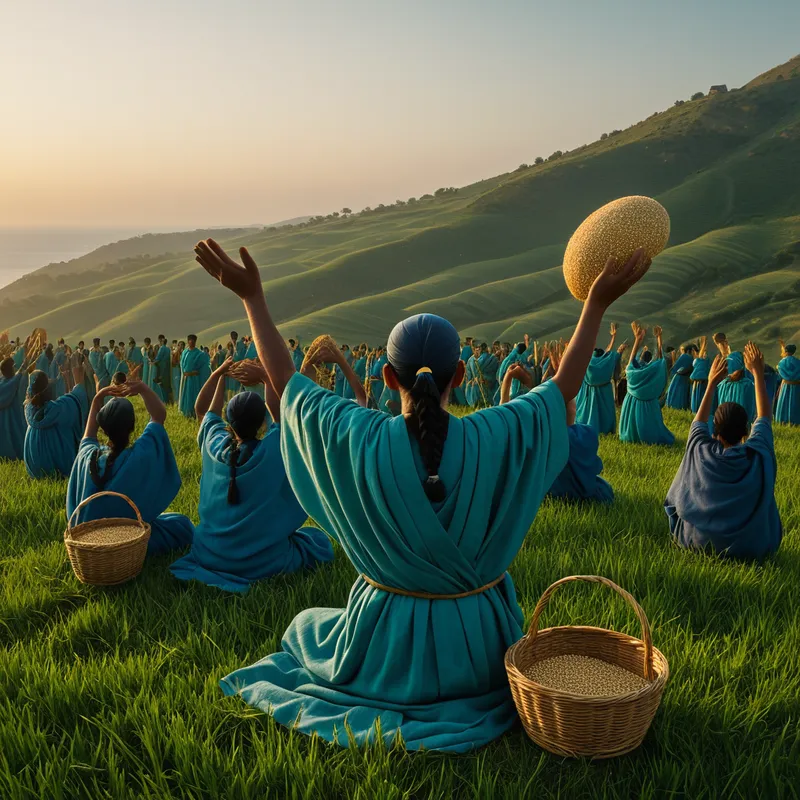
The sun was a weary coin, sinking toward the rim of [the world](/myths/the-world “Myth from Tarot culture.”/), staining [the sky](/myths/the-sky “Myth from Persian culture.”/) over [the Sea](/myths/the-sea “Myth from Greek culture.”/) of Galilee with the purple of a deep bruise. All day they had come—a river of humanity flowing up from the towns, a tide of the lame, the curious, the desperate, and the hopeful, drawn by a single name whispered on [the wind](/myths/the-wind “Myth from Various culture.”/): Yeshua. He had sought the solitude of [the wilderness](/myths/the-wilderness “Myth from Biblical culture.”/), a moment of quiet with his chosen companions, but the people had found him. His heart, a well without bottom, saw not an inconvenience, but a flock without a shepherd.
He spoke to them of a kingdom not of stone and legion, but of spirit and seed. He touched the fevered brow, and the fire retreated. Hours bled away, and the great crowd, five thousand men and more, not counting women and children, sat upon the green grass, captivated. But as the light bled from the day, so did the strength from their bodies. The great, gnawing emptiness—the belly’s honest plea—began to murmur through the ranks.
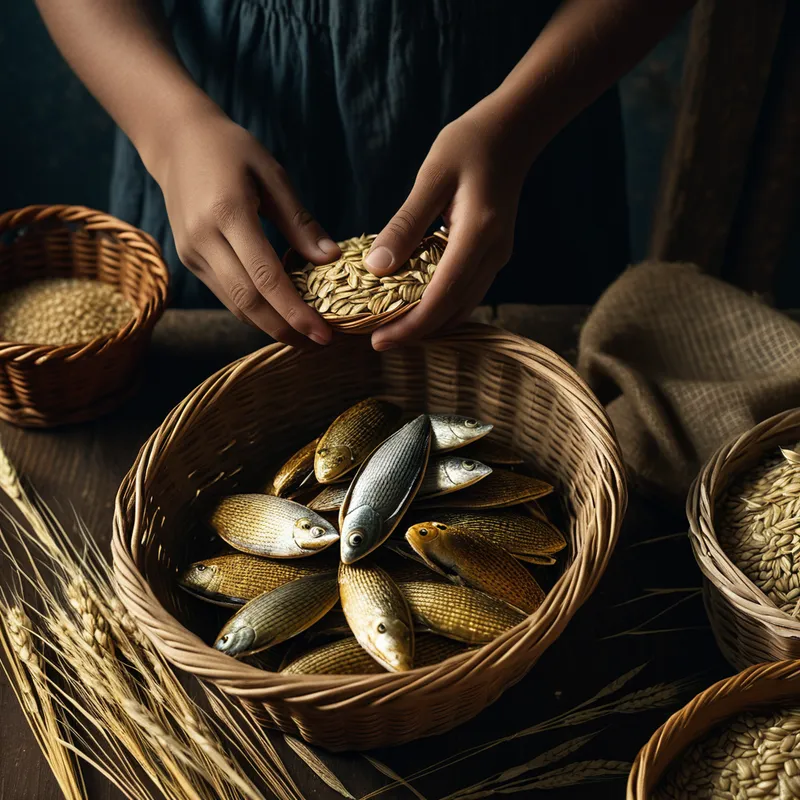
His closest disciple, Philip, approached, his voice tight with pragmatic dread. “Master, this place is a desert. Where can we buy enough bread for all these people to eat?” It was a calculation of despair. Another, Andrew, spoke up, a note of futile hope in his voice. “There is a boy here who has five barley loaves and two small fish. But what is that among so many?”
The air grew taut. Five thousand faces, now turned from the teacher to the emptiness within. Then, Yeshua spoke. “Have the people sit down.” The command was calm, an anchor in the gathering storm of need. He took the boy’s meager offering—the coarse, round loaves of the poor, the tiny, salted fish. He looked up to the heavens, where the first stars were pricking through the violet, and gave thanks. The blessing was not a plea, but a recognition.
Then, he broke the loaves.
The sound of the crust cracking was small in the vast space. But as he gave the fragments to his disciples, and they began to move among the people, a miracle unfolded not with thunder, but with a quiet, relentless generosity. Hand to hand, basket to basket, the food passed. And it did not diminish. A mother received a piece, broke it for her children, and found her own hand still full. A hungry laborer ate his fill, and the basket offered to him seemed as heavy as when it began. The murmurs of hunger softened into the sounds of shared sustenance—the quiet chewing, the satisfied sighs, the laughter of children with full bellies.
When every soul was satisfied, Yeshua spoke again. “Gather the leftover fragments, so that nothing may be lost.” They went out among the now-contented crowds and filled twelve great baskets with the broken pieces that remained—more, far more, than the little they had begun with. On the hillside, under the emerging stars, the economy of scarcity had been dissolved in the silent mathematics of grace.
Cultural Origins & Context
This narrative is recorded in all four canonical Gospels, a rarity that underscores its foundational importance in early Christian memory. It emerged from an oral tradition among the first communities of followers, likely within decades of the events they describe, circulating as a powerful testament to the identity and mission of Yeshua.
Societally, it functioned on multiple levels. For a community often marginalized and poor, it was a story of divine provision, echoing the [manna](/myths/manna “Myth from Biblical culture.”/) in the wilderness and prefiguring the Eucharist, the central act of communal worship. It positioned Yeshua as the new Elisha and the true shepherd-king, contrasting his compassionate, generative authority with the extractive, political power of Herod or Rome. The story was a narrative anchor, assuring believers that in the economy of God’s kingdom, their humble offerings and profound needs were seen and could be transformed.
Symbolic Architecture
At its [heart](/symbols/heart “Symbol: The heart symbolizes love, emotion, and the core of one’s existence, representing deep connections with others and self.”/), this is a myth about the [alchemy](/symbols/alchemy “Symbol: A transformative process of purification and creation, often symbolizing personal or spiritual evolution through difficult stages.”/) of [consciousness](/symbols/consciousness “Symbol: Consciousness represents the state of awareness and perception, encompassing thoughts, feelings, and experiences.”/) when confronted with the impossible equation of finite resources and infinite need. The five loaves and two fish symbolize the conscious ego’s perceived inadequacy—our talents, time, [energy](/symbols/energy “Symbol: Energy symbolizes vitality, motivation, and the drive that fuels actions and ambitions.”/), love—which always feels insufficient to meet the demands of the world or the [depths](/symbols/depths “Symbol: Represents the subconscious, hidden emotions, or foundational aspects of the self, often linked to primal fears or profound truths.”/) of our own inner [hunger](/symbols/hunger “Symbol: A primal bodily sensation symbolizing unmet needs, desires, or emotional voids. It represents craving for fulfillment beyond physical nourishment.”/).
The miracle is not in the multiplication of objects, but in the transformation of perception from scarcity to participatory abundance.
The crowd represents the multitude of inner demands—the complexes, the responsibilities, the hungers of the [soul](/symbols/soul “Symbol: The soul represents the essence of a person, encompassing their spirit, identity, and connection to the universe.”/) and the world—that clamor for nourishment. The disciples symbolize the pragmatic, anxious mind that sees only lack and logistical failure. The act of giving thanks before the distribution is the pivotal psychological move: it is an [acceptance](/symbols/acceptance “Symbol: The experience of being welcomed, approved, or integrated into a group or situation, often involving validation of one’s identity or actions.”/) and blessing of the [reality](/symbols/reality “Symbol: Reality signifies the state of existence and perception, often reflecting one’s understanding of truth and life experiences.”/) as it is, the “what is” in hand, without protest or [despair](/symbols/despair “Symbol: A profound emotional state of hopelessness and loss, often signaling a need for transformation or surrender to deeper truths.”/). This gratitude unlocks a different order of reality. The breaking of the [bread](/symbols/bread “Symbol: Bread symbolizes nourishment, sustenance, and the daily essentials of life, often representing fundamental needs and comfort.”/) is essential; wholeness must be sacrificed, fragmented, and distributed to become truly nourishing and to multiply. The twelve baskets of leftovers signify the surprising superabundance that flows from this process—the grace notes, the unexpected reserves, the psychological [wealth](/symbols/wealth “Symbol: Wealth in dreams often represents abundance, security, or inner resources, but can also symbolize burdens, anxieties, or moral/spiritual values.”/) that is generated not by hoarding, but by trusting [circulation](/symbols/circulation “Symbol: Represents the flow of life force, energy, emotions, or resources through a system, often indicating balance, blockage, or vitality.”/).

The Dreamer’s Resonance
When this myth patterns a modern dream, the dreamer is often at a crisis point of perceived depletion. They may dream of hosting a party with no food, facing an endless line of clients with empty hands, or staring into a refrigerator that contains only a single, inadequate item. The somatic feeling is one of tightness in the chest, a sinking dread, the anxiety of exposure and failure.
This dream signals that the [psyche](/myths/psyche “Myth from Greek culture.”/) is grappling with the archetype of the Caregiver under immense pressure. The conflict is between [the ego](/myths/the-ego “Myth from Jungian culture.”/)’s conviction of its own poverty (“I have nothing to give”) and [the Self](/myths/the-self “Myth from Jungian culture.”/)’s knowledge of a deeper, generative source. The dream is an initiation into a profound trust exercise. The resolution, if the dream allows it, comes not from a magical appearance of external resources, but from the dreamer finding within the dream the courage to offer the “five and two” they do have—to speak the kind word despite fear, to begin the project despite imperfect tools, to offer love despite feeling wounded. The ensuing feeling of nourishment and surplus in the dream marks a psychic shift from an economy of lack to one of flow.
Alchemical Translation
The individuation process modeled here is the transmutation of the lead of scarcity consciousness into the gold of generative wholeness. The “wilderness” is the state of being stripped to one’s essential, inadequate-seeming resources. The hero’s journey is not to acquire more, but to consent to the transformative process of offering what little one has.
Individuation often feels like feeding five thousand with a child’s lunch; it is the absurd, faithful act of presenting your fragmented self to the numinous, and discovering you are a conduit, not a reservoir.
First, one must see the crowd—acknowledge the full scope of one’s hungers and responsibilities without turning away in denial or panic (the disciple’s anxiety). Second, one must accept the offering—the humble, embarrassing, seemingly irrelevant gifts of one’s own personality and history. Third, and most crucially, one must give thanks for it—a psychological stance of radical acceptance and blessing that aligns the ego with the deeper, abundant Self. Fourth, one must break and distribute—allow one’s wholeness to be fragmented in service of life, to be shared, to be spent.
The final stage is the gathering of the twelve baskets—the integration of the surplus. This is the new psychic structure formed from the process: a lasting sense of inner richness, resilience, and the knowledge that from conscious, blessed offering, an unexpected bounty for the self and the world will always remain. The miracle is the discovery that the source is not in the quantity of the loaf, but in the quality of the blessing.
Associated Symbols
Explore related symbols from the CaleaDream lexicon: