The Fata Morgana Myth Meaning & Symbolism
A spectral island of eternal youth appears on the horizon, luring sailors with a promise that dissolves upon approach, revealing a deeper truth of the soul.
The Tale of The Fata Morgana
Listen, and let the salt-spray tell it. Let the groan of the oak hull and the sigh of [the wind](/myths/the-wind “Myth from Various culture.”/) through the rigging be your chorus. We sail west, always west, where the sun drowns itself in a cup of endless ocean, and [the world](/myths/the-world “Myth from Tarot culture.”/) grows thin as a veil.
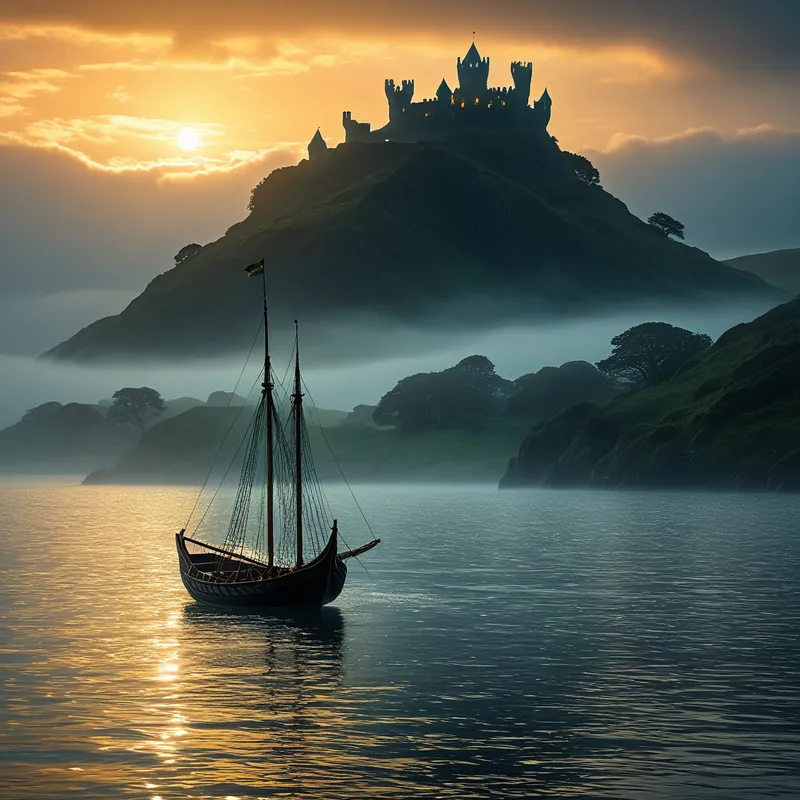
[The sea](/myths/the-sea “Myth from Greek culture.”/) was not always empty. In the time when heroes walked with one foot in the world of men and the other in the Annwn, a vision haunted [the horizon](/myths/the-horizon “Myth from Various culture.”/). It came not with storm, but with a terrible, aching calm. The sailors would first see a smudge of purple on the edge of sight, a bruise on [the sky](/myths/the-sky “Myth from Persian culture.”/). Then, as if drawn by the longing in their own hearts, it would solidify. Towers of white crystal, piercing a sky of eternal twilight. Orchards heavy with apples that shone with their own inner gold. Sweet music, faint as memory, carried on a wind that smelled of blossom and untouched earth. This was [Fata Morgana](/myths/fata-morgana “Myth from Various culture.”/), the phantom isle. Some called it Avalon, the isle of apple trees, the resting place of the wounded king.
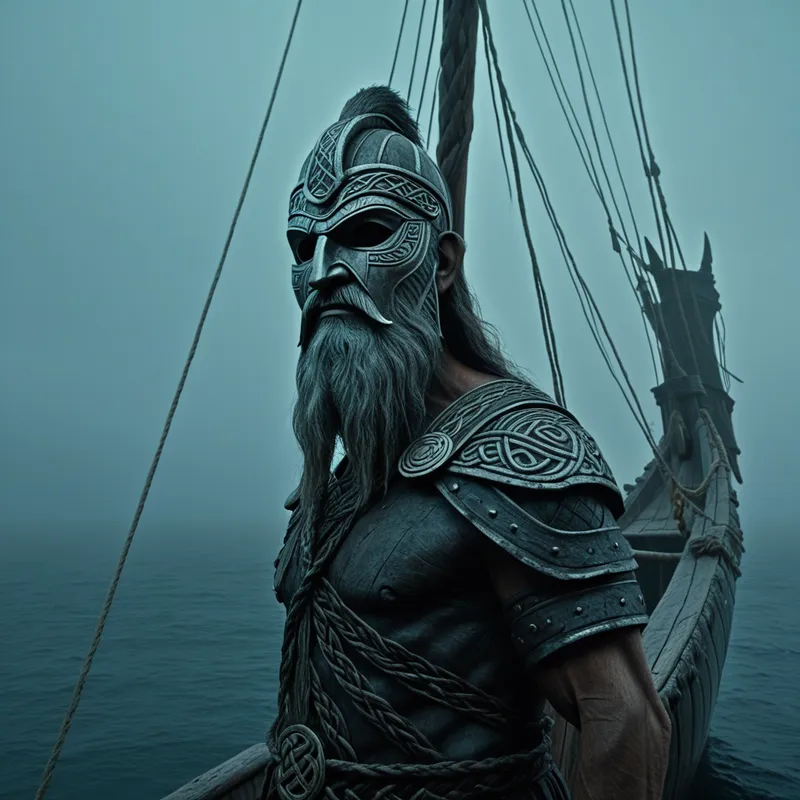
A chieftain, his soul weary from battle and the weight of rule, saw it from the cliffs of his own rocky shore. The promise in that vision was a hook in his heart. He gathered his nine best men—not for war, but for a quest of the spirit. They built a coracle of willow and ox-hide, a vessel fit for crossing the boundaries between worlds. For seven days and seven nights they rowed, guided only by the fading light of the pole star and the growing brilliance of the island ahead. The air grew warm. The sea turned glassy and still. They could see figures on the distant shores, graceful and tall, moving in a slow, eternal dance.
On the eighth morning, the chieftain reached out, his callused hand trembling, certain he could almost touch the silver-sanded beach. And as his fingers stretched, the music stuttered. The crystalline towers wavered, like a reflection in a pond disturbed by a stone. The golden apples blurred into the colour of the rising sun, and the sun itself drank the entire vision. Where there was solid land, there was only the empty, grey, endless sea. The island had not vanished with a roar, but with a sigh—a final, gentle exhalation that left the men colder than any winter gale. They sat in their fragile boat, adrift in a vastness suddenly more profound for having held a dream. They did not speak of it on the long row home. But in their eyes, a new depth had been carved, a hollow shaped exactly like the paradise they had almost grasped.
Cultural Origins & Context
The name Fata Morgana itself is a linguistic palimpsest, revealing the myth’s journey. It originates from the Latin Fata ([the Fates](/myths/the-fates “Myth from Greek culture.”/)) and merges with the figure of [Morgan le Fay](/myths/morgan-le-fay “Myth from Celtic culture.”/), the otherworldly enchantress of later Arthurian cycles who was, in her earliest Celtic incarnations, a sovereignty goddess and a guardian of the Annwn. This myth was not penned in a manuscript but breathed onto the air by seanchaí—the traditional Gaelic storytellers—around peat fires. Its primary stage was the western seaboards of Ireland, Scotland, Brittany, and Wales, where the Atlantic horizon is a constant, tantalizing mystery.
The tale served a profound societal function. For a coastal people, the sea was both provider and grave. The Fata Morgana myth was a narrative container for the very real, perilous phenomenon of superior mirages, where atmospheric conditions project distant or non-existent landmasses. But it transformed physics into metaphysics. It taught of the peril of unexamined longing and the discipline required when facing the sublime. It was a warning against abandoning one’s earthly duties for a chimera, and simultaneously, a sacred story that validated the human experience of profound, spiritual yearning. It acknowledged that [the Otherworld](/myths/the-otherworld “Myth from Celtic culture.”/) was real in its effects, even if it could not be captured or colonized.
Symbolic Architecture
At its core, the Fata Morgana is the archetypal [symbol](/symbols/symbol “Symbol: A symbol can represent an idea, concept, or belief, serving as a powerful tool for communication and understanding.”/) of the unattainable ideal. It is the ignis fatuus of the [soul](/symbols/soul “Symbol: The soul represents the essence of a person, encompassing their spirit, identity, and connection to the universe.”/), the luminous goal that organizes a [life](/symbols/life “Symbol: The symbol of ‘Life’ represents a journey of growth, interconnectedness, and existential meaning, encompassing both the joys and challenges that define human experience.”/)’s [journey](/symbols/journey “Symbol: A journey in dreams typically signifies adventure, growth, or a significant life transition.”/), yet whose ultimate [purpose](/symbols/purpose “Symbol: Purpose signifies direction, meaning, and intention in life, often reflecting personal ambitions and core values.”/) may not be possession, but the transformation wrought by the [pursuit](/symbols/pursuit “Symbol: A chase or being chased in dreams often reflects unresolved anxieties, unfulfilled desires, or internal conflicts demanding attention.”/).
The phantom isle does not lie on the map, but at the precise coordinates where desire meets impossibility. Its reality is not in its substance, but in its power to pull us from our moorings.
Psychologically, the [island](/symbols/island “Symbol: An island represents isolation, self-reflection, and the need for separation from the external world.”/) represents the unconscious itself—a [realm](/symbols/realm “Symbol: The symbol of ‘Realm’ often signifies the boundaries of one’s consciousness, experiences, or emotional states, suggesting aspects of reality that are either explored or ignored.”/) of potential wholeness (the healing [Avalon](/symbols/avalon “Symbol: A mythical island from Arthurian legend, often representing a spiritual paradise, eternal rest, or a place of healing and transformation.”/)), pristine and perfect, but which can only be perceived through the distorting [lens](/symbols/lens “Symbol: A lens in dreams represents focus, perspective, clarity, or distortion in how one perceives reality, art, or self.”/) of [consciousness](/symbols/consciousness “Symbol: Consciousness represents the state of awareness and perception, encompassing thoughts, feelings, and experiences.”/) (the atmospheric [mirage](/symbols/mirage “Symbol: A mirage in dreams often signifies unattainable desires or illusions, reflecting hopes that may deceive or mislead.”/)). The chieftain is [the ego](/myths/the-ego “Myth from Jungian culture.”/), setting out on a heroic [quest](/symbols/quest “Symbol: A quest symbolizes a journey or search for purpose, fulfillment, or knowledge, often representing life’s challenges and adventures.”/) to integrate this wholeness. The [dissolution](/symbols/dissolution “Symbol: The process of breaking down, dispersing, or losing form, often representing transformation, release, or the end of a state of being.”/) of the [island](/symbols/island “Symbol: An island represents isolation, self-reflection, and the need for separation from the external world.”/) at the [moment](/symbols/moment “Symbol: The symbol of a ‘moment’ embodies the significance of transient experiences that encapsulate emotional depth or pivotal transformations in life.”/) of grasping is the critical [revelation](/symbols/revelation “Symbol: A sudden, profound disclosure of truth or insight, often through artistic or musical means, that transforms understanding.”/): the contents of the unconscious cannot be seized by [the ego](/myths/the-ego “Myth from Jungian culture.”/)’s will. They cannot be owned; they can only be related to. The beautiful figures on the shore are the latent aspects of the [psyche](/myths/psyche “Myth from Greek culture.”/)—the [anima](/symbols/anima “Symbol: The feminine archetype within the male unconscious, representing soul, creativity, and connection to the inner world.”/), the [puer aeternus](/symbols/puer-aeternus “Symbol: The eternal youth archetype representing perpetual adolescence, divine child energy, and resistance to mature adulthood.”/)—forever receding, inviting a [relationship](/symbols/relationship “Symbol: A representation of connections we have with others in our lives, often reflecting our emotional state.”/), not a conquest.
The Dreamer’s Resonance
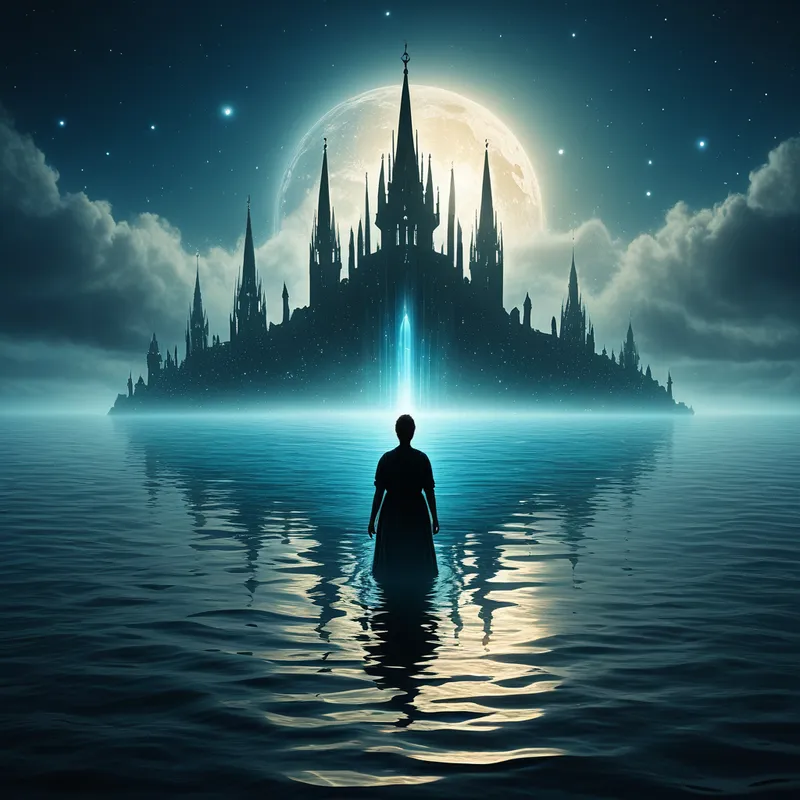
When this myth stirs in the modern dreamer, it often manifests as dreams of elusive destinations: a breathtaking city seen across a river with no bridge, a luminous room at the end of a hallway that lengthens as you run, or a beloved person who turns a corner and vanishes. The somatic experience is one of exhilarating pursuit followed by a hollow, quiet ache upon waking—a feeling of profound nearness eternally deferred.
This dream pattern signals a psyche engaged with a core, perhaps spiritual, longing. The dreamer is likely projecting their need for perfection, completion, or salvation onto an external goal: the perfect career, the ideal relationship, a state of enlightenment. The dream’s function is not to cruelly deny, but to initiate. It is showing the dreamer that the object of their desire, as currently conceived, is a mirage. The ensuing feeling of loss is the necessary void where the true work begins—the withdrawal of the [projection](/myths/projection “Myth from Alchemical culture.”/) and the inquiry: What in me is seeking that island? What wound seeks the healing orchards of Avalon? The dream invites a shift from pursuit to inner dialogue.
Alchemical Translation
The alchemical process mirrored here is the [Nigredo](/myths/nigredo “Myth from Alchemical culture.”/), the blackening. The glorious, golden vision (the unconscious ideal) must dissolve into the black sea of despair and disillusionment for true transmutation to begin. The chieftain’s journey is a map for individuation.
[The first stage](/myths/the-first-stage “Myth from Alchemical culture.”/) is Conjunction, the spark of desire that unites the conscious mind with a symbol of [the Self](/myths/the-self “Myth from Jungian culture.”/). The island appears, creating a compelling tension. The voyage is the Albedo, the purification, where worldly attachments are stripped away on the empty sea. The critical moment—the island’s dissolution—is the Mortificatio, the death of the old understanding. The ego’s project of capture dies.
The treasure is not the island of gold, but the sea of grey. In the stillness after the vision fades, the soul finds its true bearings, no longer chasing a reflection but learning to sail the depths of its own nature.
The [triumph](/myths/triumph “Myth from Roman culture.”/) is not in finding Avalon, but in becoming the coracle—[the vessel](/myths/the-vessel “Myth from Alchemical culture.”/) that can hold the tension between the tangible world and the call of the infinite. The hollow carved in the sailors’ eyes is the Vas, the sacred container now prepared to receive a more authentic, less illusory, connection to the divine. The myth teaches that our most profound longings are not GPS coordinates to a external paradise, but the magnetic pull of our own unlived life, calling us to become more than we are. The Fata Morgana, in the end, is not a place we reach, but a reflection of the wholeness we must learn to carry within.
Associated Symbols
Explore related symbols from the CaleaDream lexicon: