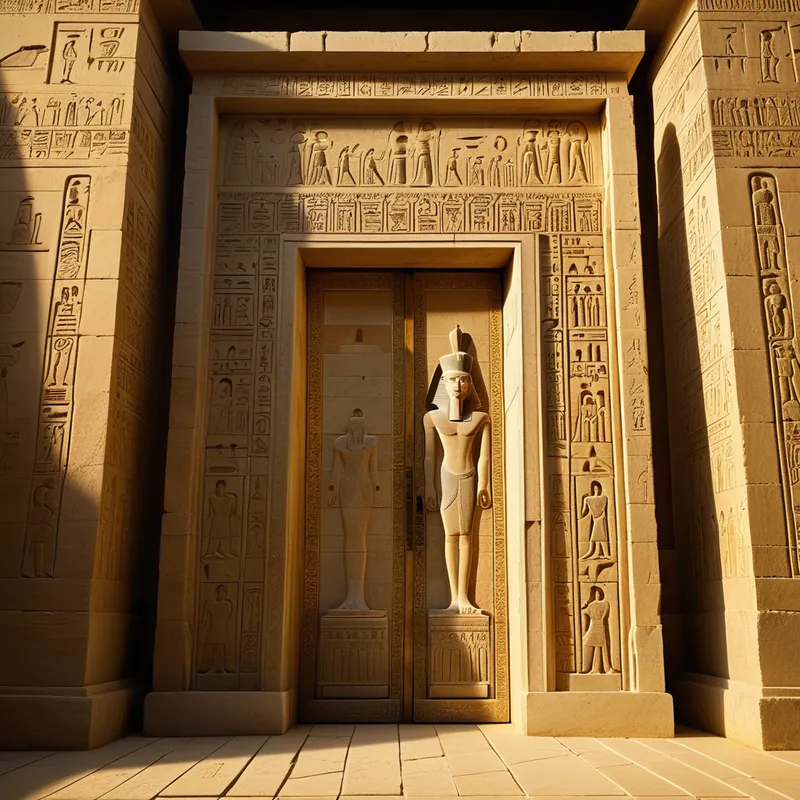
The False Door Myth Meaning & Symbolism
A sacred architectural illusion serving as a spiritual threshold, allowing the soul of the departed to commune with the living world.
The Tale of The False Door
Hear now the story not of gods, but of the human soul’s most profound desire. It begins in the silent, sun-baked necropolis, the city of the eternal, where the air is thick with the scent of incense and the weight of eternity.
There was a nobleman, Ka, who had walked the earth under the watchful eye of Ra. His body now rested within a chamber of stone, wrapped in linen, anointed with oils. But his journey was not complete. For the Ka, that vital spark, remained, hungry and thirsty, adrift in the Duat.
His family, hearts heavy yet resolute, commissioned the artisans. “Build him a door,” they instructed. “But not a door that opens.” And so, from the living rock, they carved a masterpiece of illusion. A portal of deepest indigo and ochre, framed by the serpent Uraeus, inscribed with spells from the Book of the Dead. They carved his image upon it, seated before a table heaped with unseen bounty. They carved the very syllables of his name, giving it power in the realm of silence.
This was the False Door. A threshold that was not a threshold. A passage sealed for mortal hands, but forever open to the spirit’s gaze.
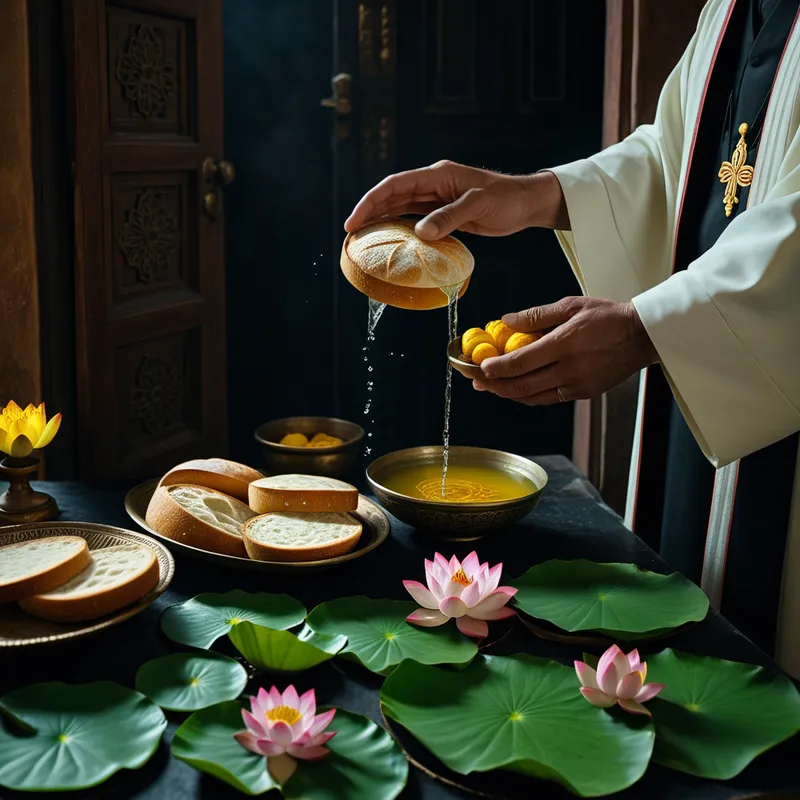
On the appointed day, the Kher Heb priest approached. The air cooled. He raised his voice, not in lament, but in invocation. He called the name of the departed. He poured cool water, placed warm bread, sweet dates, and a lotus blossom upon the offering slab that kissed the base of the stone. The scent of myrrh coiled in the still air.
And in that moment, the solid stone shimmered like a mirage. The carved image of the nobleman seemed to breathe. The Ka, drawn by the sustenance of memory and ritual, passed through the immutable rock as if it were mist. It partook of the essence of the offerings, felt the love in the spoken name, and was sustained. The living, feeling a chill breeze where none could blow, knew he was there. A communion was achieved, not in flesh, but in spirit, across the ultimate veil. The door was false, but the connection was utterly, sacredly real.
Cultural Origins & Context
The False Door was not born from a single mythic tale of gods and monsters, but from the bedrock of Egyptian metaphysical reality. It was a central architectural and religious feature in the mastaba tombs of the Old Kingdom and beyond, primarily for the elite. This was not mere decoration; it was functional spiritual technology.
Its origin lies in the complex Egyptian conception of the soul. The Ka needed sustenance to endure in the afterlife. The False Door provided a fixed, ritualized point of contact—a spiritual interface—between the world of the living and the realm of the dead. It was the address where offerings were delivered. The rituals were performed by funerary priests and family members, ensuring the deceased’s name was spoken and their memory kept alive, which was synonymous with existence itself. Its societal function was profound: it maintained the cosmic order (Maat) by honoring the ancestors, thus ensuring their continued benevolence and the stability of the family lineage and, by extension, the kingdom.
Symbolic Architecture
The False Door is a master symbol of the liminal—the in-between space where opposites meet and communicate. It represents the ultimate paradox: a barrier that is a conduit, a solid object that is a permeable membrane.
The most impenetrable wall often hides the most accessible gateway, but only for that part of us which knows it is not solid.
Architecturally, it is a representation of a door, making it a meta-symbol—a symbol about symbolism itself. It tells us that the map is not the territory, but that a faithful map can become the territory for the spirit. Psychologically, it represents the interface between the conscious ego (the living, material world) and the unconscious, particularly the ancestral or personal unconscious (the realm of the dead). The carved image of the deceased is the persona presented to the afterlife, while the offerings are the libido, the psychic energy, we must invest to maintain a relationship with the depths of our own psyche.
The “falseness” is the key. It acknowledges the illusion of separation. We build walls between our present identity and our past, our denied aspects, our inner ancestors. The False Door is that wall, but it is inscribed with the truth of connection, inviting a dialogue that bypasses literal, physical logic.
The Dreamer’s Resonance
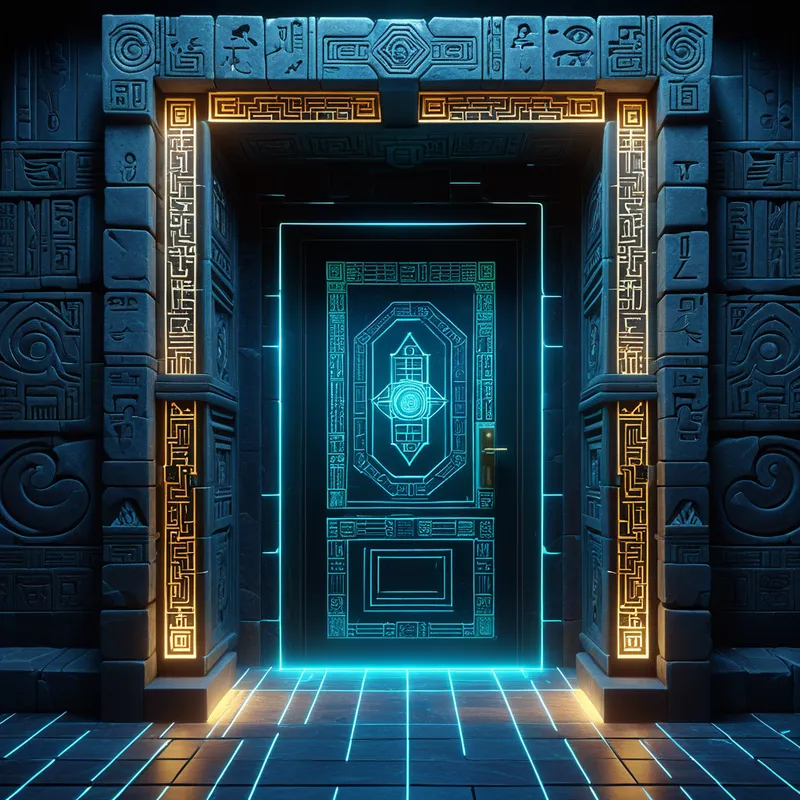
When a modern dreamer encounters a False Door—perhaps a door in their home that wasn’t there before, a bookcase that feels like an entrance, or a mirror that reflects a corridor instead of a room—they are at a profound psychic threshold.
Somatically, one might feel a chill, a pull, or a static charge in the dream. Psychologically, this is the soul’s architecture announcing a need to commune with a disowned part of the self. It often appears during periods of grief, not just for people, but for lost versions of oneself, abandoned potentials, or silenced truths. The door is “false” because the dream ego believes the separation from this inner content is real and insurmountable. The dream is presenting the ritual space—the offering slab—where that inner Ka can be fed. To dream of passing through it is to experience a moment of profound psychic integration, where a shadow aspect is finally invited in and recognized.
Alchemical Translation
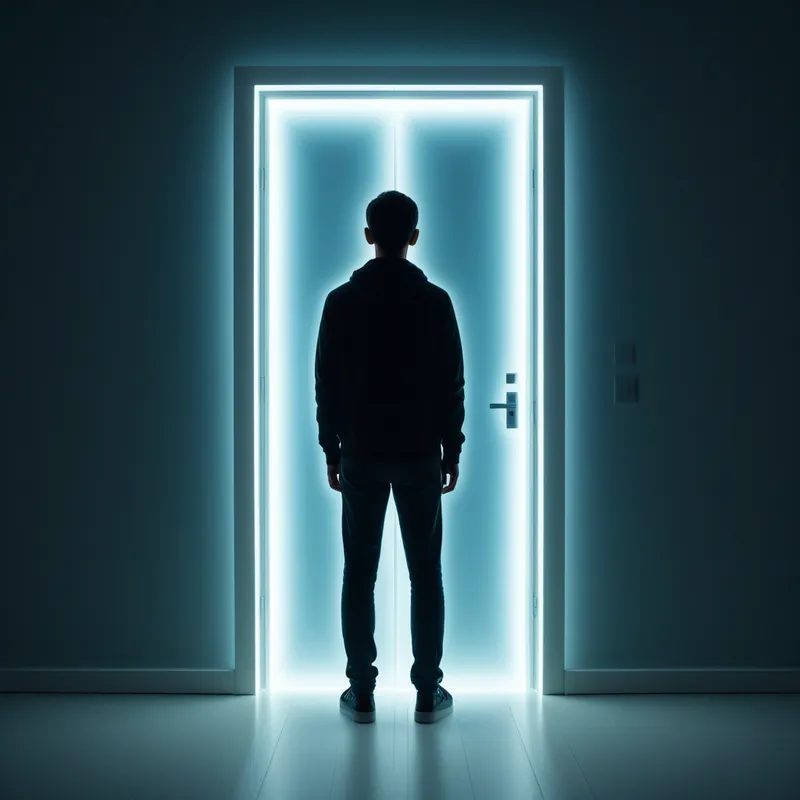
The individuation process, the alchemical work of becoming whole, is modeled perfectly by the mythos of the False Door. Our conscious personality is the tomb chapel, bright and decorated with the achievements and identities we show the world. But wholeness lies in the sealed chamber behind us, in the dark.
Individuation is the art of building a False Door to your own sealed tomb, then learning the ritual to feed what lies within.
The “false” aspect is the initial, necessary illusion of the ego: “I am only this. My past is dead. That pain, that talent, that memory is walled off forever.” The alchemical work is to carve the door—through therapy, active imagination, or creative expression. We inscribe it with the true names (acknowledging our history) and images (facing our self-concept) of what is buried.
The offerings are the crucial, repeated act. They are the libido—the attention, curiosity, and emotional energy—we must pour out at the threshold. We offer our time in reflection, our tears of recognition, our written words, our artistic attempts to the memory of a lost parent, a childhood trauma, a forsaken dream. This is the Kher Heb priest’s ritual performed for the self.
The transmutation occurs not by violently breaking down the wall, but by realizing, through sustained ritual, that the wall itself is the gateway. The solidity of our repression becomes translucent to the spirit of understanding. We do not destroy the past; we learn to commune with it, to feed it with consciousness, so that it, in turn, sustains our present life with the wisdom and vitality we had locked away. The False Door thus becomes the Truest Passage, the sacred interface where the soul nourishes itself.
Associated Symbols
Explore related symbols from the CaleaDream lexicon: